







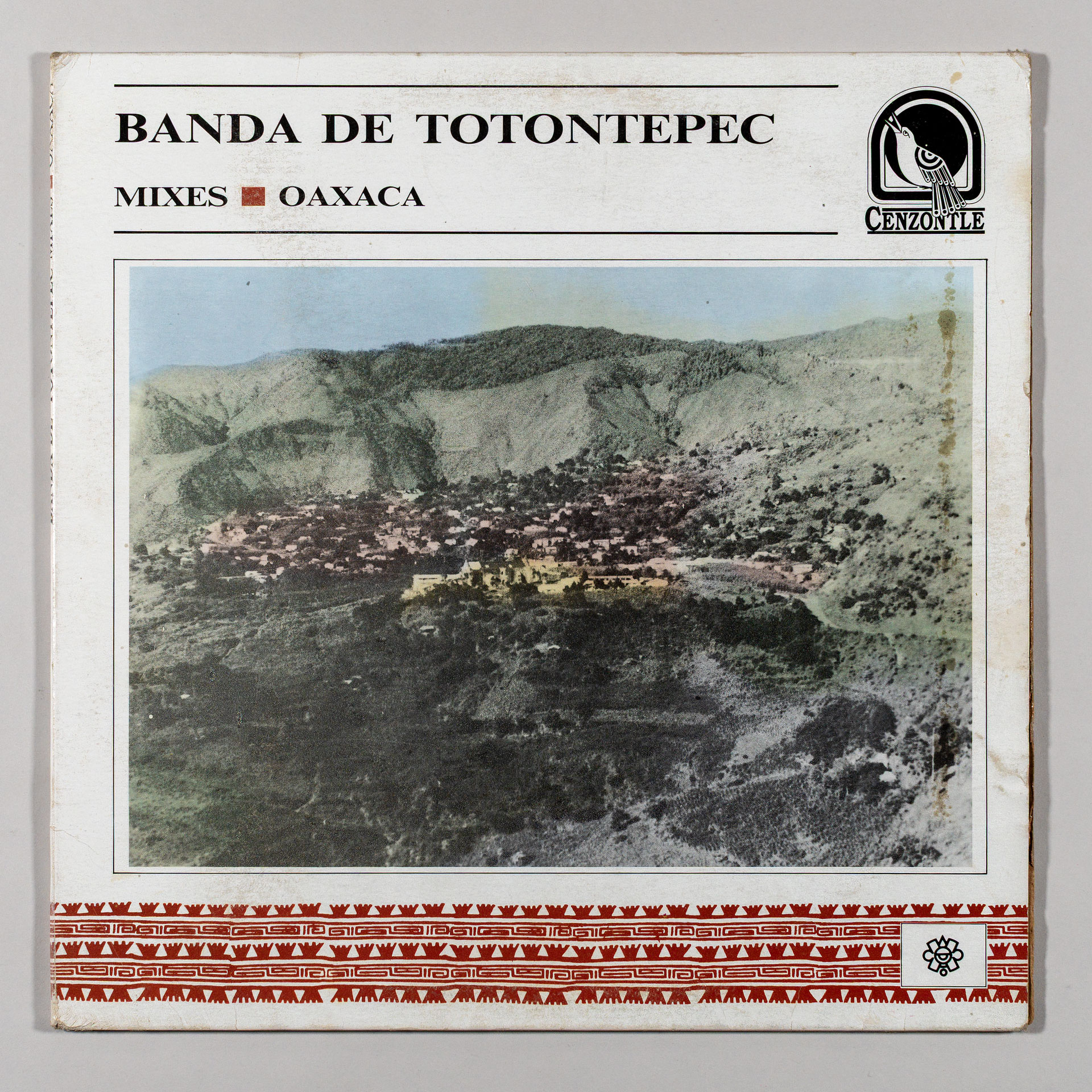
TOTONTEPEC MIXES BAND – OAXACA
Cenzontle
|
Format: Vinyl LP Album 12" 33 1/3 rpm Gatefold Compilation Released: 1990 |
Country: Mexico Genre: Folk World & Country |
Info:
TOTONTEPEC BAND
CENZONTLE
(MOCKINGBIRD)
INAH
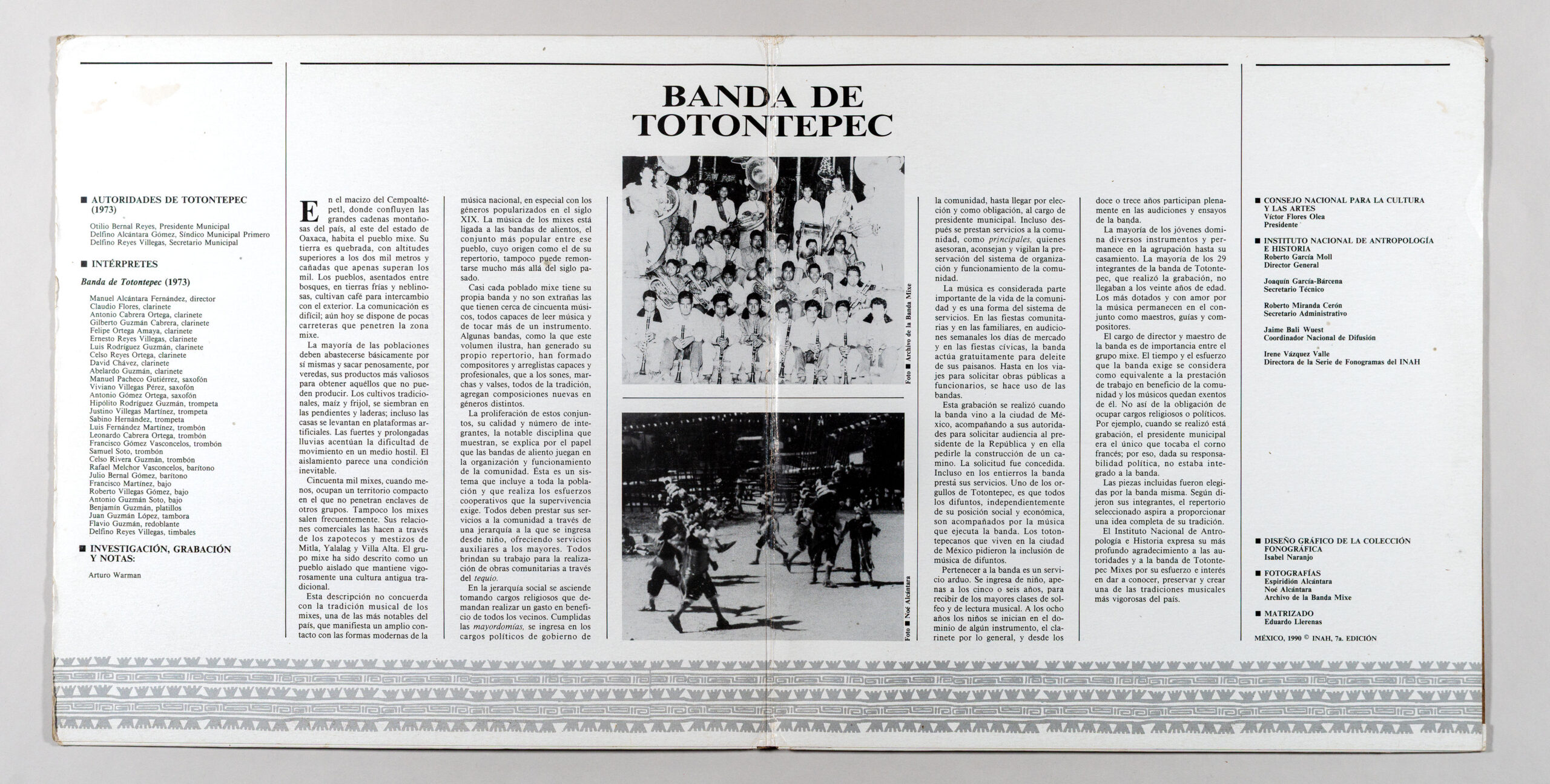
In the Cempoaltepetl massif, where the great mountain ranges of the country converge, to the east of the state of Oaxaca, the Mixe people live. Its land is broken, with altitudes above two thousand meters and ravines that barely exceed one thousand. The towns, settled among forests, in cold and foggy lands, grow coffee for exchange with the outside world. Communication is difficult; Even today there are few roads that penetrate the Mixe area.
The majority of the populations must basically provide for themselves and laboriously remove, by sidewalks, their most valuable products to obtain those that they cannot produce. The traditional crops, maize and beans, are planted on the slopes and slopes; even the houses are raised on artificial platforms. The strong and prolonged rains accentuate the difficulty of movement in a hostile environment. Isolation seems an unavoidable condition.
Fifty thousand Mixes, at least, occupy a compact territory in which enclaves of other groups do not penetrate. The mixes don’t come out frequently either. Their commercial relations are made through the Zapotecs and mestizos of Mitla, Yalalag and Villa Alta. The Mixe group has been described as an isolated people who vigorously maintain a traditional ancient culture.
This description does not agree with the musical tradition of mixes, one of the most notable in the country, which shows extensive contact with modern forms of national music, especially with the genres popularized in the 19th century. The music of the mixes is linked to the wind bands, the most popular group among that town, whose origin, like that of its repertoire, cannot go back much further than the last century.
Almost every Mixe town has its own band, and it is not uncommon for them to have close to fifty musicians, all capable of reading music and playing more than one instrument. Some bands, such as the one illustrated in this volume, have generated their own repertoire, have trained capable and professional composers and arrangers, who add new compositions in different genres to the sones, marches and waltzes, all from the tradition.
The proliferation of these ensembles, their quality and number of members, the remarkable discipline they show, is explained by the role that the encouragement bands play in the organization and functioning of the community. This is a system that includes the entire population and that makes the cooperative efforts that survival demands. Everyone must provide their services to the community through a hierarchy that is entered as a child, offering auxiliary services to the elderly. Everyone offers their work to carry out community works through the tequio.
In the social hierarchy, one ascends by taking religious positions that demand spending for the benefit of all the neighbors. Once the mayordomías have been fulfilled, one enters the political positions of the community government, until arriving by election and as an obligation, to the position of municipal president. Even later, services are provided to the community, as principals, who advise, advise and monitor the preservation of the system of organization and operation of the community.
Music is considered an important part of community life and is a form of service system. At community and family festivals, in weekly auditions on market days and at civic festivals, the band performs for free to the delight of their countrymen. Even on trips to request public works from officials, bands are used.
This recording was made when the band came to Mexico City, accompanying its authorities to request an audience with the President of the Republic and in it request the construction of a road. The request was granted. Even at funerals the band provides its services. One of the prides of Totontepec is that all the deceased, regardless of their social and economic position, are accompanied by the music played by the band. The Totontepecanos who live in Mexico City requested the inclusion of music for the deceased.
Belonging to the band is an arduous service. You enter as a child, barely five or six years old, to receive solfeggio and music reading classes from the older ones. At the age of eight, children begin to master an instrument, generally the clarinet, and from the age of twelve or thirteen they fully participate in auditions and band rehearsals.
Most of the young people dominate various instruments and remain in the group until their marriage. Most of the 29 members of the Totontepec band, which made the recording, were less than twenty years old. The most gifted and with a love for music remain in the ensemble as teachers, guides and composers.
The position of director and teacher of the band is of importance among the mixe group. The time and effort that the band requires is considered equivalent to the provision of work for the benefit of the community and the musicians are exempt from it. This is not the case with the obligation to hold religious or political positions. For example, when this recording was made, the municipal president was the only one who played the French horn; for this reason, given his political responsibility, he was not integrated into the band. The pieces included were chosen by the same band.
According to its members, the selected repertoire aspires to provide a complete idea of its tradition.
The National Institute of Anthropology and History expresses its deepest gratitude to the authorities and the Totontepec Mixes band for their effort and interest in publicizing, preserving, and creating one of the most vigorous musical traditions in the country.
■ TOTONTEPEC AUTHORITIES (1973)
Otilio Bernal Reyes, Municipal President
Delfino Alcántara Gómez, First Municipal Trustee
Delfino Reyes Villegas, Municipal Secretary
■ PERFORMERS
Totontepec Band (1973)
Manuel Alcántara Fernández, director
Claudio Flores, clarinet
Antonio Cabrera Ortega, clarinet
Gilberto Guzman Cabrera, clarinet
Felipe Ortega Amaya, clarinet
Ernesto Reyes Villegas, clarinet
Luis Rodríguez Guzmán, clarinet
Celso Reyes Ortega, clarinet
David Chavez, clarinet
Abelardo Guzman, clarinet
Manuel Pacheco Gutierrez, saxophone
Viviano Villegas Pérez, saxophone
Antonio Gomez Ortega, saxophone
Hipólito Rodríguez Guzmán, trumpet
Justino Villegas Martínez, trumpet
Sabino Hernandez, trumpet
Luis Fernández Martínez, trombone
Leonardo Cabrera Ortega, trombone
Francisco Gomez Vasconcelos, trombone
Samuel Soto, trombone
Celso Rivera Guzmán, trombone
Rafael Melchor Vasconcelos, baritone
Julio Bernal Gómez, baritone
Francisco Martinez, bass
Roberto Villegas Gomez, bass
Antonio Guzman Soto, bass
Benjamin Guzman, cymbals
Juan Guzmán López, drummer
Flavio Guzmán, drummer
Delfino Reyes Villegas, timbales
■ RESEARCH, RECORDING AND NOTES:
Arturo Warman
■ NATIONAL COUNCIL FOR CULTURE AND THE ARTS
Víctor Flores Olea
President
■ NATIONAL INSTITUTE OF ANTHROPOLOGY AND HISTORY
Roberto García Moll
Managing Director
Joaquín García-Bárcena
Technical secretary
Roberto Miranda Cerón
Administrative Secretary
Jaime Bali Wuest
National Dissemination Coordinator
Irene Vázquez Valle
Director of the INAH Phonogram Series
■ GRAPHIC DESIGN OF THE PHONOGRAPHIC COLLECTION
Isabel Naranjo
■ PHOTOGRAPHS
Espiridión Alcántara
Noé Alcántara
Mixe Band Archive
■ MATRIZED
Eduardo Llerenas
MEXICO, 1990 INAH, 7th. EDITION
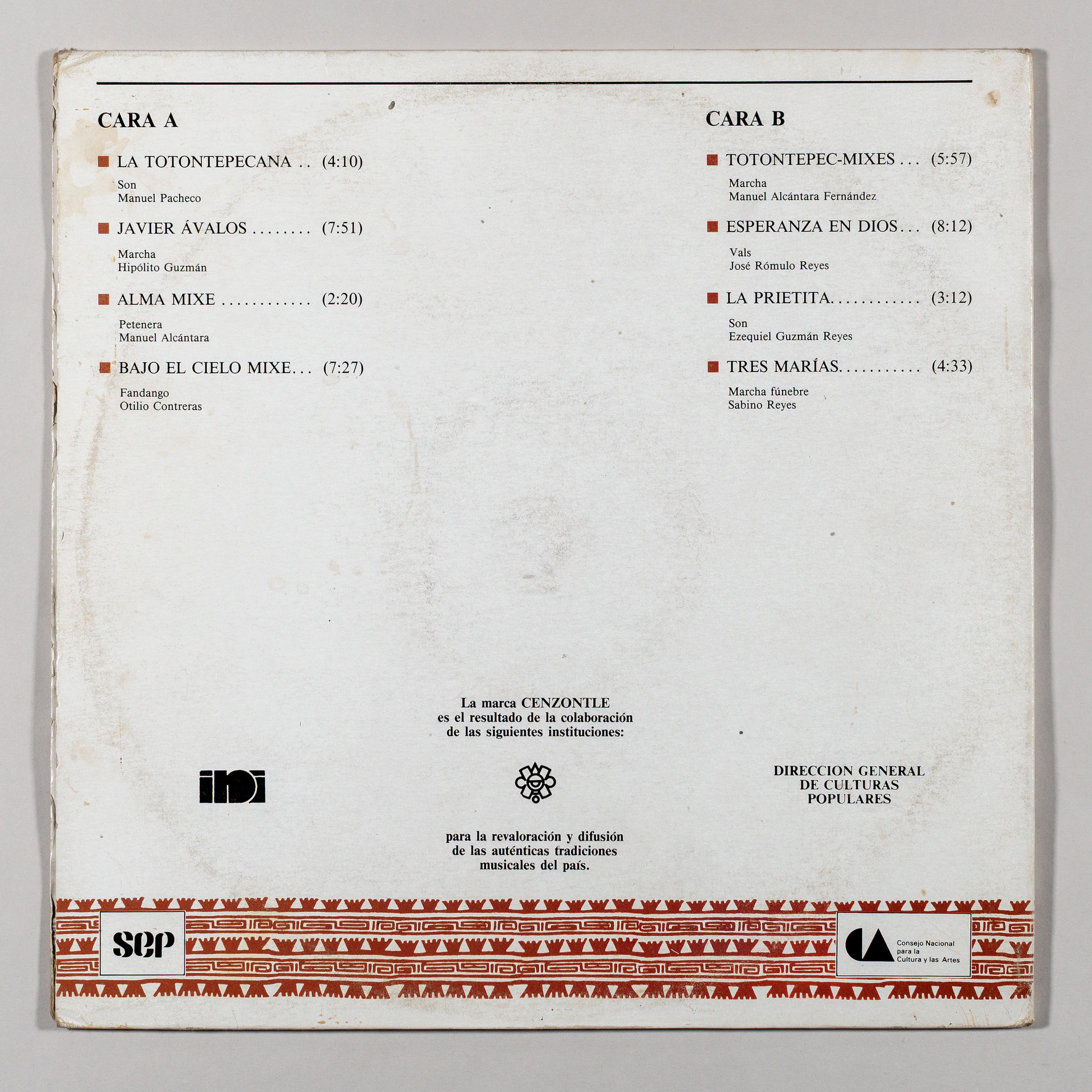
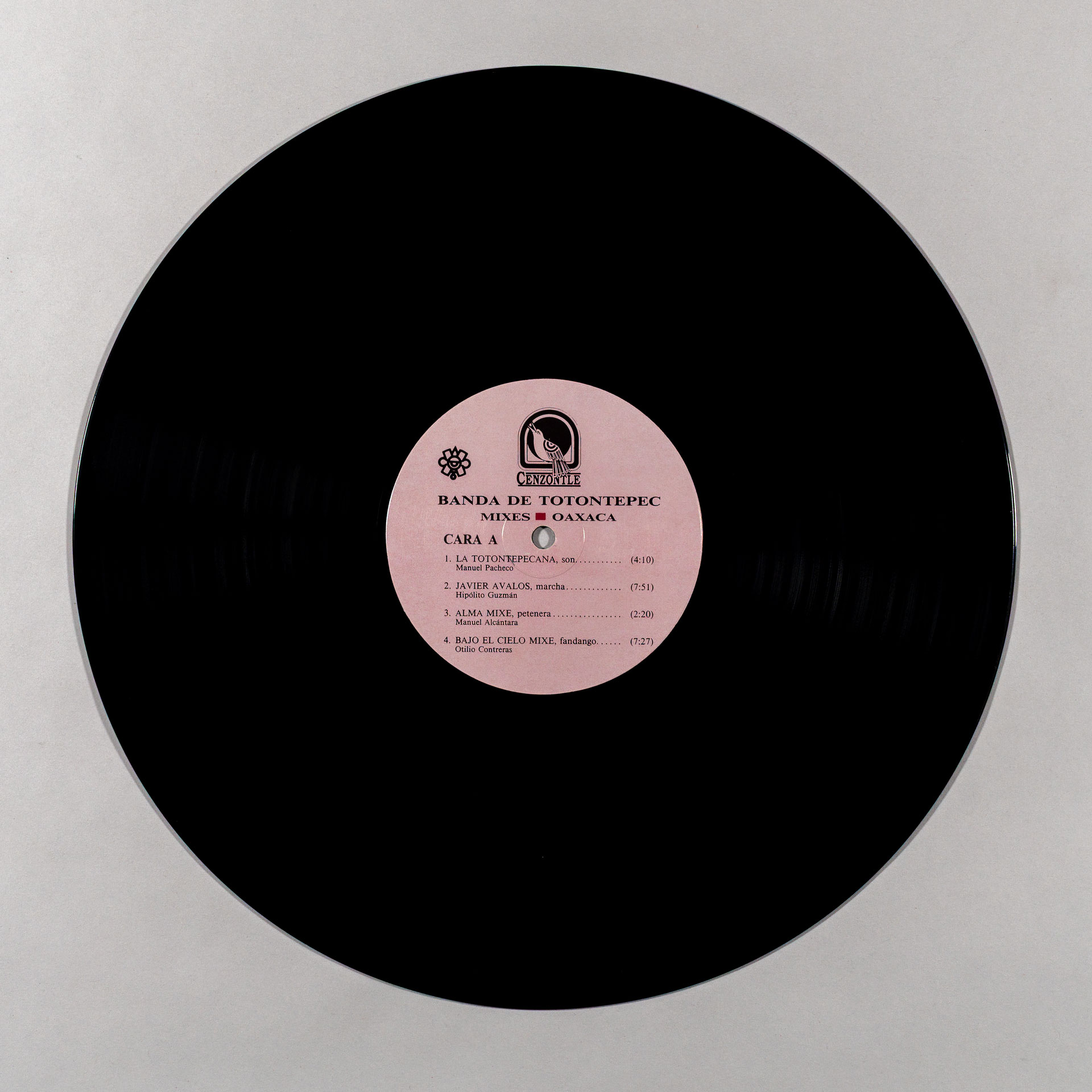
A SIDE
■ THE TOTONTEPECANA…………(4:10)
Son
Manuel Pacheco
■ JAVIER ÁVALOS…………(7:51)
Marcha
Hipólito Guzmán
■ MIXE SOUL…………(2:20)
Petenera
Manuel Alcántara
■ UNDER THE MIXED SKY…………(7:27)
Fandango
Otilio Contreras
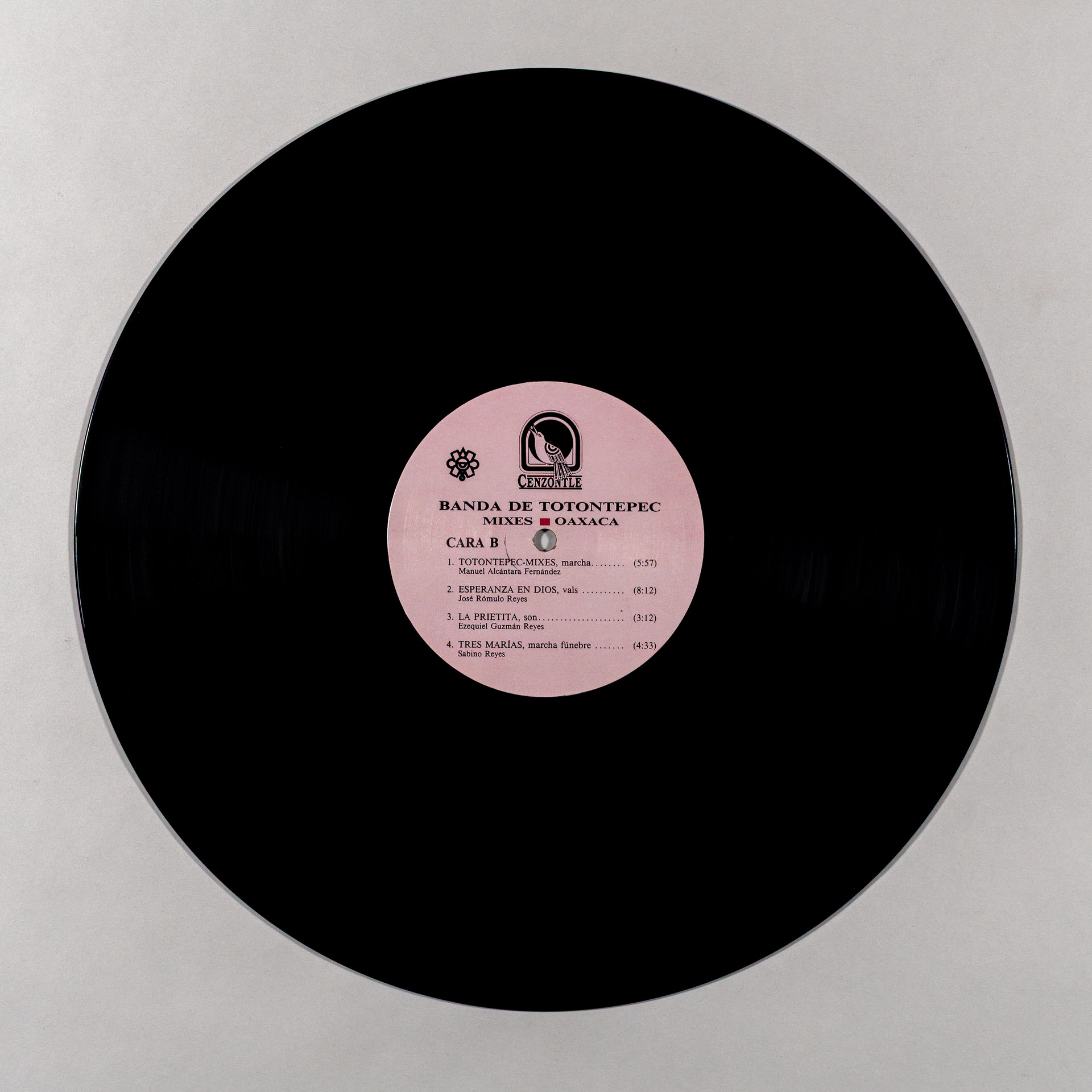
B SIDE
■ TOTONTEPEC-MIXES…………(5:57)
March
Manu Alcántara Fernández
■ HOPE IN GOD…………(8:12)
Waltz
José Rómulo Reyes
■ THE PRIETITA…………(3:12)
Son
Ezequiel Guzmán Reyes
■ THREE MARIAS…………(4:33)
Funeral march
Sabino Reyes
The CENZONTLE brand is the result of the collaboration of the following institutions:
SEP, Consejo Nacional para la Cultura y las Artes, INAH, INI, DIRECCIÓN GENERAL DE CULTURAS POPULARES
For the revaluation and diffusion of the authentic musical traditions of the country.
Galería:
Tracklist:
TOTONTEPEC MIXES BAND – OAXACA
SIDE 1
- The Totontepecana 4:10
Performer(s): Totontepec Band - Javier Ávalos 7:51
Performer(s): Totontepec Band - Mixe Soul 2:20
Performer(s): Totontepec Band - Under The Mixed Sky 7:27
Performer(s): Totontepec Band
LADO 2
- Totontepec-Mixes 5:57
Performer(s): Totontepec Band - Hope In God 8:12
Performer(s): Totontepec Band
- The Prietita 3:12
Performer(s): Totontepec Band
- Three Marias 4:33
Performer(s): Totontepec Band
Credits:
RESEARCH, RECORDING AND NOTES: Arturo Warman
NATIONAL COUNCIL FOR CULTURE AND THE ARTS: President, Víctor Flores Olea.
NATIONAL INSTITUTE OF ANTHROPOLOGY AND HISTORY: Roberto García Moll, General Director; Joaquín García-Bárcena, Technical Secretary; Roberto Miranda Cerón, Administrative Secretary; Jaime Bali Wuest, National Outreach Coordinator; Irene Vázquez Valle, Director of the INAH Phonogram Series.
GRAPHIC DESIGN OF THE COLLECTION: Isabel Naranjo.
PHOTOGRAPHS: Spiridion Alcántara; Noah Alcantara; Archive of the Mixe Band.
MATRIX: Eduardo Llerenas
Links:
 Banda De Tontontepec – Mixes - Oaxaca
Condition:
Media Condition:
Mint (M)Sleeve Condition:
Mint (M)Other Versions:
TOTONTEPEC MIXES OAXACA BAND with the INAH_SEP label.