







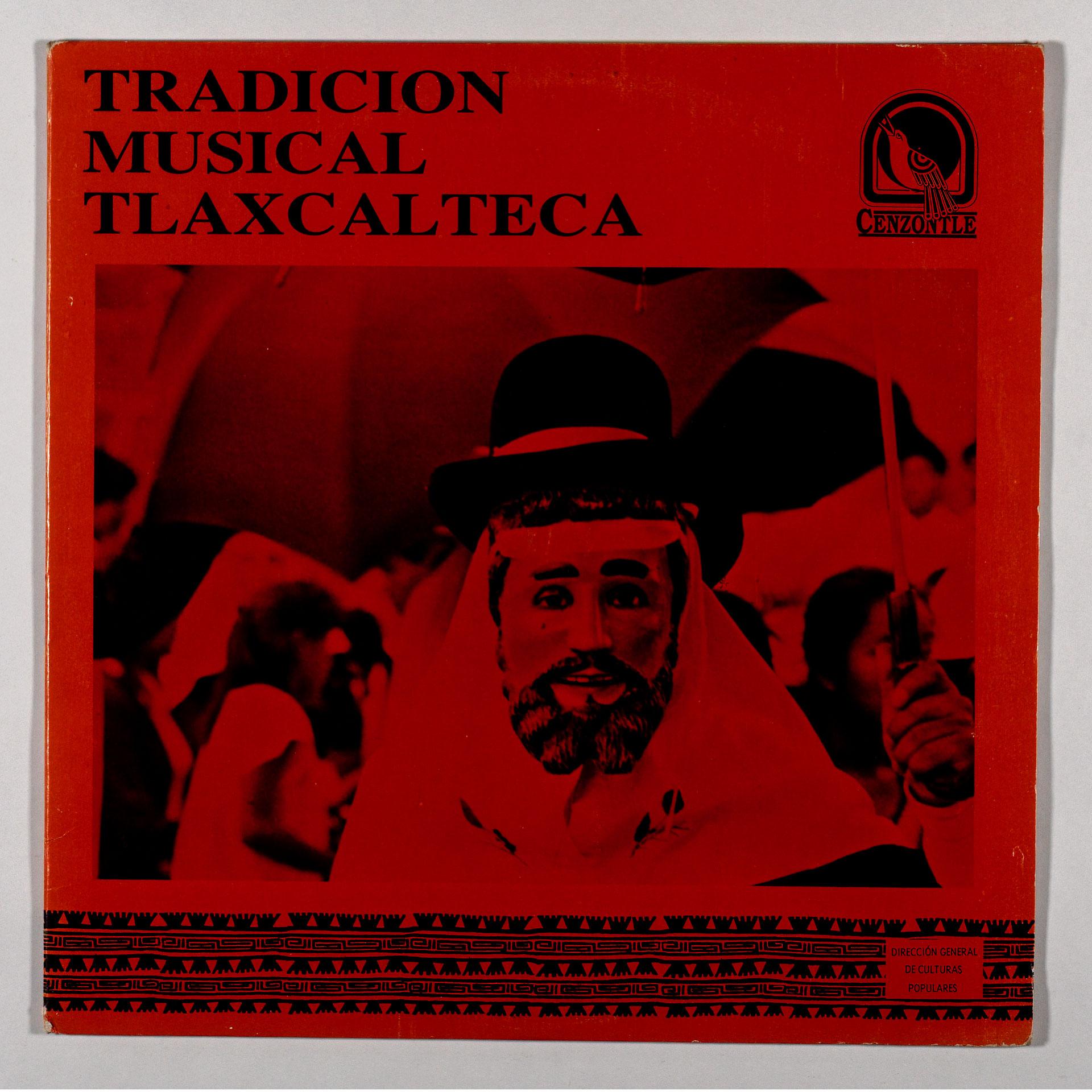
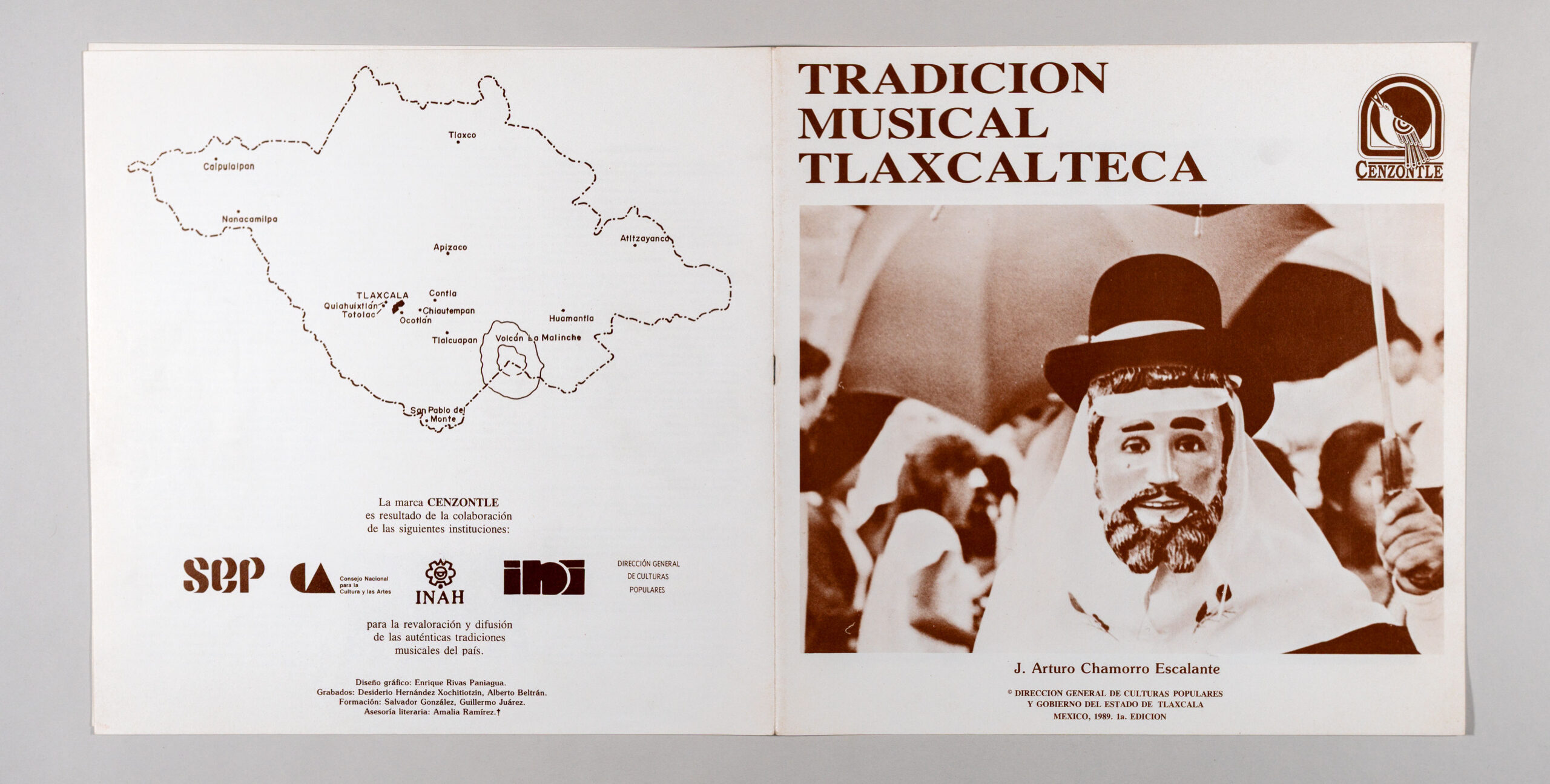
TLAXCALTEC MUSICAL TRADITION
Cenzontle
|
Label: CENZONTLE DIRECCIÓN GENERAL DE CULTURAS POPULARES LME-567 Released: 1989 |
Country: Mexico Genre: Folk World & Country |
Info:
TLAXCALTEC MUSICAL TRADITION
CENZONTLE
(MOCKINGBIRD)
DIRECCIÓN GENERAL DE CULTURAS POPULARES
(GENERAL DIRECTORATE OF POPULAR CULTURES)
J. Arturo Chamorro Escalante
© GENERAL DIRECTORATE OF POPULAR CULTURES AND GOVERNMENT OF THE STATE OF TLAXCALA
MEXICO, 1989. 1st. EDITION
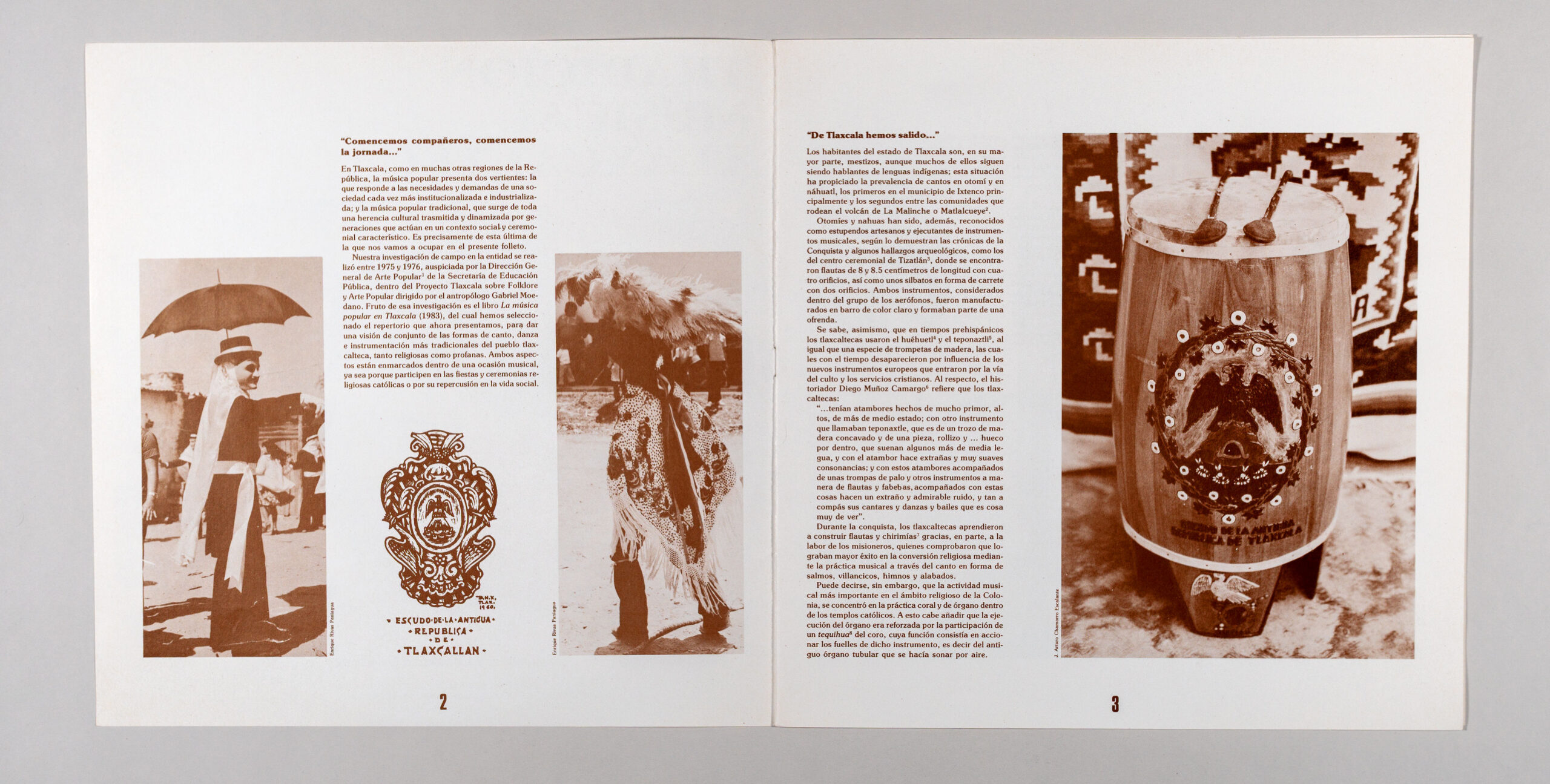
“Let’s start comrades, let’s start the day…”
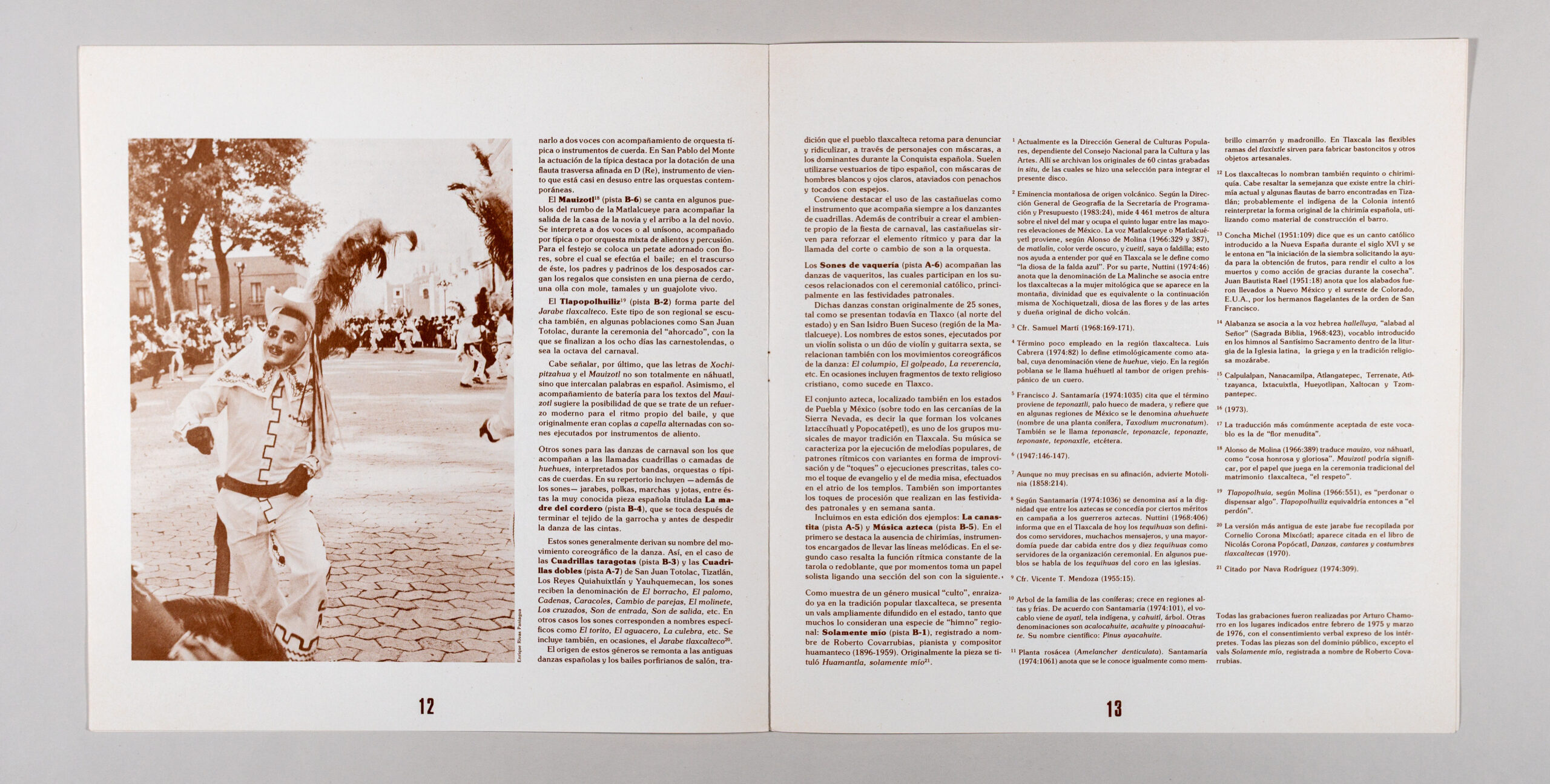
In Tlaxcala, as in many other regions of the Republic, popular music presents two aspects: the one that responds to the needs and demands of an increasingly institutionalized and industrialized society; and traditional popular music, which arises from a whole cultural heritage transmitted and energized by generations that act in a characteristic social and ceremonial context. It is precisely the latter that we are going to deal with in this brochure.
Our field research in the entity was carried out between 1975 and 1976, sponsored by the General Directorate of Popular Art¹ of the Ministry of Public Education, within the Tlaxcala Project on Folklore and Popular Art directed by the anthropologist Gabriel Moedano. The result of this research is the book La música popular en Tlaxcala (1983), from which we have selected the repertoire that we present now, to give an overview of the most traditional forms of song, dance and instrumentation of the Tlaxcalan people, both religious and profane. Both aspects are framed within a musical occasion, either because they participate in Catholic religious festivals and ceremonies or because of their impact on social life.
“We have left Tlaxcala…”
The inhabitants of the state of Tlaxcala are, for the most part, mestizos, although many of them continue to speak indigenous languages; This situation has led to the prevalence of songs in Otomi and Nahuatl, the former mainly in the municipality of Ixtenco and the latter among the communities surrounding the La Malinche or Matlalcueye volcano².
Otomi and Nahuas have also been recognized as stupendous craftsmen and performers of musical instruments, as evidenced by the chronicles of the Conquest and some archaeological finds, such as those of the Tizatlán³ ceremonial center, where flutes 8 and 8.5 centimeters in length were found. with four holes, as well as reel-shaped whistles with two holes. Both instruments, considered within the group of aerophones, were made of light-colored clay and were part of an offering.
It is also known that in pre-Hispanic times the Tlaxcalans used the huehuetl⁴ and teponaztli⁵, as well as a kind of wooden trumpet, which over time disappeared under the influence of the new European instruments that entered through the cult and Christian services. In this regard, the historian Diego Muñoz Camargo⁶ states that the Tlaxcalans:
“…they had drums made of great care, tall, of more than half a state; with another instrument that they called teponaxtle, which is a concave piece of wood and one piece, plump and… hollow inside, which sound some more than half a league, and with the drum it makes strange and very soft consonances, and with these drums accompanied by some wooden trumpets and other instruments like flutes and fabebas, accompanied by these things they make a strange and admirable noise, and so to rhythm their songs and dances and dances that is something to see”.
During the conquest, the Tlaxcalans learned to build flutes and shawms⁷ thanks, in part, to the work of the missionaries, who verified that they achieved greater success in religious conversion through musical practice through singing in the form of psalms, Christmas carols, hymns and praised.
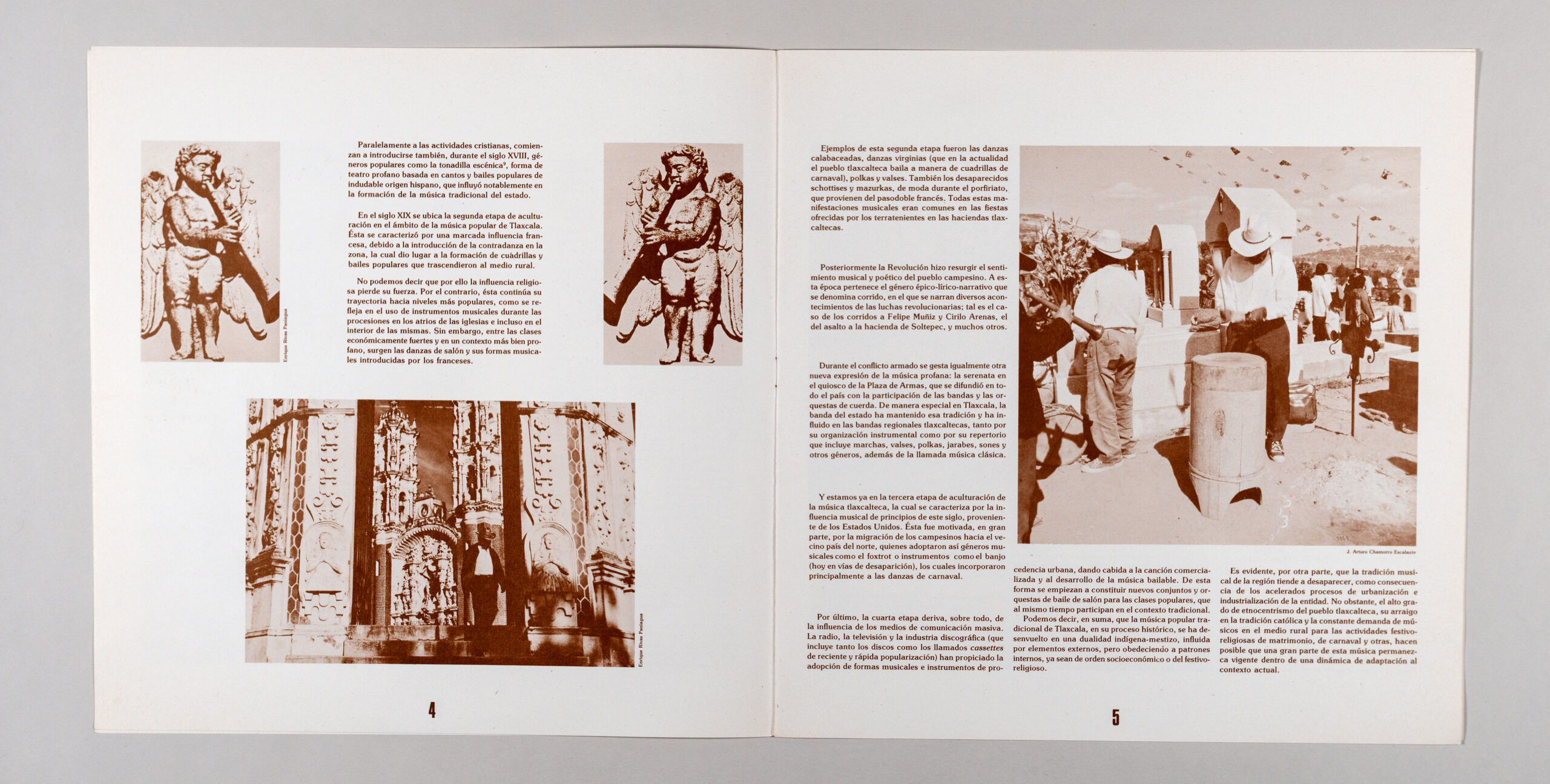
It can be said, however, that the most important musical activity in the religious field of the Colony, was concentrated in the choral and organ practice inside the Catholic temples. To this it should be added that the playing of the organ was reinforced by the participation of a tequihua⁸ from the choir, whose function was to activate the bellows of said instrument, that is to say, of the old tubular organ that was played by air.
Parallel to Christian activities, popular genres began to be introduced during the 18th century, such as the scenic tonadilla⁹, a form of secular theater based on popular songs and dances of undoubtedly Hispanic origin, which significantly influenced the formation of the traditional music of the state. .
The second stage of acculturation in the field of popular music in Tlaxcala was located in the 19th century. This was characterized by a marked French influence, due to the introduction of the contradanza in the area, which gave rise to the formation of cuadrillas and popular dances that transcended the rural environment.
We cannot say that because of this the religious influence loses its force. On the contrary, it continues its trajectory towards more popular levels, as reflected in the use of musical instruments during processions in the atriums of the churches and even inside them. However, among the economically strong classes and in a rather profane context, ballroom dances and their musical forms introduced by the French arose.
Examples of this second stage were the gourd dances, virginian dances (which the Tlaxcalan people currently dance like carnival gangs), polkas and waltzes. Also the disappeared schottisches and mazurkas, in fashion during the Porfiriato, which come from the French pasodoble. All these musical manifestations were common in the parties offered by the landowners in the Tlaxcalan haciendas.
Subsequently, the Revolution revived the musical and poetic feeling of the peasant people. The epic-lyrical-narrative genre called corrido belongs to this period, in which various events of the revolutionary struggles are narrated; such is the case of the corridos to Felipe Muñiz and Cirilo Arenas, the assault on the Soltepec hacienda, and many others.
During the armed conflict, another new expression of secular music also took shape: the serenade at the Plaza de Armas kiosk, which spread throughout the country with the participation of bands and string orchestras. In a special way in Tlaxcala, the state band has maintained that tradition and has influenced the Tlaxcalan regional bands, both for its instrumental organization and for its repertoire that includes marches, waltzes, polkas, syrups, sones and other genres, in addition to the called classical music.
And we are already in the third stage of acculturation of Tlaxcalan music, which is characterized by the musical influence of the beginning of this century, coming from the United States. This was motivated, in large part, by the migration of peasants to the neighboring country to the north, who thus adopted musical genres such as the foxtrot or instruments such as the banjo (today in the process of disappearing), which they mainly incorporated into the dances of carnival.
Finally, the fourth stage derives, above all, from the influence of the mass media. Radio, television and the recording industry (which includes both records and the so-called cassettes of recent and rapid popularity) have fostered the adoption of musical forms and instruments of urban origin, giving rise to the commercialized song and the development of music. danceable. In this way, new ballroom dance ensembles and orchestras began to be formed for the popular classes, which at the same time participated in the traditional context.
We can say, in short, that the traditional popular music of Tlaxcala, in its historical process, has developed in an indigenous-mestizo duality, influenced by external elements, but obeying internal patterns, whether socioeconomic or festive-religious. .
It is evident, on the other hand, that the musical tradition of the region tends to disappear, as a consequence of the accelerated processes of urbanization and industrialization of the entity. However, the high degree of ethnocentrism of the Tlaxcalan people, their roots in the Catholic tradition and the constant demand for musicians in rural areas for festive-religious marriage, carnival and other activities, make it possible for a large part of this music remains in force within a dynamic of adaptation to the current context.
“As old as I am, I go…”
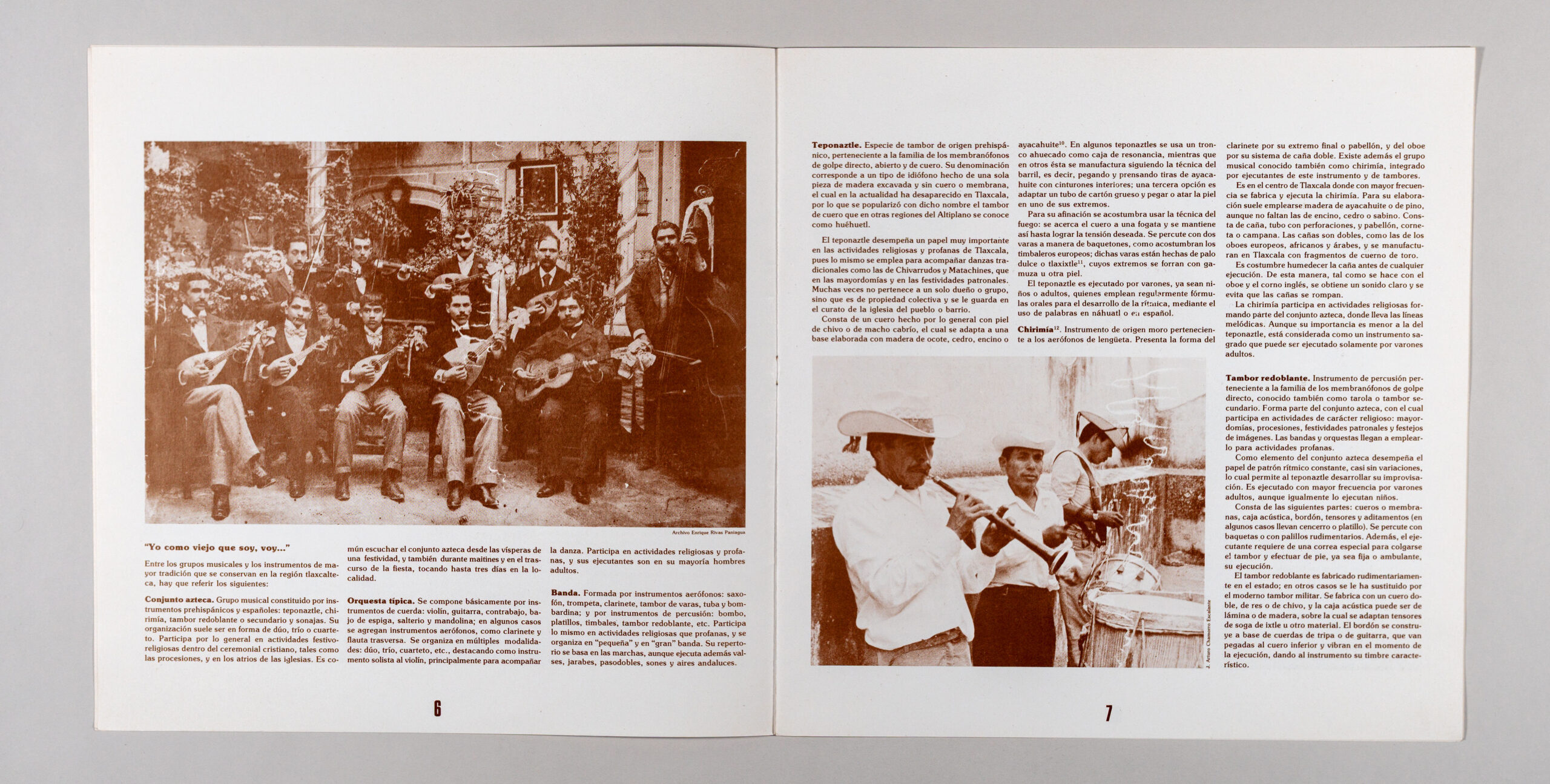
Among the musical groups and instruments with the greatest tradition that are preserved in the Tlaxcala region, the following must be mentioned:
Aztec set. Musical group made up of pre-Hispanic and Spanish instruments: teponaztle, shawm, redoubling or secondary drum and rattles. Their organization is usually in the form of a duo, trio or quartet. He generally participates in festive-religious activities within the Christian ceremonial, such as processions, and in the atriums of churches. It is common to hear the Aztec ensemble from the eve of a festival, and also during matins and during the festival, playing for up to three days in the town.
Typical orchestra. It is basically made up of string instruments: violin, guitar, double bass, herringbone bass, psaltery and mandolin; in some cases aerophone instruments are added, such as clarinet and transverse flute. It is organized in multiple modalities: duo, trio, quartet, etc., highlighting the violin as a solo instrument, mainly to accompany the dance. It participates in religious and secular activities, and its performers are mostly adult men.
Band. Formed by aerophone instruments: saxophone, trumpet, clarinet, rod drum, tuba and euphonium; and by percussion instruments: bass drum, cymbals, timpani, snare drum, etc. He participates in both religious and profane activities, and is organized into a “small” and a “big” band. His repertoire is based on marches, although he also performs waltzes, syrups, pasodobles, sones and Andalusian airs.
Teponaztle.
Kind of drum of pre-Hispanic origin, belonging to the family of direct, open and leather hit membranophones. Its denomination corresponds to a type of idiophone made of a single piece of excavated wood and without leather or membrane, which has now disappeared in Tlaxcala, for which reason the leather drum became popular with that name, which in other regions of the Altiplano It is known as huehuetl.
The teponaztle plays a very important role in the religious and secular activities of Tlaxcala, since it is used to accompany traditional dances such as Chivarrudos and Matachines, as well as in stewardships and patron saint festivities. Many times it does not belong to a single owner or group, but is collective property and is kept in the parish of the town or neighborhood church.
It consists of a leather generally made with goat or goat skin, which is adapted to a base made of ocote, cedar, oak or ayacahuite wood¹⁰. In some teponaztles a hollowed-out trunk is used as a resonance box, while in others it is manufactured following the barrel technique, that is, gluing and pressing strips of ayacahuite with interior belts; a third option is to adapt a thick cardboard tube and glue or tie the skin at one end.
For its tuning, it is customary to use the fire technique: the leather is brought closer to a bonfire and it is kept that way until the desired tension is achieved. It is struck with two rods in the manner of drumsticks, as the said rods are customary, they are made of European timbaleros stick; dulce or tlaxixtle¹¹, whose ends are lined with chamois or another skin.
The teponaztle is performed by men, whether they are children or adults, who regularly use oral formulas for the development of rhythm, through the use of words in Nahuatl or Spanish.
Chirimia¹². Instrument of Moorish origin belonging to the reed aerophones. It presents the shape of the clarinet for its final end or pavilion, and of the oboe for its double reed system. There is also a musical group also known as shawm, made up of players of this instrument and drums.
It is in the center of Tlaxcala where the shawm is most often made and performed. For its preparation, ayacahuite or pine wood is usually used, although there is no shortage of oak, cedar or sabino wood. It consists of a reed, a tube with perforations, and a pavilion, bugle or bell. The reeds are double, like those of the European, African and Arab oboes, and are manufactured in Tlaxcala with fragments of bull’s horn.
It is customary to moisten the reed before any performance. In this way, as is done with the oboe and English horn, a clear sound is obtained and the reeds are prevented from breaking.
The shawm participates in religious activities as part of the Aztec ensemble, where it leads the melodic lines. Although its importance is less than that of the teponaztle, it is considered a sacred instrument that can only be played by adult males.
Rolling drum. Percussion instrument belonging to the family of direct hit membranophones, also known as tarola or secondary drum. He is part of the Aztec group, with which he participates in religious activities: mayordomías, processions, patron saint festivities and image celebrations. Bands and orchestras come to use it for profane activities.
As an element of the Aztec ensemble, it plays the role of a constant rhythmic pattern, almost without variations, which allows the teponaztle to develop his improvisation. It is performed more frequently by adult males, although it is also performed by boys.
It consists of the following parts: leathers or membranes, acoustic box, snare, tension rods and accessories (in some cases they have a cowbell or saucer). It is struck with drumsticks or rudimentary sticks. In addition, the performer requires a special strap to hang the drum and carry out his execution standing up, whether stationary or walking.
The snare drum is crudely manufactured in the state; in other cases it has been replaced by the modern military drum. It is made of double leather, beef or goat, and the speaker can be made of sheet metal or wood, on which ixtle rope tensioners or other material are adapted. The snare is made from gut or guitar strings, which are attached to the lower leather and vibrate at the time of playing, giving the instrument its characteristic timbre.
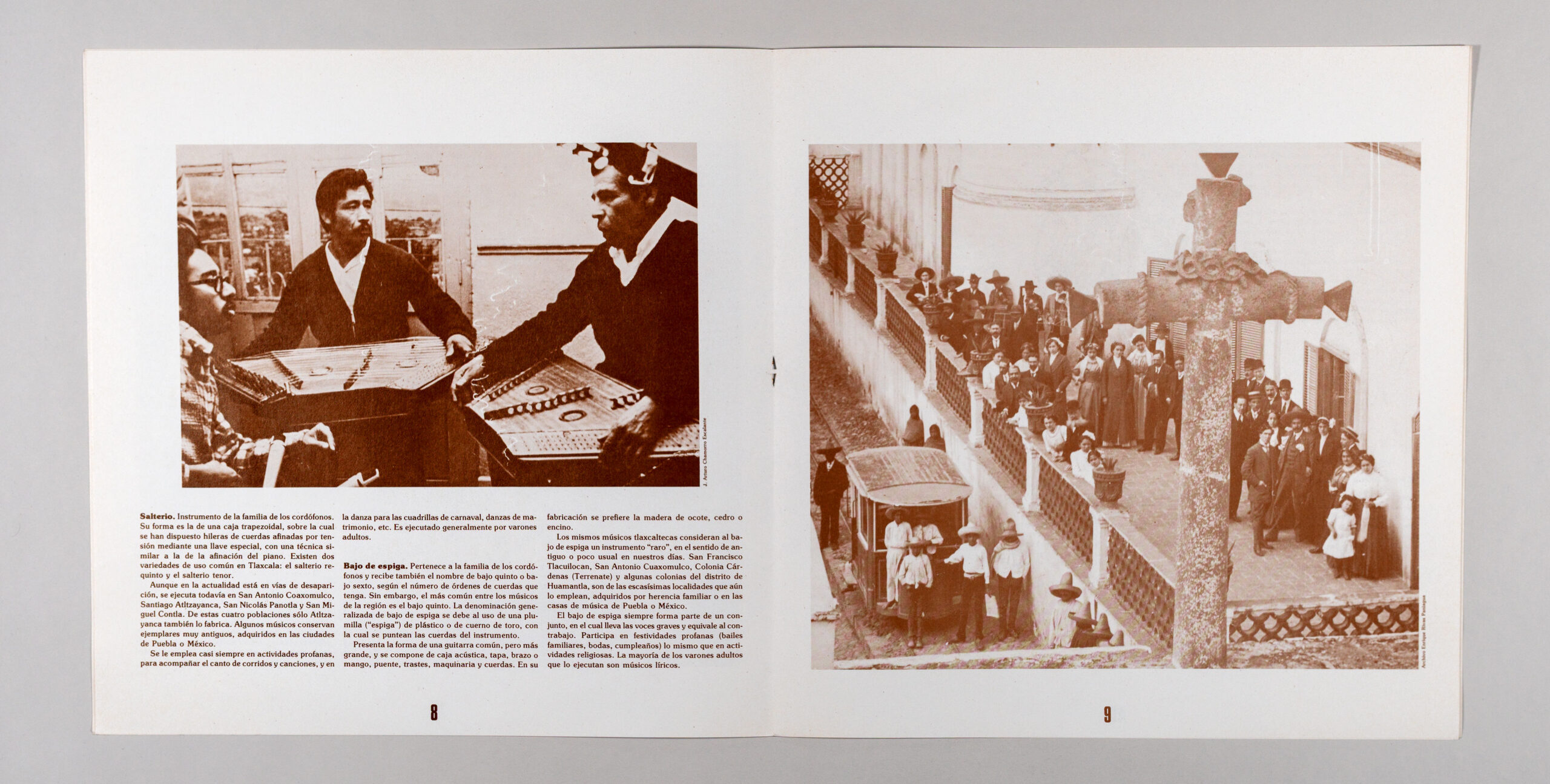
Psalter. Instrument of the family of chordophones. Its shape is that of a trapezoidal box, on which rows of strings tuned by tension have been arranged by means of a special key, with a technique similar to that of piano tuning. There are two varieties of common use in Tlaxcala: the Psalter re. fifth and tenor psaltery.
Although it is currently in the process of disappearing, it is still carried out in San Antonio Cuaxomulco, Santiago Altzayanca, San Nicolás Panotla and San Miguel Contla. Of these four towns, only Altzayanca also makes it. Some musicians keep very old copies, acquired in the cities of Puebla or Mexico.
It is almost always used in secular activities, to accompany the singing of corridos and songs, and in the dance for carnival crews, wedding dances, etc. It is generally performed by adult males.
Herringbone bass. It belongs to the chordophone family and is also called bajo quinto or bajo sixtho, depending on the number of string orders it has. However, the most common among the musicians of the region is the bajo quinto. The general denomination of spike bass is due to the use of a plastic or bull horn nib (“spike”), with which the strings of the instrument are plucked.
It has the shape of a common guitar, but larger, and is made up of an acoustic box, cover, arm or neck, bridge, frets, machinery and strings. In its manufacture, ocote, cedar or oak wood is preferred.
The same Tlaxcalan musicians consider the spike bass a “rare” instrument, in the sense of old or unusual in our days. San Francisco Tlacuilohcan, San Antonio Cuaxomulco, Colonia Cárdenas (Terrenate) and some neighborhoods in the district of Huamantla, are among the very few towns that still use it, acquired by family inheritance or in music houses in Puebla or Mexico.
The herringbone bass is always part of a set, in which it carries the low voices and is equivalent to the double bass. Participate in secular festivities (family dances, weddings, birthdays) as well as religious activities. Most of the adult males who perform it are lyrical musicians.
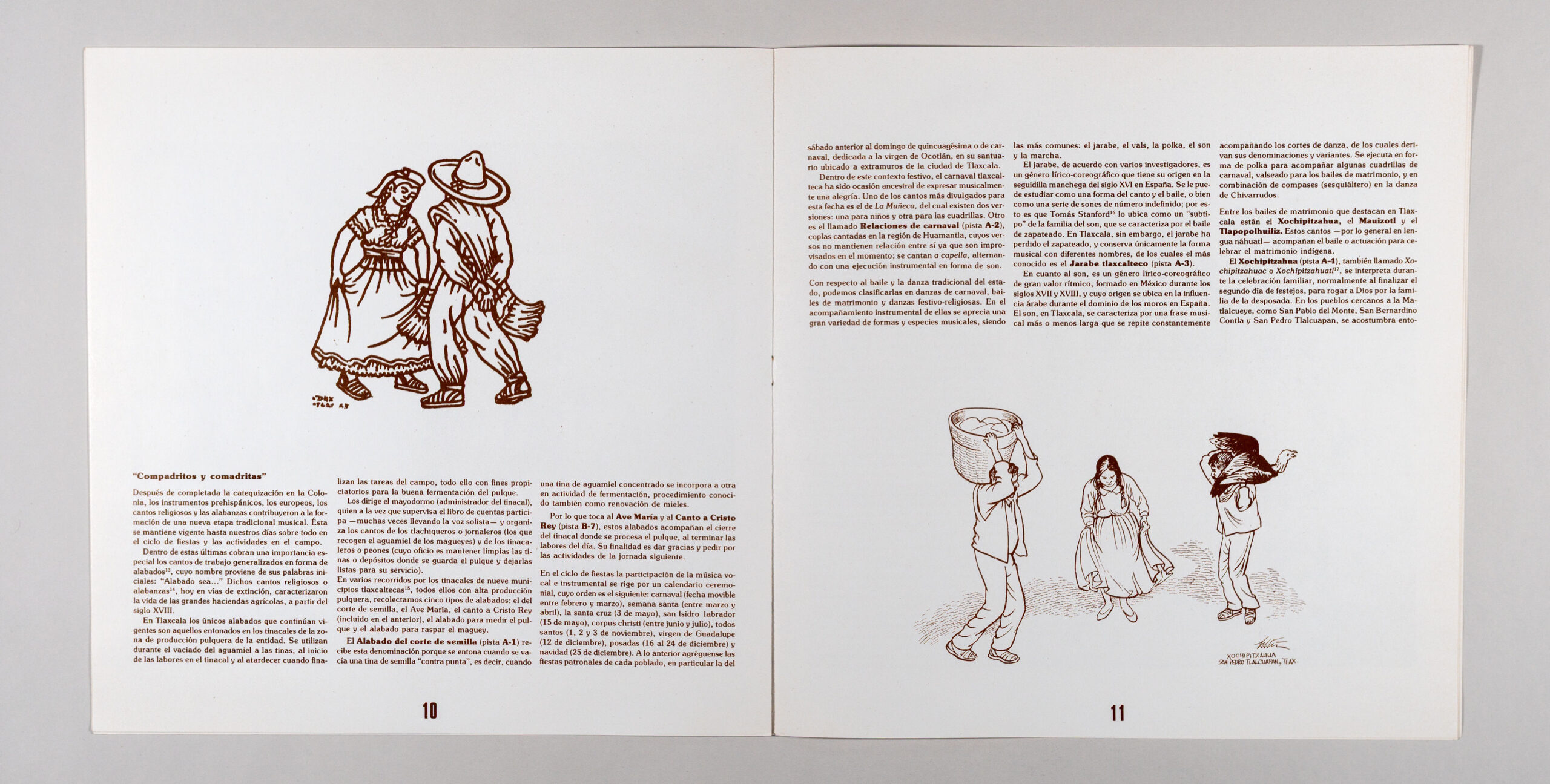
“Compadritos and comadritas”
After the catechization was completed in the Colony, the pre-Hispanic instruments, the European ones, the religious songs and the praises contributed to the formation of a new traditional musical stage. This remains in force to this day, especially in the cycle of festivals and activities in the countryside.
Within the latter, the generalized work songs in the form of praises¹³, whose name comes from their initial words: “Praise be…” These religious songs or praises¹⁴, today in danger of extinction, characterized the life of the large agricultural estates, from the eighteenth century.
In Tlaxcala, the only praises that are still valid are those sung in the tinacalas of the pulque production area of the entity. They are used during the emptying of the mead into the vats, at the beginning of the work in the tinacal and at sunset when the field tasks are finished, all with propitiatory purposes for the good fermentation of the pulque.
They are directed by the mayordomo (administrator of the tinacal), who, while supervising the account book, participates –often taking the lead voice– and organizes the songs of the tlachiqueros or day laborers (those who collect the mead from the magueys) and of the tinacaleros or laborers (whose job is to keep the vats or deposits where the pulque is kept clean and leave them ready for service).
In various tours of the tinacalas of nine Tlaxcalan municipalities¹⁵, all of them with high pulque production, we collected five types of praised: the cut seed, the Ave Maria, the song to Christ the King (included in the previous one), the praised to measure the pulque and the praised to scrape the maguey.
The Seed Cut Praise (track A-1) receives this name because it is intoned when a “counterpoint” seed vat is emptied, that is, when a vat of concentrated mead is incorporated into another in fermentation activity, a procedure also known as renewal of honeys.
Regarding the Hail Mary and the Canto a Cristo Rey (track B-7), these praises accompany the closing of the tinacal where the pulque is processed, at the end of the day’s work. Its purpose is to give thanks and ask for the activities of the following day.
In the cycle of festivities, the participation of vocal and instrumental music is governed by a ceremonial calendar, whose order is as follows: carnival (movable date between February and March), holy week (between March and April), the holy cross (3 May), San Isidro Labrador (May 15), Corpus Christi (between June and July), All Saints (November 1, 2 and 3), Virgin of Guadalupe (December 12), Posadas (December 16 to 24 ) and Christmas (December 25). To the above, add the patron saint festivities of each town, in particular the one on the Saturday before the fiftieth or carnival Sunday, dedicated to the Virgin of Ocotlán, in her sanctuary located outside the city of Tlaxcala.
Within this festive context, the Tlaxcalan carnival has been an ancestral occasion to express happiness musically. One of the most popular songs for this date is that of La Muñeca, of which there are two versions: one for children and the other for gangs. Another is the so-called Carnival Relations (track A-2), couplets sung in the Huamantla region, whose verses are not related to each other since they are improvised at the moment; they are sung a capella, alternating with an instrumental performance in the form of a son.
Regarding the dance and the traditional dance of the state, we can classify them into carnival dances, wedding dances and festive-religious dances. In their instrumental accompaniment, a great variety of musical forms and species can be appreciated, the most common being: the syrup, the waltz, the polka, the son and the march.
The syrup, according to several researchers, is a lyrical-choreographic genre that has its origin in the Manchegan seguidilla of the 16th century in Spain. It can be studied as a form of song and dance, or as a series of sones of indefinite number; this is why Tomás Stanford¹⁶ places it as a “subtype” of the son family, which is characterized by the zapateado dance. In Tlaxcala, however, the jarabe has lost its zapateado, and only preserves the musical form with different names, of which the best known is the Tlaxcalan syrup (track A-3).
As for the son, it is a lyrical-choreographic genre of great rhythmic value, formed in Mexico during the 17th and 18th centuries, and whose origin is located in the Arab influence during the rule of the Moors in Spain. The son, in Tlaxcala, is characterized by a more or less long musical phrase that is constantly repeated accompanying the dance cuts, from which its denominations and variants derive. It is executed in the form of a polka to accompany some carnival gangs, waltzed for wedding dances, and in a combination of compasses (sesquiáltero) in the Chivarrudos dance.
Among the wedding dances that stand out in Tlaxcala are the Xochipitzahua, the Mahuizotl and the Tlapopolhuiliz. These songs –generally in the Nahuatl language– accompany the dance or performance to celebrate the indigenous marriage.
The Xochipitzahua (track A-4), also called Xochipitzahuac or Xochipitzahuatl¹⁷, is performed during the family celebration, normally at the end of the second day of festivities, to pray to God for the family of the bride. In the towns near Matlalcueye, such as San Pablo del Monte, San Bernardino Contla and San Pedro Tlalcuapan, it is customary to sing it for two voices accompanied by a typical orchestra or string instruments. In San Pablo del Monte, the typical performance stands out for the provision of a transverse flute tuned in D (Re), a wind instrument that is almost out of use among contemporary orchestras.
The Mahuizotl¹⁸ (track B-6) is sung in some towns in the direction of Matlalcueye to accompany the departure from the bride’s house and the arrival at the groom’s house. It is performed in two voices or in unison, accompanied by a typical or mixed orchestra of wind and percussion. For the celebration, a petate decorated with flowers is placed, on which the dance is performed; During the event, the parents and godparents of the newlyweds carry gifts consisting of a pork leg, a pot with mole, tamales, and a live turkey.
The Tlapopolhuiliz¹⁹ (track B-2) is part of the Jarabe tlaxcalteco. This type of regional son is also heard, in some towns such as San Juan Totolac, during the “hanged” ceremony, which ends after eight days the carnival, that is, the eighth of the carnival.
Finally, it should be noted that the letters of Xochipitzahua and the Mahuizotl are not entirely in Nahuatl, but rather interspersed words in Spanish. Likewise, the drum accompaniment for the Mahuizotl texts suggests the possibility that it is a modern reinforcement for the rhythm of the dance, and that originally they were a cappella couplets alternated with sounds played by wind instruments.
Other sounds for carnival dances are those that accompany the so-called cuadrillas or litters of huehues, performed by bands, orchestras or typical strings. In their repertoire they include –in addition to the sones– jarabes, polkas, marchas and jotas, including the well-known Spanish piece entitled The mother of the lamb (track B-4), which is played after finishing the weaving of the garrocha and before to say goodbye to the dance of the tapes.
These sones generally derive their name from the choreographic movement of the dance. Thus, in the case of the Taragotas Cuadrillas (track B-3) and the Double Cuadrillas (track A-7) of San Juan Totolac, Tizatlán, Los Reyes Quiahuixtlan and Yauhquemehcan, the sones are called El borracho, El dove, Chains, Snails, Change of couples, The pinwheel, The Crusaders, They are in, They are out, etc. In other cases the sones correspond to specific names such as El torito, El aguacero, La culebra, etc. Sometimes the Tlaxcalteco Syrup²⁰ is also included.
The origin of these genres goes back to the old Spanish dances and the Porfirian ballroom dances, a tradition that the Tlaxcalan people take up again to denounce and ridicule, through characters with masks, those who dominated during the Spanish Conquest. Spanish-type costumes are usually used, with masks of white men with light eyes, dressed in plumes and headdresses with mirrors.
It is worth highlighting the use of castanets as the instrument that always accompanies the quadrille dancers. In addition to contributing to creating the atmosphere typical of the carnival party, the castanets serve to reinforce the rhythmic element and to give the call to cut or change the sound to the orchestra.
The Sones de vaquería (track A-6) accompany the dances of cowboys, who participate in events related to the Catholic ceremonial, mainly in patron saint festivities.
These dances originally consist of 25 sones, as they are still performed in Tlaxco (in the north of the state) and in San Isidro Buen Suceso (Matlalcueye region). The names of these sones, performed by a solo violin or a duet of violin and sixth guitar, are also related to the choreographic movements of the dance: The swing, The beaten, The bow, etc. Sometimes they include fragments of Christian religious text, as in Tlaxco.
The Aztec group, also located in the states of Puebla and Mexico (especially in the vicinity of the Sierra Nevada, that is, the one formed by the Iztaccíhuatl and Popocatépetl volcanoes), is one of the musical groups with the longest tradition in Tlaxcala. His music is characterized by the execution of popular melodies, rhythmic patterns with variants in the form of improvisation and “touches” or prescribed executions, such as the gospel touch and the half-mass, performed in the atrium of the temples. The procession calls that they perform in the patron saint festivities and in Holy Week are also important.
We include in this edition two examples: The little basket (track A-5) and Aztec music (track B-5). In the first, the absence of shawms stands out, instruments in charge of carrying the melodic lines. In the second case, the constant rhythmic function of the snare or snare stands out, which at times takes on a solo role, linking one section of the son with the next.
As a “cult” musical genre, already rooted in the popular Tlaxcalan tradition, shows a waltz widely spread in the state, so much so that many consider it a kind of regional “anthem”: Only mine (track B-1), recorded in the name of Roberto Covarrubias, pianist and composer from Huamante (1896-1959). The piece was originally titled Huamantla, only mine²¹.
¹ It is currently the General Directorate of Popular Cultures, dependent on the National Council for Culture and the Arts. The originals of 60 tapes recorded in situ are archived there, from which a selection was made to integrate this disc.
² Mountainous eminence of volcanic origin. According to the General Directorate of Geography of the Secretariat of Programming and Budget (1983:24), it measures 4,461 meters above sea level and ranks fifth among the highest elevations in Mexico. The word Matlalcueye or Matlalcuéyetl comes, according to Alonso de Molina (1966:329 and 387), from matlalin, dark green, and cueitl, saya or skirt; This helps us to understand why in Tlaxcala she is defined as “the goddess of the blue skirt”. For his part, Nuttini (1974:46) notes that the name of La Malinche is associated among the Tlaxcalans with the mythological woman who appears on the mountain, a divinity that is equivalent or the very continuation of Xochiquetzali, goddess of flowers and the arts and original owner of said volcano.
³ Cf. Samuel Martí (1968:169-171).
⁴ Term rarely used in the Tlaxcala region. Luis Cabrera (1974:82) defines it etymologically as atabal, whose name comes from huehue, old. In the Puebla region, the drum of pre-Hispanic origin made of leather is called huéhuetl.
⁵ Francisco J. Santamaría (1974:1035) cites that the term comes from teponaztli, a hollow wooden stick, and mentions that in some regions of Mexico it is called ahuehuete (name of a coniferous plant, Taxodium mucronatum). It is also called teponascle, teponazcle, teponazte, teponaste, teponaxtle, etc.
⁶ (1947:146-147).
⁷ Although not very precise in its tuning, warns Motolinia (1858:214).
⁸ According to Santamaría (1974:1036), this is the name given to the dignity that among the Aztecs was granted to Aztec warriors for certain merits in the campaign. Nuttini (1968:406) reports that in today’s Tlaxcala tequihuas are defined as servants, messenger boys, and a mayordomía can accommodate between two and ten tequihuas as servants of the ceremonial organization. In some towns there is talk of the tequihuas of the choir in the churches.
⁹ Cf. Vicente T. Mendoza (1955:15).
¹⁰ Tree of the coniferous family; It grows in high and cold regions. According to Santamaría (1974:101), the word comes from ayatl, indigenous cloth, and cahuiti, tree. Other denominations are acalocahuite, acahuite and pinoacahuite. Its scientific name: Pinus ayacahuite.
¹¹ Rosacea plant (Amelancher denticulata). Santamaría (1974:1061) notes that it is also known as cimarrón quince and madronillo. In Tlaxcala, the flexible branches of the tlaxistle are used to make sticks and other craft objects.
¹² The Tlaxcalans also call it requinto or chirimiquía. It is worth noting the similarity that exists between the current shawm and some clay flutes found in Tizatlán; probably the native of the Colony tried to reinterpret the original shape of the Spanish shawm, using clay as a construction material.
¹³ Concha Michel (1951:109) says that it is a Catholic song introduced to New Spain during the 16th century and is sung at “the initiation of sowing, requesting help to obtain fruits, to worship the dead and as thanksgiving during the harvest”. Juan Bautista Rael (1951:18) notes that the praised were taken to New Mexico and southeastern Colorado, U.S.A., by the flagellant brothers of the order of San Francisco.
¹⁴ Praise is associated with the Hebrew voice hallelujah, “praise the Lord” (Sacred Bible, 1968:423), a word introduced in hymns to the Blessed Sacrament within the liturgy of the Latin and Greek Churches and in the Mozarabic religious tradition.
¹⁵ Calpulalpan, Nanacamilpa, Atlangatepec, Terrenate, Altzayanca, Ixtacuixtla, Hueyotlipan, Xaltocan and Tzompantepec.
¹⁶ (1973).
¹⁷ The most commonly accepted translation of this word is “little flower”.
¹⁸ Alonso de Molina (1966:389) translates mauizo, Nahuatl voice, as “honorable and glorious thing”. Mahuizotl could mean, due to the role it plays in the traditional Tlaxcalan marriage ceremony, “respect.”
¹⁹ Tlapopolhuia, according to Molina (1966:551), is “to forgive or dispense something”. Tlapopolhuiliz would then be equivalent to “forgiveness”.
²⁰ The oldest version of this syrup was compiled by Cornelio Corona Mixcóatl; It is cited in the book by Nicolás Corona Popócatl, Dances, songs and Tlaxcalan customs (1970).
²¹ Cited by Nava Rodríguez (1974:309).
All the recordings were made by Arturo Chamorro in the places indicated between February 1975 and March 1976, with the express verbal consent of the performers. All the pieces are in the public domain, except the waltz Solamente mío, registered in the name of Roberto Covarrubias.
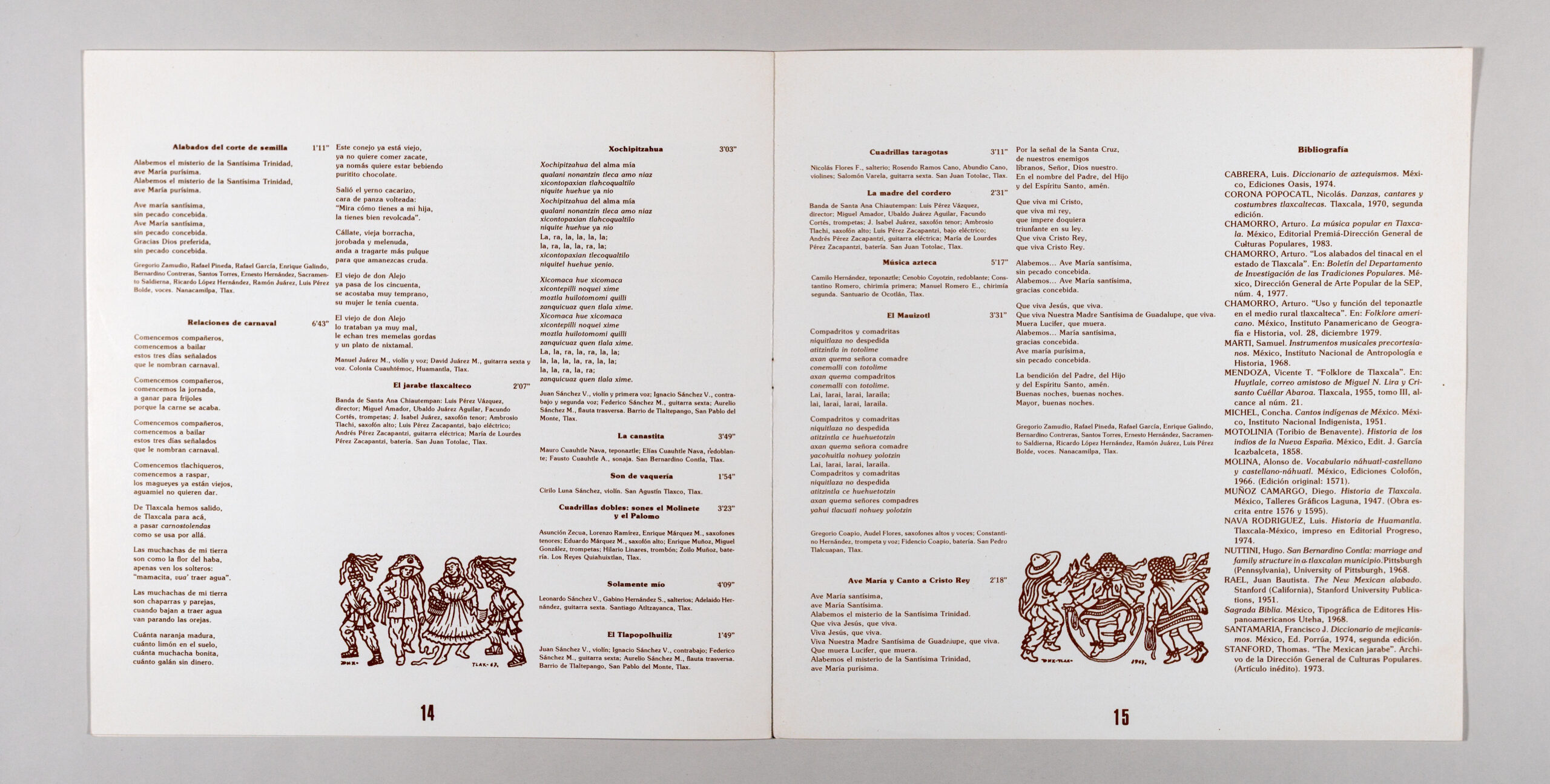
Seed Cut Praises 1’11”
Let us praise the mystery of the Holy Trinity,
the Virgin Mary.
Let us praise the mystery of the Holy Trinity,
the Virgin Mary.
Holy Mary Hail,
conceived without sin.
Hail Mary most holy,
conceived without sin
Thank God favorite
conceived without sin.
Gregorio Zamudio, Rafael Pineda, Rafael García, Enrique Galindo, Bernardino Contreras, Santos Torres, Ernesto Hernández, Sacramento Saldierna, Ricardo López Hernández, Ramón Juárez, Luis Pérez Bolde, voices. Nanacamilpa, Tlax.
Carnival relations 6’43”
let’s start comrades
let’s start dancing
these three appointed days
who call it carnival.
let’s start comrades
let’s start the day
to win for beans
because the meat runs out.
let’s start comrades
let’s start dancing
these three appointed days
who call it carnival.
Let’s start tlachiqueros,
let’s start scraping,
the magueyes are already old,
mead do not want to give.
We have left Tlaxcala,
from Tlaxcala to here,
to spend carnival
How is it used there?
The girls of my land
they are like the flower of the bean,
singles hardly see:
“mamacita, vua’ bring water.”
The girls of my land
they are short and couples,
when they go down to bring water
their ears are perking up.
How much ripe orange,
how much lemon on the ground,
what a pretty girl,
how much gallant without money.
This rabbit is already old,
he no longer wants to eat grass,
he just wants to be drinking
pure chocolate.
The cacarizo son-in-law came out,
turned tummy face:
“Look how you have my daughter,
You have it well rolled “.
Shut up, old drunk
hunchbacked and hairy,
go swallow more pulque
so that you wake up raw
Don Alejo’s old man
It’s over fifty
he went to bed very early
his wife had an account for him.
Don Alejo’s old man
they already treated him very badly,
they throw three fat memelas
and a plate of nixtamal.
Manuel Juárez M., violin and voice; David Juárez M., sixth guitar and voice. Colonia Cuauhtémoc, Huamantla, Tlax.
Tlaxcalan syrup 2’07”
Band of Santa Ana Chiautempan: Luis Pérez Vázquez, director; Miguel Amador, Ubaldo Juárez Aguilar, Facundo Cortés, trumpets; J. Isabel Juárez, tenor saxophone; Ambrosio Tlachi, alto saxophone; Luis Pérez Zacapantzi, electric bass: Andrés Pérez Zacapantzi, electric guitar; María de Lourdes Pérez Zacapantzi, drums. San Juan Totolac, Tlax.
Xochipitzahua 3’03”
Xochipitzahua of my soul
qualani nonantzin tleca i love niaz
xicontopaxian tlahcoqualtilo
niquite huehue ya niño
Xochipitzahua of my soul
qualani nonantzin tleca i love niaz
xicontopaxian tlahcoqualtilo
niquite huehue ya niño
La, ra, la, la, la, la;
la, ra, la, la, ra, la;
xicontopaxian tlecoqualtilo
niquitel huehue yenio.
Xicomaca Hue Xicomaca
xicontepilli knock out xime
moztla huilotomomi quilli
leggy quen tlala xime.
Xicomaca Hue Xicomaca
xicontepilli knock out xime
moztla huilotomomi quilli
leggy quen tlala xime.
La, la, ra, la, ra, la, la;
la, la, la, la, ra, la, la;
la, la, ra, la, ra;
leggy quen tlala xime.
Juan Sánchez V., violin and first voice; Ignacio Sánchez V., double bass and second voice; Federico Sánchez M., sixth guitar; Aurelio Sánchez M., transverse flute. Tlaltepango neighborhood, San Pablo del Monte, Tlax.
The little basket 3’49”
Mauro Cuauhtle Nava, Teponaztle; Elías Cuauhtle Nava, drummer; Fausto Cuauhtle A., rattle. San Bernardino Contla, Tlax.
Son de vaquería 1’54”
Cirilo Luna Sánchez, violin. San Agustin Tlaxco, Tlax.
Double cuadrillas: sounds el Molinete and el Palomo 3’23”
Asunción Zecua, Lorenzo Ramírez, Enrique Márquez M., tenor saxophones; Eduardo Márquez M., alto saxophone; Enrique Muñoz, Miguel González, trumpets; Hilario Linares, trombone; Zoilo Muñoz, drums. The Kings Quiahuixtlan, Tlax.
Only mine 4’09”
Leonardo Sánchez V., Gabino Hernández S., psalters; Adelaido Hernández, sixth guitar. Santiago Altzayanca, Tlax.
The Tlapopolhuiliz 1’49”
Juan Sánchez V., violin; Ignacio Sánchez V., double bass; Federico Sánchez M., sixth guitar; Aurelio Sánchez M., transverse flute. Tlaltepango neighborhood, San Pablo del Monte, Tlax.
Taragota crews 3’11”
Nicolás Flores F., psalter; Rosendo Ramos Cano, Abundio Cano, violins; Salomón Varela, sixth guitar. San Juan Totolac, Tlax.
The mother of the lamb 2’31”
Band of Santa Ana Chiautempan: Luis Pérez Vázquez, director; Miguel Amador, Ubaldo Juárez Aguilar, Facundo Cortés, trumpets; J. Isabel Juárez, tenor saxophone; Ambrosio Tlachi, alto saxophone; Luis Pérez Zacapantzi, electric bass; Andrés Pérez Zacapantzi, electric guitar; María de Lourdes Pérez Zacapantzi, drums. San Juan Totolac, Tlax.
Aztec music 5’17”
Camilo Hernández, Teponaztle; Cenobio Coyotzin, drummer; Constantino Romero, first shawm; Manuel Romero E., second shawm. Ocotlán Sanctuary, Tlax.
The Mahuizotl 3’31”
Compadritos and comadritas
niquitlaza not fired
atitzintla in totolime
axan burns lady comadre
conemalli with totolime
axan burns compadritos
conemalli with totolime.
Lai, larai, larai, laraila;
lai, larai, larai, laraila.
Compadritos and comadritas
niquitlaza not fired
atitzintla ce huehuetotzin
axan burns lady comadre
yacohuitla nohuey yolotzin
Lai, larai, larai, laraila.
Compadritos and comadritas
niquitlaza not fired
atitzintla ce huehuetotzin
axan burns gentlemen compadres
yahui tlacuati nohuey yolotzin
Gregorio Coapio, Audel Flores, alto saxophones and vocals; Constantino Hernández, trumpet and voice; Fidencio Coapio, drums. San Pedro Tlalcuapan, Tlax.
Hail Mary and Song to Christ the King 2’18”
Hail Mary most holy,
Hail Mary Most Holy.
Let us praise the mystery of the Holy Trinity.
Long live Jesus, long live.
Long live Jesus, long live.
Long live Our Blessed Mother of Guadalupe, long live.
Let Lucifer die, let him die.
Let us praise the mystery of the Holy Trinity,
the Virgin Mary.
By the sign of the Holy Cross,
of our enemies
deliver us, Lord, our God.
In the name of the Father, of the Son
and of the Holy Spirit, amen.
long live my Christ
long live my king
that prevails everywhere
triumphant in his law.
Long live Christ the King!
Long live Christ the King.
Let us praise… Hail Mary most holy,
conceived without sin.
Let us praise… Hail Mary most holy,
thanks conceived.
Long live Jesus, long live.
Long live Our Blessed Mother of Guadalupe, long live.
Death to Lucifer, death to him.
Let us praise… Holy Mary,
thanks conceived.
The Virgin Mary,
conceived without sin.
The blessing of the Father, of the Son
and of the Holy Spirit, amen.
Good night Good Night.
Major, good night.
Gregorio Zamudio, Rafael Pineda, Rafael García, Enrique Galindo, Bernardino Contreras, Santos Torres, Ernesto Hernández, Sacramento Saldierna, Ricardo López Hernández, Ramón Juárez, Luis Pérez Bolde, voices. Nanacamilpa, Tlax.
Bibliography
CABRERA, Luis. Dictionary of Aztecisms. Mexico, Oasis Editions, 1974.
CROWN POPOCATL, Nicolás. Dances, songs and Tlaxcalan customs. Tlaxcala, 1970, second edition.
CHAMORRO, Arthur. Popular music in Tlaxcala. Mexico, Editorial Premiá-General Directorate of Popular Cultures, 1983.
CHAMORRO, Arthur. “The praised of the tinacal in the state of Tlaxcala”. In: Bulletin of the Department of Investigation of Popular Traditions. Mexico, General Directorate of Popular Art of the SEP, no. 4, 1977.
CHAMORRO, Arthur. “Use and function of the teponaztle in the rural area of Tlaxcala”. In: American Folklore. Mexico, Pan American Institute of Geography and History, vol. 28, December 1979.
MARTI, Samuel. Pre-Cortesian musical instruments. Mexico, National Institute of Anthropology and History, 1968.
MENDOZA, Vicente T. “Folklore of Tlaxcala”. In: Huytlale, friendly mail from Miguel N. Lira and Crisanto Cuéllar Abaroa. Tlaxcala, 1955, volume III, scope to no. twenty-one.
MICHEL, Shell. Indigenous songs of Mexico. Mexico, National Indigenous Institute, 1951.
MOTOLINIA (Toribio de Benavente). History of the Indians of New Spain. Mexico, Edit. J. Garcia Icazbalceta, 1858.
MOLINA, Alonso de. Nahuatl-Spanish and Spanish-Nahuatl vocabulary. Mexico, Ediciones Colofón, 1966. (Original edition: 1571).
MUÑOZ CAMARGO, Diego. History of Tlaxcala. Mexico, Talleres Gráficos Laguna, 1947. (Work written between 1576 and 1595).
NAVA RODRIGUEZ, Luis. History of Huamantla. Tlaxcala-Mexico, printed in Editorial Progreso, 1974.
NUTTINI, Hugo. San Bernardino Contla: marriage and family structure in a tlaxcalan municipality. Pittsburgh (Pennsylvania), University of Pittsburgh, 1968.
RAEL, John the Baptist. The New Mexican praised. Stanford (California), Stanford University Publications, 1951. Holy Bible. Mexico, Uteha Hispano-American Publishers Typographic, 1968.
SANTAMARÍA, Francisco J. Dictionary of Mexicanisms. Mexico, Ed. Porrúa, 1974, second edition.
STANFORD, Thomas. “The Mexican Syrup”. Archive of the General Directorate of Popular Cultures. (Unpublished article). 1973.
Graphic design: Enrique Rivas Paniagua.
Engravings: Desiderio Hernández Xochitiotzin, Alberto Beltrán.
Formation: Salvador González, Guillermo Juárez.
Literary advisor: Amalia Ramírez.†
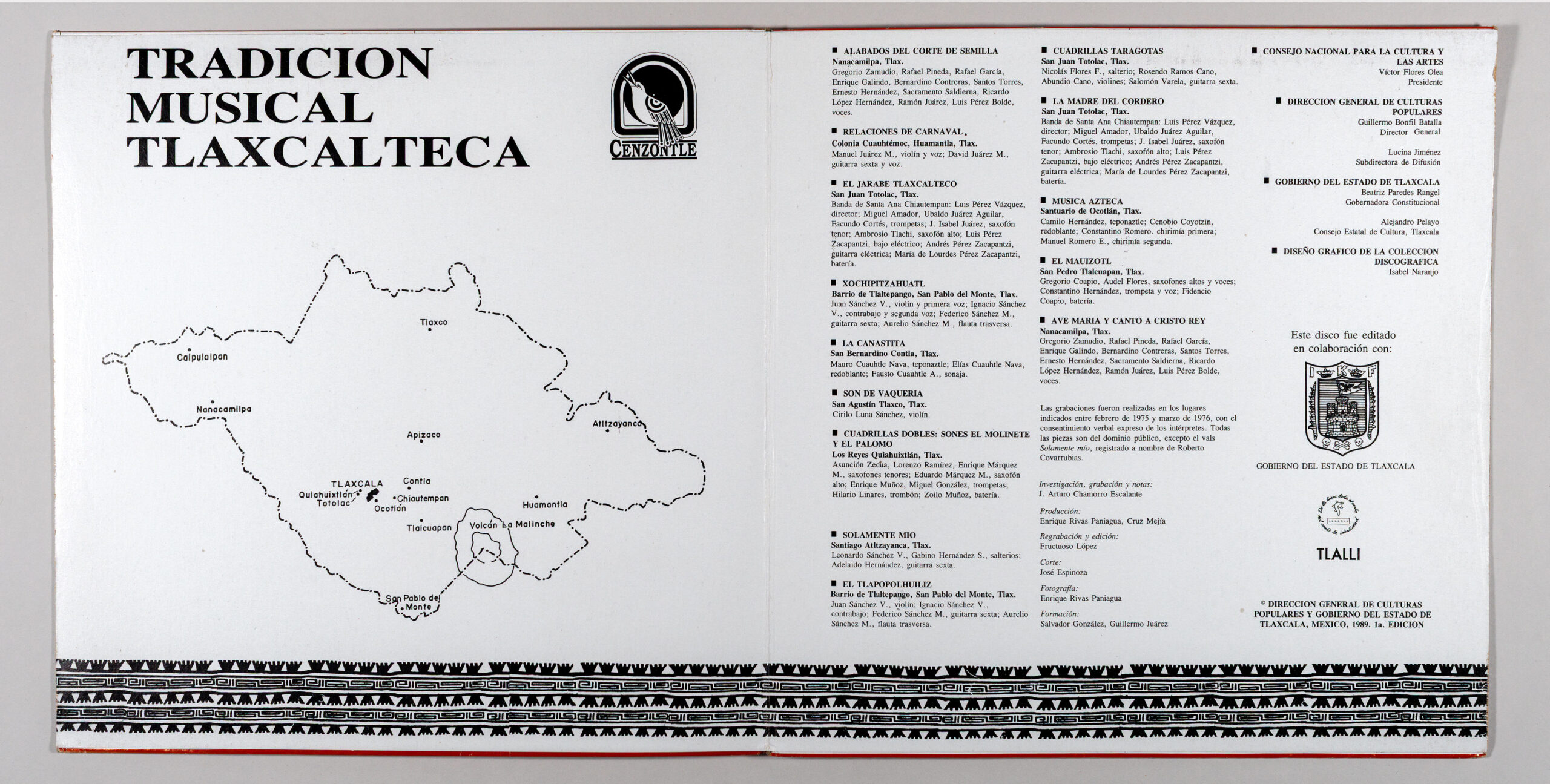
■ PRAISE OF THE SEED CUT
Nanacamilpa, Tlax.
Gregorio Zamudio, Rafael Pineda, Rafael García, Enrique Galindo, Bernardino Contreras, Santos Torres, Ernesto Hernández, Sacramento Saldierna, Ricardo López Hernández, Ramón Juárez, Luis Pérez Bolde, voices.
■ CARNIVAL RELATIONSHIPS
Colonia Cuauhtémoc, Huamantla, Tlax.
Manuel Juárez M., violin and voice; David Juárez M., sixth guitar and voice.
■ THE TLAXCALTECO SYRUP
San Juan Totolac, Tlax.
Band of Santa Ana Chiautempan: Luis Pérez Vázquez, director; Miguel Amador, Ubaldo Juárez Aguilar, Facundo Cortés, trumpets; J. Isabel Juárez, tenor saxophone; Ambrosio Tlachi, alto saxophone; Luis Pérez Zacapantzi, electric bass; Andrés Pérez Zacapantzi, electric guitar; María de Lourdes Pérez Zacapantzi, drums.
■ XOCHIPITZAHUATL
Tlaltepango neighborhood, San Pablo del Monte, Tlax.
Juan Sánchez V., violin and first voice; Ignacio Sánchez V., double bass and second voice; Federico Sánchez M., sixth guitar; Aurelio Sánchez M., transverse flute.
■ THE LITTLE BASKET
San Bernardino Contla, Tlax.
Mauro Cuauhtle Nava, Teponaztle; Elías Cuauhtle Nava, drummer; Fausto Cuauhtle A., rattle.
■ VAQUERÍA SON
San Agustín Tlaxco, Tlax.
Cirilo Luna Sánchez, violin.
■ DOUBLE SQUADS: SONES EL MOLINETE AND EL PALOMO
Los Reyes Quiahuixtlán, Tlax.
Asunción Zecua, Lorenzo Ramírez, Enrique Márquez M., tenor saxophones; Eduardo Márquez M., alto saxophone; Enrique Muñoz, Miguel González, trumpets; Hilario Linares, trombone; Zoilo Muñoz, drums.
■ ONLY MINE
Santiago Altzayanca, Tlax.
Leonardo Sánchez V., Gabino Hernández S., Salterios; Adelaido Hernández, sixth guitar.
■ THE TLAPOPOLHUILIZ
Tlaltepango neighborhood, San Pablo del Monte, Tlax.
Juan Sánchez V., violin; Ignacio Sánchez V., double bass; Federico Sánchez M., sixth guitar; Aurelio Sánchez M., transverse flute.
■ TARAGOTAS CREWS
San Juan Totolac, Tlax.
Nicolás Flores F., psalter; Rosendo Ramos Cano, Abundio Cano, violins; Salomón Varela, sixth guitar.
■ THE MOTHER OF THE LAMB
San Juan Totolac, Tlax.
Band of Santa Ana Chiautempan: Luis Pérez Vázquez, director; Miguel Amador, Ubaldo Juárez Aguilar, Facundo Cortés, trumpets; J. Isabel Juárez, tenor saxophone; Ambrosio Tlachi, alto saxophone; Luis Pérez Zacapantzi, electric bass; Andrés Pérez Zacapantzi, electric guitar; María de Lourdes Pérez Zacapantzi, drums.
■ AZTEC MUSIC
Santuario de Ocotlán, Tlax.
Camilo Hernández, Teponaztle; Cenobio Coyotzin, drummer; Constantine Romero. first shawm; Manuel Romero E., second shawm.
■ THE MAHUIZOTL
San Pedro Tlalcuapan, Tlax.
Gregorio Coapio, Audel Flores, alto saxophones and vocals; Constantino Hernández, trumpet and voice; Fidencio Coapio, drums.
■ AVE MARIA AND SONG TO CHRIST THE KING
Nanacamilpa, Tlax.
Gregorio Zamudio, Rafael Pineda, Rafael García, Enrique Galindo, Bernardino Contreras, Santos Torres, Ernesto Hernández, Sacramento Saldierna, Ricardo López Hernández, Ramón Juárez, Luis Pérez Bolde, voices.
The recordings were made in the indicated places between February 1975 and March 1976, with the express verbal consent of the performers. All the pieces are in the public domain, except the waltz Solamente mío, registered in the name of Roberto Covarrubias.
Research, recording and notes: J. Arturo Chamorro Escalante
Production: Enrique Rivas Paniagua, Cruz Mejía
Re-recording and editing: Fructuoso López
Court: Jose Espinoza
Photography: Enrique Rivas Paniagua
Formation: Salvador González, Guillermo Juárez
■ NATIONAL COUNCIL FOR CULTURE AND THE ARTS
Víctor Flores Olea
President
■ GENERAL DIRECTORATE OF POPULAR CULTURES
Guillermo Bonfil Batalla
Managing Director
Lucina Jimenez
Diffusion Deputy Director
■ GOVERNMENT OF THE STATE OF TLAXCALA
Beatriz Paredes Rangel
Constitutional Governor
Alejandro Pelayo
State Council of Culture, Tlaxcala
■ GRAPHIC DESIGN OF THE RECORD COLLECTION
Isabel Naranjo
This record was edited in collaboration with:
GOVERNMENT OF THE STATE OF TLAXCALA
TLALLI
From the earth springs the song, from the song the identity
GENERAL DIRECTORATE OF POPULAR CULTURES AND GOVERNMENT OF THE STATE OF TLAXCALA, MEXICO, 1989. la. EDITION
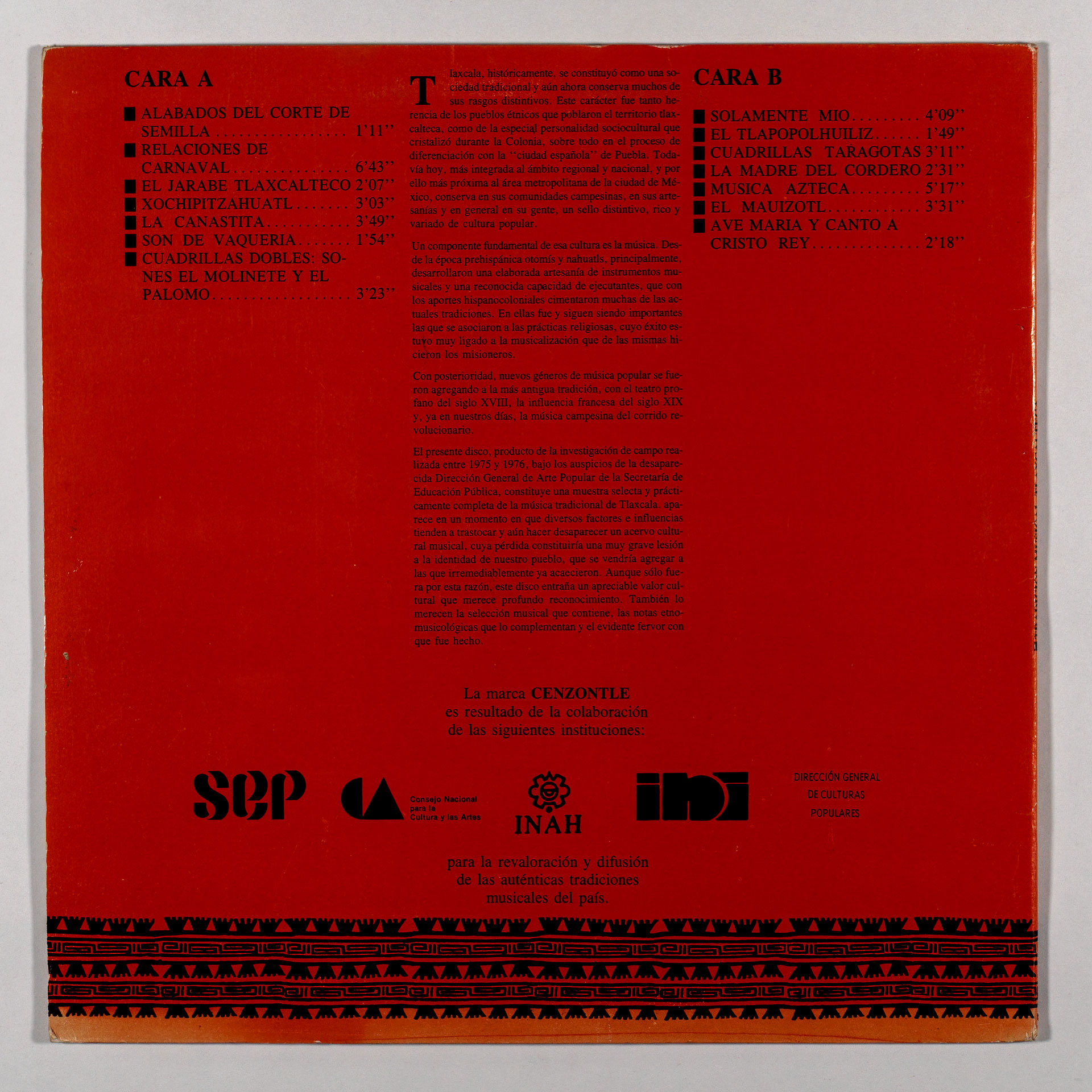
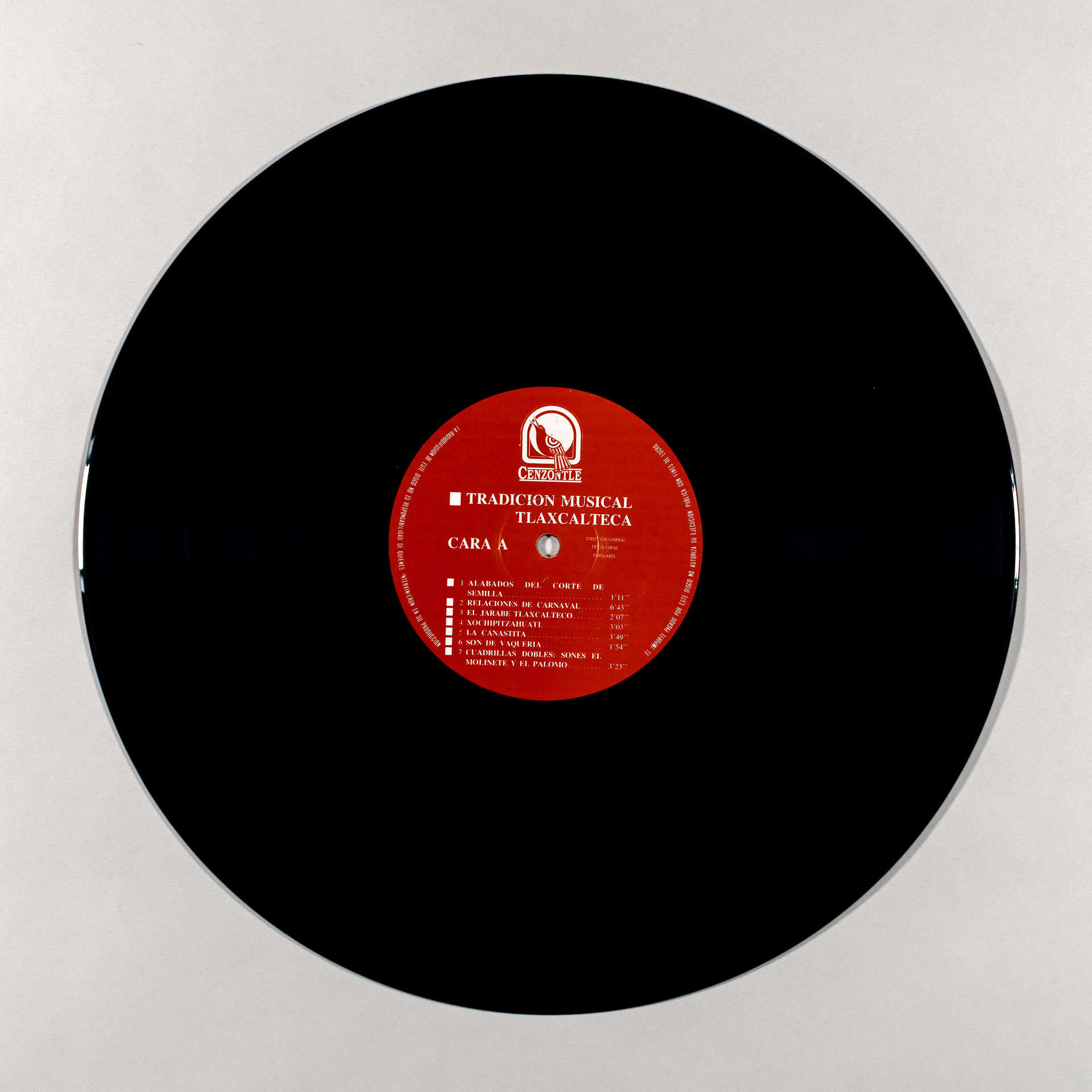
A SIDE
■ SEED CUTTING PRAISE 1’11”
■ CARNIVAL RELATIONS 6’43”
■ THE TLAXCALTECO SYRUP 2’07”
■ XOCHIPITZAHUATL 3’03”
■ THE BASKET 3’49”
■ SON OF DAIRY 1’54”
■ DOUBLE SQUADS: SONES EL MOLINETE AND EL PALOMO 3’23”
Tlaxcala, historically, was constituted as a traditional society and even now it preserves many of its distinctive features. This character was inherited both from the ethnic peoples that populated the Tlaxcalan territory, and from the special sociocultural personality that crystallized during the Colony, especially in the process of differentiation with the “Spanish city” of Puebla. Still today, more integrated into the regional and national sphere, and therefore closer to the metropolitan area of Mexico City, it preserves in its peasant communities, in its crafts and in general in its people, a distinctive, rich and varied stamp of culture. popular.
A fundamental component of that culture is music. Since pre-Hispanic times, the Otomi and Nahuatls, mainly, developed an elaborate craft of musical instruments and a recognized capacity of performers, which with the Spanish-colonial contributions cemented many of the current traditions. In them, those associated with religious practices were and continue to be important, the success of which was closely linked to the musicalization that the missionaries made of them.
Subsequently, new genres of popular music were added to the oldest tradition, with the secular theater of the 18th century, the French influence of the 19th century and, even today, the country music of the revolutionary corrido.
This record, the product of field research carried out between 1975 and 1976, under the auspices of the former General Directorate of Popular Art of the Ministry of Public Education, constitutes a select and practically complete sample of the traditional music of Tlaxcala. It appears at a time when various factors and influences tend to disrupt and even make a musical cultural heritage disappear, the loss of which will constitute a very serious injury to the identity of our people, which would add to those that have already inevitably occurred. If only for this reason, this album carries appreciable cultural value that deserves deep recognition. The musical selection it contains, the ethno-musicological notes that complement it, and the evident fervor with which it was made are also worth it.
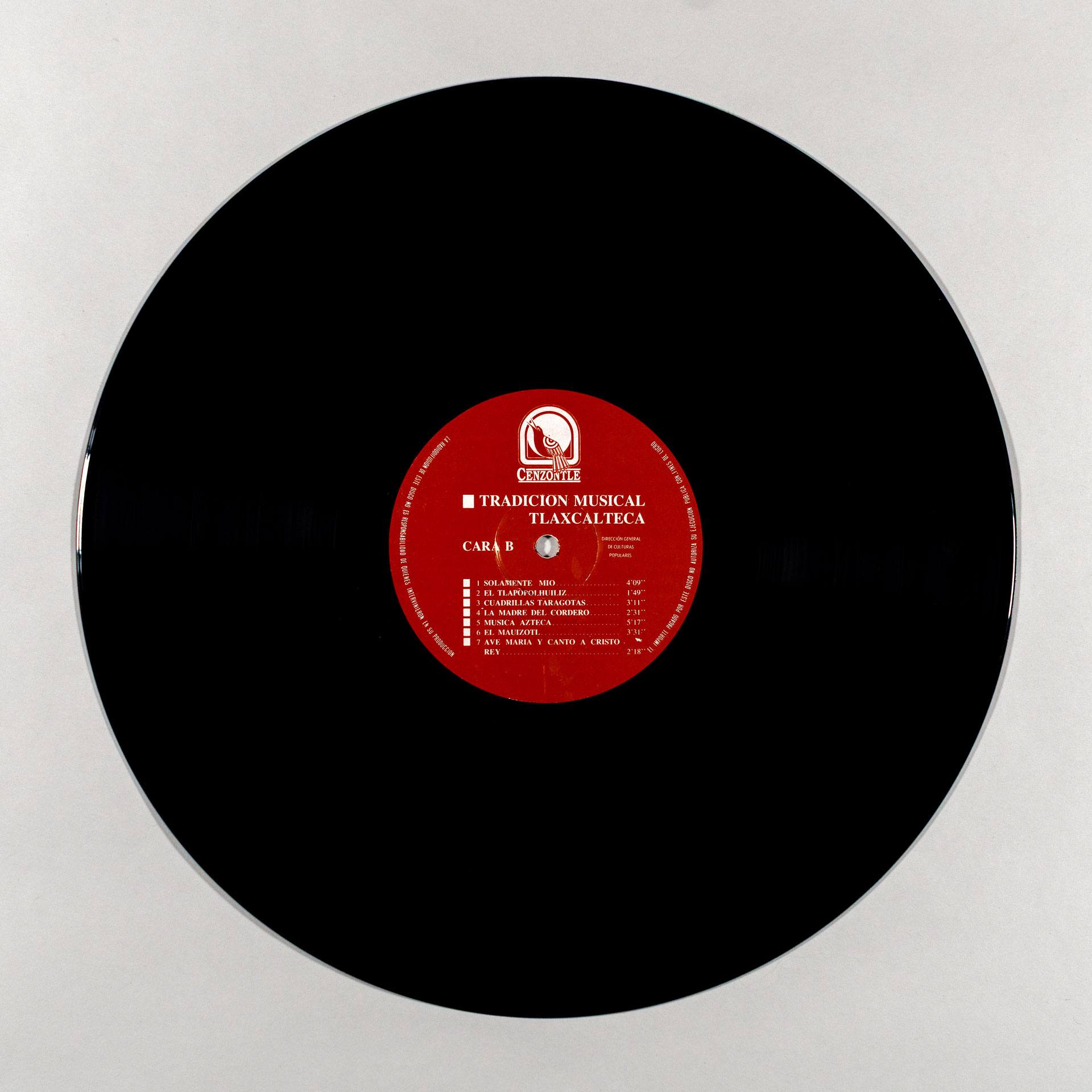
B SIDE
■ ONLY MINE 4’09”
■ THE TLAPOPOLHUILIZ 1’49”
■ TARAGOTAS 3’11”
■ THE MOTHER OF THE LAMB 2’31”
■ AZTEC MUSIC……. 5’17”
■ THE MAHUIZOTL 3’31”
■ AVE MARÍA AND SONG TO CHRIST THE KING 2’18”
The CENZONTLE brand is the result of the collaboration of the following institutions:
SEP, Consejo Nacional para la Cultura y las Artes, INAH, INI, DIRECCIÓN GENERAL DE CULTURAS POPULARES
For the revaluation and diffusion of the authentic musical traditions of the country.
Gallery:
Tracklist:
TLAXCALTEC MUSICAL TRADITION
SIDE 1
- A1 PRAISE OF SEED CUTTING 1:11
Performer(s): Gregorio Zamudio, Rafael Pineda, Rafael García, Enrique Galindo, Bernardino Contreras, Santos Torres, Ernesto Hernández, Sacramento Saldierna, Ricardo López Hernández, Ramón Juárez, Luis Pérez Bolde, voices. - A2 CARNIVAL RELATIONSHIPS 6:43
Performer(s): Manuel Juárez M., violin and voice; David Juárez M., sixth guitar and voice. - A3 THE TLAXCALTEAN SYRUP 2:07
Performer(s): Band of Santa Ana Chiautempan: Luis Pérez Vázquez, director; Miguel Amador, Ubaldo Juárez Aguilar, Facundo Cortés, trumpets; J. Isabel Juárez, tenor saxophone; Ambrosio Tlachi, alto saxophone; Luis Pérez Zacapantzi, electric bass; Andrés Pérez Zacapantzi, electric guitar; María de Lourdes Pérez Zacapantzi, drums. - A4 XOCHIPITZAHUATL 3:03
Performer(s): Juan Sánchez V., violin and first voice; Ignacio Sánchez V., double bass and second voice; Federico Sánchez M., sixth guitar; Aurelio Sánchez M., transverse flute. - A5 THE LITTLE BASKET 3:49
Performer(s): Mauro Cuauhtle Nava, Teponaztle; Elías Cuauhtle Nava, drummer; Fausto Cuauhtle A., rattle. - A6 VAQUERIA SON 1:54
Performer(s): Cirilo Luna Sánchez, violin. - A7 DOUBLE SQUADS: SONES EL MOLINETE AND EL PALOMO 3:23
Performer(s): Asunción Zecua, Lorenzo Ramírez, Enrique Márquez M., tenor saxophones; Eduardo Márquez M., alto saxophone; Enrique Muñoz, Miguel González, trumpets; Hilario Linares, trombone; Zoilo Muñoz, drums.
SIDE 2
- B1 ONLY MINE 4:09
Performer(s): Leonardo Sánchez V., Gabino Hernández S., Salterios; Adelaido Hernández, sixth guitar. - B2 THE TLAPOPOLHUILIZ 1:49
Performer(s): Juan Sánchez V., violin; Ignacio Sánchez V., double bass; Federico Sánchez M., sixth guitar; Aurelio Sánchez M., transverse flute. - B3 TARAGOTAS GANGS 3:11
Performer(s): Nicolás Flores F., psalter; Rosendo Ramos Cano, Abundio Cano, violins; Salomón Varela, sixth guitar. - B4 THE MOTHER OF THE LAMB 2:31
Performer(s): Band of Santa Ana Chiautempan: Luis Pérez Vázquez, director; Miguel Amador, Ubaldo Juárez Aguilar, Facundo Cortés, trumpets; J. Isabel Juárez, tenor saxophone; Ambrosio Tlachi, alto saxophone; Luis Pérez Zacapantzi, electric bass; Andrés Pérez Zacapantzi, electric guitar; María de Lourdes Pérez Zacapantzi, drums. - B5 AZTEC MUSIC 5:17
Performer(s): Camilo Hernández, Teponaztle; Cenobio Coyotzin, drummer; Constantine Romero. first shawm; Manuel Romero E., second shawm. - B6 THE MAHUIZOTL 3:31
Performer(s): Gregorio Coapio, Audel Flores, alto saxophones and voices; Constantino Hernández, trumpet and voice; Fidencio Coapio, drums. - B7 AVE MARIA AND SONG TO CHRIST THE KING 2:18
Performer(s): Gregorio Zamudio, Rafael Pineda, Rafael García, Enrique Galindo, Bernardino Contreras, Santos Torres, Ernesto Hernández, Sacramento Saldierna, Ricardo López Hernández, Ramón Juárez, Luis Pérez Bolde, voices.
Credits:
Graphic design: Enrique Rivas Paniagua.
Engravings: Desiderio Hernández Xochitiotzin, Alberto Beltrán.
Formation: Salvador González, Guillermo Juárez.
Literary advisor: Amalia Ramírez.†
Research, recording and notes: J. Arturo Chamorro Escalante.
Production: Enrique Rivas Paniagua, Cruz Mejía.
Re-recording and editing: Fructuoso López.
Court: Jose Espinoza.
Photography: Enrique Rivas Paniagua.
Formation: Salvador González, Guillermo Juárez.
NATIONAL COUNCIL FOR CULTURE AND THE ARTS: Víctor Flores Olea, President.
GENERAL DIRECTORATE OF POPULAR CULTURES: Guillermo Bonfil Batalla, General Director; Lucina Jiménez, Deputy Director of Diffusion.
GOVERNMENT OF THE STATE OF TLAXCALA: Beatriz Paredes Rangel, Constitutional Governor; Alejandro Pelayo, State Council of Culture, Tlaxcala.
GRAPHIC DESIGN OF THE RECORD COLLECTION: Isabel Naranjo.
Notes:
The recordings were made in the indicated places between February 1975 and March 1976, with the express verbal consent of the performers. All the pieces are in the public domain, except the waltz Solamente mío, registered in the name of Roberto Covarrubias.
This record was edited in collaboration with: GOVERNMENT OF THE STATE OF TLAXCALA and TLALLI: From the earth springs the song, from the song the identity
 Various – Tradicion Musical Tlaxcalteca