







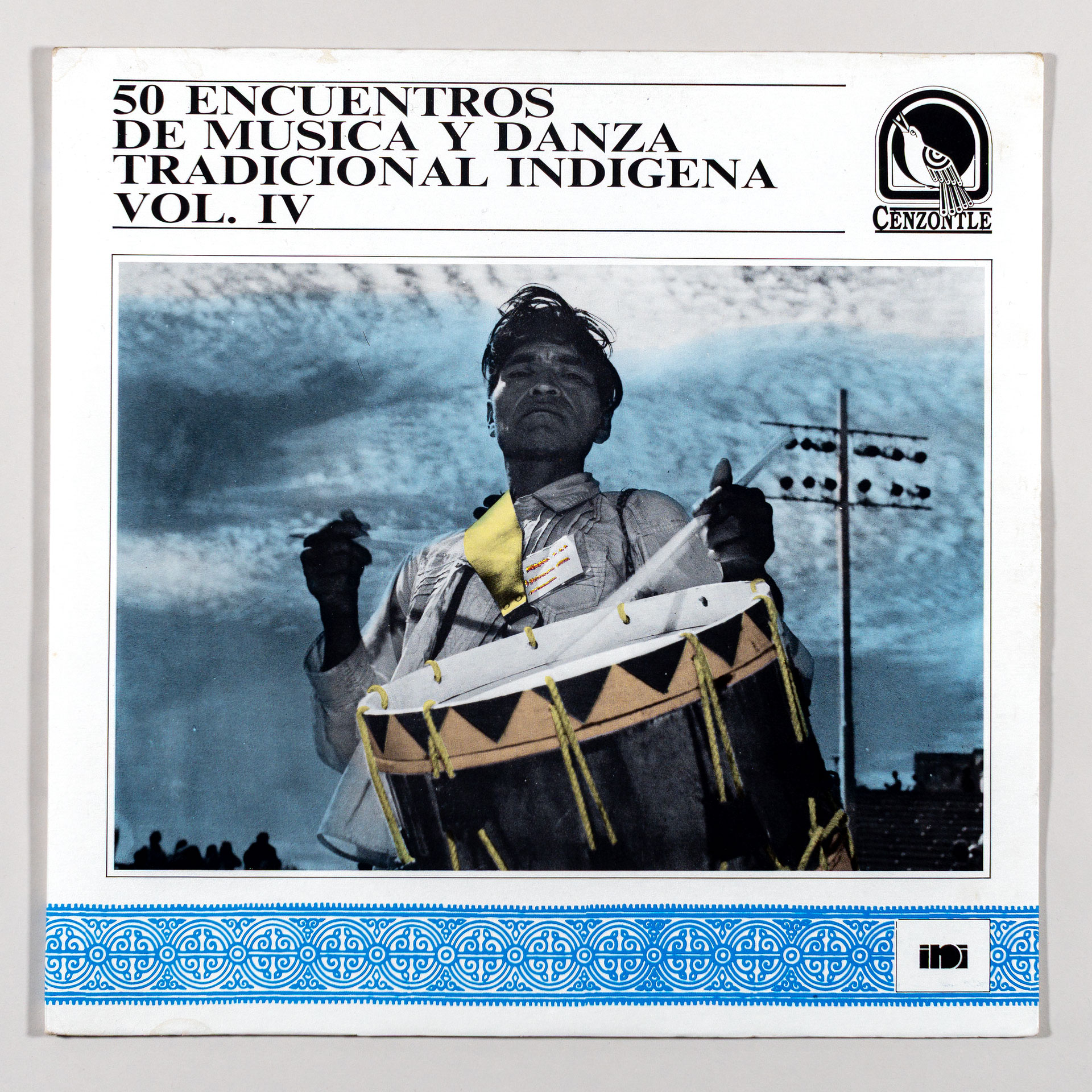
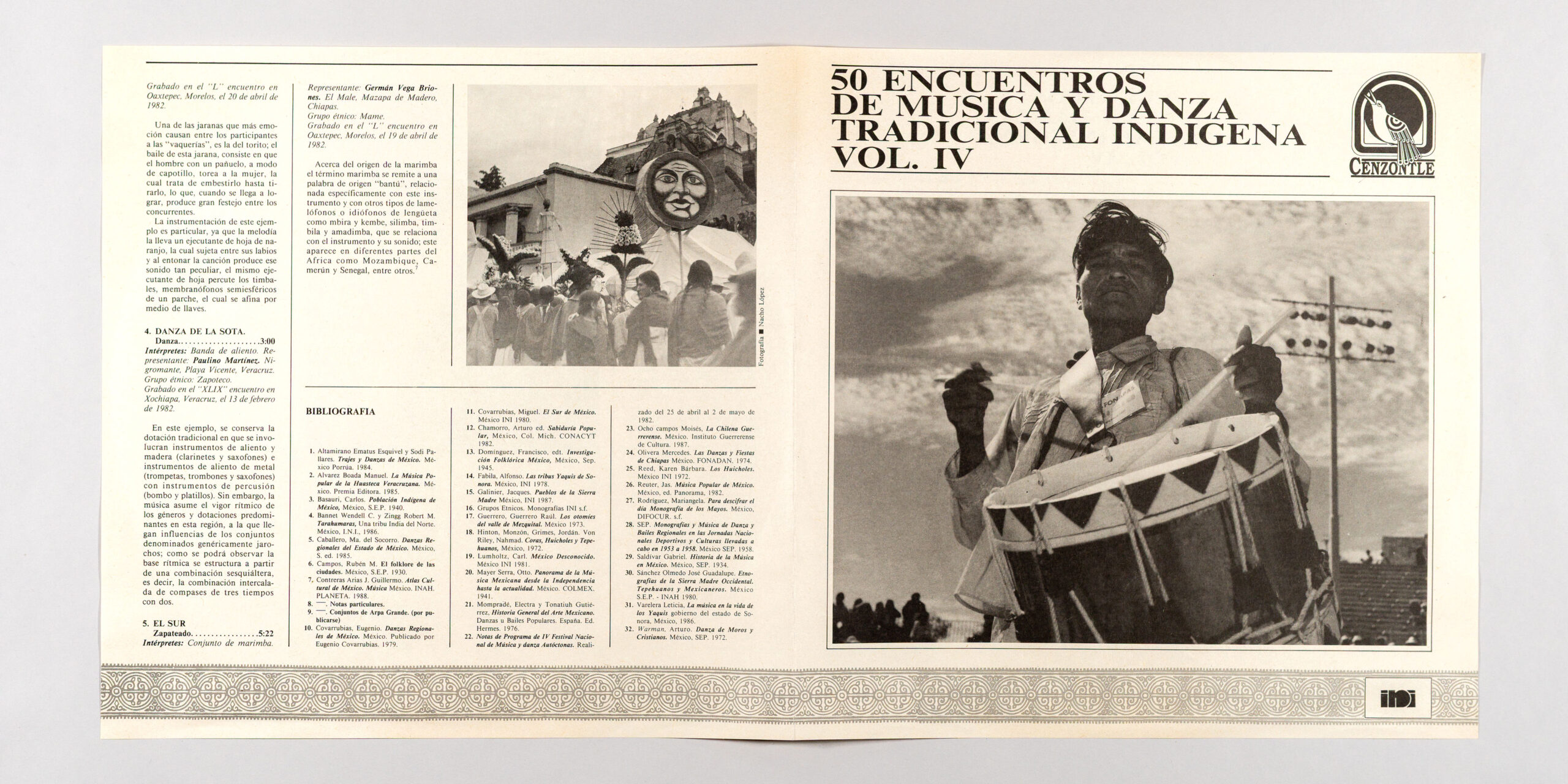
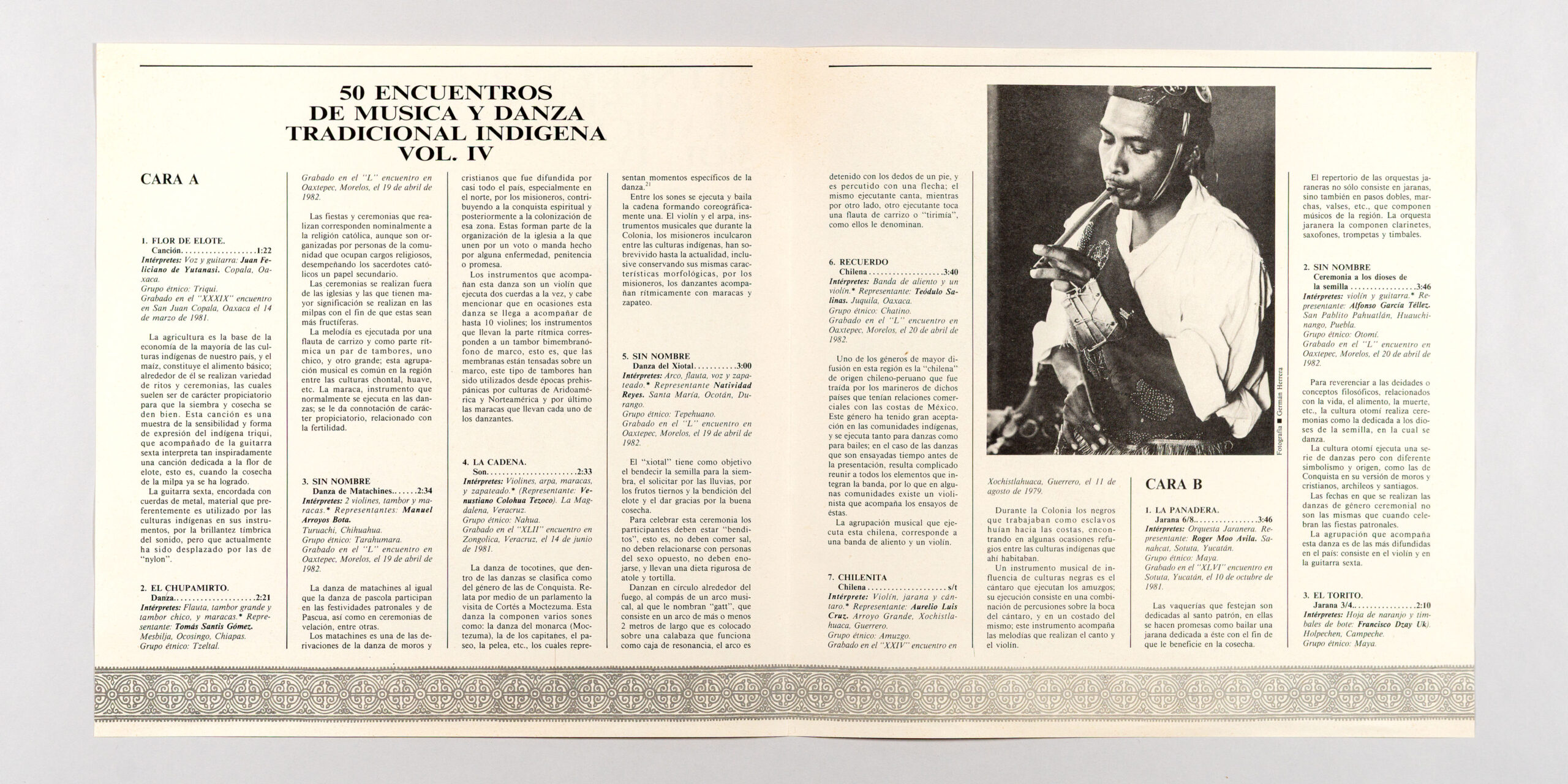
50 MEETINGS OF INDIGENOUS TRADITIONAL MUSIC AND DANCE VOL. IV
Cenzontle
|
Format: Vinyl LP Album 12" 33 1/3 rpm Gatefold Compilation Released: 1990 |
Country: Mexico Genre: Folk World & Country |
Info:
50 MEETINGS OF INDIGENOUS TRADITIONAL MUSIC AND DANCE VOL. IV
CENZONTLE
(MOCKINGBIRD)
INI
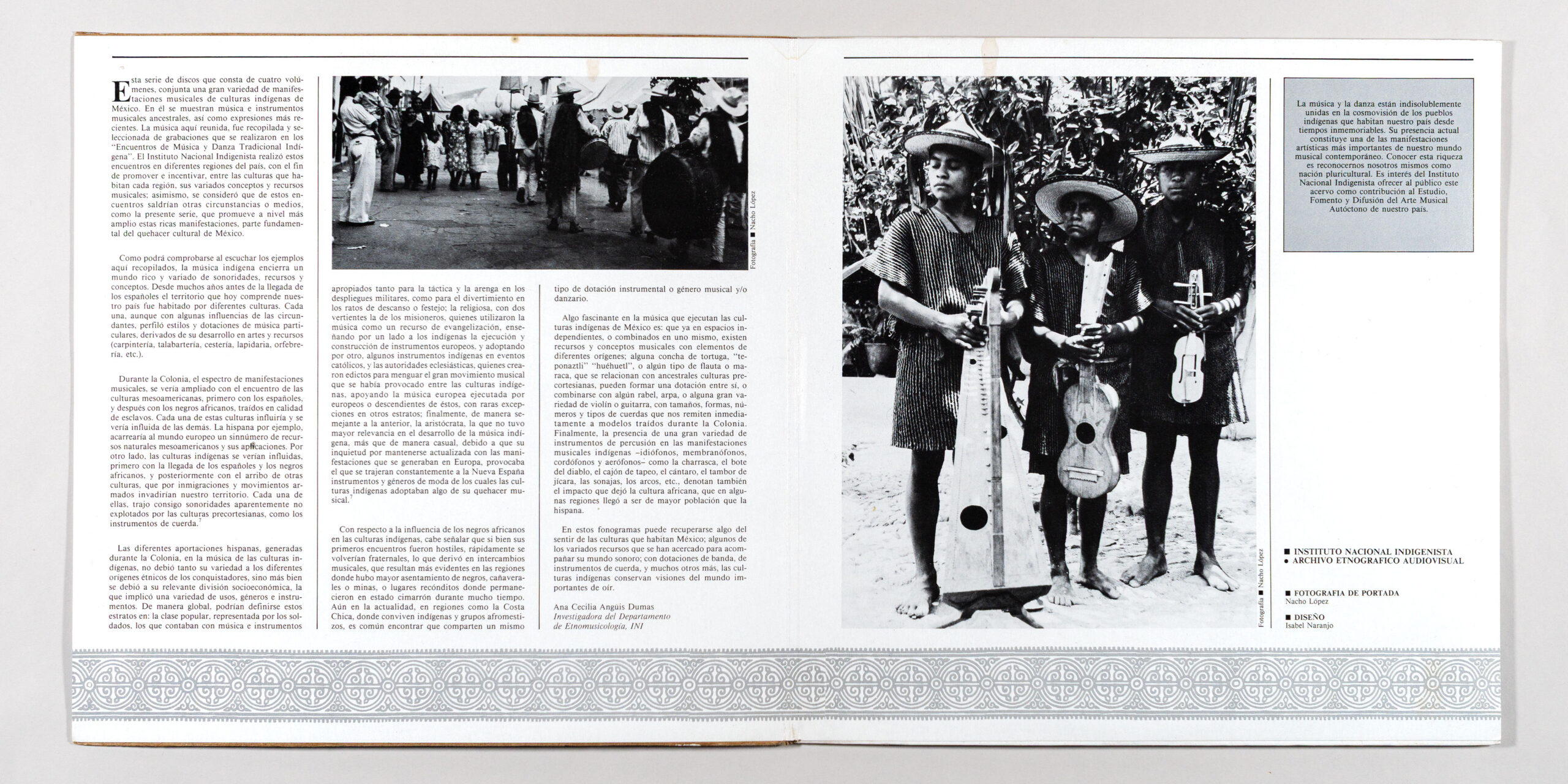
This series of discs that consists of four volumes, brings together a great variety of musical manifestations of indigenous cultures of Mexico. It shows music and ancient musical instruments, as well as more recent expressions. The music gathered here, was compiled and selected from recordings that were made in the “Meetings of Traditional Indigenous Music and Dance”. The National Indigenous Institute held these meetings in different regions of the country, in order to promote and encourage, among the cultures that inhabit each region, its various concepts and musical resources; Likewise, it was considered that other circumstances or media would emerge from these meetings, such as this series, which promotes these rich manifestations at a broader level, a fundamental part of Mexico’s cultural endeavor.
As can be verified by listening to the examples compiled here, indigenous music contains a rich and varied world of sounds, resources and concepts. For many years before the arrival of the Spanish, the territory that today comprises our country was inhabited by different cultures. Each one, although with some influences from the surrounding ones, outlined particular styles and music endowments, derived from their development in arts and resources (carpentry, saddlery, basketry, lapidary, goldsmithing, etc.).
During the Colony, the spectrum of musical manifestations would be expanded with the encounter of Mesoamerican cultures, first with the Spanish, and later with the African blacks, brought as slaves. Each of these cultures would influence and be influenced by the others. The Hispanic, for example, would bring to the European world countless Mesoamerican natural resources and their applications. On the other hand, indigenous cultures would be influenced, first with the arrival of the Spaniards and black Africans, and later with the arrival of other cultures, which through immigration and armed movements would invade our territory. Each of them brought with it sounds apparently not exploited by pre-Cortesian cultures, such as string instruments.⁷
The different Hispanic contributions, generated during the Colony, in the music of indigenous cultures, did not owe its variety so much to the different ethnic origins of the conquerors, but rather due to its relevant socioeconomic division, which implied a variety of uses. , genres and instruments. In a global way, these strata could be defined as: the popular class, represented by the soldiers, those who had appropriate music and instruments both for tactics and harangues in military deployments, as well as for entertainment in times of rest or celebration. ; the religious one, with two aspects: that of the missionaries, who used music as a resource for evangelization, teaching the indigenous people the execution and construction of European instruments on the one hand, and adopting, on the other hand, some indigenous instruments in Catholic events, and the ecclesiastical authorities, who created edicts to diminish the great musical movement that had been provoked among indigenous cultures, supporting European music performed by Europeans or their descendants, with rare exceptions in other strata; finally, in a similar way to the previous one, the aristocrat, the one who had no major relevance in the development of indigenous music, more than in a casual way, due to the fact that her concern to keep up to date with the manifestations that were generated in Europe, caused the constant bringing to New Spain of fashionable instruments and genres from which the indigenous cultures adopted something of their musical work.7
Regarding the influence of black Africans on indigenous cultures, it should be noted that although their first encounters were hostile, they would quickly become fraternal, which led to musical exchanges, which are more evident in the regions where there was a greater settlement of blacks. , cane fields or mines, or remote places where they remained in a wild state for a long time. Even today, in regions such as the Costa Chica, where indigenous and Afro-Mestizo groups coexist, it is common to find that they share the same type of instrumental endowment or musical and/or dance genre.
Something fascinating in the music performed by the indigenous cultures of Mexico is: that already in independent spaces, or combined in one, there are musical resources and concepts with elements of different origins; some turtle shell, “teponaztli” “huehuetl”, or some type of flute or maraca, which are related to ancestral pre-Cortesian cultures, can form an endowment with each other, or be combined with some rebec, harp, or some great variety of violin or guitar, with sizes, shapes, numbers and types of strings that immediately refer us to models brought during the Colony. Finally, the presence of a great variety of percussion instruments in indigenous musical manifestations –idiophones, membranophones, chordophones and aerophones– such as the charrasca, the devil’s boat, the tapas drawer, the pitcher, the gourd drum, the rattles , the arches, etc., also denote the impact left by African culture, which in some regions became more populous than Hispanic.
In these phonograms, something of the feeling of the cultures that inhabit Mexico can be recovered; some of the various resources that have come to accompany his world of sound; With endowments of bands, stringed instruments, and many others, indigenous cultures preserve visions of the world that are listenable.
Ana Cecilia Angüis Dumas
Researcher at the Department of Ethnomusicology, INI
BIBLIOGRAPHY
1. Altamirano Ematus Esquivel and Sodi Pallares. Costumes and Dances of Mexico. Mexico Porrua. 1984.
2. Alvarez Boada Manuel. The Popular Music of the Huasteca Veracruzana. Mexico. Editor Award. 1985.
3. Basauri, Carlos. Indigenous Population of Mexico, Mexico, S.E.P. 1940.
4. Bannet Wendell C. and Zingg Robert M. Tarahumaras, A North Indian tribe. Mexico, I.N.I., 1986.
5. Caballero, Ma. del Socorro. Regional Dances of the State of Mexico. Mexico, S. ed. 1985.
6. Campos, Rubén M. The folklore of the cities. Mexico, S.E.P. 1930.
7. Contreras Arias J. Guillermo. Cultural Atlas of Mexico. Music Mexico. INAH. PLANET. 1988.
8. –. particular notes.
9. –. Large Harp Ensembles. (to be published)
10. Covarrubias, Eugenio. Regional Dances of Mexico. Mexico. Posted by Eugenio Covarrubias. 1979.
11. Covarrubias, Miguel. The South of Mexico. Mexico INI 1980.
12. Chamorro, Arturo ed. Popular Wisdom, Mexico, Col. Mich. CONACYT 1982.
13. Dominguez, Francisco, edt. Folkloric Investigation Mexico, Mexico, Sep. 1945.
14. Fabila, Alfonso. The Yaqui tribes of Sonora. Mexico, INI 1978.
15. Galinier, Jacques. Peoples of the Sierra Madre Mexico, INI 1987.
16. Ethnic groups. INI Monographs s.f.
17. Guerrero, Guerrero Raúl. The Otomi of the Mezquital Valley. Mexico 1973.
18. Hinton, Monsoon, Grimes, Jordan. VonRiley, Nahmad. Coras, Huicholes and Tepehuanos, Mexico, 1972.
19. Lumholtz, Carl. Unknown Mexico. Mexico INI 1981.
20. Mayer Serra, Otto. Panorama of Mexican Music from Independence to the present. Mexico. COLMEX. 1941.
21. Mompradé, Electra and Tonatiuh Gutiérrez, General History of Mexican Art. Dances or Popular Dances. Spain. Ed. Hermes. 1976.
22. Program Notes of the IV National Festival of Autochthonous Music and Dance. Held from April 25 to May 2, 1982.
23. Eight Moses fields, La Chilena Guerrerense. Mexico. Guerrero Institute of Culture. 1987.
24. Olivera Mercedes. The Dances and Festivals of Chiapas Mexico. FONADAN. 1974.
25. Reed, Karen Barbara. The Huichols. Mexico INI 1972.
26. Reuter, Jas. Popular Music of Mexico. Mexico, ed. Panorama, 1982.
27. Rodriguez, Mariangela. To decipher the day Monograph of the Mayos. Mexico, DIFOCUR. s.f.
28. SEP. Monographs and Dance Music and Regional Dances in the National Sports and Cultures Days carried out in 1953 to 1958. Mexico SEP. 1958.
29. Saldivar Gabriel. History of Music in Mexico. Mexico, Sept. 1934.
30. Sanchez Olmedo Jose Guadalupe. Ethnographies of the Sierra Madre Occidental. Tepehuanos and Mexicaneros. Mexico S.E.P. -INAH 1980.
31. Varelera Leticia, Music in the life of the Yaquis, government of the state of Sonora, Mexico, 1986.
32. Warman, Arturo, Dance of Moors and Christians. Mexico, Sept. 1972.
Music and dance are inextricably linked in the worldview of the indigenous peoples who have inhabited our country since time immemorial. His current presence constitutes one of the most important artistic manifestations of our contemporary musical world. Knowing this richness is recognizing ourselves as a multicultural nation. It is the interest of the National Indigenous Institute to offer the public this collection as a contribution to the Study, Promotion and Diffusion of the Autochthonous Musical Art of our country.
■ NATIONAL INDIGENIST INSTITUTE AUDIOVISUAL ETHNOGRAPHIC ARCHIVE
■ COVER PHOTOGRAPH
Nacho López
■ DESIGN
Isabel Naranjo
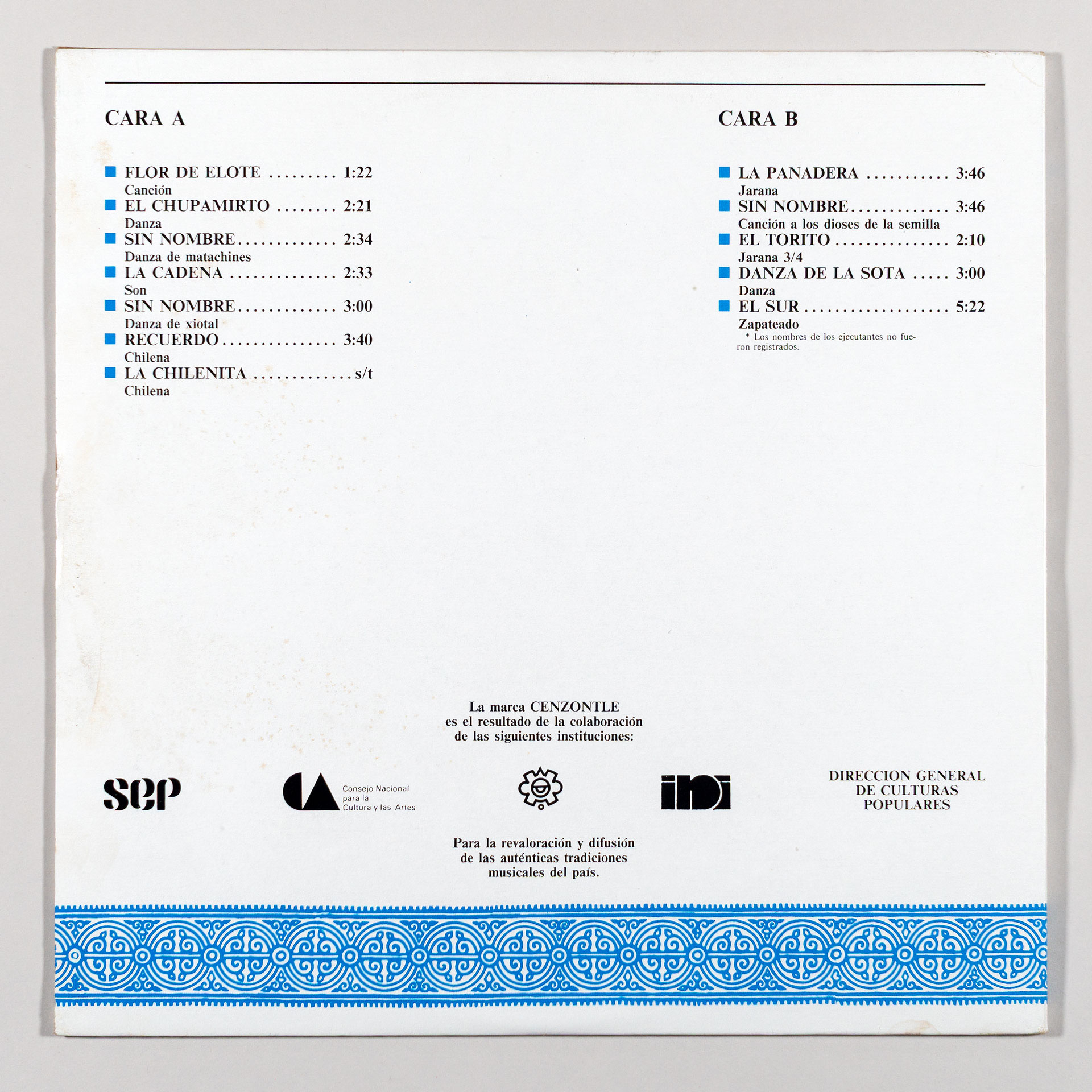
A-SIDE
■ CORN FLOWER…………1:22
Song
■ THE SUCKER……………2:21
Dance
■ WITHOUT A NAME…………3:25
Matachines dance
■ THE CHAIN…………4:00
Son
■ NAMELESS…………2:36
Dance of xiotal
■ I REMEMBER…………2:36
Chilean
■ THE CHILENITA…………2:36
Chilean
B-SIDE
■ THE BAKER…………3:46
Revelry
■ NO NAME…………3:46
Song to the seed gods
■ THE BULL…………2:10
Revelry 3/4
■ DANCE OF THE JACK…………3:00
Dance
■ THE SOUTH…………5:22
Tap dance
* The names of the performers were not recorded.
The CENZONTLE brand is the result of the collaboration of the following institutions:
SEP, Consejo Nacional para la Cultura y las Artes, INAH, INI, DIRECCIÓN GENERAL DE CULTURAS POPULARES
For the revaluation and diffusion of the authentic musical traditions of the country.
Gallery
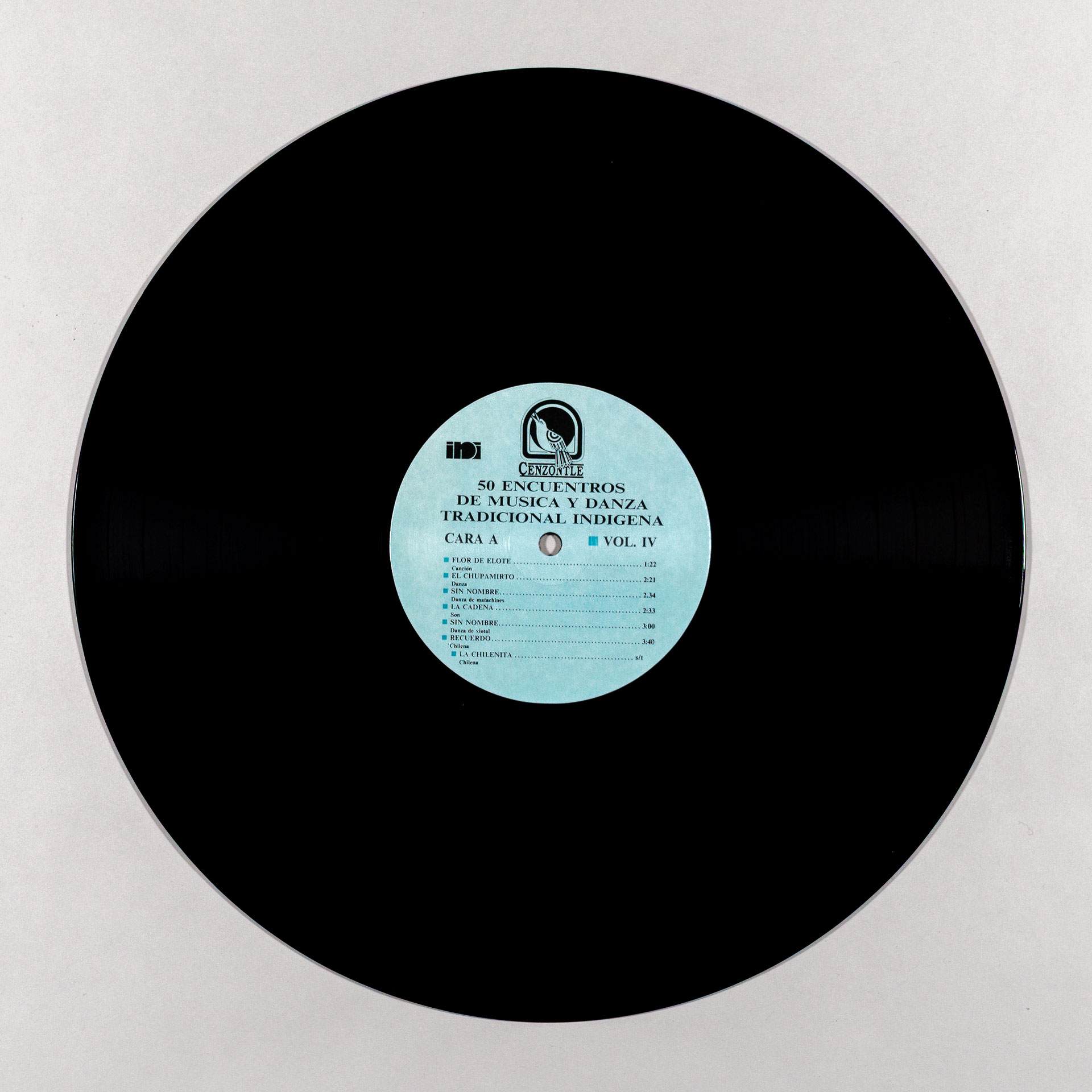
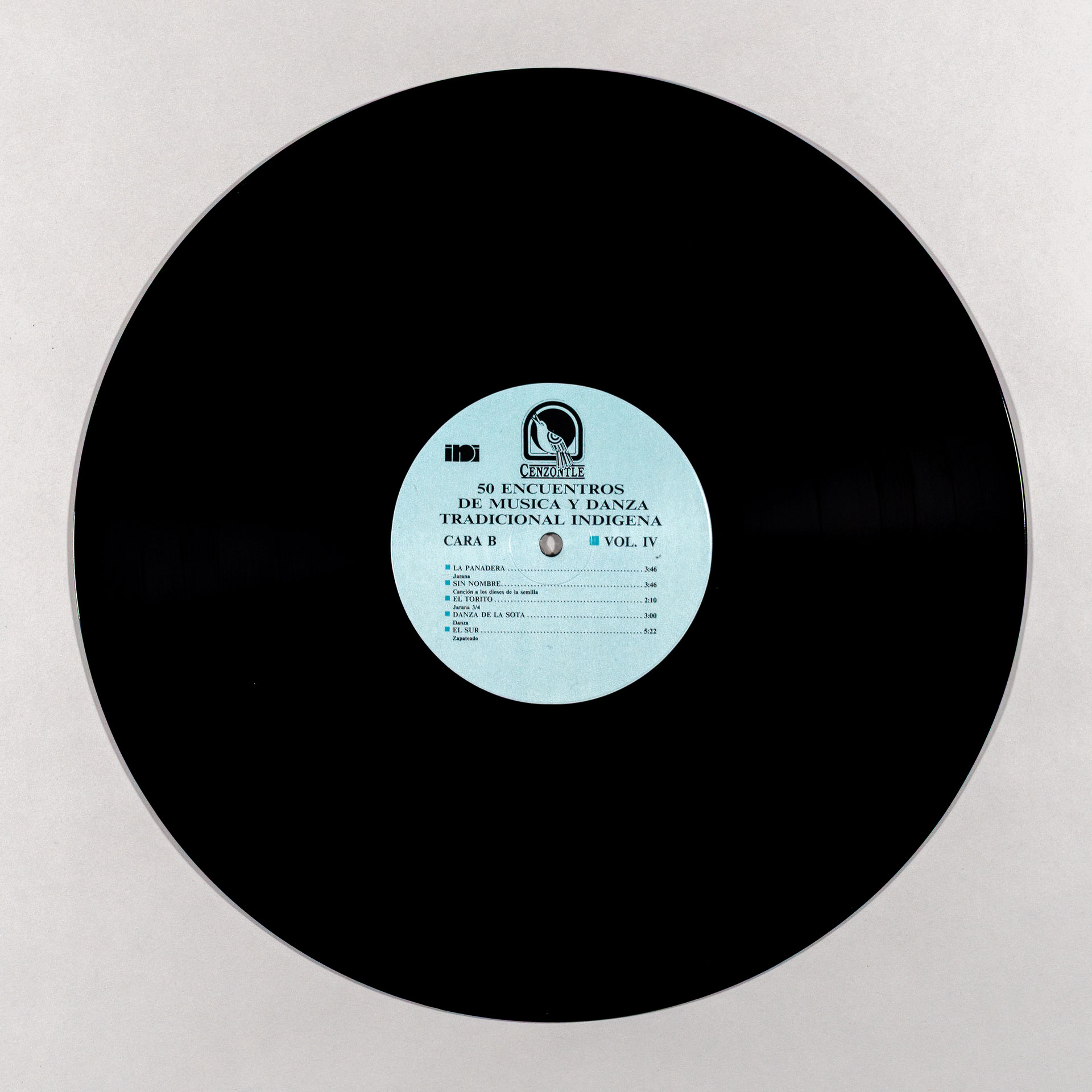
Tracklist:
50 MEETINGS OF INDIGENOUS TRADITIONAL MUSIC AND DANCE VOL. IV
SIDE 1
- A1 CORN FLOWER 1:22
Performer(s): - A2 THE SUCKER 2:21
Performer(s): - A3 NAMELESS 3:25
Performer(s): - A4 THE CHAIN 4:00
Performer(s): - A5 NAMELESS 2:36
Performer(s): - A6 I REMEMBER 2:36
Performer(s): - A7 THE CHILENITA
Performer(s):
LADO 2
- B1 THE BAKER 3:46
Performer(s): - B2 NAMELESS 3:46
Performer(s): - B3 THE BULL 2:10
Performer(s): - B4 DANCE OF THE JACK 3:00
Performer(s): - B5 THE SOUTH 5:22
Performer(s):
Credits:
Researcher at the Department of Ethnomusicology, INI
Ana Cecilia Anguis Dumas
NATIONAL INDIGENIST INSTITUTE AUDIOVISUAL ETHNOGRAPHIC ARCHIVE
COVER PHOTOGRAPH
nacho lopez
DESIGN
Isabel Naranjo
Links:
 50 MEETINGS OF INDIGENOUS TRADITIONAL MUSIC AND DANCE VOL. IV
Condition:
Media Condition:
Mint (M)Sleeve Condition:
Mint (M)Condition Notes:
SEALED