







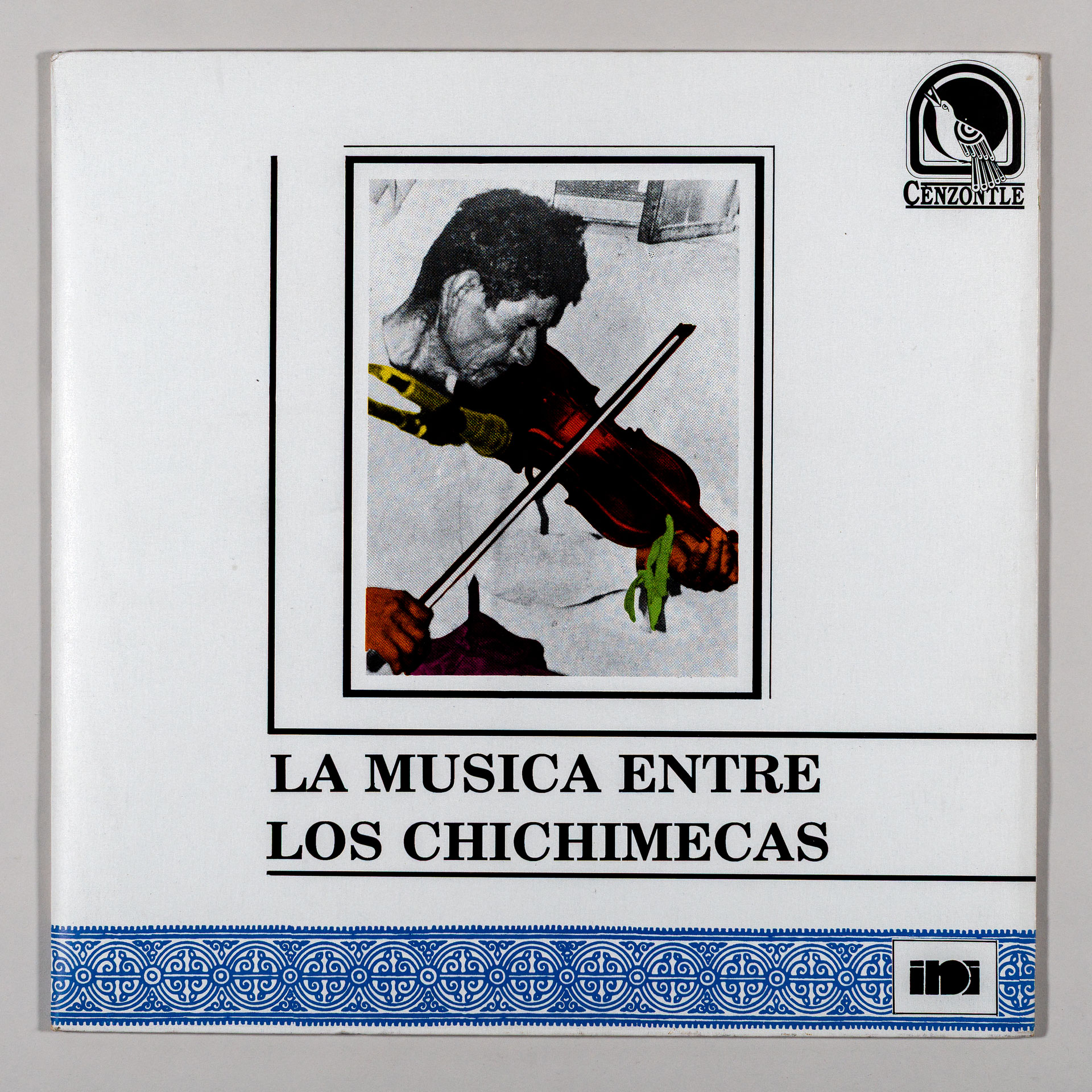
Music Among the Chichimecas
Cenzontle
|
Serie: CENZONTLE |
Country: México Genre: Folk World & Country |
Info:
Music Among the Chichimecas
Cenzontle Series · National Indigenous Institute (INI) · Catalog MA-344 · Vinyl LP
About the Recording
La música entre los chichimecas (Music Among the Chichimecas) brings together musical expressions associated with religious traditions, community dances, and everyday life among Chichimeca communities in the San Luis de la Paz region of Guanajuato, Mexico. These field recordings document jarabes, minuets, sones, funeral music, and sung poetry. The accompanying booklet explores historical background, community organization, and the instruments used by the performers.
The release belongs to the Cenzontle series, an initiative devoted to the study and dissemination of Mexico’s musical traditions. The booklet’s texts and program notes are presented below in an editorial structure designed to facilitate consultation.
Archival note: This text was recovered through assisted transcription of photographs of the original booklet. Some names, quotations, and verses are uncertain and require verification against the physical copy before being considered definitive literal transcriptions. Historical descriptions and terminology reflect the original booklet and should be read in that context.
Institutional Presentation
Music and dance are inseparably linked in the worldview of the Indigenous peoples who have inhabited our country since time immemorial. Their continued presence represents one of the most important artistic expressions in our contemporary musical world. To know this richness is to recognize ourselves as a multicultural nation. The National Indigenous Institute seeks to make this collection available to the public as a contribution to the study, encouragement, and dissemination of our country’s Indigenous musical arts.
Introduction
Historical Background
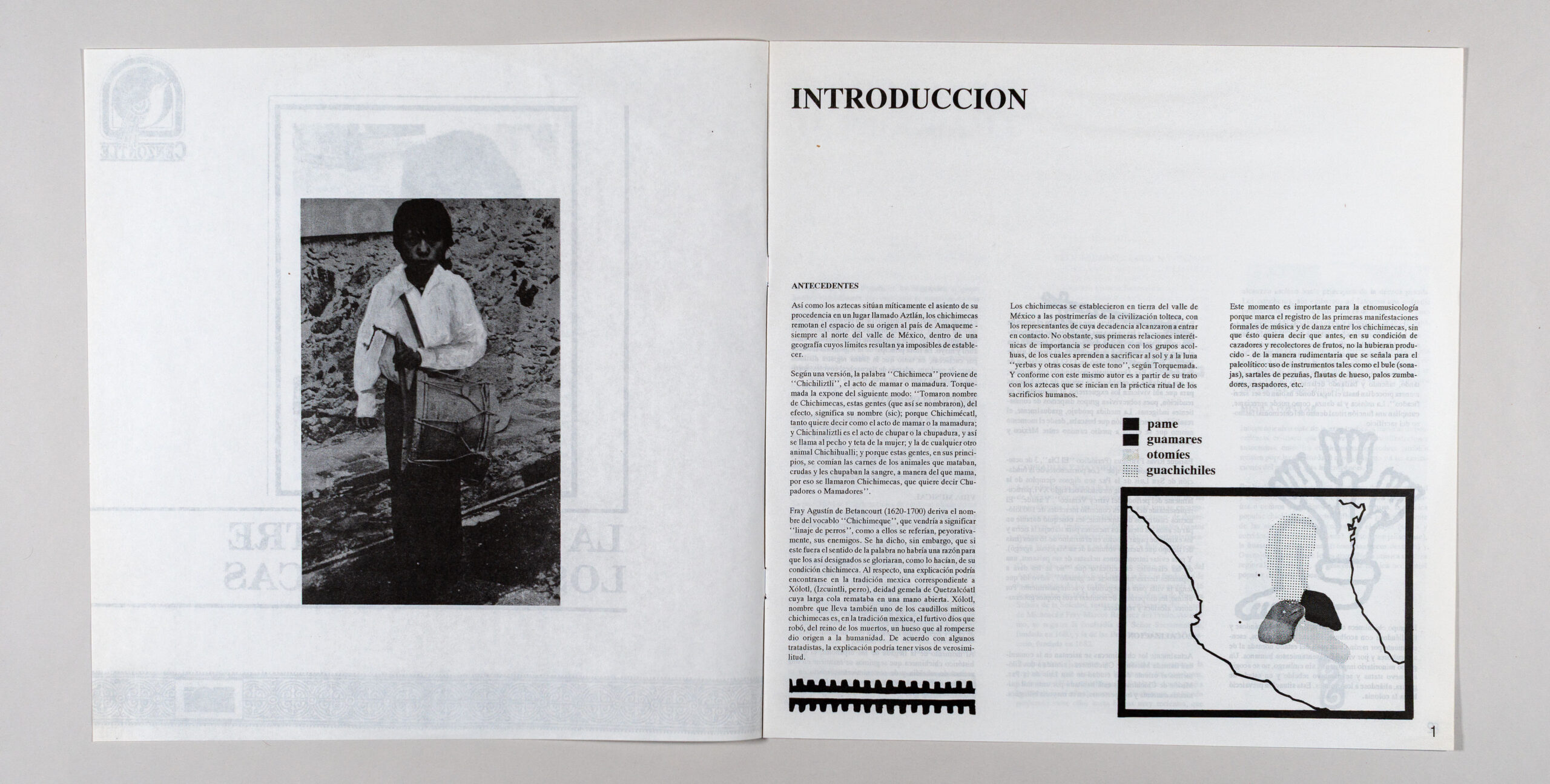
Just as the Aztecs mythically locate their place of origin in a land called Aztlán, the Chichimecas trace theirs to the country of Amaqueme, also north of the Valley of Mexico, in a geography whose boundaries can no longer be established.
According to one interpretation, the term Chichimeca comes from chichiliztli, meaning the act of suckling. Torquemada relates the name to the notion of sucking or nursing and recounts an etymology in which early Chichimeca groups ate the raw flesh of animals they hunted and sucked their blood. This is a historical author’s interpretation, not an established contemporary linguistic explanation.
Fray Agustín de Betancourt (1620–1700) derives the name from Chichimeque, which he interprets as “lineage of dogs,” a derogatory description allegedly used by their enemies. The booklet questions this explanation, pointing out that the people so named took pride in their Chichimeca identity. It then connects this possible meaning to the Mexica figure of Xólotl (itzcuintli, dog), the twin deity of Quetzalcóatl, and to the tradition concerning the recovery of a bone from the underworld from which humanity arose. Xólotl was also the name of a legendary Chichimeca leader.
The Chichimecas settled in the Valley of Mexico toward the end of Toltec civilization and came into contact with its declining populations. According to Torquemada, significant relations with the Acolhua included learning to make ritual offerings to the sun and moon; the author also associated their later contact with the Aztecs with the practice of human sacrifice.
The booklet’s map distinguishes Pame, Guamares, Otomíes, and Guachichiles.
These accounts are important to the booklet’s ethnomusicological argument because they offer some of the earliest written references to formal musical and dance practices among the Chichimecas. This does not imply that music was absent in their earlier hunter-gatherer societies. The author points to instruments such as gourd rattles, strings of hooves, bone flutes, bullroarers, and scrapers.
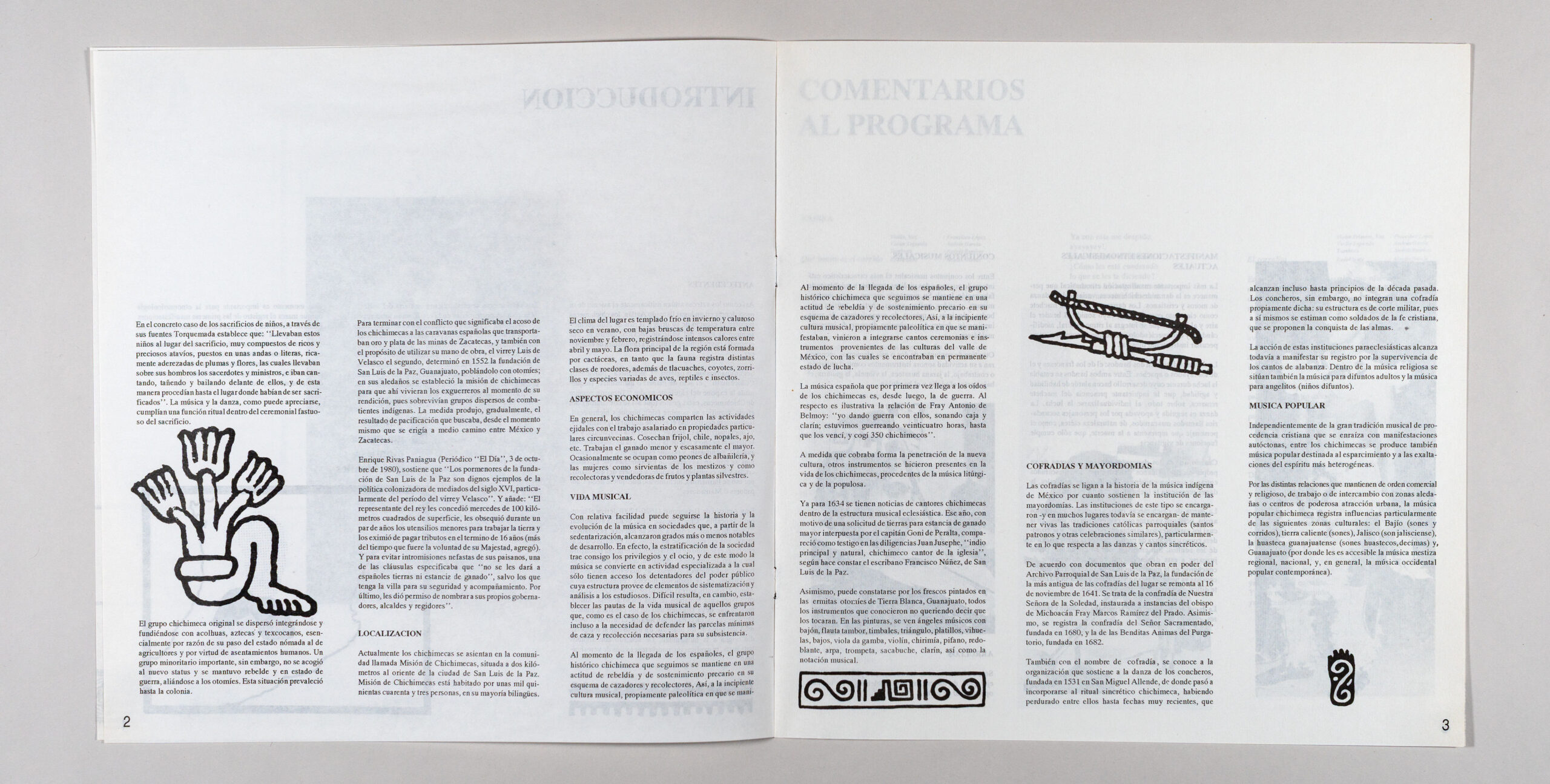
Torquemada describes processions associated with the sacrifice of children, during which priests and attendants carried the children on decorated litters while singing, playing instruments, and dancing. Music and dance therefore served ritual functions within such ceremonies.
The original Chichimeca groups dispersed and mingled with Acolhua, Aztec, and Texcocan populations as some communities moved from nomadic life to farming and permanent settlement. Other groups, however, resisted this transformation, maintained armed resistance, and formed alliances with the Otomíes. This situation continued into the colonial period.
Seeking to put an end to attacks on Spanish caravans carrying gold and silver from the mines of Zacatecas, and also to obtain Indigenous labor, colonial authorities established San Luis de la Paz, Guanajuato. The booklet attributes its founding to Viceroy Luis de Velasco II and dates it to 1552; this date and attribution should be checked against historical sources. Otomí settlers were brought in, while a nearby Chichimeca mission was established for former warriors following their surrender. Situated between Mexico City and Zacatecas, the settlement was intended to facilitate pacification.
Enrique Rivas Paniagua, writing in El Día on October 3, 1980, describes the founding of San Luis de la Paz as an example of mid-sixteenth-century colonial policy under Viceroy Velasco. He reports that land grants totaling approximately 100 square kilometers were made, agricultural tools were provided, and tax exemptions were granted for sixteen years. A provision was intended to prevent Spanish settlers from taking over land, apart from what was necessary for the town’s security. The Indigenous settlers were also reportedly permitted to appoint their own governors, mayors, and council members.
Location
At the time described in the booklet, the Chichimeca community lived in Misión de Chichimecas, approximately two kilometers east of San Luis de la Paz. The booklet recorded a population of about 1,543 people, most of whom were bilingual. This is a historical figure, not a present-day population estimate.
The local climate was described as temperate to cold in winter and hot and dry in summer, with sudden drops in temperature between November and February and particularly intense heat in April and May. Cacti predominated among local plants, while wildlife included rodents, opossums, coyotes, skunks, birds, reptiles, and insects.
Economic Life
The booklet describes agricultural work on ejido lands alongside paid labor on nearby privately owned properties. Crops included beans, chili peppers, prickly pear cactus, and garlic. Small livestock were raised more frequently than cattle. Some community members also worked in construction, domestic service, or gathering and selling wild fruits and plants.
Musical Life
The history and development of music can be traced relatively easily in societies that established permanent settlements and achieved significant social differentiation. In such societies, privilege and leisure helped make music a specialized activity associated with centers of political power, leaving institutions and records for later study. By contrast, it is much more difficult to reconstruct the musical lives of communities such as the Chichimecas, whose subsistence depended on protecting limited hunting and gathering territories.
When the Spanish arrived, the historical Chichimeca groups discussed in the booklet were still resisting colonial domination and subsisting precariously as hunters and gatherers. A portion of the original paragraph is incomplete in the photographic transcription.
The first Spanish music the Chichimecas heard, according to the author, was the music of war. A historical account attributed to Fray Antonio de Belmoy describes fighting accompanied by drums and trumpets over a period of twenty-four hours. As colonial influence increased, instruments associated with both liturgical and popular music entered Chichimeca musical life.
By 1634, documents already referred to Chichimeca singers participating in church music. That year, Juan Jusephe appeared as a witness in a land petition and was described by the notary Francisco Núñez of San Luis de la Paz as a leading Indigenous man and a Chichimeca church singer.
The murals in the Otomí chapels of Tierra Blanca, Guanajuato, offer further evidence of the instruments known in the region, though not necessarily played by its inhabitants. Depictions include musical angels with bassoons or shawms, flutes, drums, kettledrums, triangles, cymbals, vihuelas, bass instruments, violas da gamba, violins, fifes, side drums, harps, trumpets, sackbuts, and bugles, as well as musical notation.
Brotherhoods and Mayordomías
Religious brotherhoods (cofradías) are connected to the history of Indigenous music in Mexico through their role in sustaining mayordomías, the systems responsible for organizing community religious celebrations. These institutions maintained—and in many places continue to maintain—Catholic patron-saint festivals and associated syncretic dances and songs.
According to documents in the parish archive of San Luis de la Paz, the oldest local brotherhood was founded on November 16, 1641: the Brotherhood of Our Lady of Solitude, established at the initiative of Fray Marcos Ramírez del Prado, Bishop of Michoacán. The booklet also mentions the Brotherhood of the Blessed Sacrament, founded in 1680, and the Brotherhood of the Holy Souls in Purgatory, established in 1682.
The term cofradía was also used for the organization supporting the concheros dance. The booklet traces it to San Miguel de Allende in 1531 and describes its subsequent integration into Chichimeca syncretic ritual. Unlike a conventional religious brotherhood, the concheros organization had a military-style hierarchy and its members considered themselves soldiers of the Christian faith.
The continued influence of these religious institutions can be heard in surviving songs of praise. The religious repertoire also includes music for deceased adults and for angelitos, the children who had died.
Popular Music
Alongside the extensive Christian-derived musical tradition blended with local practices, the Chichimecas also developed popular music for entertainment and other forms of celebration.
Through trade, religious practice, employment, and exchanges with nearby regions and urban centers, this music absorbed influences from the Bajío (sones and corridos), Tierra Caliente (sones), Jalisco (son jalisciense), the Guanajuato Huasteca (sones huastecos and décimas), and Guanajuato more broadly, through which regional, national, and contemporary Western popular music circulated.
Contemporary Ethnomusical Expressions
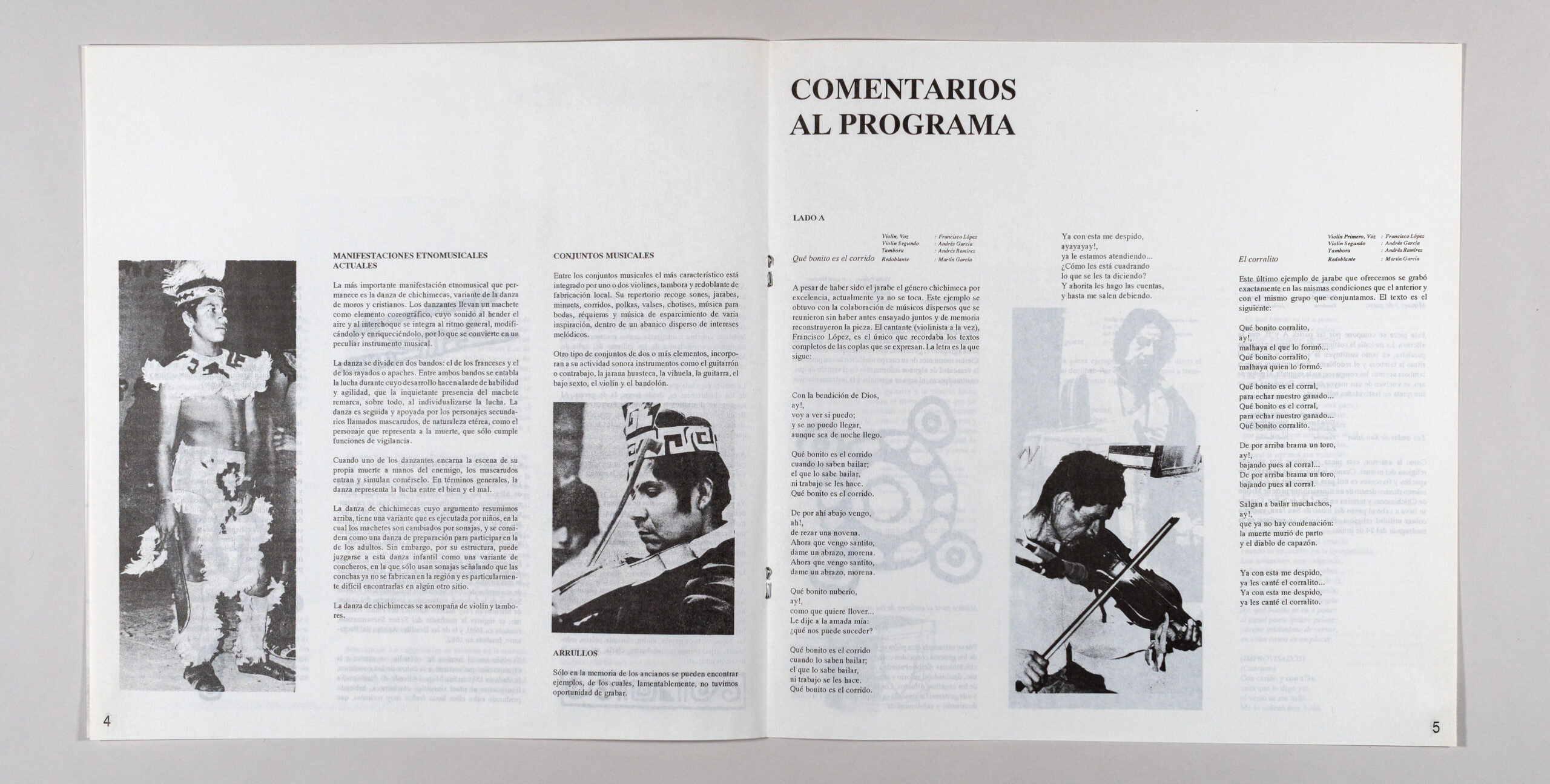
The booklet identifies the Chichimeca dance as the most important surviving ethnomusical expression. It describes it as a variant of the dance of the Moors and Christians. The dancers carry machetes whose sounds—produced as they cut through the air and clash against one another—become part of the rhythmic accompaniment, enriching the dance and effectively turning the machetes into musical instruments.
The performers divide into two opposing groups: the French and the rayados, or Apaches. Their staged combat emphasizes dexterity and agility, especially during individual encounters. Supporting characters known as mascarudos appear alongside them, including a figure representing death.
When one of the dancers acts out his own death at the hands of an opponent, the masked figures enter and pretend to devour him. Broadly speaking, the author interprets the dance as representing the struggle between good and evil.
A children’s version replaces machetes with rattles and functions as preparation for the adult dance. The booklet suggests that, structurally, it may also be understood as a variant of the concheros dance. It notes that traditional shell-backed instruments were no longer made in the region and had become difficult to obtain elsewhere.
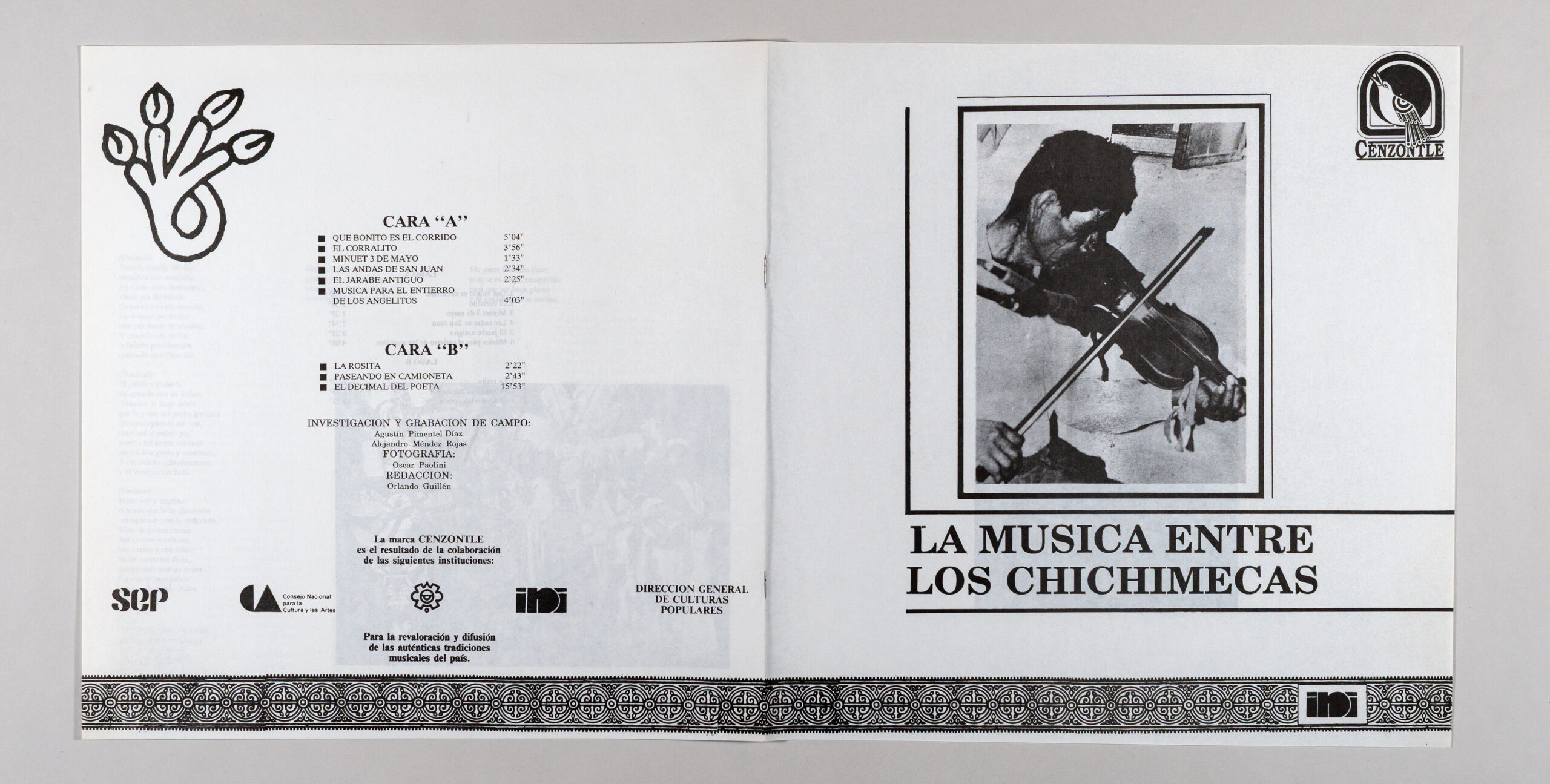
The Chichimeca dance is accompanied by violin and drums.
Musical Ensembles
The most characteristic ensembles consist of one or two violins, a large drum (tambora), and a locally made side drum (redoblante). Their repertoire encompasses sones, jarabes, minuets, corridos, polkas, waltzes, schottisches, wedding music, requiems, and entertainment music from a variety of influences.
Other groups of two or more musicians use instruments such as the guitarrón or double bass, Huastecan jarana, vihuela, guitar, bajo sexto, violin, and bandolón.
Lullabies
The researchers report that examples of traditional lullabies survived only in the memories of older community members. Unfortunately, they were unable to record them.
Program Notes
Side A
1. Qué bonito es el corrido
Performers: Francisco López (lead violin and voice), Andrés García (second violin), Andrés Ramírez (large drum), and Martín García (side drum; name to be verified).
Although the jarabe had once been the Chichimeca musical genre par excellence, the booklet states that it was no longer regularly performed. This example was recovered by bringing together musicians who had not rehearsed together and who reconstructed the piece from memory. Francisco López, the singer and violinist, was the only musician who remembered the complete verses.
The song opens by invoking God’s blessing, then moves through verses about dancing, love, reunion, and parting. Its recurring refrain praises the corrido and those who know how to dance it. The full Spanish-language verses, which require final verification, are preserved in the original transcription.
2. El corralito
Performers: Francisco López (lead violin and voice), Andrés García (second violin), Andrés Ramírez (large drum), and Martín García (side drum; name to be verified).
This second jarabe was recorded under exactly the same conditions as the preceding piece, with the same group of musicians. The playful verses describe a little corral, cattle, dancers, and a final farewell. The original lyrics are available in the Spanish transcription.
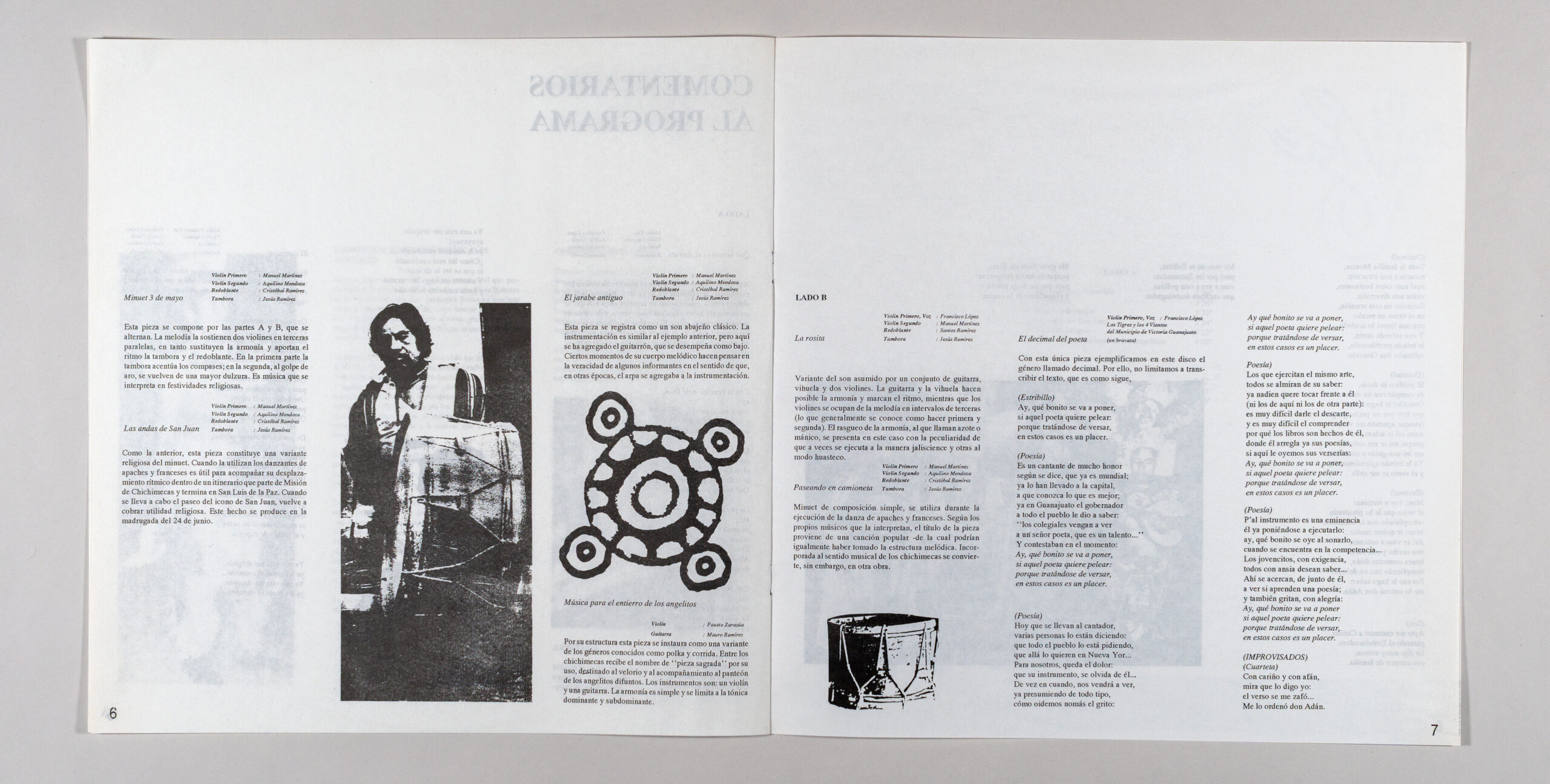
3. Minuet 3 de mayo
Performers: Manuel Martínez (lead violin), Aquilino Mendoza (second violin), Cristóbal Ramírez (side drum), and Jesús Ramírez (large drum; names to be verified).
This piece alternates between sections A and B. Two violins sustain the melody in parallel thirds, while the tambora and side drum provide the rhythmic foundation. In the first section the larger drum emphasizes the beats; in the second, striking the rim gives the music a gentler character. The piece is performed at religious festivities.
4. Las andas de San Juan
Performers: Manuel Martínez (lead violin), Aquilino Mendoza (second violin), Cristóbal Ramírez (side drum), and Jesús Ramírez (large drum).
Like the previous track, this is a religious variation of the minuet. It accompanies the rhythmic procession of the Apache and French dancers along a route from Misión de Chichimecas to San Luis de la Paz. It also accompanies the procession of the image of Saint John, traditionally held in the early hours of June 24.
5. El jarabe antiguo
Performers: Manuel Martínez (lead violin), Aquilino Mendoza (second violin), Cristóbal Ramírez (side drum), and Jesús Ramírez (large drum; consult booklet for exact credits).
The booklet classifies this piece as a classic son abajeño. The instrumentation resembles that of the previous selection, but adds a guitarrón for the bass line. Certain melodic passages suggest that accounts of the harp’s former presence in this type of ensemble may be accurate.
6. Música para el entierro de los angelitos
Performers: Fausto Zarar[a/í]a (violin; surname uncertain) and Mauro Ramírez (guitar).
Structurally, this piece resembles a variant of the polka and corrido. Among the Chichimecas, it is described as a “sacred piece” because it accompanies the wake and burial procession of deceased children, known as angelitos. Its simple harmonies revolve around the tonic, dominant, and subdominant chords.
Side B
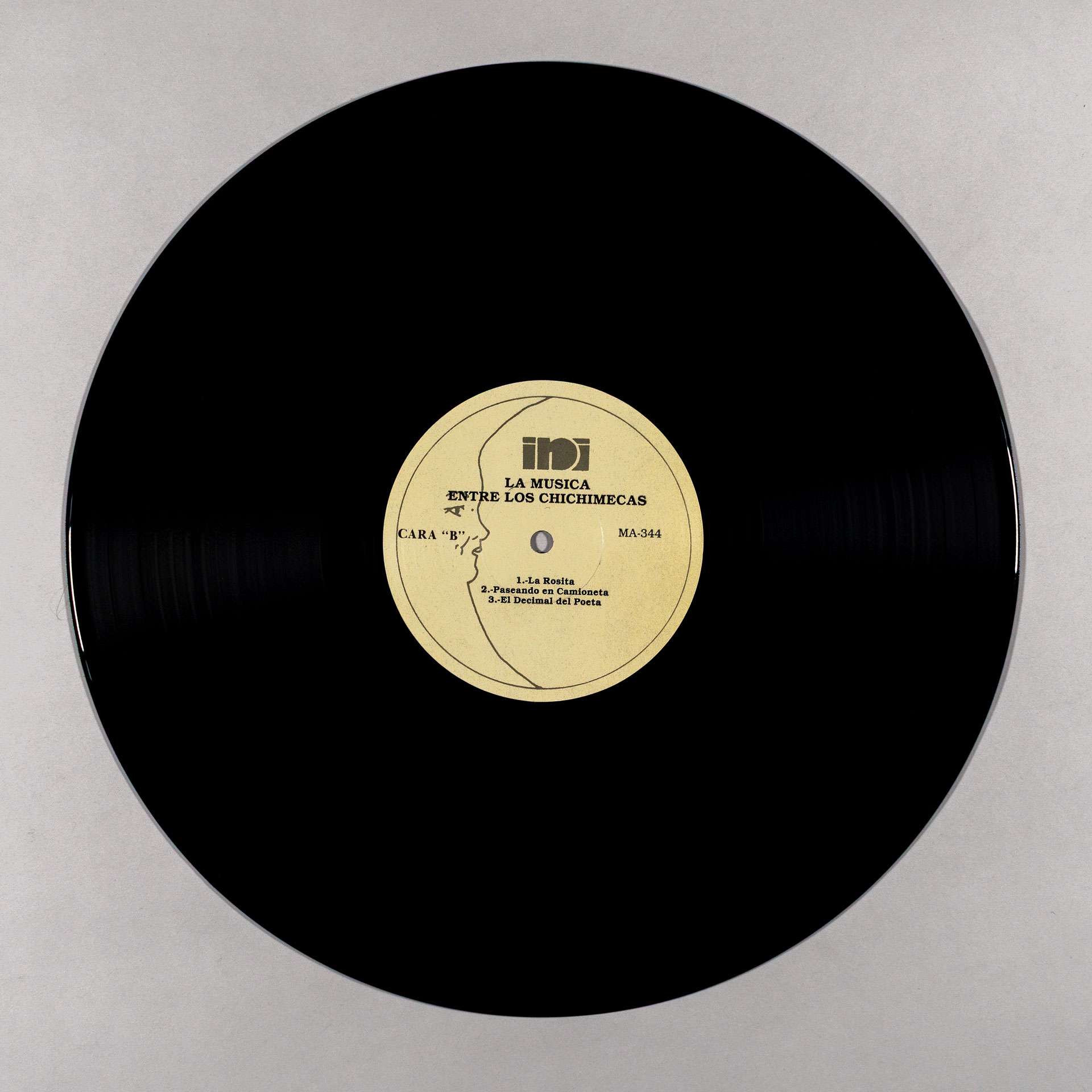
1. La rosita
Performers: The printed credits include Francisco López, a second violinist, a side drummer, and Jesús Ramírez on tambora. Some names require verification.
This is a variation of the son performed by an ensemble of guitar, vihuela, and two violins. The guitar and vihuela establish the harmony and rhythm while the violins carry the melody in thirds, commonly referred to as playing first and second violin. The strumming, called azote or maniqueo, alternates between styles associated with Jalisco and the Huasteca.
2. Paseando en camioneta
Performers: Manuel Martínez (lead violin), Aquilino Mendoza (second violin), a side drummer, and Jesús Ramírez (large drum; consult original credits).
A simply composed minuet used during the Apache and French dance. According to its performers, the title comes from a popular song, from which the musicians may also have borrowed its melodic structure. Once incorporated into Chichimeca musical practice, however, it became a distinct work.
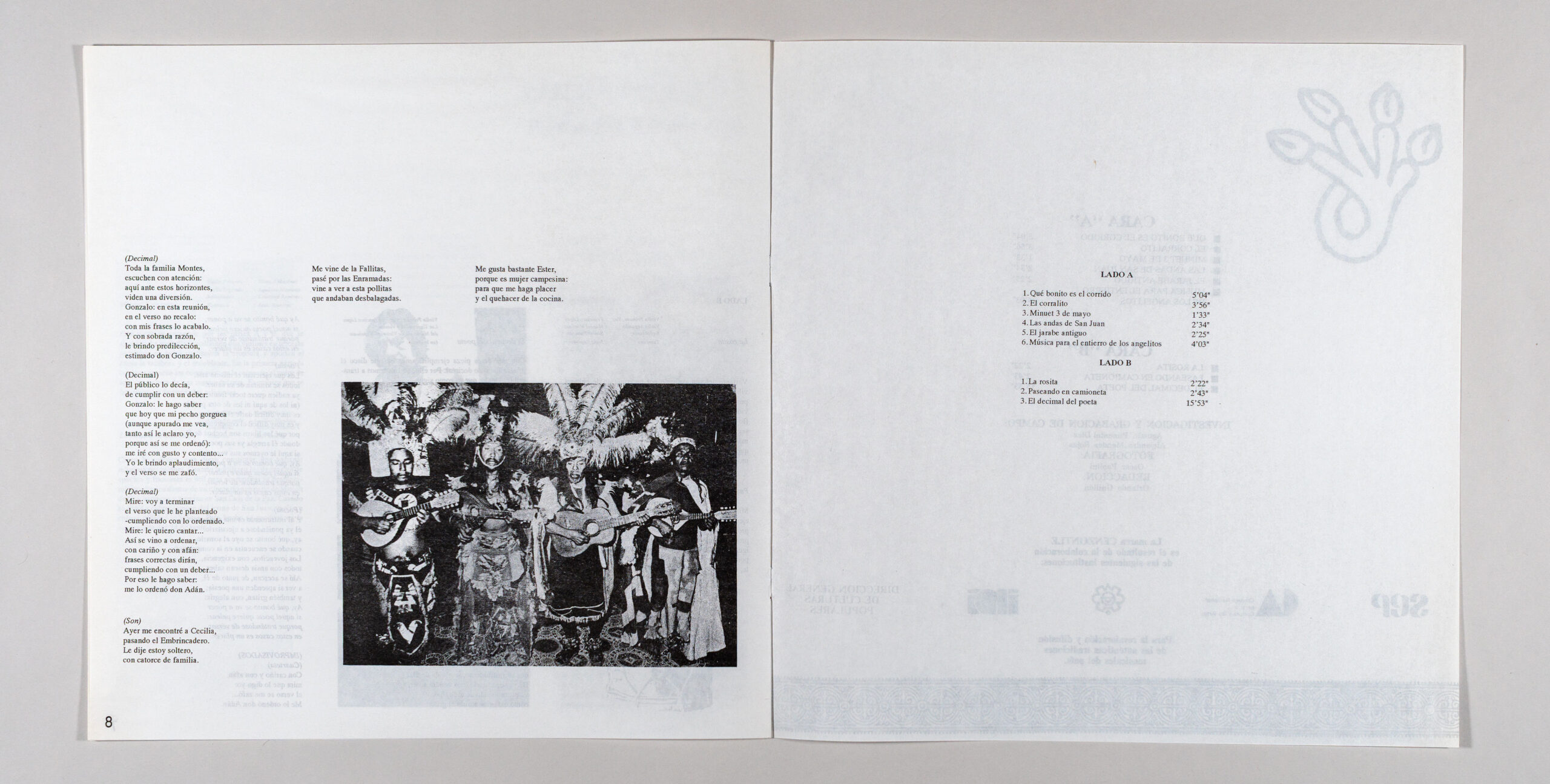
3. El decimal del poeta
Performance: Francisco López (lead violin and voice), with the group identified in the booklet as Los Tigres y los 4 Vientos from the municipality of Victoria, Guanajuato (group name to be verified).
The recording offers a single extended example of the genre called decimal, a form of competitive and improvised sung poetry. The booklet transcribes verses in which a singer celebrates and challenges a rival poet. The recurring refrain expresses excitement at the prospect of a poetic contest. Other verses praise a musician’s reputation, performance skills, and ability to compose, while improvised stanzas address members of the audience, including Gonzalo and Don Adán. The piece concludes with humorous son verses about encounters and courtship.
Because the Spanish text contains dialectal expressions, complex wordplay, and several uncertain readings, a literal English rendering would risk inventing meanings. The lyrics have therefore been retained in Spanish in the companion archival transcription rather than presented here as an unverified translation.
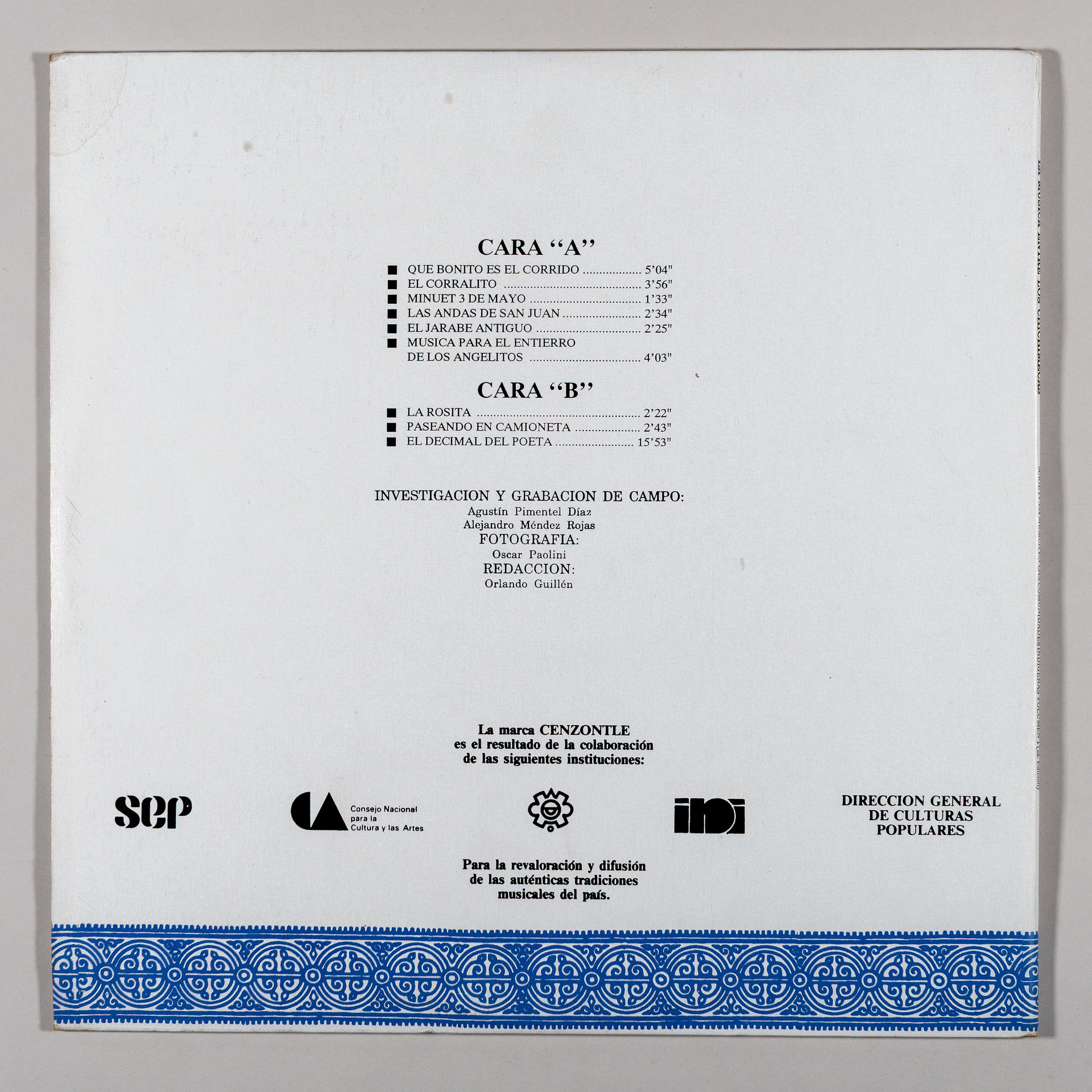
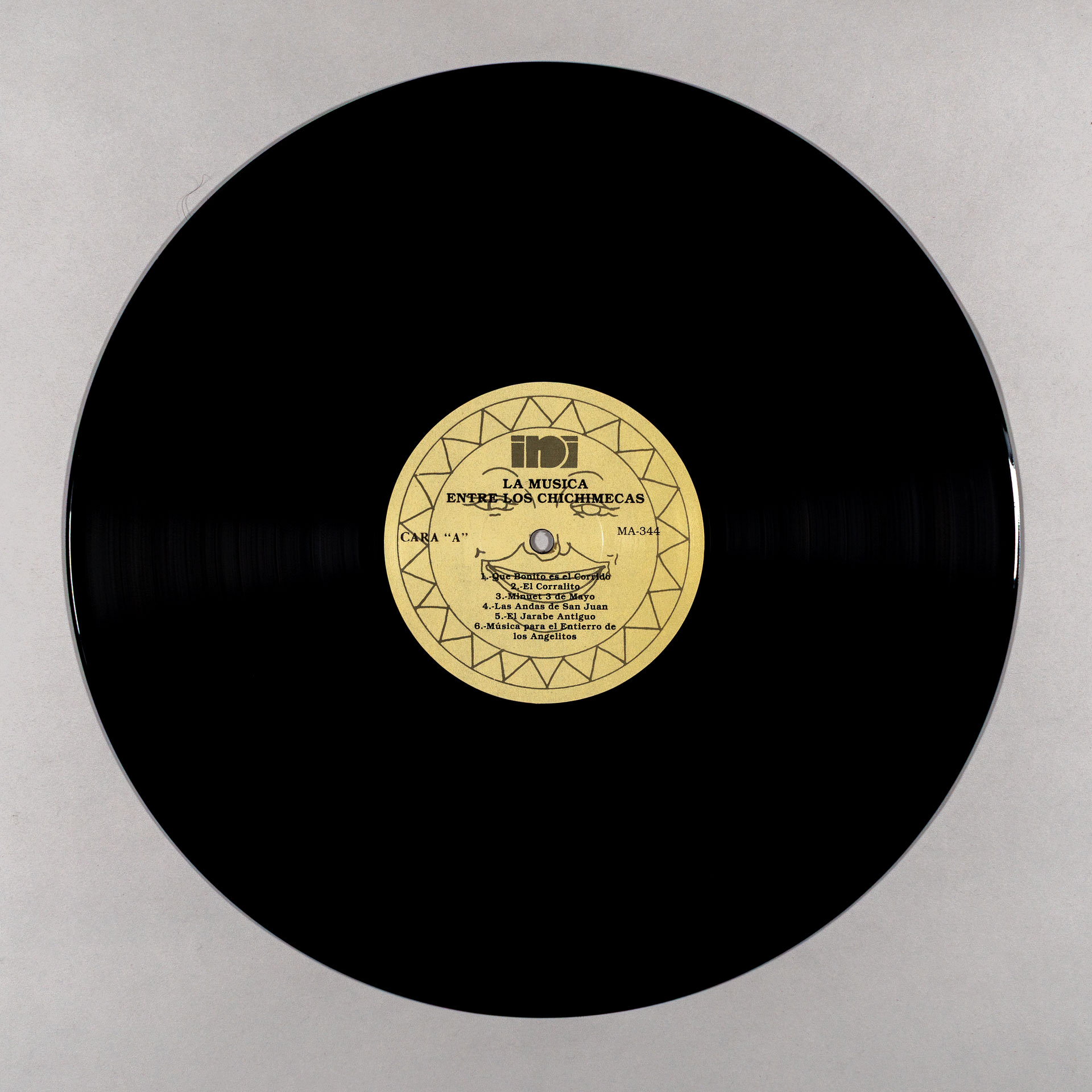
Tracklist
Side A
- Qué bonito es el corrido — 5:04
- El corralito — 3:56
- Minuet 3 de mayo — 1:33
- Las andas de San Juan — 2:34
- El jarabe antiguo — 2:25
- Música para el entierro de los angelitos — 4:03
Side B
- La rosita — 2:22
- Paseando en camioneta — 2:43
- El decimal del poeta — 15:53
Credits
Field research and recording: Agustín Pimentel Díaz and Alejandro Méndez Rojas.
Photography: Oscar Paolini.
Text: Orlando Guillén.
Series: Cenzontle, National Indigenous Institute (INI).
Participating institutions: Secretaría de Educación Pública (SEP), Consejo Nacional para la Cultura y las Artes, and Dirección General de Culturas Populares.
Gallery:

Tracklist:
Music Among the Chichimecas — Tracklist
Side A
-
Qué bonito es el corrido — 5:04
-
El corralito — 3:56
-
Minuet 3 de mayo — 1:33
-
Las andas de San Juan — 2:34
-
El jarabe antiguo — 2:25
-
Música para el entierro de los angelitos — 4:03
Side B
-
La rosita — 2:22
-
Paseando en camioneta — 2:43
-
El decimal del poeta — 15:53
Credits:
Credits
Field Research and Recordings: Agustín Pimentel Díaz and Alejandro Méndez Rojas.
Photography: Oscar Paolini.
Text: Orlando Guillén.
Series: Cenzontle.
Production: Instituto Nacional Indigenista (INI).
Collaborating Institutions:
-
Secretaría de Educación Pública (SEP).
-
Consejo Nacional para la Cultura y las Artes (CONACULTA).
-
Dirección General de Culturas Populares.
Notes:
La marca CENZONTLE es el resultado de la colaboración de las siguientes instituciones:
SEP, Consejo Nacional para la Cultura y las Artes, INAH, INI, DIRECCIÓN GENERAL DE CULTURAS POPULARES
Por la revalorización y difusión de las auténticas tradiciones musicales del país.
 Chichimecas – La Música Entre Los Chichimecas