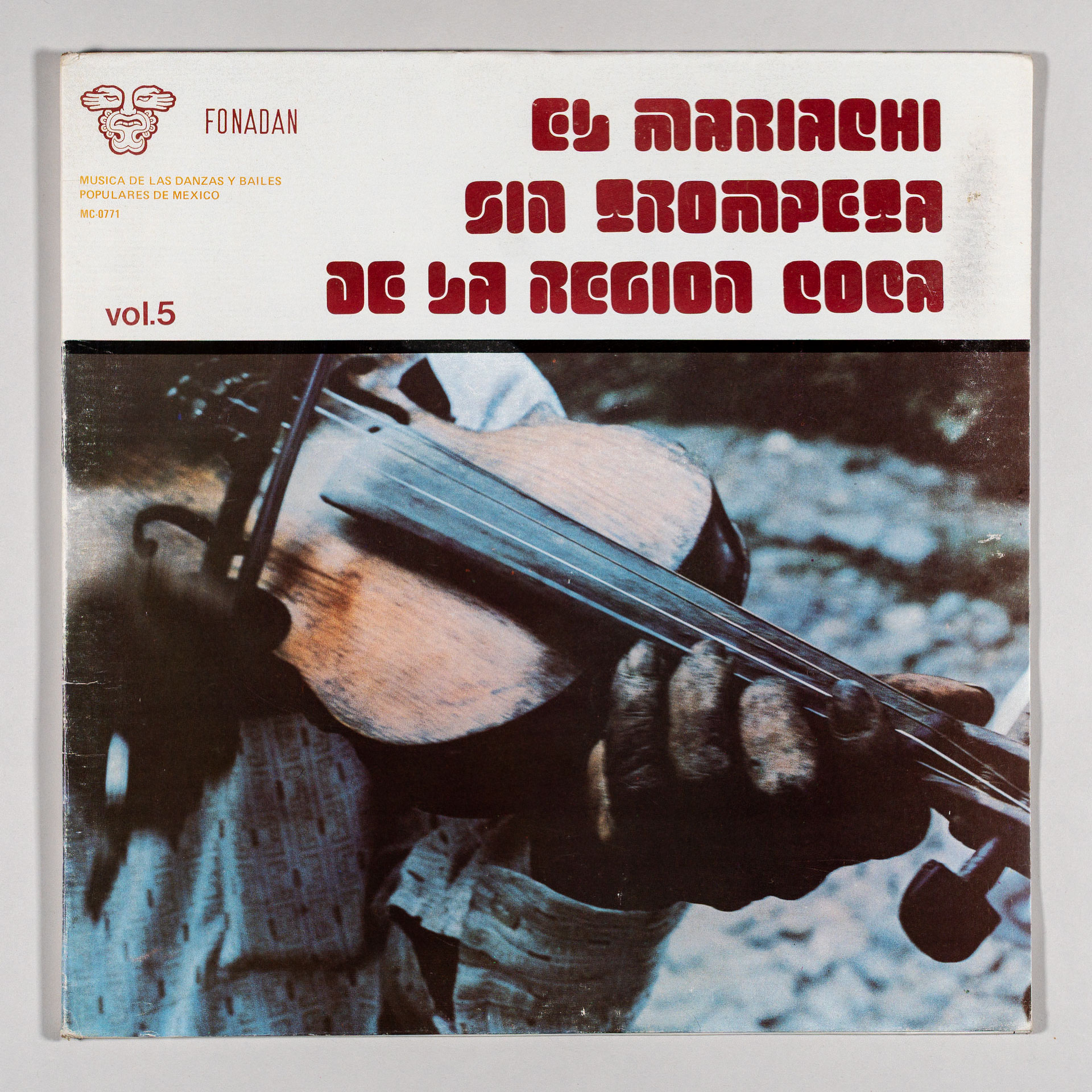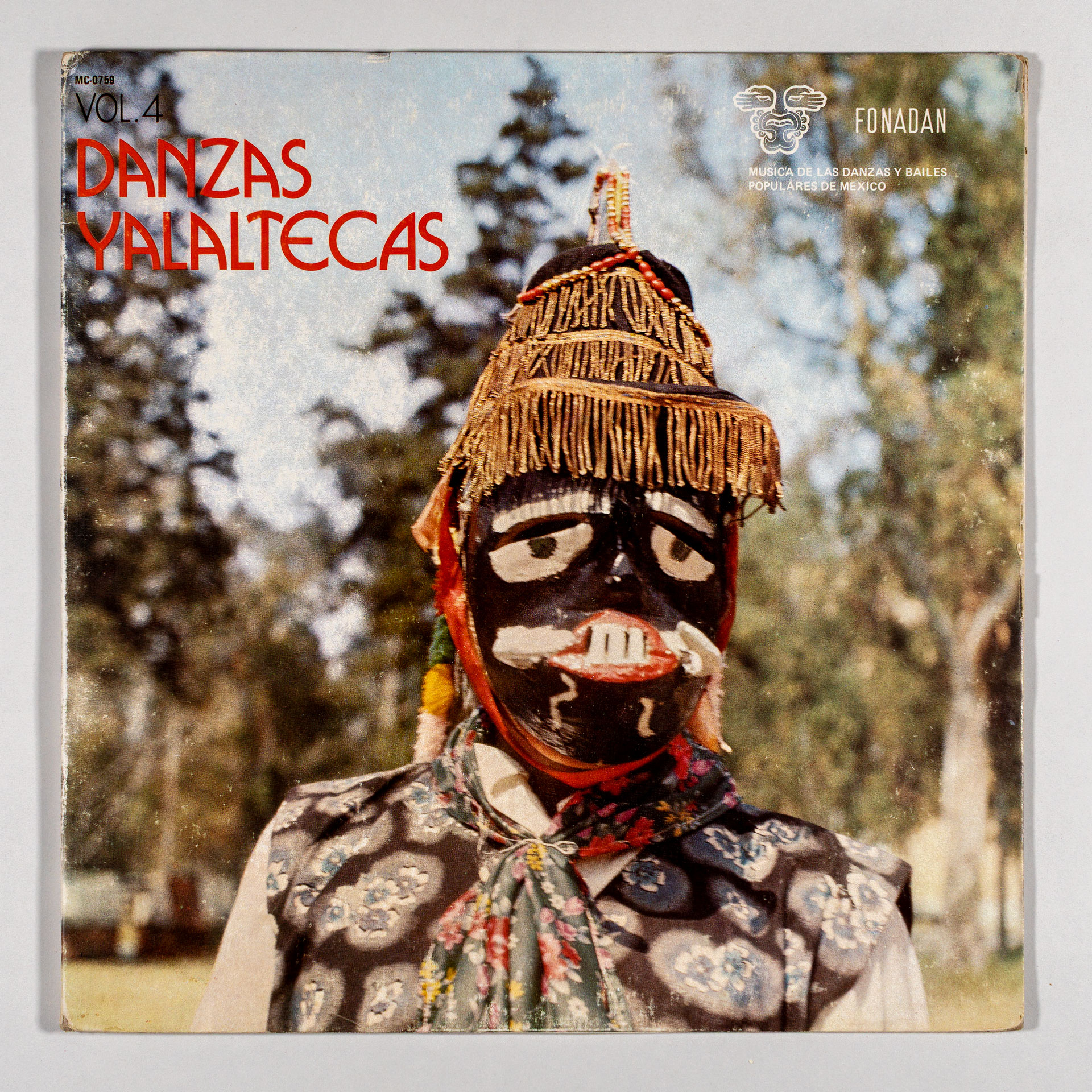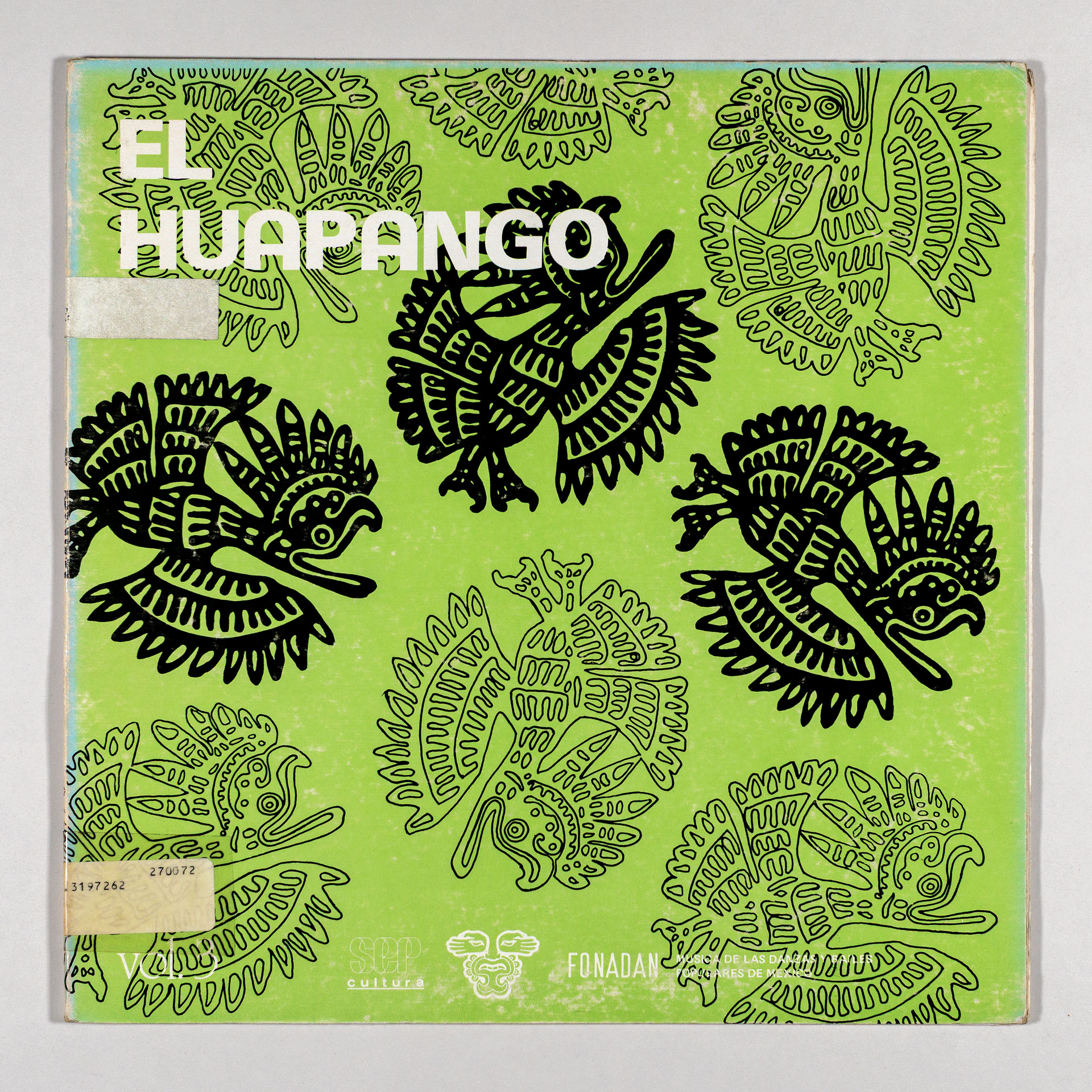








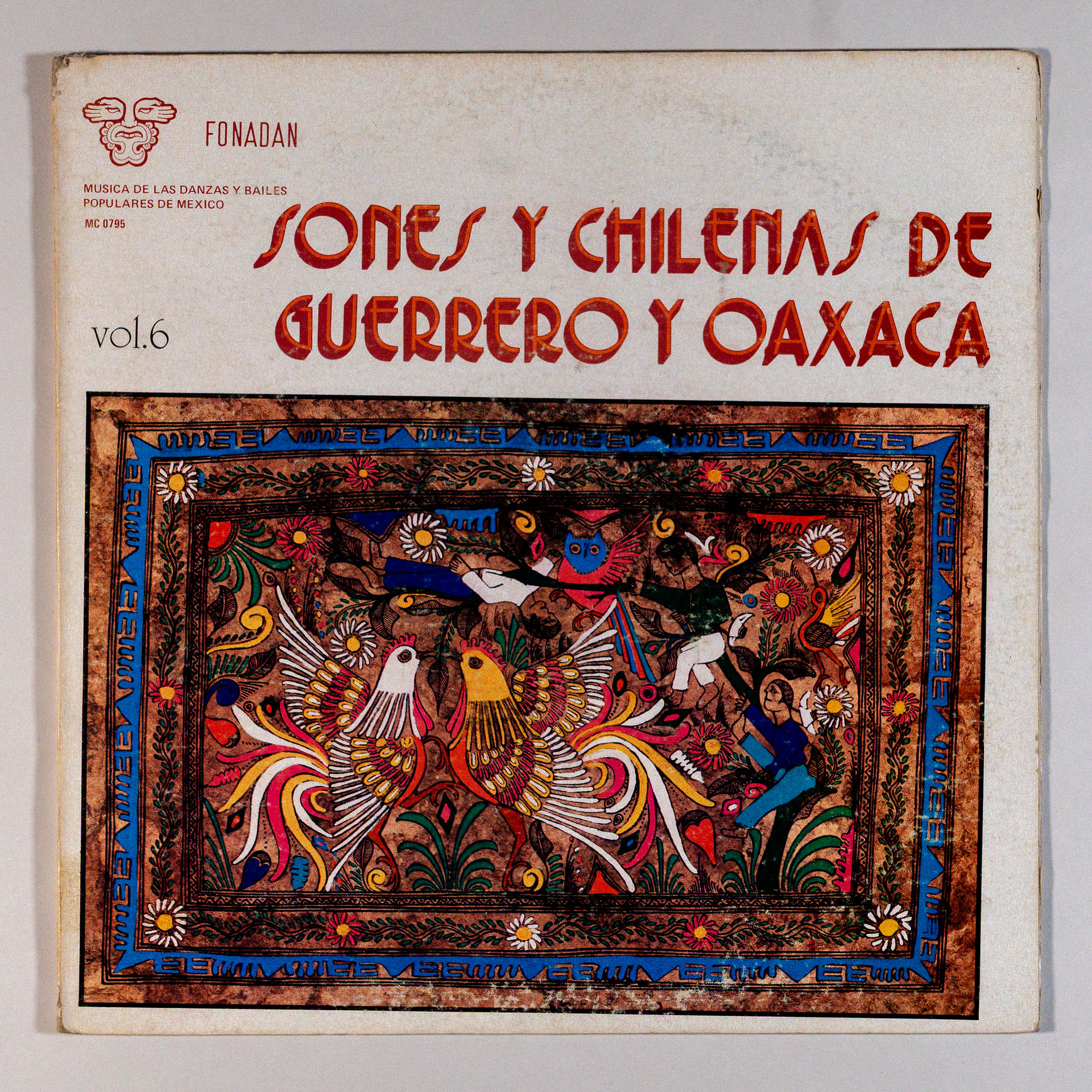
SONES AND CHILENAS OF GUERRERO AND OAXACA
FONADAN
|
Label: FONADAN MC-0795 Format: Vinyl LP Album 12" 33 1/3 rpm Gatefold Compilation |
Country: Mexico Genre: Folk World & Country |
Info:
FONADAN
National Fund for the Development of Mexican Popular Dance.
MUSIC OF THE DANCES AND POPULAR DANCES OF MEXICO
MC-0771
SONES AND CHILENAS OF GUERRERO AND OAXACA
VOL. 6
Third edition
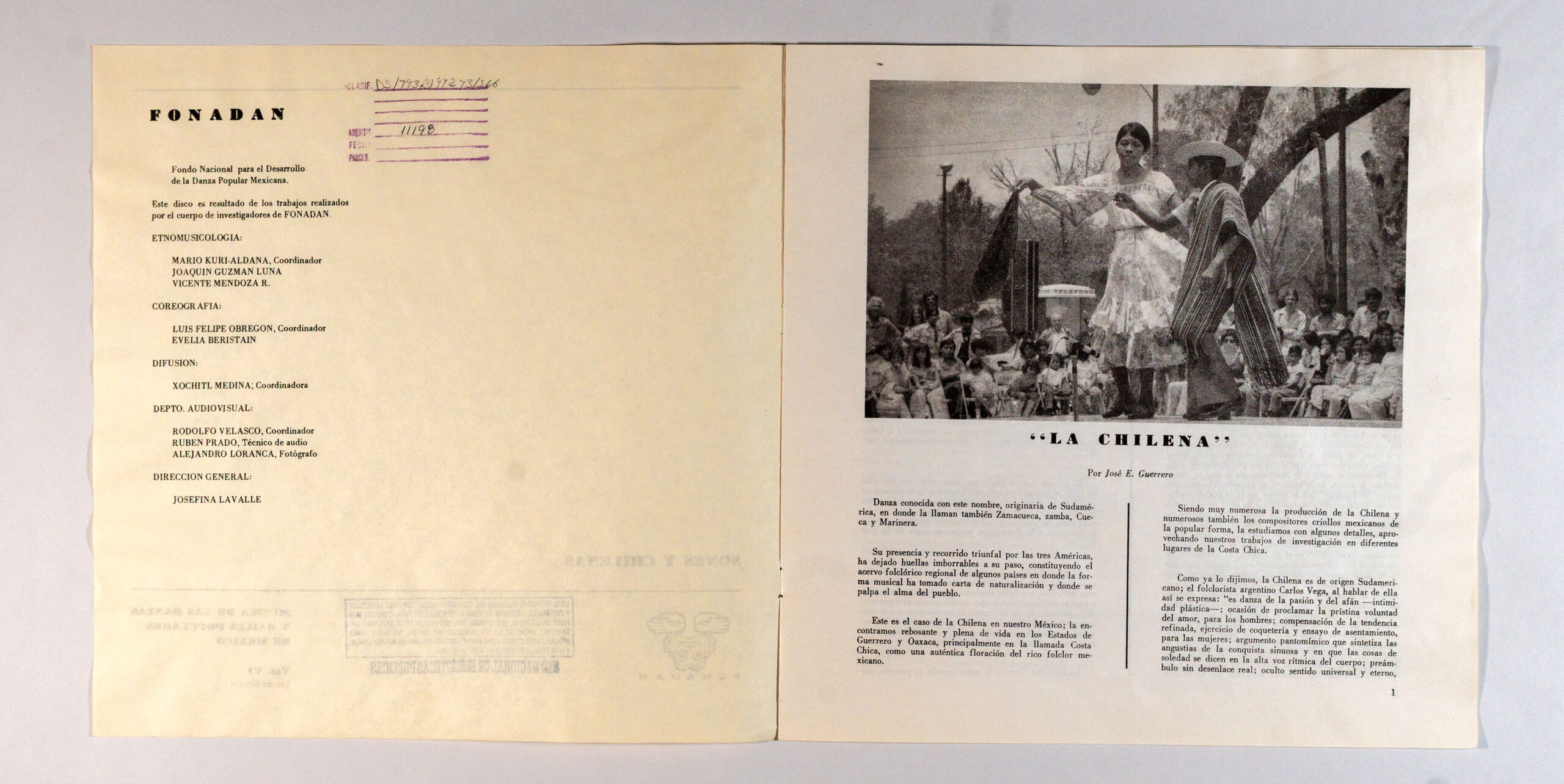
This record is the result of the work carried out by the FONADAN research body.
ETHNOMUSICOLOGY:
MARIO KURI-ALDANA, Coordinator
JOAQUÍN GUZMÁN LUNA
VICENTE MENDOZA R.
CHOREOGRAPHY:
LUIS FELIPE OBREGÓN, Coordinator
EVELIA BERISTAIN
DIFFUSION:
XOCHITL MEDINA, Coordinator
AUDIOVISUAL DEPARTMENT:
RODOLFO VELASCO, Coordinator
ALEJANDRO LORANCA, Photographer
RUBEN PRADO, Audio technician
GENERAL DIRECTORATE:
JOSEFINA LAVALLE
“THE CHILENA”
By José E. Guerrero
Dance known by this name, originally from South America, where it is also called Zamacueca, zamba, Cueca and Marinera.
His presence and triumphant journey through the three Americas has left indelible marks in his wake, constituting the regional folkloric heritage of some countries where the musical form has taken naturalization and where the soul of the people is palpable.
This is the case of the Chilean in our Mexico; we find it overflowing and full of life in the States of Guerrero and Oaxaca, mainly in the so-called Costa Chica, as an authentic flowering of the rich Mexican folklore.
Being very numerous the production of the Chilean and also numerous Mexican Creole composers of the popular form, we study it in some detail, taking advantage of our research work in different places on the Costa Chica.
As we already said, the Chilean is of South American origin; Argentine folklorist Carlos Vega, when speaking of her, expresses himself this way: “it is a dance of passion and eagerness —plastic intimacy—; an opportunity to proclaim the pristine will of love, for men; compensation of the refined tendency, exercise of coquetry and settlement essay, for women; pantomimic argument that synthesizes the anxieties of the sinuous conquest and in which things of solitude are said in the high rhythmic voice of the body; preamble without real outcome; hidden universal and eternal meaning, franking itself in environment of tolerance or approval.La Zamacueca was lauded and denied, mocked and acclaimed, rejected and chosen, adored and cursed.
THEIR NAMES:
As in the second quarter of the last century, the dance was known by the name of Zamacueca in a large part of the Argentine Republic; “It was not danced in good society, but in meetings of great confidence”, little by little this word was used less until it was almost completely lost, when Peru gave it the name of Chilena, calling it Zamacueca Chilena for that reason. The influence of Chilean music was already evident in the popular dance, thus justifying the name Chilean. It was in Chile where Zamacueca “lost her head”, because by apheresis the Chileans suppressed the first two syllables, leaving only the final two, Cueca, and that is how it was later called. When the Cueca emigrated from Chile already revamped, the geographical qualifier Chilean was added in the surrounding countries, such as Chilena or Zamacueca from Tucumán, Cueca or Chilena from San Juan, etc.
The zamba, which has nothing to do with the zamba of the 16th century, is of Peruvian origin and is considered the predecessor of the Zamacueca; it was used less than the Cueca, but was finally absorbed by the latter. It spread to Argentina and Chile, where the Zamacueca took on its choreographic aspect, also disappearing its old name of Zamba. Regarding the name of Marinera, with which the dance is also known, it is attributed to the Peruvian Abelardo Gamarra “El Tunante”, who imposed it in 1879 when the following circumstances mediated: on April 5 of that year, Chile declared the war to Peru; The Peruvians then realized that their national dance, the Cueca, was called Chilena, but it was also known by these others: tondero, mozamala, slippery, dance of Sajuriana land, but the most general name until 1879 was Chilean. The feeling of patriotism was then taken advantage of by Gamarra so that on his own motion he proposed the word Marinera, since he believed it inappropriate to keep such a title of Chilean in the mouth of the people and in its moments of expansion. He also took advantage of the fact that at that time, the Peruvian Navy carried out acts that drew the attention of the world and because the rocking of a ship speaks volumes about the swagger and smoothness of those who can and know how to dance that dance. “We put a sailor on it,” says the “Rogue,” “and a sailor it stayed: of course, by then and for the seed to bear fruit, we launched many picaresque lyrics to which those unknown masters who live no one knows where they put to music, but who surprise us with their delicious music”.
COUNTRIES WHERE THE CHILENA WAS GROWN
The Chilean was known in several countries of the South, with different names, but in reality it has been the same: Peru, place of origin, Bolivia, Argentina, Ecuador, Paraguay, Uruguay; In other latitudes there is Mexico and although in a temporary way, in the territory of the current State of Sonora, when the gold rush predominated, back in 1850. There were Argentines, Peruvians, Mexicans, North Americans, Chileans, etc., those who From time to time they organized gatherings and moments of recreation, to the chords of the Chileans.
Writers of different nationalities as well as notable researchers and travelers have made important narrations about how the Chilean dance was and is danced, something that there is not much difference between in the past and today. The Argentine Joaquín V. González says: “The Indian Panta, drummer at religious festivals, the indispensable musician of gatos and zamacuecas in Creole dances, spent the nights from clear to clear, tapping the foot and shouting “Aro!” let the swift-footed girl and the squeaky-spurred boy turn gracefully, fluttering their handkerchiefs over their heads.” Some onlooker who contemplates the dance, usually exclaims enthusiastically: “what legs for a Cueca!”.
The French Alfred Ebelot lets us know that back in 1870 it was customary in Argentina that the Zamacueca was used in wakes for “little angels”. As he passed in front of the little dead man, he says, some of the dancers, swaying on their hips due to the lascivious movement required by the Habanera and the Zamacueca, made a furtive sign of the cross.
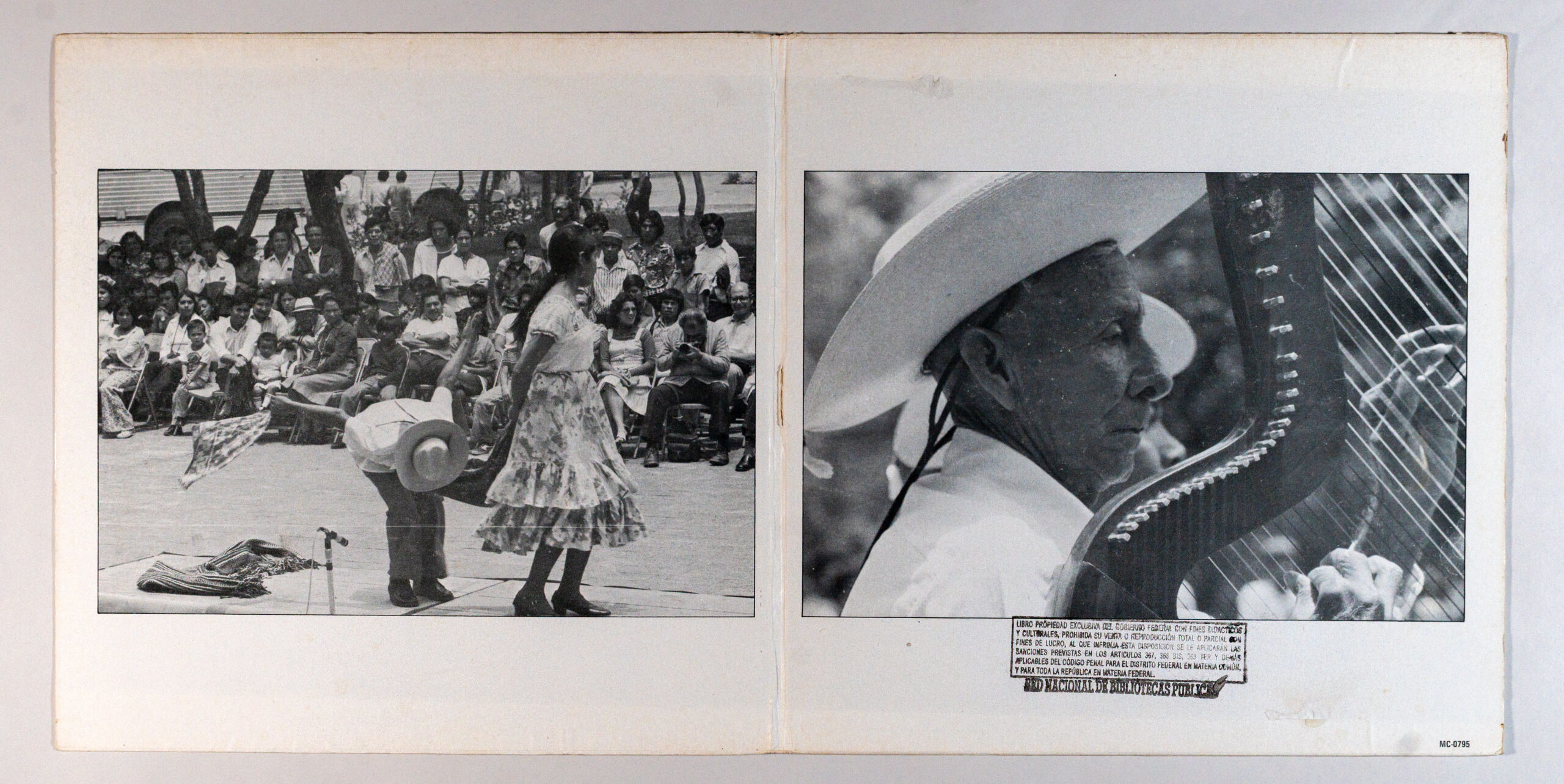
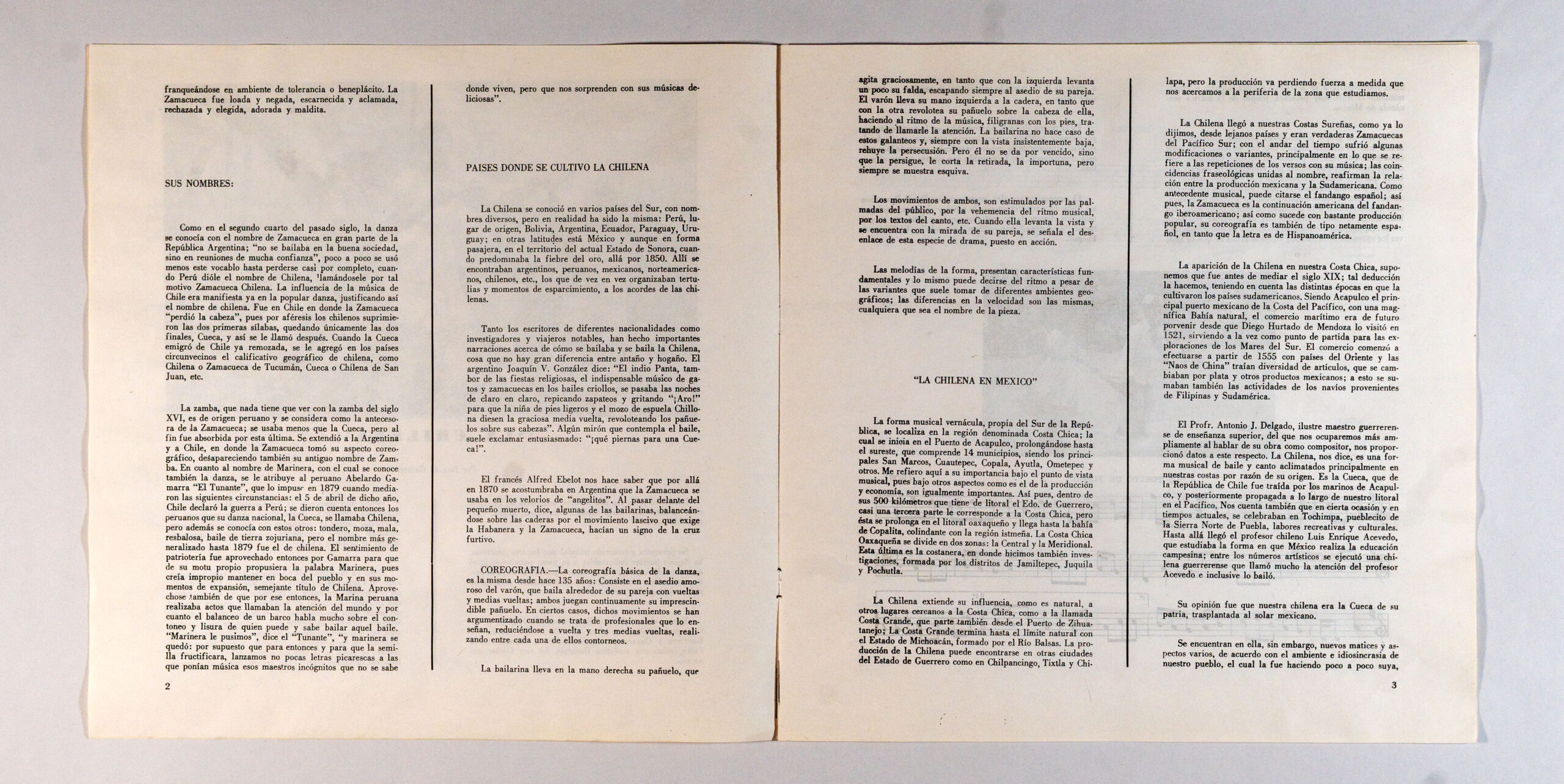
CHOREOGRAPHY.—The basic choreography of the dance has been the same for 135 years: It consists of the loving siege of the man, who dances around his partner with turns and half turns; both continually play their essential handkerchief. In certain cases, these movements have been argued when it comes to professionals who teach them, being reduced to a turn and three half turns, performing contouring between each of them.
The dancer holds her handkerchief in her right hand, which she waves gracefully, while with her left she lifts her skirt a little, always escaping the siege of her partner. The man puts his left hand on her hip, while with the other he flutters her scarf over her head, doing filigree movements with his feet to the rhythm of the music, trying to get her attention. The ballerina pays no attention to these courtships and, always keeping her eyes insistently downcast, she flees from the chase. But he doesn’t give up on her, he chases her, cuts off her retreat, pesters her, but she’s always elusive.
The movements of both are stimulated by the claps of the public, by the vehemence of the musical rhythm, by the texts of the song, etc. When she looks up and meets the gaze of her partner, the outcome of this kind of drama is signaled, put into action.
The melodies of the form present fundamental characteristics and the same can be said of the rhythm despite the variants that it usually takes from different geographical environments; the differences in speed are the same, whatever the name of the piece.
“THE CHILEAN IN MEXICO”
The vernacular musical form, typical of the South of the Republic, is located in the region called Costa Chica; which begins in the Port of Acapulco, extending to the southeast, which includes 14 municipalities, the main ones being San Marcos, Cuautepec, Copala, Ayutla, Ometepec and others. I am referring here to its importance from the musical point of view, because under other aspects such as production and economy, they are equally important. Thus, within its 500 kilometers of coastline that Edo. of Guerrero, almost a third corresponds to the Costa Chica, but this extends along the Oaxacan coast and reaches the bay of Copalita, adjacent to the isthmus region. The Oaxacan Small Coast is divided into two zones: the Central and the Southern. The latter is the waterfront, where we also did research, formed by the districts of Jamiltepec, Juquila and Pochutla.
La Chilena extends its influence, as is natural, to other places close to the Costa Chica, such as the so-called Costa Grande, which also starts from the Port of Zihuatanejo; The Costa Grande ends at the natural limit with the State of Michoacán, formed by the Balsas River. The Chilean production can be found in other cities of the State of Guerrero such as Chilpancingo, Tixtla and Chilapa, but the production is losing strength as we approach the periphery of the area we studied.
The Chilean came to our Southern Coasts, as we have already said, from distant countries and they were true Zamacuecas from the South Pacific; With the passage of time, it underwent some modifications or variants, mainly in what refers to the repetitions of the verses with its music; Phraseological coincidences attached to the name reaffirm the relationship between Mexican and South American production. As a musical background, the Spanish fandango can be cited; thus, the Zamacueca is the American continuation of the Ibero-American fandango; as it happens with quite a lot of popular production, its choreography is also of a purely Spanish type, while the lyrics are from Latin America.
The appearance of the Chilean in our Costa Chica, we assume that it was before the mid-nineteenth century; We make such a deduction, taking into account the different times in which the South American countries cultivated it. Being Acapulco the main Mexican port on the Pacific Coast, with a magnificent natural bay, maritime trade was of the future since Diego Hurtado de Mendoza visited it in 1521, serving at the same time as a starting point for explorations of the Seas. from the south. The trade began to take place from 1555 with countries of the East the “Naos de China” brought a diversity of articles, which were exchanged for silver and other Mexican products; Added to this were the activities of ships from the Philippines and South America.
The Prof. Antonio J. Delgado, an illustrious teacher of higher education from Guerrero, who we will deal with more fully when talking about his work as a composer, provided us with data in this regard. La Chilena, he tells us, is a musical form of dance and song acclimatized mainly on our coasts due to its origin. It is the Cueca, which was brought from the Republic of Chile by the sailors from Acapulco, and later spread along our Pacific coast. He also tells us that on a certain occasion and in current times, recreational and cultural activities were held in Tochimpa, a small town in the Sierra Norte de Puebla. The Chilean professor Luis Enrique Acevedo arrived there, who studied the way in which Mexico carries out rural education; Among the artistic numbers there was a Chilean from Guerrero that caught the attention of Professor Acevedo and he even danced it.
His opinion was that our Chilean was the Cueca of his homeland, transplanted to the Mexican solar.
However, new nuances and various aspects are found in it, in accordance with the environment and idiosyncrasies of our people, who gradually made it their own, until they incorporated it into their collection of popular music and imprinted on it a very personal stamp, typical of the vernacular music of Mexico.
Already with that own personality, we can find quite a few Chileans in some places more than in others; we point out as the main place of popular production, Ometepec. The most numerous collections of sones and chilenas are from this place, made by Antonio J. Delgado and Moisés Guevara V., teachers from Guerrero; but there are also good performers and empirical composers who do not write their music, but receive it and spread it in the traditional way. A good friend, Don David Bracamontes, from Ometepec, told us in this regard, that the sones were taught to him by his father, who in turn learned them from his grandfather; now he boasts that his son, whom he has also introduced to music, already knows them all.
In the region called Mixteca Alta, in the coastal part of Guerrero, populated by Mixtecs and Amuzgos, it is where vernacular music persists firmly, this circumstance being further accentuated by the aversion they feel against the mestizo.
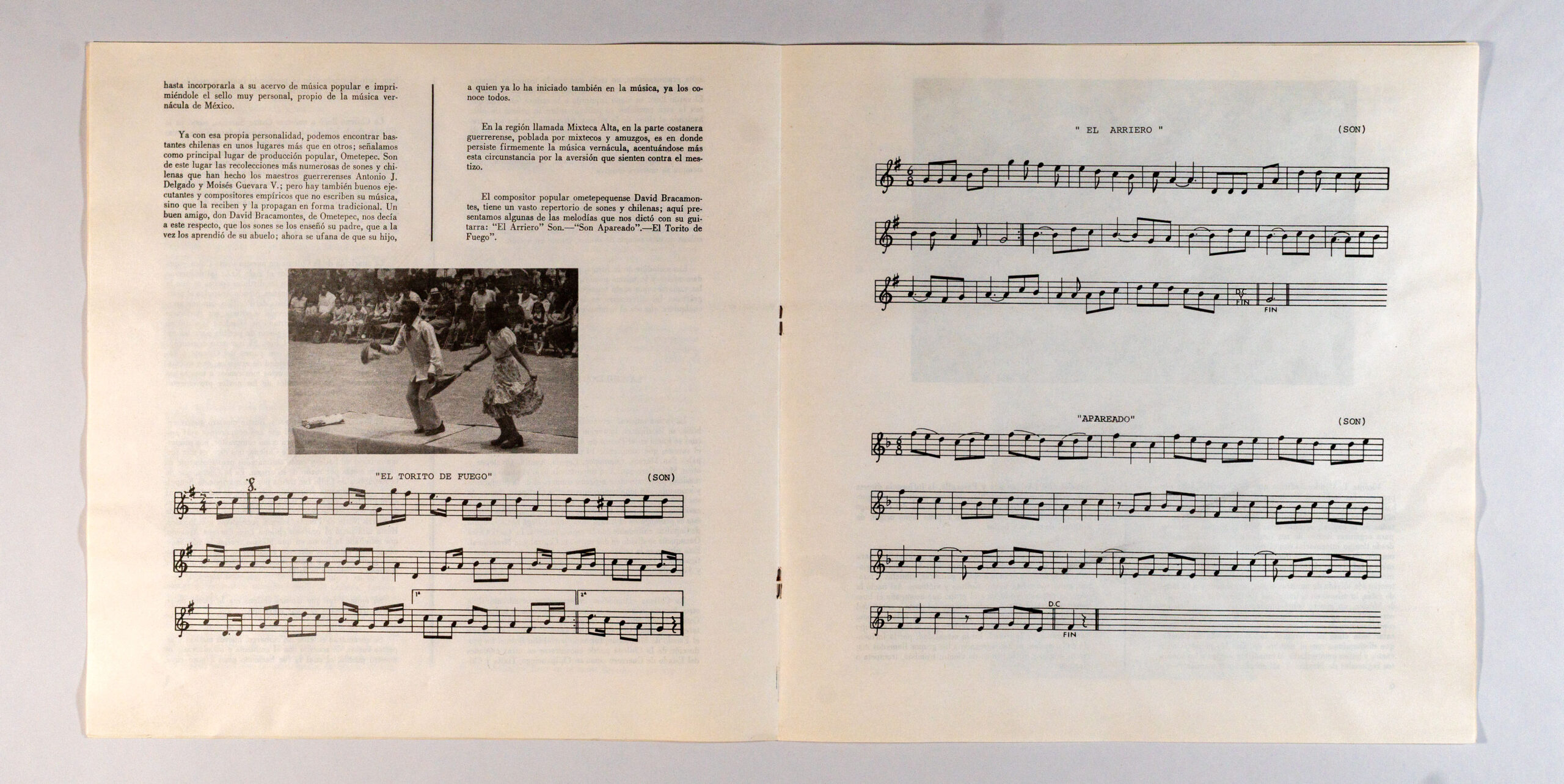
The popular composer from Ometepequense, David Bracamontes, has a vast repertoire of sones and chilenas; Here we present some of the melodies that he dictated to us with his guitar: “El Arriero” Son .— “Son Paired” .— El Torito de Fuego “.
THE SOUND
Vicente T. Mendoza affirms that it is not possible to accurately determine the dates of entry into the country of some Spanish songs and dances, such as the ¡Ay, ay, ay!, or the Pasacalle, except when the rural people of Mexico, in regions remote from the capital, assimilated these and other musical forms to organize within their festivities what has been known since time immemorial by the name of fandango, that is, a gathering of people in which there is singing, dancing, revelry, food and drink. ; The truth is that the heat, the animation, the vivacity and energy of the dances and songs coincide with the torrid season of our coasts, it is found along these, the same on the Pacific coast, as in the Gulf of Mexico. , an overabundant genre, of a lyrical and choreographic nature, supported by a strong instrumental rhythm, rich in combinations of measures, as well as fantasy to intersperse all kinds of literature, also coming from Spain, which we distinguish with the name of Son. In it, peninsular songs and dances, the stage tune and the regional Mexican sonecitos take part. And so we find in addition to the aforementioned ¡Ay, ay ay! and Pasacalle, the direct and predominant influence of seguidillas, boleras, guajiras, malagueñas and peteneras, the latter as a legacy of the Spanish fandango, considered in Spain itself as the origin of a multitude of songs and dances.
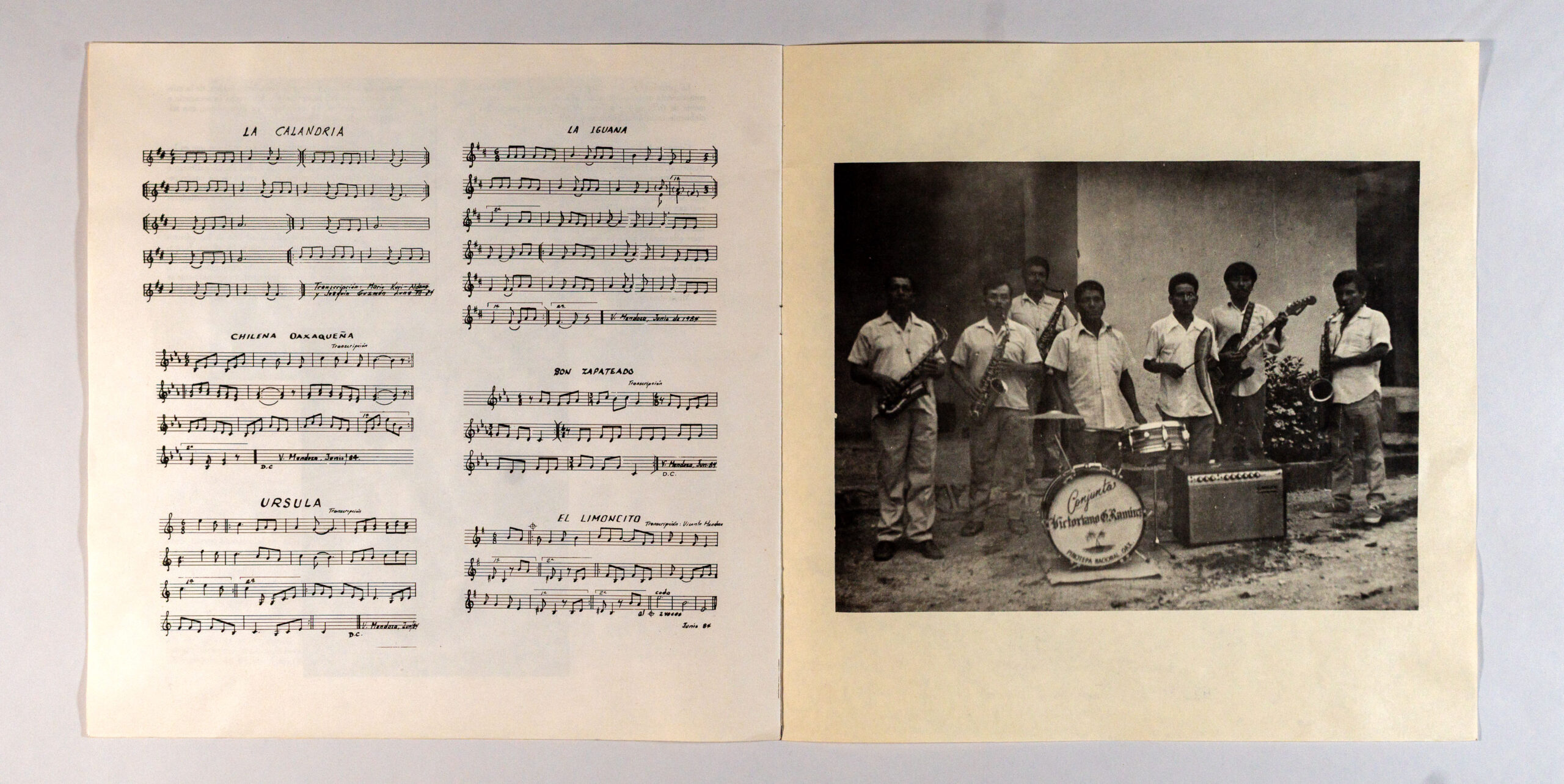
From this rich combination of elements the Son was born, for which it was necessary to adapt various types of regional orchestra based on the large or small harp, guitars, vihuelas and jaranas, guitarrón and bajo sexto, violins and violons. This is how the small Yucatecan orchestra or the group that accompanies the huapango was born, in addition to other combinations from the north and center of the country. The harp occupies a prominent place in States such as Jalisco, Colima, Michoacán or Guerrero and the group is called the “big harp of the coast”. At present, due to the influence of the city, some wind instruments have been added to the groups called mariachi: trombone, trumpet or clarinet.
The main characteristic of the son is its rhythmic vigor, a consequence of the happy combination of measures, mainly 6/8, 3/4 and sometimes 5/8. It is an essentially enthusiastic, lively and brilliant genre.
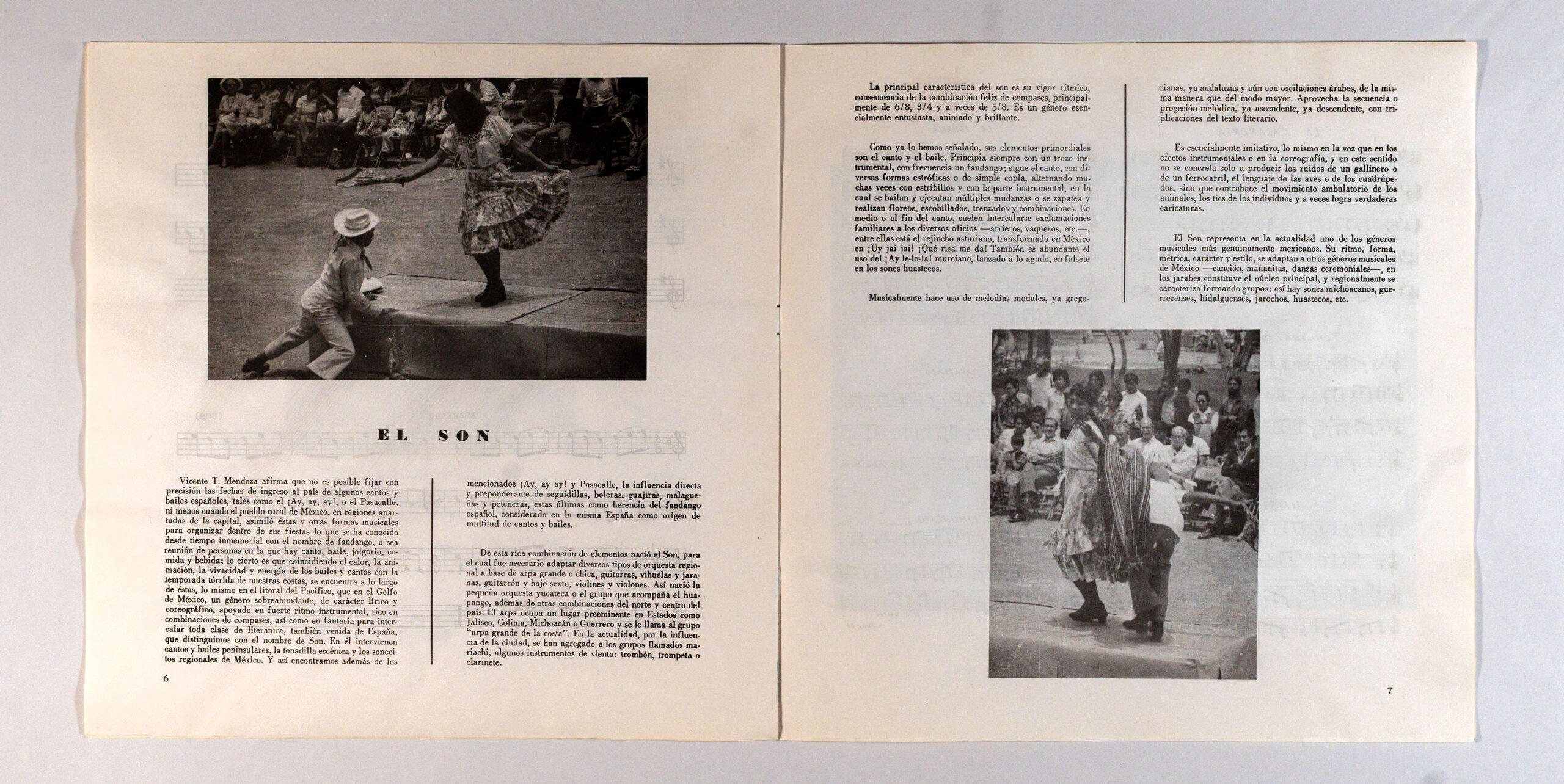
As we have already pointed out, its primary elements are singing and dancing. It always begins with an instrumental piece, frequently a fandango; The song continues, with various stanza forms or simple couplets, often alternating with refrains and with the instrumental part, in which multiple moves are danced and performed, or footwork is performed and flourishes, brush strokes, braids, and combinations. In the middle or at the end of the song, exclamations familiar to the various trades — muleteers, cowboys, etc. — are usually interspersed, among them is the Asturian grincho, transformed in Mexico into ¡Uy jai jai! What a laugh it makes me! There is also abundant use of Ay le-lo-la! Murcian, thrown to the acute, in falsetto in the sounds huastecos.
Musically, it makes use of modal melodies, now Gregorian, now Andalusian and even with Arabic oscillations, in the same way as in the major mode. Take advantage of the melodic sequence or progression, either ascending or descending, with triplings of the literary text.
It is essentially imitative, the same in the voice as in the instrumental effects or in the choreography, and in this sense it does not just produce the noise of a chicken coop or a railway, the language of birds or quadrupeds, but that counteracts the ambulatory movement of animals, the tics of individuals and sometimes achieves true caricatures.
The Sound currently represents one of the most genuinely Mexican musical genres. Its rhythm, shape, metrics, character and style, adapt to other musical genres in Mexico —canción, mañanitas, ceremonial dances—, in the syrups it constitutes the main nucleus, and regionally it is characterized by forming groups; Thus there are sounds from Michoacán, Guerrero, Hidalguense, Jarochos, Huastecos, etc.
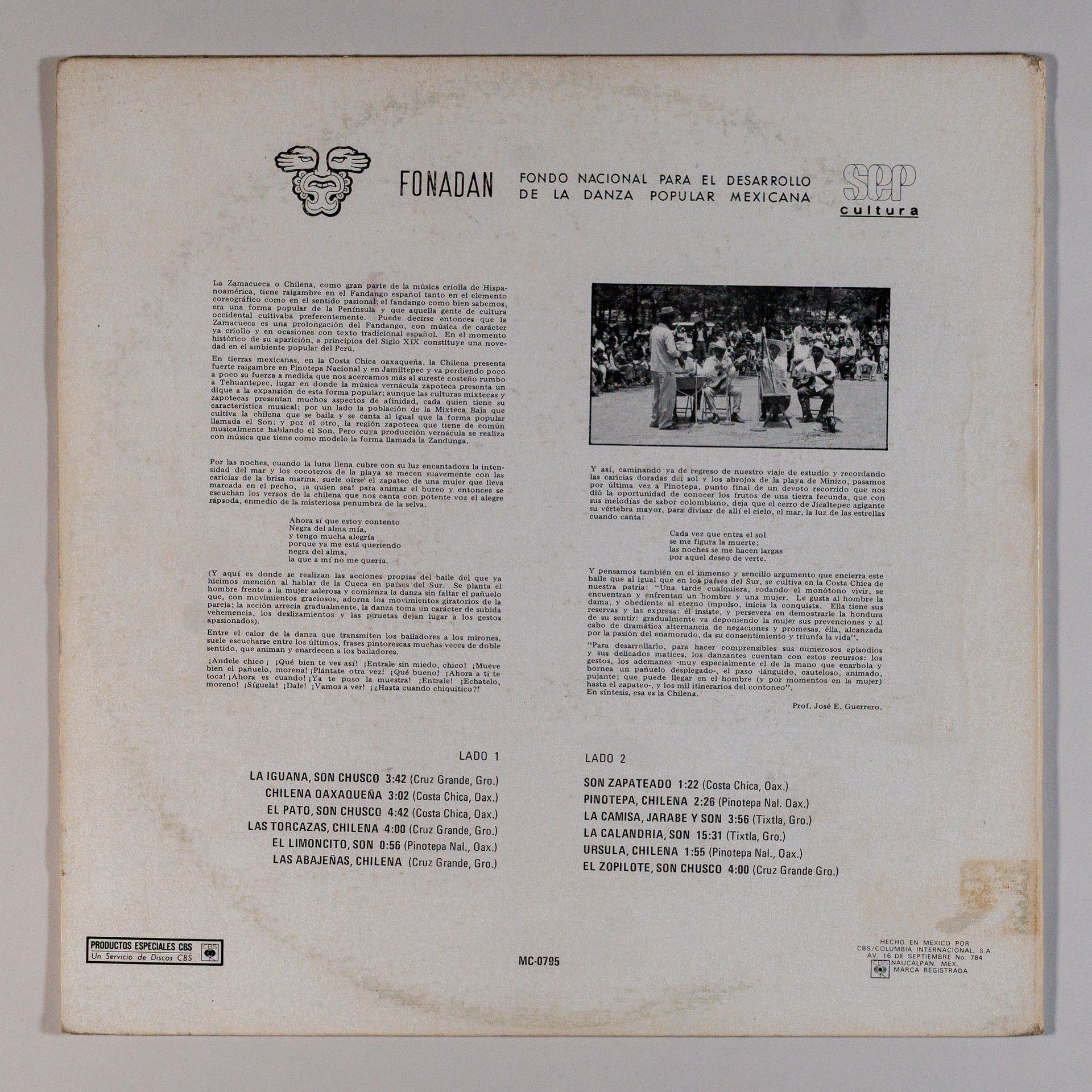
FONADAN, National Fund for the Development of Mexican Popular Dance, SEP culture
The Zamacueca or Chilena, like much of the Creole music of Latin America, has roots in the Spanish Fandango both in the choreographic element and in the passionate sense; The fandango, as we well know, was a popular form of the Peninsula and that those people of Western culture cultivated preferably. It can be said then that the Zamacueca is an extension of the Fandango, with music of a Creole character and sometimes with a traditional Spanish text. At the historical moment of its appearance, at the beginning of the 19th century, it constitutes a novelty in the popular environment of Peru.
In Mexican lands, on the Oaxacan Costa Chica, the Chilean has strong roots in Pinotepa Nacional and Jamiltepec and gradually loses its strength as we get closer to the southeast coast towards Tehuantepec, a place where Zapotec vernacular music presents a dam to the expansion of this popular form: although the Mixtec and Zapotec cultures present many aspects of affinity, each one has its musical characteristic; on the one hand the population of the Mixteca, Baja that cultivates the Chilean that is danced and sung as well as the popular form called the Son; and on the other, the Zapotec region that has in common musically speaking the Son, but whose vernacular production is carried out with music that has as its model the form called the Zandunga.
At night, when the full moon covers the intensity of the sea with its enchanting light and the coconut palms on the beach sway gently in the caress of the sea breeze, the stamping of a woman who has a mark on her chest is often heard, whoever! to animate the bureo and then the verses of the Chilean woman are heard, which the cheerful rhapsody sings to us with a powerful voice, in the midst of the mysterious gloom of the jungle.
Now I am happy
black of my soul,
and I am very happy
because she is already loving me
soul black,
the one who didn’t want me.
(And this is where the actions of the dance that we already mentioned when talking about the Cueca in southern countries take place. The man stands in front of the salerosa woman and begins the dance without missing the handkerchief that, with graceful movements, adorns the whirling movements of the couple; the action gradually intensifies, the dance takes on a character of vehemence, the glides and pirouettes give way to passionate gestures).
Between the heat of the dance that the dancers transmit to the onlookers, picturesque phrases often with double meanings are often heard among the latter, which encourage and inflame the dancers.
Come on boy; How good you look like that! Go in without fear, boy! Move touch! Now the handkerchief is good, brunette! Stand up again! Excellent! Now I’m going to you! He already gave you the sample! Enter it! Throw it out, brunette! Follow her! Go ahead! We’ll see! Until when little one?!
And so, walking back from our study trip and remembering the golden caresses of the sun and the burrs of the Minizo beach, we passed for the last time to Pinotepa, the end point of a devout journey that gave us the opportunity to see the fruits of a fertile land, which with its Colombian-flavored melodies, lets the hill of Jicaltepec grow its largest vertebra, to see from there the sky, the sea, the light of the stars when it sings:
Every time the sun comes in
death appears to me;
the nights are long
for that desire to see you.
And we also think of the immense and simple argument that this dance contains, which, as in the countries of the South, is cultivated on the Costa Chica of our homeland: “An ordinary afternoon, filming the monotonous life, they meet and face a man and a woman. The man likes the lady, and obedient to the eternal impulse, he begins the conquest. She has her reservations and expresses them: he insists, and perseveres in showing her the depth of his feeling: gradually the woman gives up her precautions and the after a dramatic alternation of denials and promises, she, seized by the passion of the lover, gives her consent and life triumphs”.
“To develop it, to make its numerous episodes and its delicate nuances understandable, the dancers have these resources: the gestures, the gestures -especially that of the hand that raises and twists an unfolded handkerchief-, the step -languid, cautious, lively, thriving; that can reach in the man (and at times in the woman) up to the stomping-, and the thousand itineraries of the wiggle”.
In short, that is the Chilean.
Professor José E. Guerrero.
SIDE 1
THE IGUANA, CHUSCO SOUND 3:42 (Cruz Grande, Gro.)
CHILEAN OAXACAN 3:02 (Costa Chica, Oax.)
THE DUCK, CHUSCO SOUND 4:42 (Costa Chica, Oax.)
THE DOVE, CHILEAN 4:00 (Cruz Grande, Gro.)
THE LITTLE LEMON, SOUND 0:56 (Pinotepa Nal., Oax.)
THE ABAJENAS, CHILEAN (Cruz Grande, Gro.)
SIDE 2
TAP DANCE SOUND 1:22 (Costa Chica, Oax.)
PINOTEPA, CHILEAN 2:26 (Pinotepa Nal. Oax.)
SHIRT, SYRUP AND SOUND 3:56 (Tixtla, Gro.)
THE CALANDRIA, SOUND 15:31 (Tixtla, Gro.)
URSULA, CHILEAN 1:55 (Pinotepa Nal., Oax.)
THE BUZZARD, CHUSCO SOUND 4:00 (Cruz Grande Gro.)
CBS SPECIAL PRODUCTS
A CBS Record Service
MC-0795
MADE IN MEXICO BYCBS/COLUMBIA INTERNACIONAL, S. A.
AV. 16 DE SEPTIEMBRE No. 784
NAUCALPAN, MEX.
CBS TRADEMARK
Gallery:
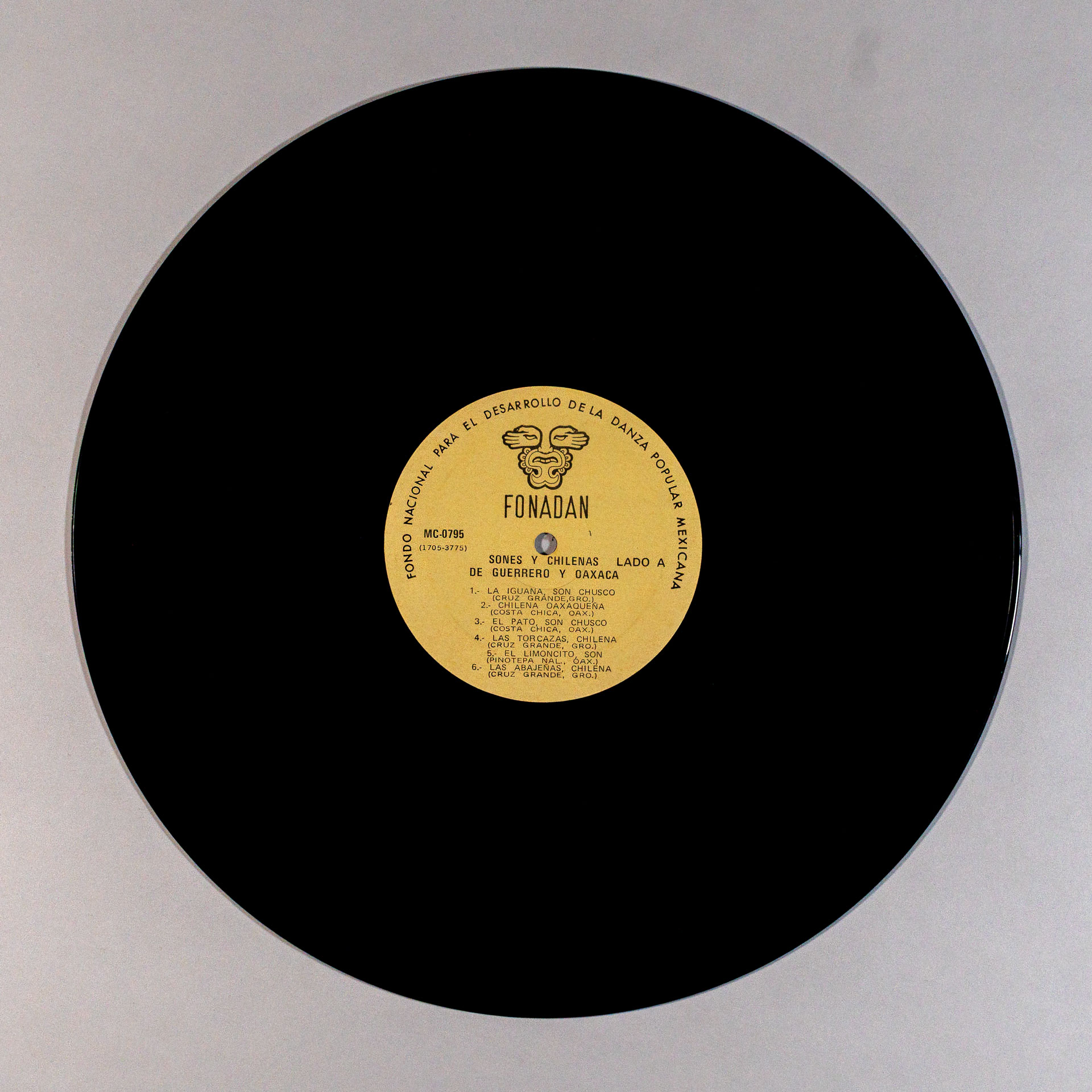

Tracklist:
SONES AND CHILENAS OF GUERRERO AND OAXACA
SIDE 1
- A1 The Iguana (Chusco Sound) 3:42
Performer(s): - A2 Chilean Oaxacan 3:02
Performer(s): - A3 The Duck (Chusco Sound) 4:42
Performer(s): - A4 The Dove (Chilean) 4:00
Performer(s): - A5 The Little Lemon (Sound) 0:56
Performer(s): - A6 The Abajenas (Chilean)
Performer(s):
SIDE 2
- B1 Tap Dance Sound 1:22
Performer(s): - B2 Pinotepa (Chilean) 2:26
Performer(s): - B3 Shirt (Syrup and Sound) 3:56
Performer(s): - B4 The Calandria (Sound) 15:31
Performer(s): - B5 Ursula (Chilean) 1:55
Performer(s): - B6 The Buzzard (Chusco Sound) 4:00
Performer(s):
Credits:
ETHNOMUSICOLOGY: Mario Kuri-Aldana, coordinator; Joaquin Guzman Luna; Vincent Mendoza R.
CHOREOGRAPHY: Luis Felipe Obregón, coordinator; Evelia Beristain.
DISSEMINATION: Xóchitl Medina, coordinator.
AUDIOVISUAL DEPARTMENT: Rodolfo Velazco R, Coordinator; Alejandro Loranca, Photographer; Rubén Prado, Audio Technician.
GENERAL MANAGEMENT: Josefina Lavalle.
 FONADAN CORPS OF RESEARCHERS – Sounds and Chileans From Guerrero And Oaxaca