







Lani Zaachilla Yoo
Cenzontle
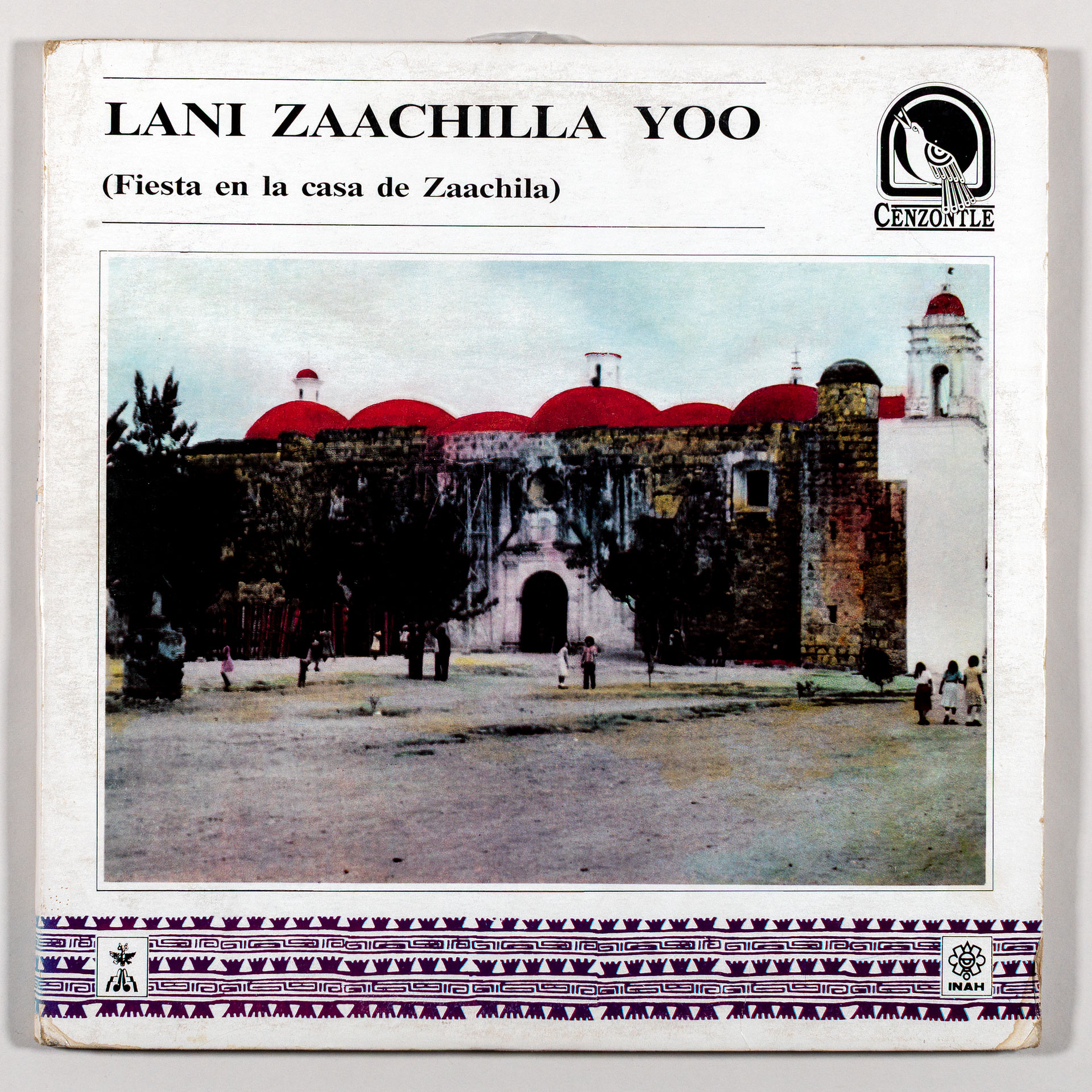
|
Label: INAH Serie: CENZONTLE Format: 12″ Vinilo 33 1/3 rpm Gatefold Album Released: 1990 |
Country: México Genre: Folk World & Country |
Info:
Lani Zaachilla Yoo
Celebration in the House of Zaachila
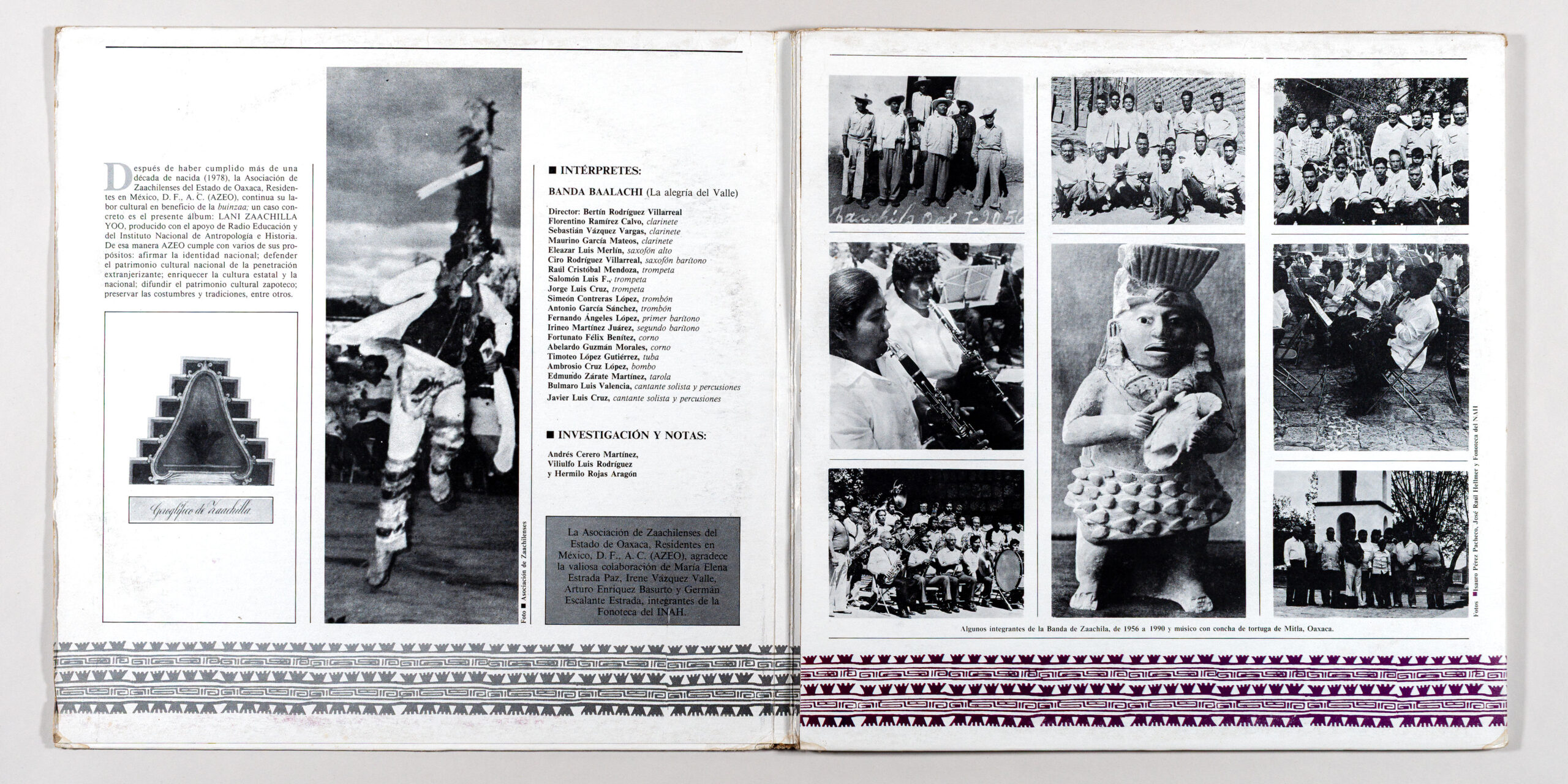
More than a decade after its founding in 1978, the Association of People from Zaachila, Oaxaca, Residing in Mexico City, D. F., A. C. (AZEO), continues its cultural work for the benefit of the buinzaa. One concrete example is this album, LANI ZAACHILLA YOO, produced with the support of Radio Educación and the National Institute of Anthropology and History. Through this project, AZEO fulfills several of its objectives: affirming national identity; defending the nation’s cultural heritage against encroaching foreign influences; enriching both state and national culture; sharing Zapotec cultural heritage; and preserving customs and traditions, among others.
Lani Zaachilla Yoo: Celebration in the House of Zaachila
By Andrés Cerero Martínez, Viliulfo Luis Rodríguez, and Hermilo Rojas Aragón.
When Mexico performs its music, each state joins in, adding its voice in different languages—Nahuatl, Maya, Purépecha, and others—to a single voice called Mexican. It brings to life musical instruments inherited from the earliest ancestors who inhabited this land, as well as other instruments brought from distant places.
Since their emergence, song and music have become the eternal sun that drives spirits seeking progress along the path of space, inspiring them to create, listen, or leave their footprints on the skin of dance. For Mexico had the distinction of being chosen as a home-paradise by the elements of music before its birth—or so tradition tells us.
The sun of sound and silence in Oaxaca cradles the music born from the depths of Tuxtepec, the Mixteca, the Cañada, the Sierra, the Isthmus, the Central Valleys, and the Coast. The sun of sound and silence illuminates them with jarabes, sones, songs, marches, chilenas, and danzones… They are danced, sung, and heard… According to the ray that shines upon them, the bands laugh and the string instruments converse; the drum, the shawm, the turtle shell, the deer antlers, and the reed flute pulse… At times, that other part of life is present, dwelling in the heart of the Mixe, diza (Zapotec), Spanish, Mixtec, and Mazatec languages…
The buinzaa—the cloud people, the Zapotec people—live in the wind-fire home of the Isthmus; in ancient muscles formed from the gigantic bodies of their ancestors in the Sierra; and on the flat floor of the vessel that gathered the water during the flood, when the clouds gave birth to the buinzaa, who began their lives on Oaxacan soil in the Central Valleys. Knowing that music existed even before their birth, this threefold people continued to hear it as they descended amid the prolonged sounds of thunder and silences that allowed their lungs to fill, affirming their diza language, their songs, and music in its entirety…
Transformed into people-community, the giants established schools called yoho-huecete, where the copa-pitoo devoted themselves to teaching song, music, and dance according to the inheritance of the first buinzaa.
Time and its earliest musical instruments set melodies permanently in flight, until they formed bonds with other instruments and created new ways of making music without forgetting their buinzaa roots—new ways of dancing that make them recognizable within the universal human world.
The radiance composed of music remains alive in Miahuatlán, Ejutla, Ocotlán, Zimatlán, Oaxaca City, Tlacolula, Etla, and Zaachila, all siblings belonging to the Central Valleys. The arms of memory need only reach into space and catch the bands’ butterfly-notes to hear “Jarabe Chenteño,” “Jarabe Zaachileño,” “Jarabe Jalpeño o Doble,” “Jarabe del Valle,” “Son del Guajolote,” “Cántaro de Coyotépec,” “Llévame Oaxaqueña,” and “Dios Nunca Muere”…
In Zaachila, situated on the musical staff of this buinzaa (Zapotec) region, approximately 17 kilometers from Oaxaca City, people remain faithful to their copapitoo ancestors and to the musical enrichment inherited over time. For this reason, its composers and musicians uphold tradition and custom, performing both old and new compositions: the Jarabe Zaachileño, sones, chilenas, schottisches, funeral and military marches, waltzes, danzones, pasodobles, and other works by Casimiro Diego Pérez, Rosendo Luis, Cipriano Pérez Cerna, and Amador Pérez Torres (Dimas), among others; as well as new marches, jarabes, sones, waltzes, and other pieces by Isauro Pérez Pacheco, Felipe Pérez Escoto, and Eleazar Luis Merlín (Pepe Luis)…
The musicians of Zaachila who bring the drum and reed flute to life—Manuel Pérez García, Julio Merlín, and Juventino Villarreal—ascend to the “Cerrito” with their melodies to touch the body of the sky, accompanied by the serving mayordomo, or festival steward, during “La Aurora.” The string instruments converse with those who have gone out to “correr gallo,” singing to the beloved night or the courted moon: Amador and Fausto Mendoza Morales, Sócrates Méndez, Manuel Benítez, Ángel Mendoza Contreras and his brother, Francisco Santos Martínez, Modesto Ambrosio, and others. Each instrument in the band tells how it has clothed—and continues to clothe—the calendas, convites, mayordomías, and fandangos in sounds and silences, without forgetting the teaching of bidding farewell to the “little angels” and the departed through candle-flowers.
The musicians also explain that, from birth, they received the inheritance of older musicians, who had themselves experienced the same. They tell us that life in Zaachila has always been lived with music; that bands and other musical groups have existed, now belonging to dusty memories, leading to the Cristóbal family’s “Paz y Unión” band and the Luis family’s “Anáhuac” band; the “Chabelita,” “Nuevo Ritmo,” and “Nicasio Vázquez” orchestras; and the Pérez family’s “Banda Fénix,” which continued to shine with the participation of other families.
Finally, the seed planted by musical custom and tradition germinates. The plant extends its arms under the name “Banda Baalachi”—The Joy of the Valley—through the determination of Salomón Luis F., Florentino Ramírez, Raúl Cristóbal, Bertín Rodríguez Villarreal, the verse reciter Fausto Mendoza Morales, and others. They bring to life the aspiration of the sun of sound and silence, as well as the wish of a community that lives with and for music. They hoped that time would not erase the staves and notes that had immortalized the surface of the paper, where the creations of composers who left their names to anonymity breathe alongside those of composers who chose to sign their works and remain present on the skin of the musical sky. Their gaze was also fixed on new compositions that would add greater brilliance to the burning light dedicated to Zaachila itself and to other sister communities.
Thus, the first fruits of the “Banda Baalachi” and the Zaachila tree could be harvested with a spirit of renewal, preserved forever on one of Oaxaca’s many musical discs. The field recording made by the sound archive of the National Institute of Anthropology and History culminated in the record “Zaachila y su Música.” Its contents included “Jarabe Zaachileño” and “Son del Guajolote,” both in the public domain, and the pasodoble “Zaachila,” as well as the new compositions: the march “Zaachila,” “Jarabe Bachos-zancudos,” and “Jarabe Donají.”
A second, especially abundant harvest comes with this three-record album, “Lani Zaachilla Yoo”—Celebration in the House of Zaachila—from a second field recording, this time made by Radio Educación. Here, the “Banda Baalachi” performs the musical birth of a celebration, as experienced in mayordomías and fandangos, through the “Danza de la Pluma,” following its unfolding and concluding with “Dios Nunca Muere.” The contents balance public-domain compositions, such as “Danza de la Pluma,” with works by identified composers, such as the danzón “Nereidas” and the waltz “Dios nunca muere,” which have been performed at celebrations since they first became known. Finally, there are new musical pieces that enrich the existing repertoire: “Bodas de Cosijoeza y Coyolicaltzin o Jarabe de los Reyes,” “Jarabe Lira,” the son “Homenaje a Oaxaca,” and the waltz “Zaachila.” Like the previous recordings, this work seeks to enrich our country’s musical heritage. It also invites associations, groups, and individuals to work for the benefit of the cultural expressions of their home communities, encouraging the recovery of what is at risk of being lost or the publication of new creations based on regional music.
Danza de la Pluma — Dance of the Feather
From the buinzaa tradition. Records 1 and 2.
The origins of the “Danza de la Pluma” lie in legend, as several communities in the Central Valleys claim it as their own. The purpose of this album is not to enter that debate; what matters most is that the dance remains alive within Oaxacan customs and traditions.
The oldest version combines theatrical and dance elements intended to represent the conquest of Mexico. It divides the participants into two sides: the Spanish invaders, represented by Cortés, his soldiers—known locally as the “little soldiers”—and Cihuapilia; and, on the other side, Moctezuma with his dancers, Malinche, and campos. In its more recent form, the dance includes only Moctezuma’s side. The dancers are accompanied by a drum—undoubtedly with pre-Hispanic antecedents—and a wind band.
The older form of the Danza de la Pluma is preserved in Teotitlán del Valle, Cuilapan, San Martín Tilcajete, Zimatlán, and Zaachila, among other Oaxacan communities, where it is performed over three days during patron saint festivals and the “Lunes del Cerro.”
Moctezuma is accompanied by two gate captains, two teotiles, four kings, one or two campos, Malinche, and Cihuapila. This last character is associated with Moctezuma when Cortés and his little soldiers do not take part.
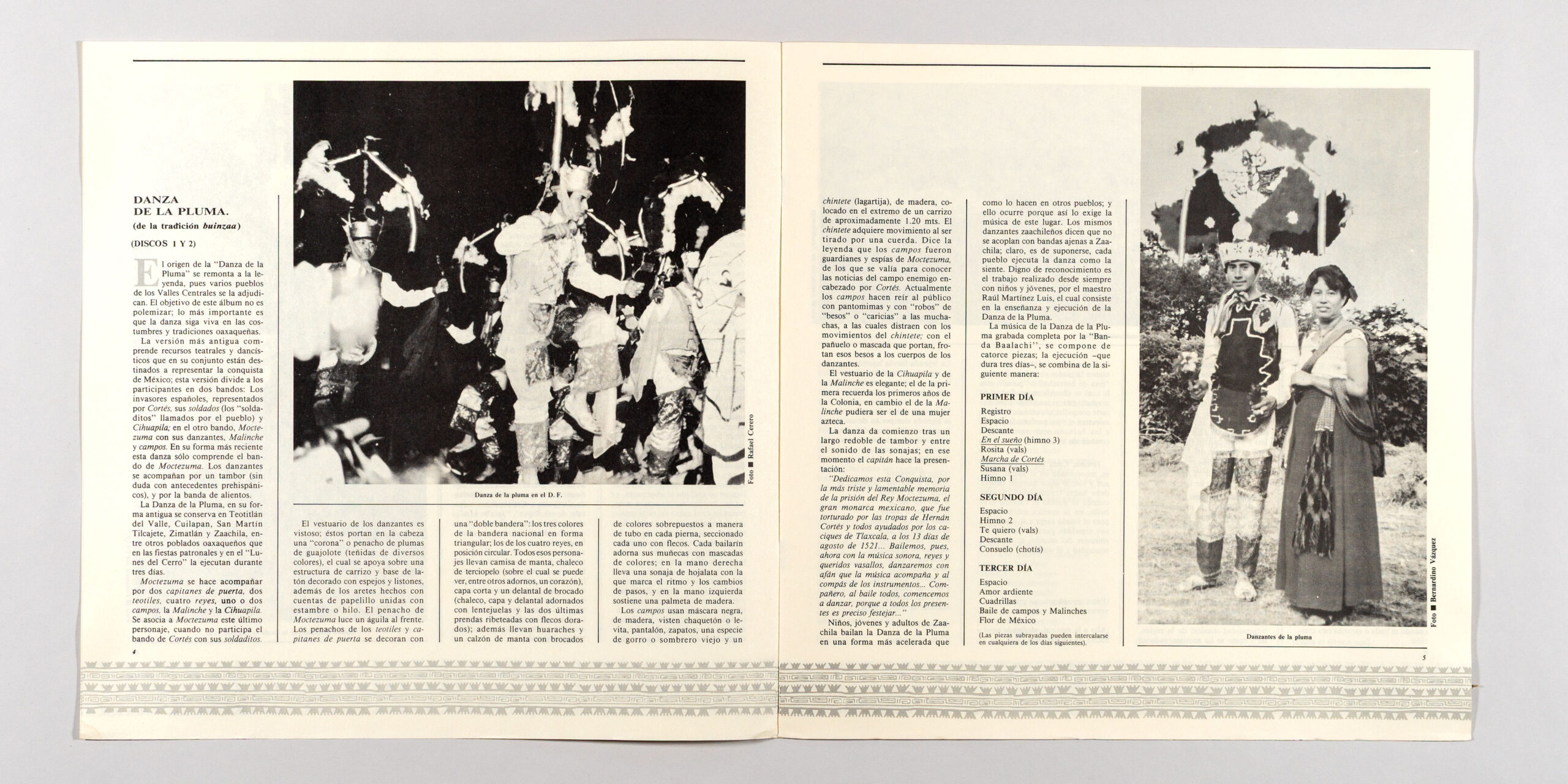
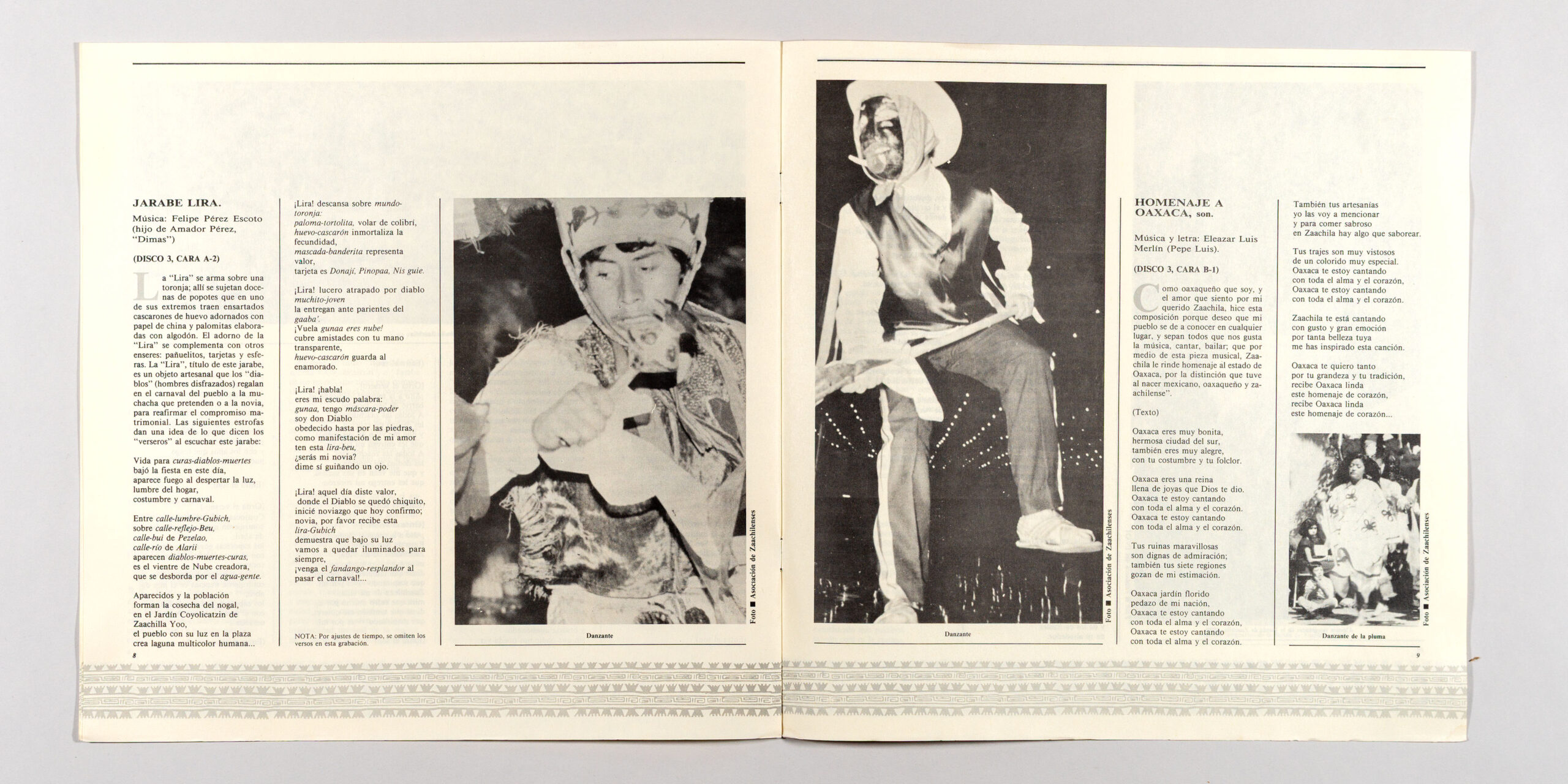
The dancers’ costumes are striking. They wear a “crown,” or headdress of turkey feathers dyed in various colors, supported by a reed framework and a brass base decorated with mirrors and ribbons. They also wear earrings made from small paper beads joined with yarn or thread. Moctezuma’s headdress displays an eagle at the front. The headdresses of the teotiles and gate captains are decorated with a “double flag,” with the three colors of the national flag arranged in a triangular shape; those of the four kings have a circular arrangement. All these characters wear an unbleached cotton shirt, a velvet vest displaying a heart among other decorations, a short cape, and a brocade apron. The vest, cape, and apron are adorned with sequins, and the latter two garments are edged with golden fringe. They also wear huarache sandals and unbleached cotton trousers with colored brocade overlays forming a tube around each leg, divided into sections by fringe. Each dancer adorns his wrists with colored scarves. In his right hand, he carries a tin rattle to mark the rhythm and changes of steps; in his left, he holds a wooden paddle.
The campos wear black wooden masks, long jackets or frock coats, trousers, shoes, a kind of cap or an old hat, and carry a wooden chintete—a lizard—mounted at the end of a reed approximately 1.20 meters long. The chintete moves when a cord is pulled. According to legend, the campos were Moctezuma’s guards and spies, whom he relied on for news from the enemy camp led by Cortés. Today, the campos make the audience laugh with pantomimes and by “stealing” “kisses” or “caresses” from young women, distracting them with the movements of the chintete. With the handkerchief or scarf they carry, they rub those kisses onto the dancers’ bodies.
The costumes of Cihuapila and Malinche are elegant. The former recalls the early colonial period, while Malinche’s might resemble that of an Aztec woman.
The dance begins after a long drumroll, amid the sound of rattles. At that moment, the captain makes the introduction:
“We dedicate this Conquest to the most sorrowful and lamentable memory of the imprisonment of King Moctezuma, the great Mexican monarch, who was tortured by the troops of Hernán Cortés, all aided by the chiefs of Tlaxcala, on the thirteenth day of August, 1521… Let us now dance to the resounding music, kings and beloved vassals; we shall dance eagerly as the music accompanies us and to the rhythm of the instruments… Companion, everyone to the dance; let us begin dancing, for all those present must be celebrated…”
Children, young people, and adults in Zaachila perform the Danza de la Pluma at a faster pace than in other communities because the local music calls for it. The dancers of Zaachila themselves say that they cannot adapt to bands from elsewhere. Naturally, each community performs the dance as it feels it. The longstanding work of maestro Raúl Martínez Luis with children and young people deserves recognition, particularly his teaching and performance of the Danza de la Pluma.
The complete music of the Danza de la Pluma, recorded by the “Banda Baalachi,” consists of fourteen pieces. The performance, which lasts three days, is arranged as follows:
First Day
Registro
Espacio
Descante
En el sueño (Hymn 3)
Rosita (waltz)
Marcha de Cortés
Susana (waltz)
Hymn 1
Second Day
Espacio
Hymn 2
Te quiero (waltz)
Descante
Consuelo (schottische)
Third Day
Espacio
Amor ardiente
Cuadrillas
Dance of the campos and Malinches
Flor de México
The underlined pieces may be interspersed on any of the following days: Espacio, Descante, Rosita (waltz), and Marcha de Cortés.
Bodas de Cosijoeza y Coyolicaltzin, or Jarabe de los Reyes
Lyrics and music: Eleazar Luis Merlín (Pepe Luis).
Record 3, Side A-1.
This jarabe first brought joy to the moon’s dawning one December night in 1986 at the open-air theater in Zaachila, Oaxaca. Since then, three ideas accompany this creation whenever it is danced or heard:
First. The composition is titled “Bodas de Cosijoeza y Coyolicaltzin”—The Wedding of Cosijoeza and Coyolicaltzin—or “Jarabe de los Reyes” because the composer conceives of Cosijoeza, the last ruler of the Buinzaa polity centered in Zaachila before the Spanish arrival in the Central Valleys, and Coyolicaltzin, daughter of Ahuitzotl, ruler of the Aztec Empire, as a duality that ultimately rests in their native Zaachila.
Second. Through this jarabe, its lyricist and composer, Eleazar Luis Merlín (Pepe Luis), shares the sweetness of the musical customs and traditions he inherited from Zaachila. Born and raised among musicians, his human roots absorbed the essence of the sones and jarabes performed at fandangos and mayordomías by bands that now stand watch on the horizon of memory. What better opportunity to create new sones from that inheritance, or recover the region’s musical originality, than through the Central Valleys custom of clasping in one’s hands the aromatic plant called “rosa de borracho” or “poleo”? This plant marks the celebrations of mayordomías and fandangos, tickling the skin of the earth while its fragrance delights the buinzaa, who were born from the heart of the trees.
Third. Each neighborhood of Zaachila is mentioned in the jarabe between one son and the next. If a name has been missed, there is no cause for concern: when the community hears or dances to it, everyone is present in the music, for the wind carries the music on its back to the corners of the world, to the sun of sound and silence…
Lyrics
(A son begins, then the verse reciter calls out)
Stop the music! Dedicated to
the neighborhood of La Purísima!
The legend was, the legend is,
the legend shall forever be,
the one that tells us things of yesterday,
what it is we ought to know.
The legend was, the legend is,
the legend shall forever be,
the one that tells us things of yesterday,
what it is we ought to know.
(The son begins)
[The verse reciter calls out]
Stop the music! Dedicated to
the neighborhood of La Soledad!
I am going to sing to you,
I am going to sing to you,
things that no one knew,
what happened yesterday,
what happened yesterday,
happened in the dynasty.
These sones were danced,
these sones were danced
by the great King Cosijoeza
and the radiant queen,
and the radiant queen,
radiant with great beauty.
(The son begins)
[The verse reciter calls out]
Stop the music! Dedicated to
the neighborhood of San Pedro!
To every one of my fellow townspeople,
I shall gladly make this plea:
our old customs
and traditions must not be forgotten.
To every one of my fellow townspeople,
I shall gladly make this plea:
our old customs
and traditions must not be forgotten.
Happy always, always I shall be,
with great pleasure I shall sing to you,
happy always, always I shall be,
with great pleasure I shall sing to you.
(The son begins)
[The verse reciter calls out]
Stop the music! Dedicated to
the neighborhood of San Sebastián!
San Sebastián is the neighborhood
where I spent night and day.
San Sebastián is the neighborhood
where I spent night and day;
where I kissed your little mouth,
as red as watermelon,
where I kissed your little mouth,
as red as watermelon.
(The son begins)
[The verse reciter calls out]
Stop the music! Dedicated
to the neighborhood of El Niño!
The beautiful nature
around you I always behold,
and so, lovely Zaachila,
I always sing to you with great love.
The beautiful nature
around you I always behold,
and so, lovely Zaachila,
I always sing to you with great love.
Blessed land where I was born,
I have always lived thinking of you,
blessed land where I was born,
I have always lived thinking of you.
(The son begins)
[The verse reciter calls out]
Stop the music! Dedicated to
the neighborhood of San José!
I wish I were the wind
so I could wrap myself around you
and kiss you passionately
without anyone seeing us.
I wish I were the wind
so I could wrap myself around you
and kiss you passionately
without anyone seeing us.
(The son begins)
[The verse reciter calls out]
Stop the music! Dedicated to
the neighborhood of San Jacinto!
To all the women of Zaachila
I dedicate my song,
and may they see me in their dreams,
for I give them my heart.
To all the women of Zaachila
I dedicate my song,
and may they see me in their dreams,
for I give them my heart.
(The son begins)
[The verse reciter calls out]
Stop the music! Dedicated to
La Raya de San Pablo!
Woman of Zaachila, love of my life,
see how much I suffer for you,
tell me that you love me too,
that you live sighing for me.
Woman of Zaachila, love of my life,
see how much I suffer for you,
tell me that you love me too,
that you live sighing for me.
(The son begins)
[The verse reciter calls out]
Stop the music! Dedicated to
the neighborhood of Lexío!
A beautiful woman of Zaachila,
beneath a lemon tree,
said to me, charming as could be:
“Oh, Pepe Luis, how I love you.”
And since I am somewhat weak,
I let myself be seduced,
and at my age,
what more could I ask for?
(The son begins)
[The verse reciter calls out]
Cosijoeza and Coyolicaltzin
were married in the month
of April,
the Zapotecs enjoyed the celebration
with the immense joy in their
hearts.
Cosijoeza and Coyolicaltzin
were married in the month of
April,
the Zapotecs enjoyed the celebration
with the immense joy in their
hearts…
(The final son begins).
Jarabe Lira
Music: Felipe Pérez Escoto, son of Amador Pérez (“Dimas”).
Record 3, Side A-2.
The “Lira” is assembled on a grapefruit. Dozens of drinking straws are attached to it, each with an eggshell threaded onto one end and decorated with tissue paper and little doves made of cotton. Other items complete the “Lira”: small handkerchiefs, cards, and ornamental balls. The “Lira,” which gives this jarabe its title, is a handcrafted object that the “devils”—men in costume—give during the town’s carnival to the young woman they are courting or to their girlfriend, reaffirming their commitment to marriage. The following stanzas offer an idea of what the verse reciters say while this jarabe is played:
Life for priests-devils-deaths,
the celebration descended on this day,
fire appears as the light awakens,
the hearth’s flame,
custom and carnival.
Between street-fire-Gubich,
upon street-reflection-Beu,
Pezelao’s street-hui,
Alari’s street-river,
devils-deaths-priests appear,
it is the womb of the creator Cloud,
overflowing with water-people.
Apparitions and the townspeople
form the harvest of the walnut tree,
in the Coyolicaltzin Garden of
Zaachilla Yoo,
the community, with its light in the square,
creates a multicolored human lagoon…
Lira! Rest upon world-grapefruit:
dove-turtledove, a hummingbird’s flight,
egg-shell immortalizes
fertility,
scarf-little flag represents
courage,
the card is Donají, Pinopaa, Ni’s guie.
Lira! Bright star captured by a devil,
muchito-young man,
they offer it before the relatives of the
gaabá.
Fly, gunaa, you are a cloud!
Cover friendships with your
transparent hand,
egg-shell shelters the
lover.
Lira! Speak!
You are my shield of words:
gunaa, I have mask-power,
I am Mr. Devil,
obeyed even by the stones.
As an expression of my love,
take this lira-beu.
Will you be my girlfriend?
Say yes with a wink.
Lira! That day you gave me courage,
when the Devil became small,
I began the courtship I now confirm;
my beloved, please accept this
lira-Gubich.
Show that beneath its light
we shall remain illuminated
forever.
Let the fandango-radiance arrive
as carnival passes!…
Note: Due to time constraints, the verses are omitted from this recording.
Homenaje a Oaxaca — Tribute to Oaxaca
Son. Music and lyrics: Eleazar Luis Merlín (Pepe Luis).
Record 3, Side B-1.
“As someone from Oaxaca, and because of the love I feel for my beloved Zaachila, I wrote this composition because I want my town to become known everywhere, and for everyone to know that we love music, singing, and dancing. Through this musical piece, Zaachila pays tribute to the state of Oaxaca, honoring the distinction I had of being born Mexican, Oaxacan, and a native of Zaachila.”
Lyrics
Oaxaca, you are so beautiful,
lovely city of the south,
you are also full of joy,
with your customs and your folklore.
Oaxaca, you are a queen
filled with jewels that God gave you.
Oaxaca, I am singing to you
with all my soul and heart.
Oaxaca, I am singing to you
with all my soul and heart.
Your wonderful ruins
are worthy of admiration;
your seven regions, too,
hold my affection.
Oaxaca, flowering garden,
a piece of my nation,
Oaxaca, I am singing to you
with all my soul and heart,
Oaxaca, I am singing to you
with all my soul and heart.
Your handicrafts, too,
I am going to mention,
and for delicious food,
Zaachila has something to savor.
Your costumes are so striking,
with a very special array of colors.
Oaxaca, I am singing to you
with all my soul and heart,
Oaxaca, I am singing to you
with all my soul and heart.
Zaachila is singing to you
with joy and great emotion;
with so much beauty,
you have inspired this song.
Oaxaca, I love you so much
for your greatness and your tradition.
Beautiful Oaxaca, accept
this heartfelt tribute,
beautiful Oaxaca, accept
this heartfelt tribute…
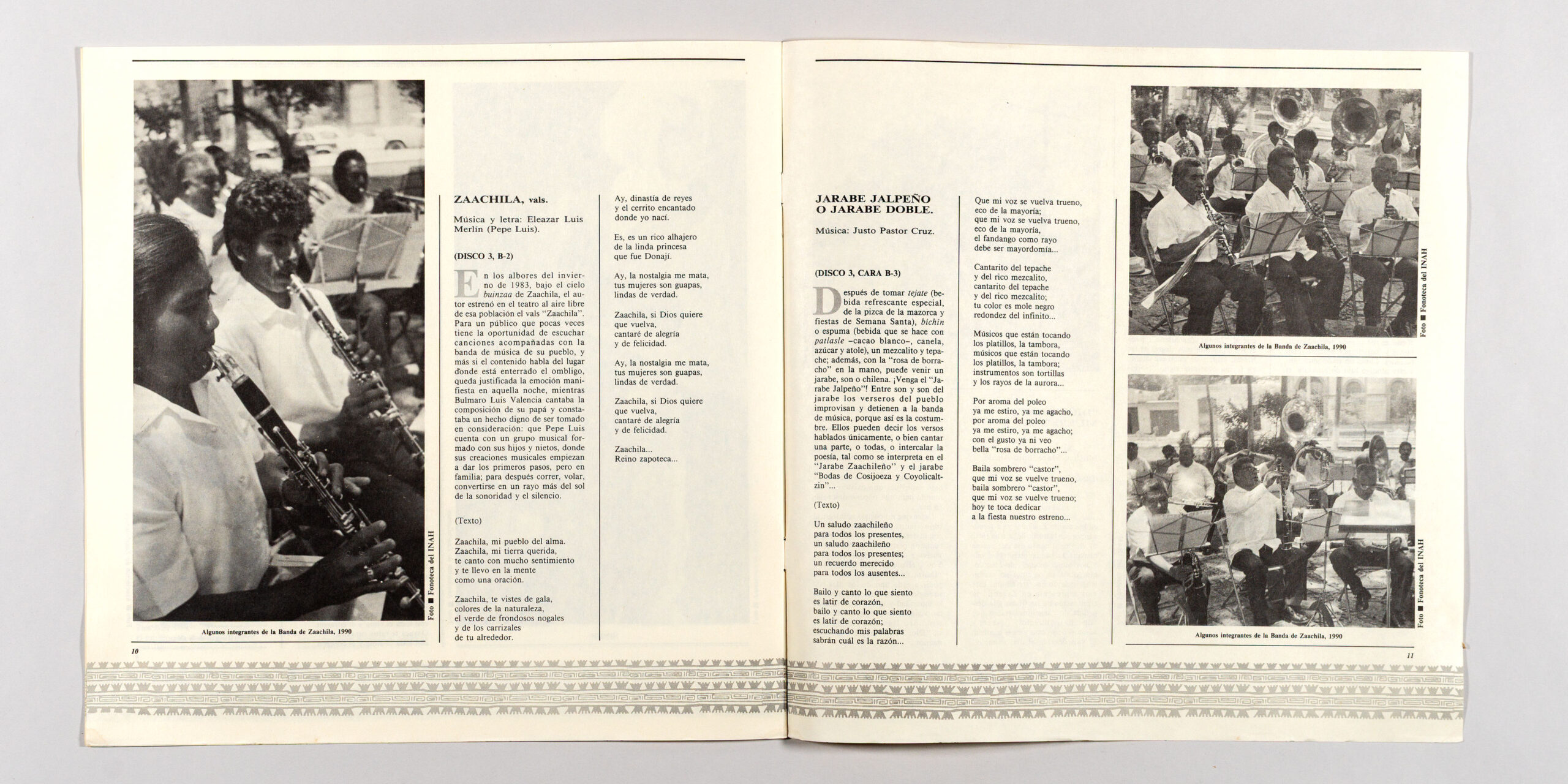
Zaachila
Waltz. Music and lyrics: Eleazar Luis Merlín (Pepe Luis).
Record 3, Side B-2.
At the beginning of the winter of 1983, beneath Zaachila’s buinzaa sky, the composer premiered the waltz “Zaachila” at the town’s open-air theater. For an audience that seldom has the opportunity to hear songs accompanied by its own town band—especially when the words speak of the place where one’s umbilical cord is buried—the emotion expressed that night is understandable. Bulmaro Luis Valencia sang his father’s composition, affirming a fact worthy of consideration: Pepe Luis has a musical group made up of his children and grandchildren, in which his musical creations take their first steps within the family before running, flying, and becoming another ray of the sun of sound and silence.
Lyrics
Zaachila, town of my soul.
Zaachila, my beloved land,
I sing to you with deep feeling
and carry you in my mind
like a prayer.
Zaachila, you dress in finery,
in the colors of nature,
the green of leafy walnut trees
and the reed beds
that surround you.
Oh, dynasty of kings
and the enchanted little hill
where I was born.
It is, it is a rich jewel box
belonging to the lovely princess
who was Donají.
Oh, longing is killing me,
your women are beautiful,
truly lovely.
Zaachila, if God wills
that I return,
I shall sing with joy
and happiness.
Oh, longing is killing me,
your women are beautiful,
truly lovely.
Zaachila, if God wills
that I return,
I shall sing with joy
and happiness.
Zaachila…
Zapotec kingdom…
Jarabe Jalpeño or Jarabe Doble
Music: Justo Pastor Cruz.
Record 3, Side B-3.
After drinking tejate—a special refreshing beverage associated with the corn harvest and Holy Week celebrations—bichin, or foam, a beverage made with patalasle (white cacao), cinnamon, sugar, and atole, a little mezcal, and tepache, and with “rosa de borracho” in hand, a jarabe, son, or chilena may follow. Let the “Jarabe Jalpeño” begin! Between the jarabe’s sones, the town’s verse reciters improvise and stop the band, as custom dictates. They may simply speak the verses, sing some or all of them, or interweave poetry, as performed in “Jarabe Zaachileño” and “Bodas de Cosijoeza y Coyolicaltzin”…
Lyrics
A greeting from Zaachila
to everyone here,
a greeting from Zaachila
to everyone here;
a well-deserved remembrance
for all those who are absent…
I dance and sing what I feel,
it is the beating of my heart,
I dance and sing what I feel,
it is the beating of my heart;
by listening to my words,
you will know the reason why…
May my voice become thunder,
an echo of the majority;
may my voice become thunder,
an echo of the majority,
the fandango, like a ray of light,
must become a mayordomía…
Little pitcher of tepache
and delicious mezcal,
little pitcher of tepache
and delicious mezcal;
your color is black mole,
the roundness of infinity…
Musicians playing
the cymbals and the bass drum,
musicians playing
the cymbals and the bass drum;
instruments are tortillas
and the rays of dawn…
With the fragrance of poleo,
now I stretch, now I bend,
with the fragrance of poleo,
now I stretch, now I bend;
with such delight I can no longer see
the lovely “rosa de borracho”…
Dance, “beaver” hat,
may my voice become thunder,
dance, “beaver” hat,
may my voice become thunder;
today it is your turn to dedicate
our premiere to the celebration…
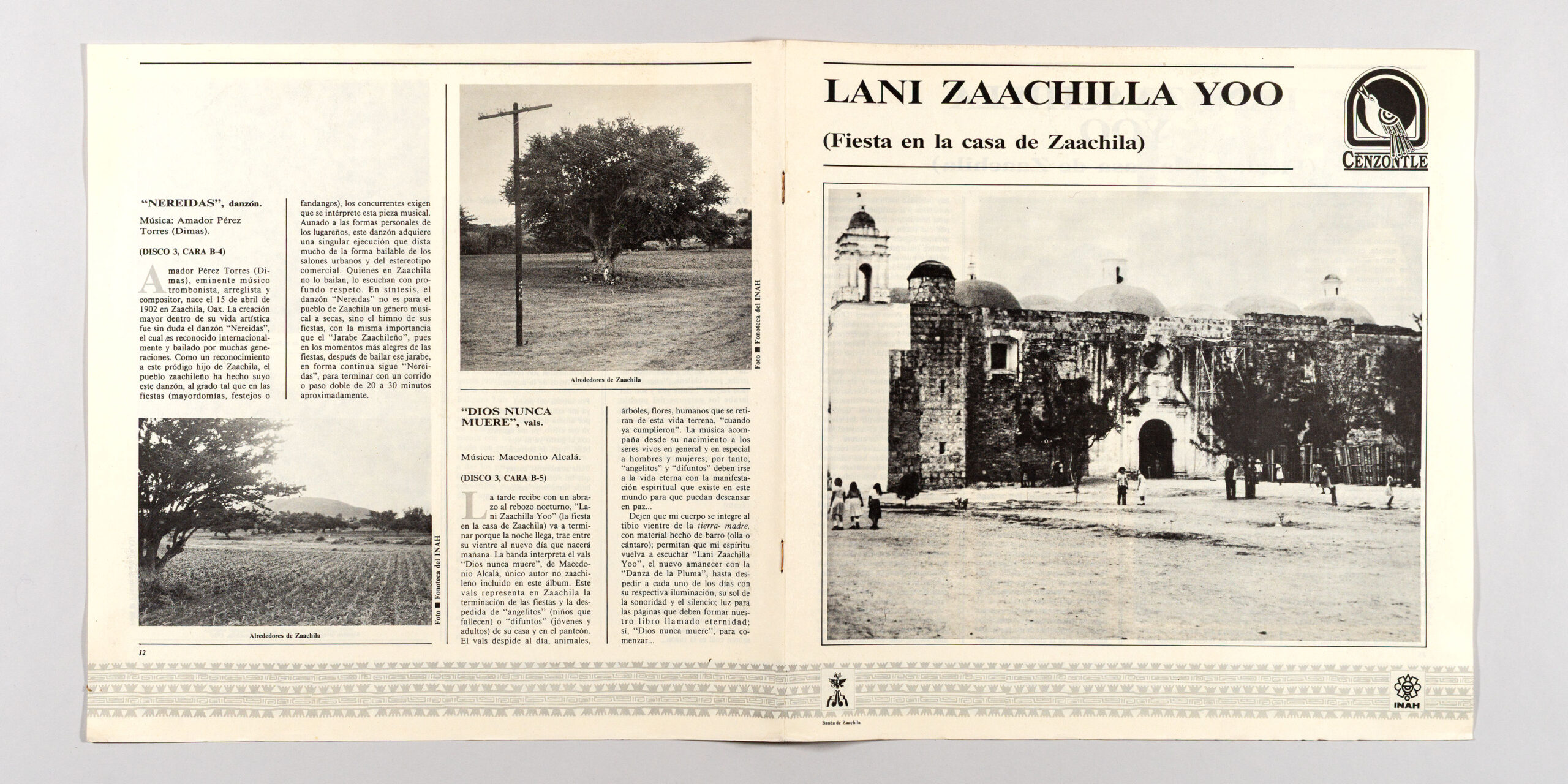
Nereidas
Danzón. Music: Amador Pérez Torres (Dimas).
Record 3, Side B-4.
Amador Pérez Torres (Dimas), the eminent trombonist, arranger, and composer, was born on April 15, 1902, in Zaachila, Oaxaca. The greatest creation of his artistic life was undoubtedly the danzón “Nereidas,” internationally recognized and danced by many generations. In recognition of this gifted son of Zaachila, the community has made the danzón its own, to such an extent that those attending celebrations—mayordomías, festivities, or fandangos—insist that it be played. Combined with the personal styles of local dancers, this danzón takes on a distinctive performance that differs greatly from the dancing found in urban ballrooms and its commercial stereotype. Those in Zaachila who do not dance to it listen with profound respect. In essence, “Nereidas” is not merely a musical genre for the people of Zaachila, but the anthem of their celebrations, as important as “Jarabe Zaachileño.” At the most joyful moments of a celebration, that jarabe is followed immediately by “Nereidas,” concluding with a corrido or pasodoble lasting approximately 20 to 30 minutes.
Dios nunca muere — God Never Dies
Waltz. Music: Macedonio Alcalá.
Record 3, Side B-5.
The afternoon embraces the shawl of night. “Lani Zaachilla Yoo”—the celebration in the house of Zaachila—is about to end because night is arriving, carrying within its womb the new day that will be born tomorrow. The band performs the waltz “Dios nunca muere” by Macedonio Alcalá, the only composer included in this album who is not from Zaachila. In Zaachila, this waltz marks the end of celebrations and the farewell to “little angels”—children who have died—or to the “departed”—young people and adults—at their homes and in the cemetery. The waltz bids farewell to the day, to animals, trees, flowers, and human beings who leave this earthly life “when their time is fulfilled.” Music accompanies living beings from birth, especially men and women; therefore, the “little angels” and the “departed” must enter eternal life with the spiritual expression that exists in this world, so that they may rest in peace…
Let my body return to the warm womb of earth-mother, with material made of clay—a pot or pitcher. Let my spirit hear “Lani Zaachilla Yoo” again, the new dawn with the “Danza de la Pluma,” until bidding farewell to each day with its own illumination, its sun of sound and silence: light for the pages that must form our book called eternity. Yes, “God never dies,” so that we may begin…
Tracklist
Record 1 — Danza de la Pluma
From the buinzaa tradition.
Side A
- Registro — 1:10
- Espacio — 1:47
- Descante — 2:23
- En el sueño, Hymn 3 — 2:00
- Rosita, waltz — 2:00
- Marcha de Cortés — 3:00
Side B
Danza de la Pluma (continued).
- Susana, waltz — 6:06
- Hymn 1 — 3:05
- Hymn 2 — 2:51
Record 2 — Danza de la Pluma
From the buinzaa tradition (continued).
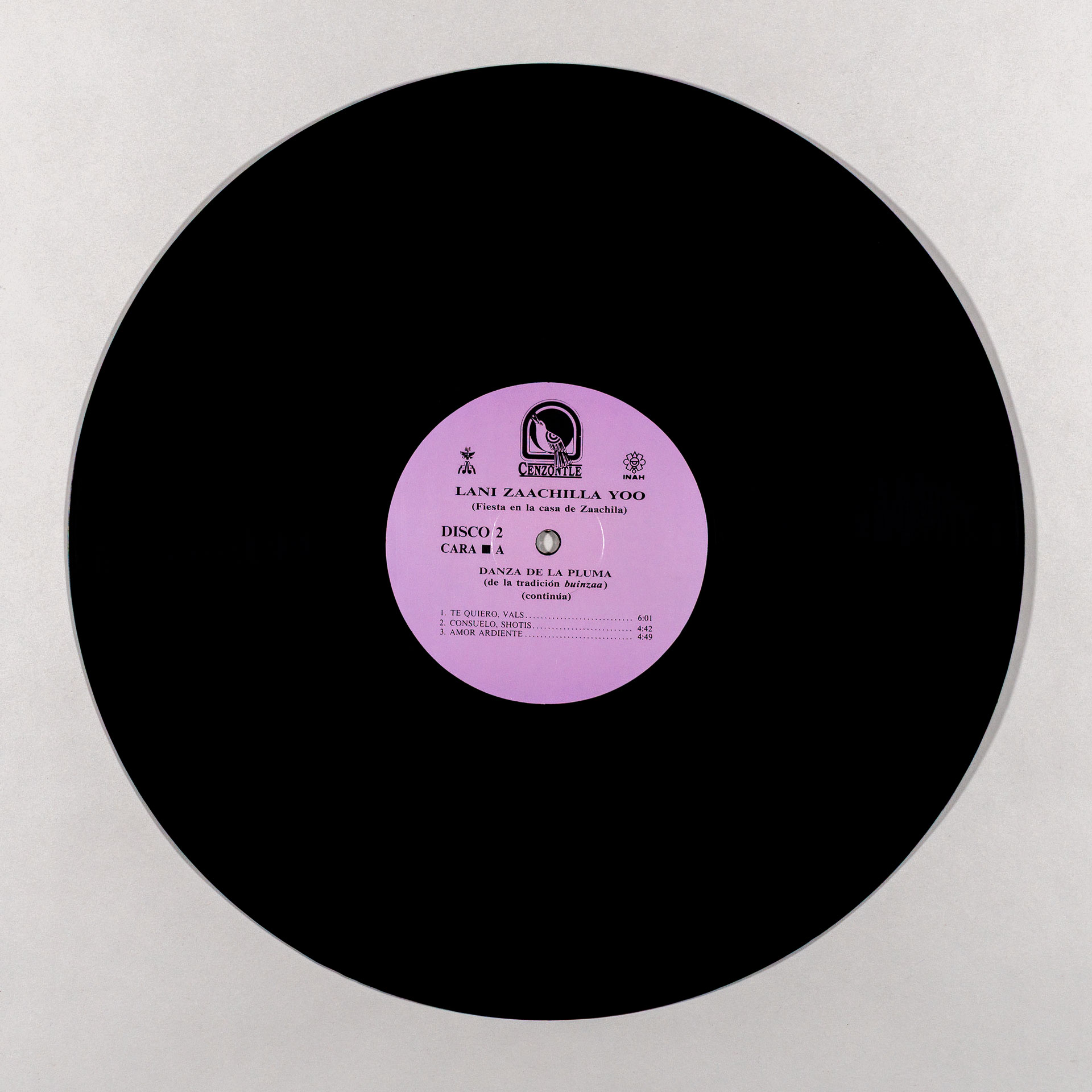
Side A
- Te quiero, waltz — 6:01
- Consuelo, schottische — 4:42
- Amor ardiente — 4:49
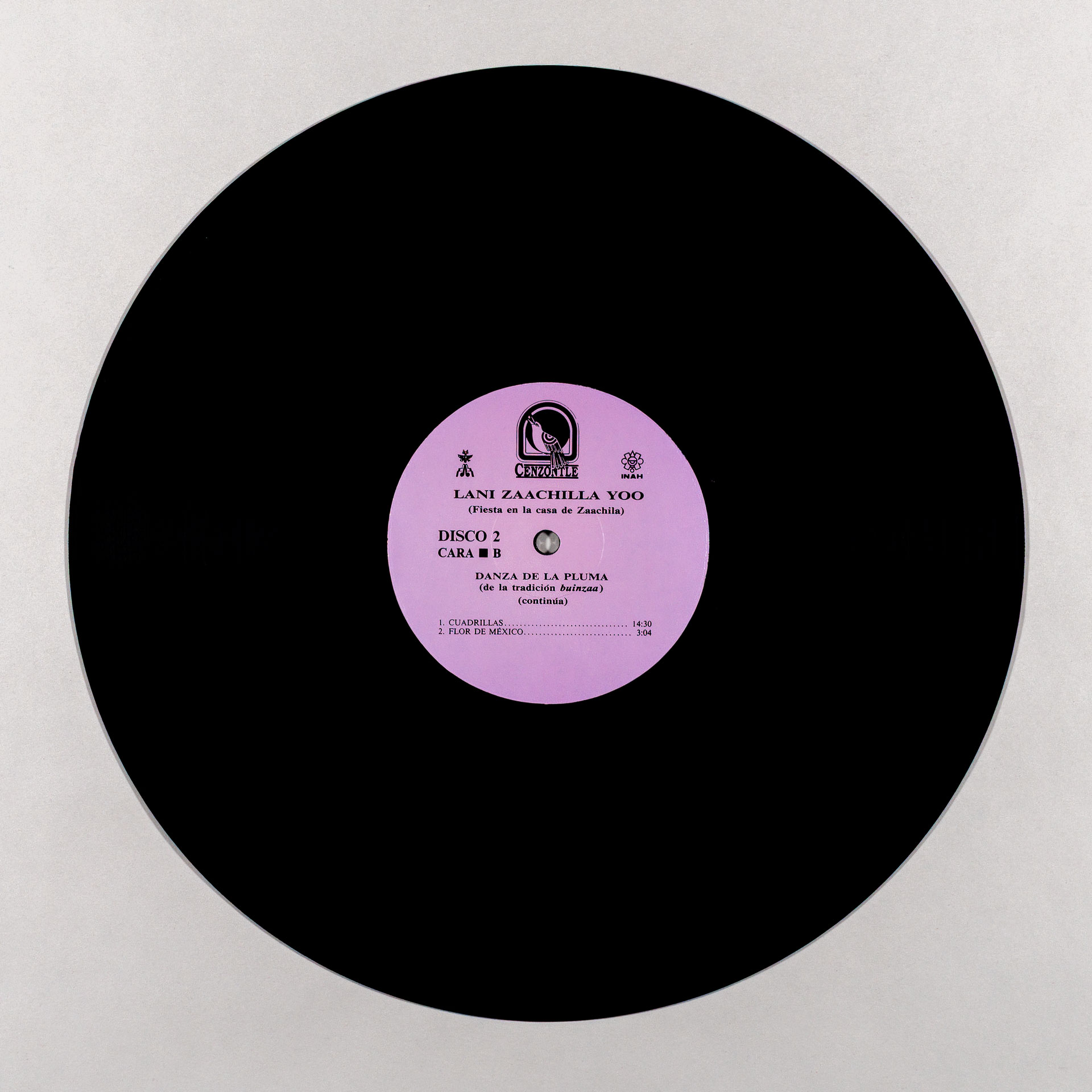
Side B
- Cuadrillas — 14:30
- Flor de México — 3:04
Record 3
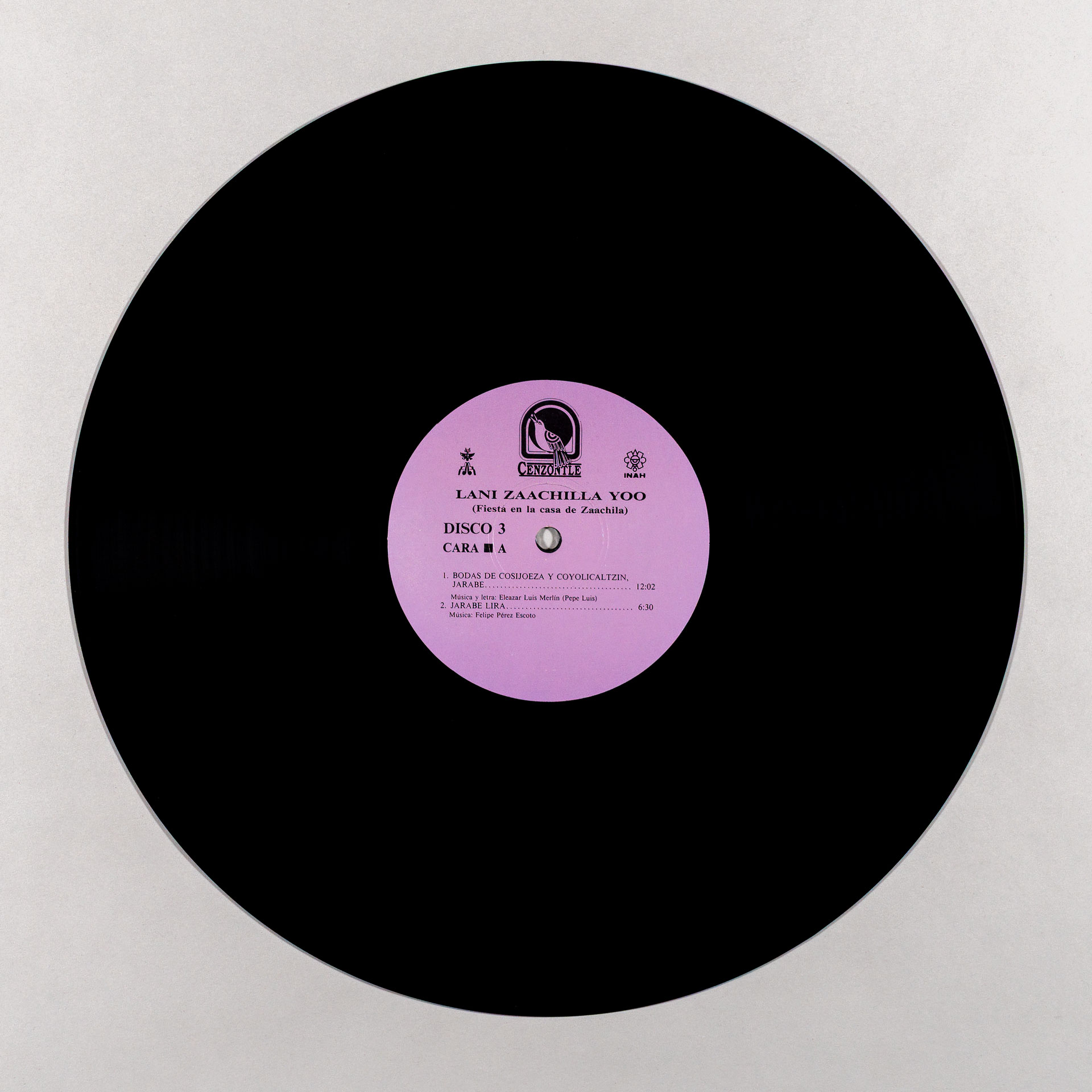
Side A
- Bodas de Cosijoeza y Coyolicaltzin, jarabe — 12:02
Music and lyrics: Eleazar Luis Merlín (Pepe Luis). - Jarabe Lira — 6:30
Music: Felipe Pérez Escoto.
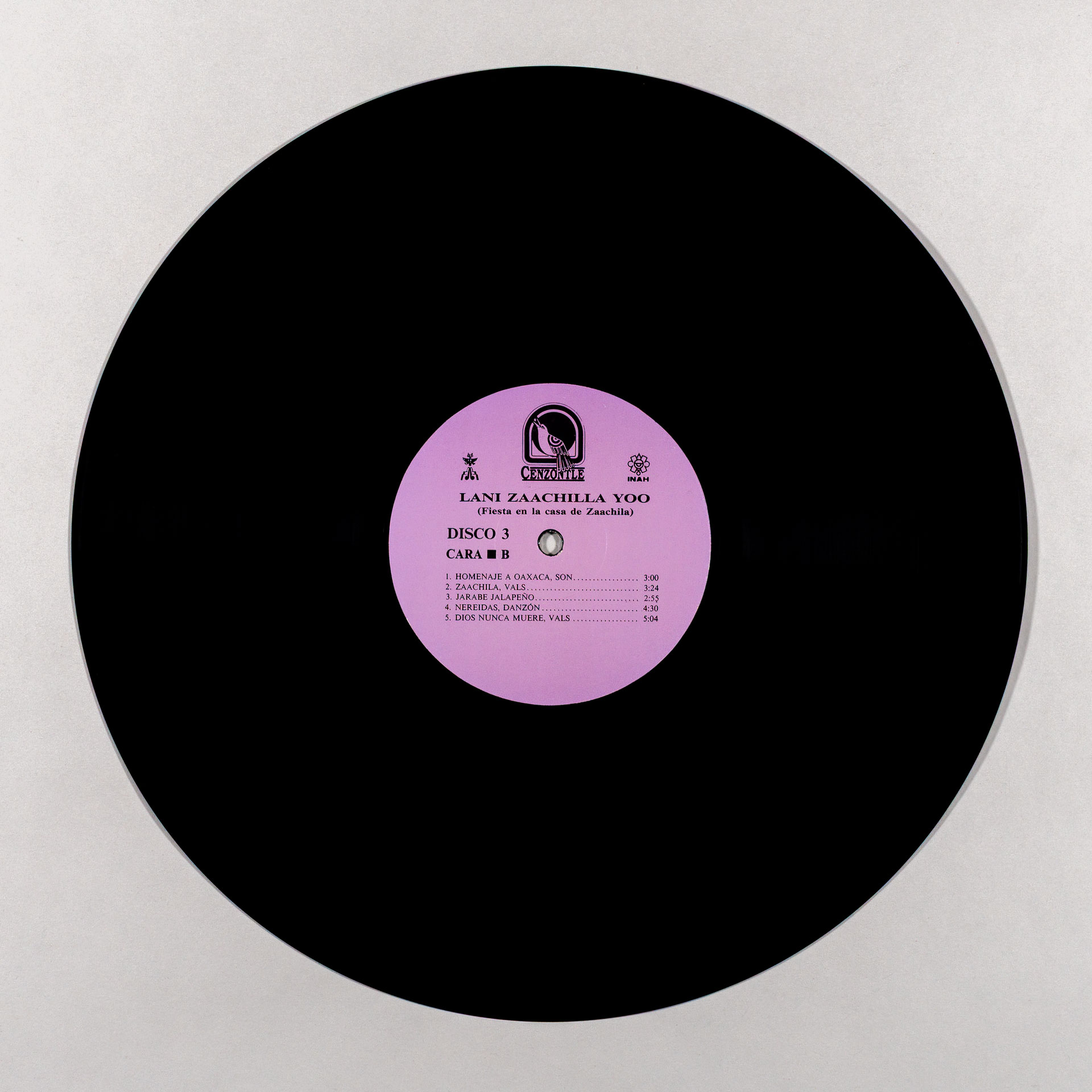
Side B
- Homenaje a Oaxaca, son — 3:00
- Zaachila, waltz — 3:24
- Jarabe Jalpeño — 2:55
- Nereidas, danzón — 4:30
- Dios nunca muere, waltz — 5:04
Performers
Banda Baalachi — The Joy of the Valley
Director: Bertín Rodríguez Villarreal.
- Florentino Ramírez Calvo — Clarinet.
- Sebastián Vázquez Vargas — Clarinet.
- Maurino García Mateos — Clarinet.
- Eleazar Luis Merlín — Alto saxophone.
- Ciro Rodríguez Villarreal — Baritone saxophone.
- Raúl Cristóbal Mendoza — Trumpet.
- Salomón Luis F. — Trumpet.
- Jorge Luis Cruz — Trumpet.
- Simeón Contreras López — Trombone.
- Antonio García Sánchez — Trombone.
- Fernando Ángeles López — First baritone horn.
- Irineo Martínez Juárez — Second baritone horn.
- Fortunato Félix Benítez — Horn.
- Abelardo Guzmán Morales — Horn.
- Timoteo López Gutiérrez — Tuba.
- Ambrosio Cruz López — Bass drum.
- Edmundo Zárate Martínez — Snare drum.
- Bulmaro Luis Valencia — Solo vocalist and percussion.
- Javier Luis Cruz — Solo vocalist and percussion.
Research and Liner Notes
Andrés Cerero Martínez, Viliulfo Luis Rodríguez, and Hermilo Rojas Aragón.
Acknowledgments
The Association of People from Zaachila, Oaxaca, Residing in Mexico City, D. F., A. C. (AZEO), gratefully acknowledges the valuable collaboration of María Elena Estrada Paz, Irene Vázquez Valle, Arturo Enríquez Basurto, and Germán Escalante Estrada, members of the INAH sound archive.
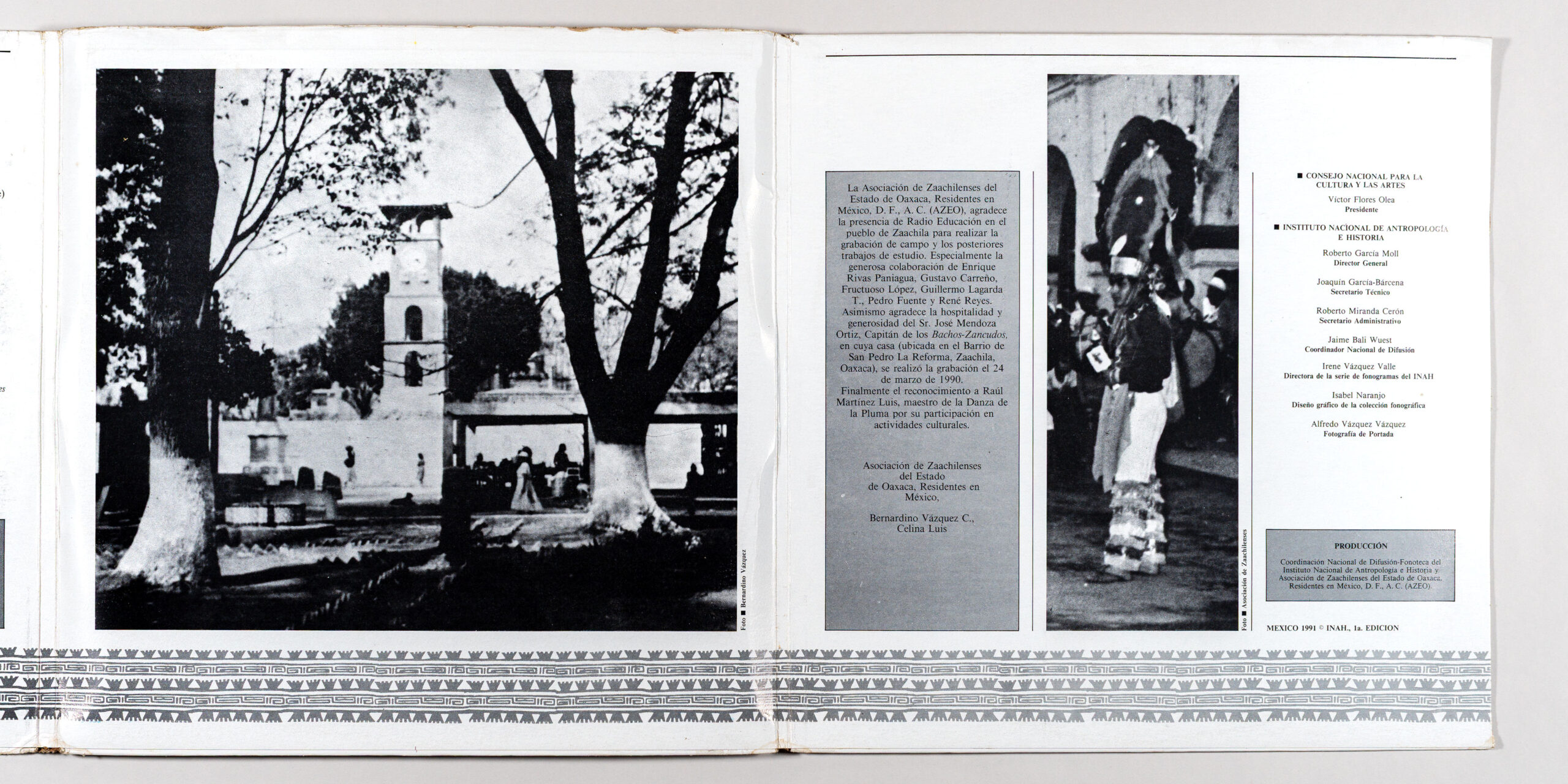
The Association of People from Zaachila, Oaxaca, Residing in Mexico City, D. F., A. C. (AZEO), thanks Radio Educación for coming to Zaachila to make the field recording and carry out the subsequent studio work. Special thanks go to Enrique Rivas Paniagua, Gustavo Carreño, Fructuoso López, Guillermo Lagarda T., Pedro Fuente, and René Reyes for their generous collaboration. The association also acknowledges the hospitality and generosity of Mr. José Mendoza Ortiz, Captain of the Bachos-Zancudos, at whose home—in the San Pedro La Reforma neighborhood of Zaachila, Oaxaca—the recording took place on March 24, 1990.
Finally, recognition is extended to Raúl Martínez Luis, teacher of the Danza de la Pluma, for his participation in cultural activities.
Association of People from Zaachila, Oaxaca, Residing in Mexico City.
Bernardino Vázquez C.
Celina Luis
Institutional and Production Credits
National Council for Culture and the Arts
Víctor Flores Olea
President.
National Institute of Anthropology and History
Roberto García Moll
Director General.
Joaquín García-Bárcena
Technical Secretary.
Roberto Miranda Cerón
Administrative Secretary.
Jaime Bali Wuest
National Coordinator for Outreach.
Irene Vázquez Valle
Director of the INAH recording series.
Isabel Naranjo
Graphic design for the recording collection.
Alfredo Vázquez Vázquez
Cover photography.
Production
National Coordination for Outreach–Sound Archive of the National Institute of Anthropology and History, and the Association of People from Zaachila, Oaxaca, Residing in Mexico City, D. F., A. C. (AZEO).
Mexico, 1991 © INAH. First edition.
Cenzontle
The CENZONTLE label is the result of collaboration among the following institutions:
- INI.
- INAH.
- General Directorate of Popular Cultures.
- Banda de Zaachila.
For the renewed appreciation and dissemination of the country’s authentic musical traditions.
National Council for Culture and the Arts.
SEP.
Photographs and Captions from the Original Material
- Glyph of Zaachilla.
- Zaachila, Oaxaca, 1956. Handwritten inscription on a photograph.
- Members of the Banda de Zaachila, from 1956 to 1990, and a musician with a turtle shell from Mitla, Oaxaca. Photos: Isauro Pérez Pacheco, José Raúl Helmer, and the INAH sound archive.
- Photograph from the inside of the record sleeve. Photo: Bernardino Vázquez.
- Photographs of dancers from the inside of the record sleeve. Photos: Association of People from Zaachila.
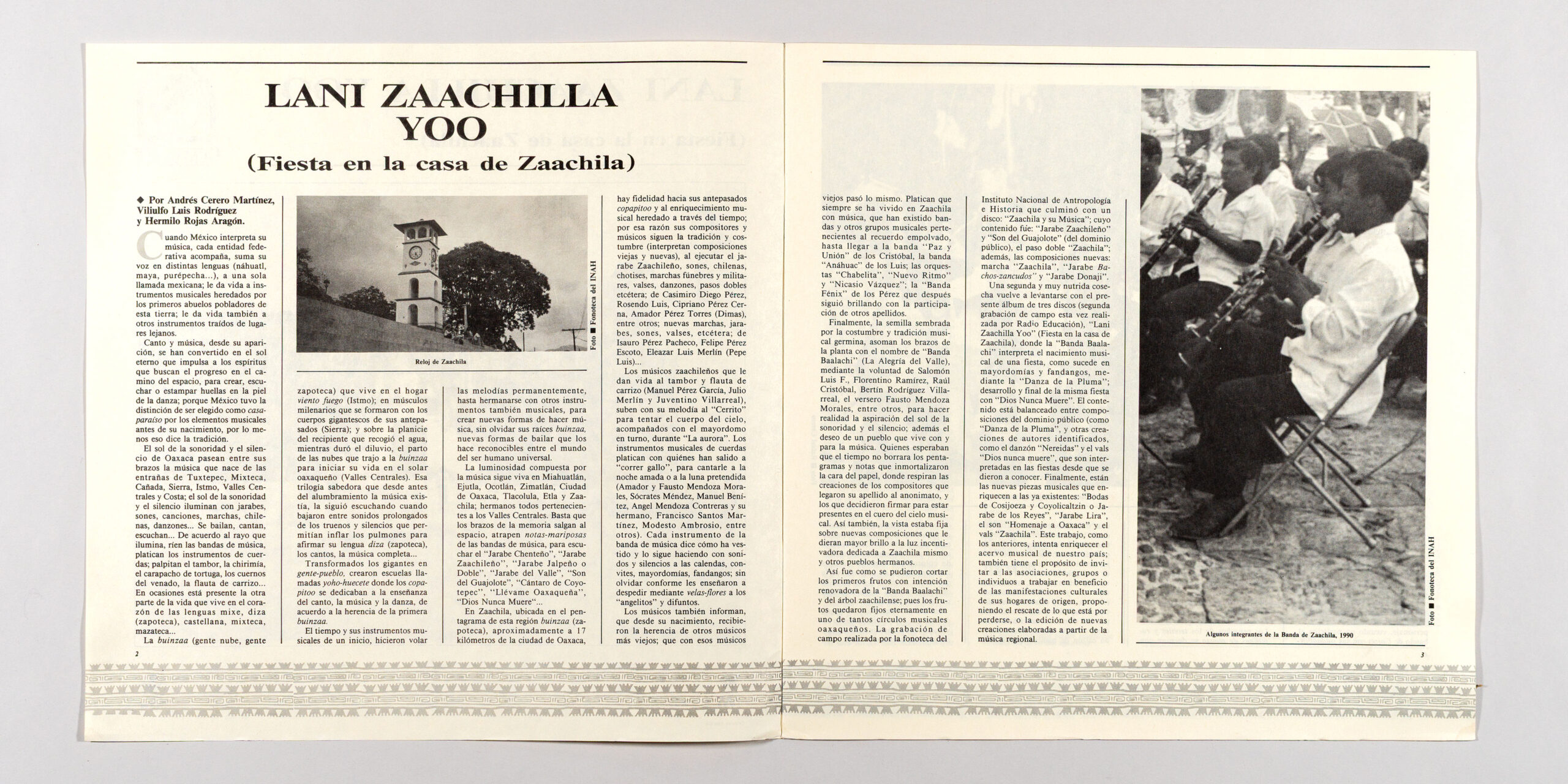
- Zaachila clock tower. Photo: INAH sound archive.
- Members of the Banda de Zaachila, 1990. Photo: INAH sound archive.
- Danza de la Pluma in Mexico City. Photo: Rafael Cerero.
- Danza de la Pluma dancers. Photo: Bernardino Vázquez.
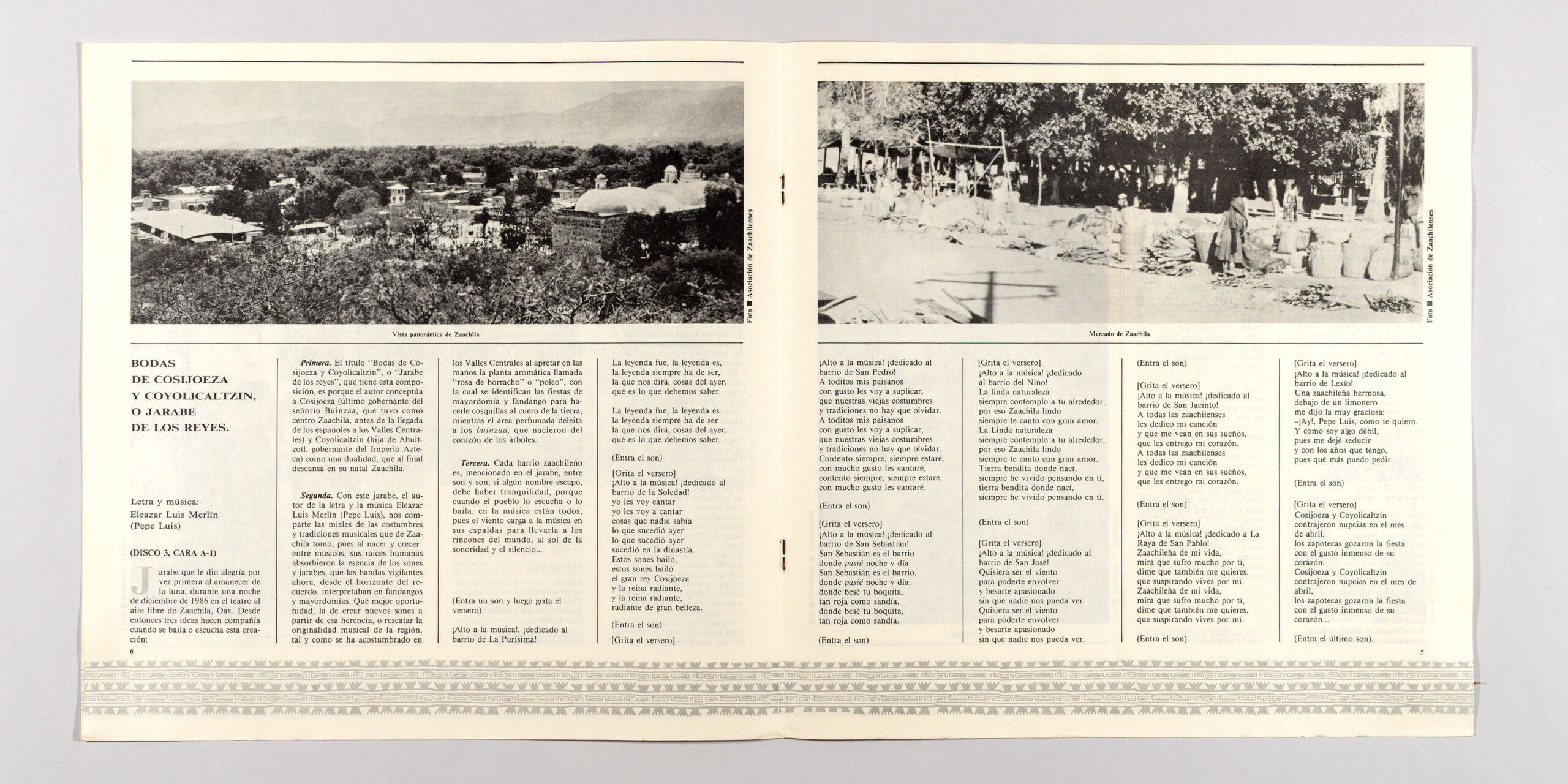
- Panoramic view of Zaachila. Photo: Association of People from Zaachila.
- Zaachila market. Photo: Association of People from Zaachila.
- Dancer. Photo: Association of People from Zaachila.
- Dancer. Photo: Association of People from Zaachila.
- Danza de la Pluma dancer. Photo: Association of People from Zaachila.
- Members of the Banda de Zaachila, 1990. Photo: INAH sound archive.
- Members of the Banda de Zaachila, 1990. Photo: INAH sound archive.
- Members of the Banda de Zaachila, 1990. Photo: INAH sound archive.
- Surroundings of Zaachila. Photo: INAH sound archive.
- Surroundings of Zaachila. Photo: INAH sound archive.
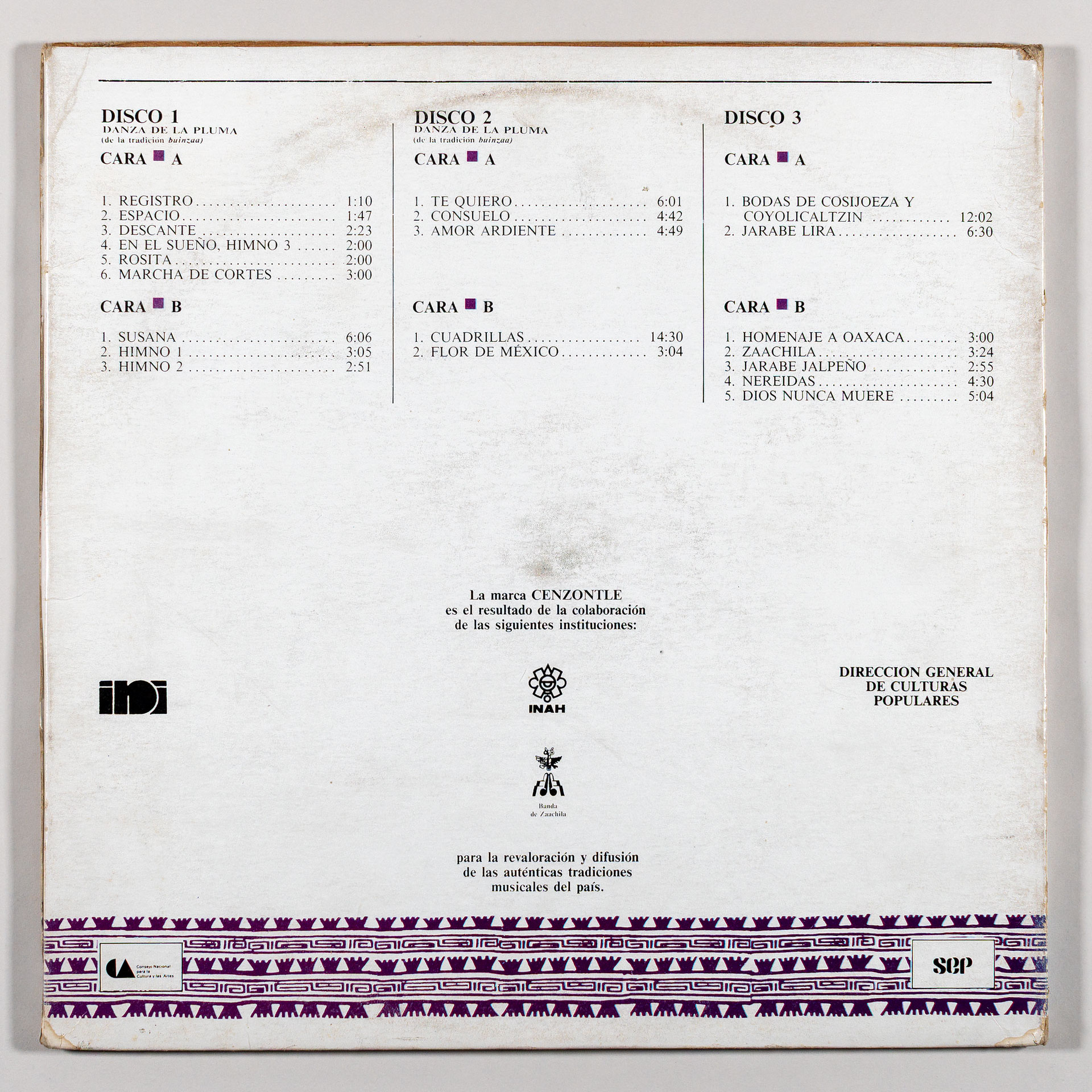
Tracklist:
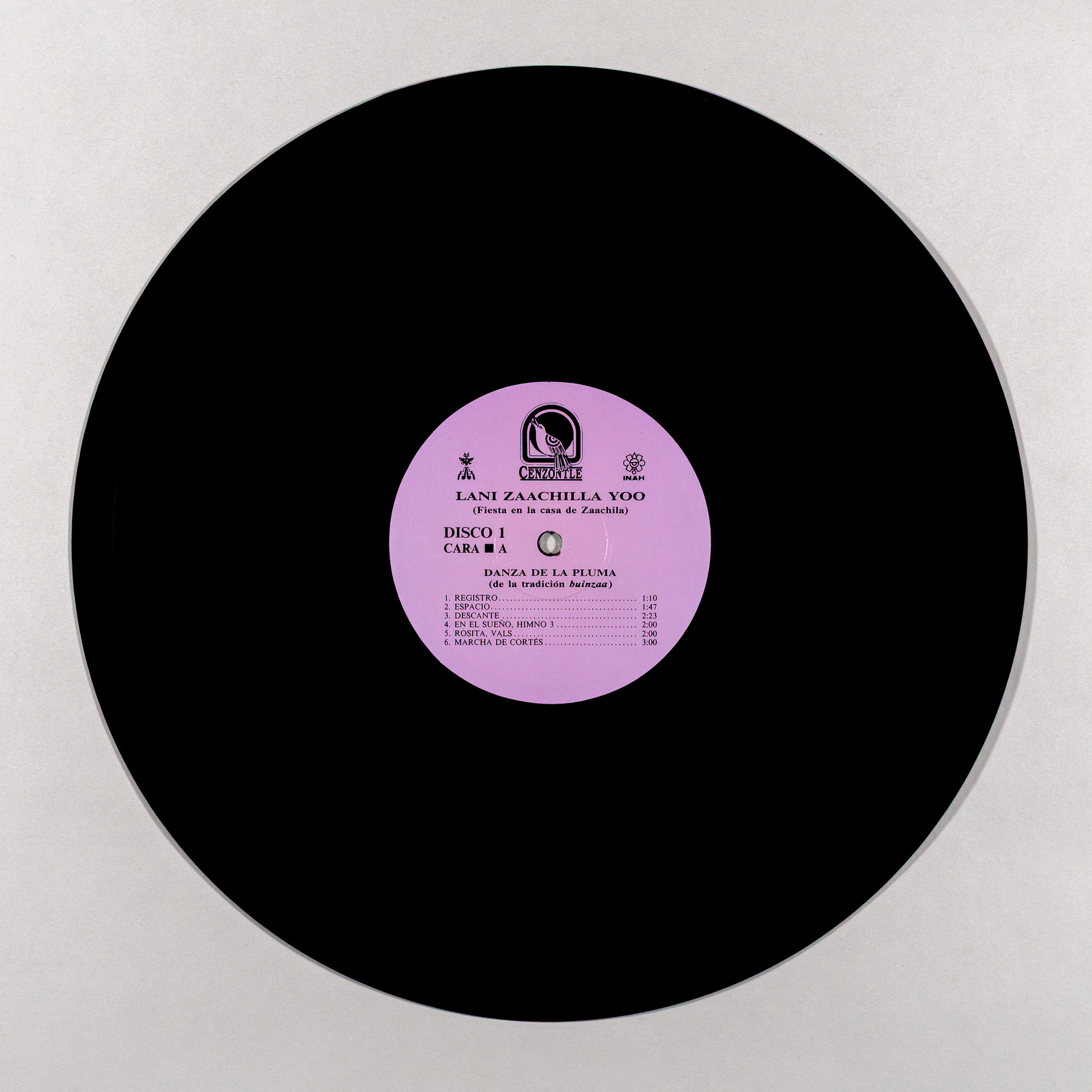
Disco 1
Cara A
- Registro — 1:10
- Espacio — 1:47
- Descante — 2:23
- En el sueño, Himno 3 — 2:00
- Rosita, vals — 2:00
- Marcha de Cortés — 3:00
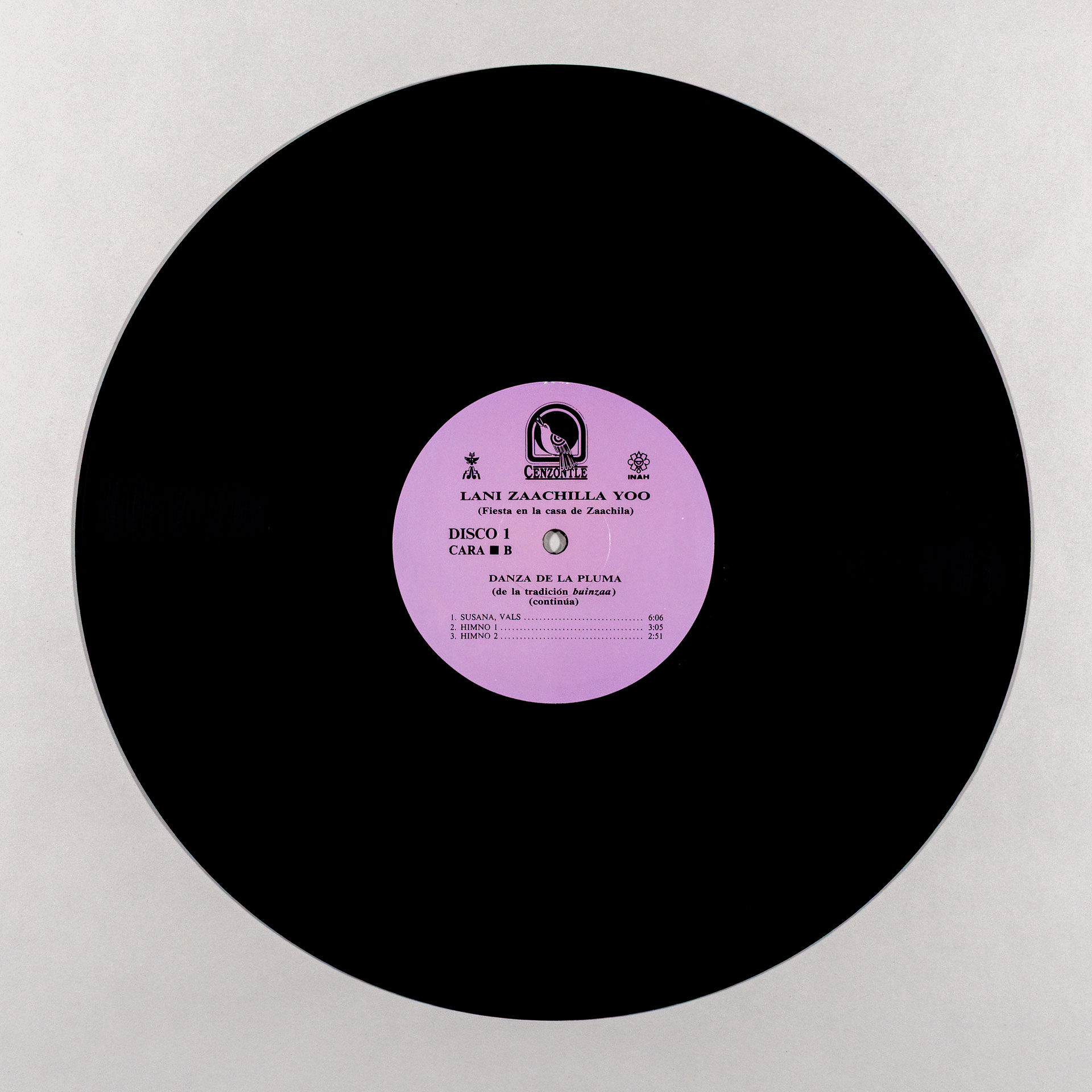
Cara B
- Susana, vals — 6:06
- Himno 1 — 3:05
- Himno 2 — 2:51
Disco 2
Cara A
- Te quiero, vals — 6:01
- Consuelo, shotis — 4:42
- Amor ardiente — 4:49
Cara B
- Cuadrillas — 14:30
- Flor de México — 3:04
Disco 3
Cara A
- Bodas de Cosijoeza y Coyolicaltzin, jarabe — 12:02
- Jarabe Lira — 6:30
Cara B
- Homenaje a Oaxaca, son — 3:00
- Zaachila, vals — 3:24
- Jarabe Jalpeño — 2:55
- Nereidas, danzón — 4:30
- Dios nunca muere, vals — 5:04
Credits:
Intérpretes
Banda Baalachi (La alegría del Valle)
Director: Bertín Rodríguez Villarreal
- Florentino Ramírez Calvo — Clarinete.
- Sebastián Vázquez Vargas — Clarinete.
- Maurino García Mateos — Clarinete.
- Eleazar Luis Merlín — Saxofón alto.
- Ciro Rodríguez Villarreal — Saxofón barítono.
- Raúl Cristóbal Mendoza — Trompeta.
- Salomón Luis F. — Trompeta.
- Jorge Luis Cruz — Trompeta.
- Simeón Contreras López — Trombón.
- Antonio García Sánchez — Trombón.
- Fernando Ángeles López — Primer barítono.
- Irineo Martínez Juárez — Segundo barítono.
- Fortunato Félix Benítez — Corno.
- Abelardo Guzmán Morales — Corno.
- Timoteo López Gutiérrez — Tuba.
- Ambrosio Cruz López — Bombo.
- Edmundo Zárate Martínez — Tarola.
- Bulmaro Luis Valencia — Cantante solista y percusiones.
- Javier Luis Cruz — Cantante solista y percusiones.
Composiciones
- Bodas de Cosijoeza y Coyolicaltzin, o Jarabe de los Reyes: letra y música de Eleazar Luis Merlín (Pepe Luis).
- Jarabe Lira: música de Felipe Pérez Escoto.
- Homenaje a Oaxaca: música y letra de Eleazar Luis Merlín (Pepe Luis).
- Zaachila: música y letra de Eleazar Luis Merlín (Pepe Luis).
- Jarabe Jalpeño o Jarabe Doble: música de Justo Pastor Cruz.
- Nereidas: música de Amador Pérez Torres (Dimas).
- Dios nunca muere: música de Macedonio Alcalá.
Investigación y notas
Andrés Cerero Martínez, Viliulfo Luis Rodríguez y Hermilo Rojas Aragón.
Producción
Coordinación Nacional de Difusión-Fonoteca del Instituto Nacional de Antropología e Historia y Asociación de Zaachilenses del Estado de Oaxaca, Residentes en México, D. F., A. C. (AZEO).
Grabación de campo: Radio Educación.
Fecha de grabación: 24 de marzo de 1990.
Lugar: casa del Sr. José Mendoza Ortiz, Capitán de los Bachos-Zancudos, Barrio de San Pedro La Reforma, Zaachila, Oaxaca.
Diseño y fotografía
Isabel Naranjo — Diseño gráfico de la colección fonográfica.
Alfredo Vázquez Vázquez — Fotografía de portada.
Fotografías interiores: Asociación de Zaachilenses, Fonoteca del INAH, Bernardino Vázquez, Rafael Cerero, Isauro Pérez Pacheco y José Raúl Helmer.
Agradecimientos
Colaboración de la Fonoteca del INAH: María Elena Estrada Paz, Irene Vázquez Valle, Arturo Enríquez Basurto y Germán Escalante Estrada.
Colaboración de Radio Educación: Enrique Rivas Paniagua, Gustavo Carreño, Fructuoso López, Guillermo Lagarda T., Pedro Fuente y René Reyes.
Hospitalidad: José Mendoza Ortiz.
Reconocimiento: Raúl Martínez Luis, maestro de la Danza de la Pluma, por su participación en actividades culturales.
Por la Asociación de Zaachilenses del Estado de Oaxaca, Residentes en México: Bernardino Vázquez C. y Celina Luis.
Créditos institucionales
Consejo Nacional para la Cultura y las Artes
Víctor Flores Olea — Presidente.
Instituto Nacional de Antropología e Historia
Roberto García Moll — Director General.
Joaquín García-Bárcena — Secretario Técnico.
Roberto Miranda Cerón — Secretario Administrativo.
Jaime Bali Wuest — Coordinador Nacional de Difusión.
Irene Vázquez Valle — Directora de la serie de fonogramas del INAH.
Cenzontle
Colaboración del INI, INAH, Dirección General de Culturas Populares y Banda de Zaachila, para la revaloración y difusión de las auténticas tradiciones musicales del país.
México, 1991 © INAH. Primera edición.
Notes:
Zaachila y su pasado como centro político
Zaachila fue una importante ciudad-Estado y sede del poder político zapoteco después del declive de Monte Albán. Las Relaciones Geográficas de Oaxaca también la mencionan como Teozapotlán. Este contexto amplía las referencias a reyes, dinastías y memoria territorial presentes en las composiciones del álbum. mna.inah.gob.mx
Las tumbas de Zaachila y el encuentro entre culturas
En 1962, el arqueólogo Roberto Gallegos Ruiz descubrió las tumbas 1 y 2 de Zaachila. Su arquitectura y sus ofrendas aportaron información sobre las relaciones entre zapotecos y mixtecos: se recuperaron objetos de oro, turquesa, concha y hueso labrado. Estos hallazgos permiten situar el paisaje del disco dentro de una historia de intercambios culturales anterior a la conquista española. mna.inah.gob.mx
La danza como compromiso de varios años
En Teotitlán del Valle, otra comunidad de los Valles Centrales, la Danza de la Pluma implica una promesa de participar durante tres años en las principales celebraciones religiosas. Este compromiso es distinto de los tres días de ejecución descritos en el libreto de Zaachila y muestra cómo una misma tradición adquiere obligaciones y formas particulares en cada comunidad. mna.inah.gob.mx
Las mujeres y la celebración de la promesa
Al concluir ese compromiso en Teotitlán del Valle, los danzantes son acompañados por mujeres de su familia que llevan jícaras decoradas, llamadas jicalpextles, con flores de azúcar para repartir. La celebración permite observar la participación familiar que sostiene la danza, además del trabajo de músicos y bailarines. mna.inah.gob.mx
El Jarabe del Valle y los objetos de la fiesta
En las bodas de Teotitlán del Valle, las mujeres de la familia del novio y de los padrinos bailan el Jarabe del Valle llevando jicalpextles con flores de azúcar. Música, alimentos y objetos artesanales forman parte de un mismo acto ceremonial. Esta práctica ofrece un contexto regional adicional para comprender la relación entre jarabes y celebraciones matrimoniales evocada en el álbum. mna.inah.gob.mx
 Lani Zaachilla Yoo (Fiesta En la Casa de Zaachila)