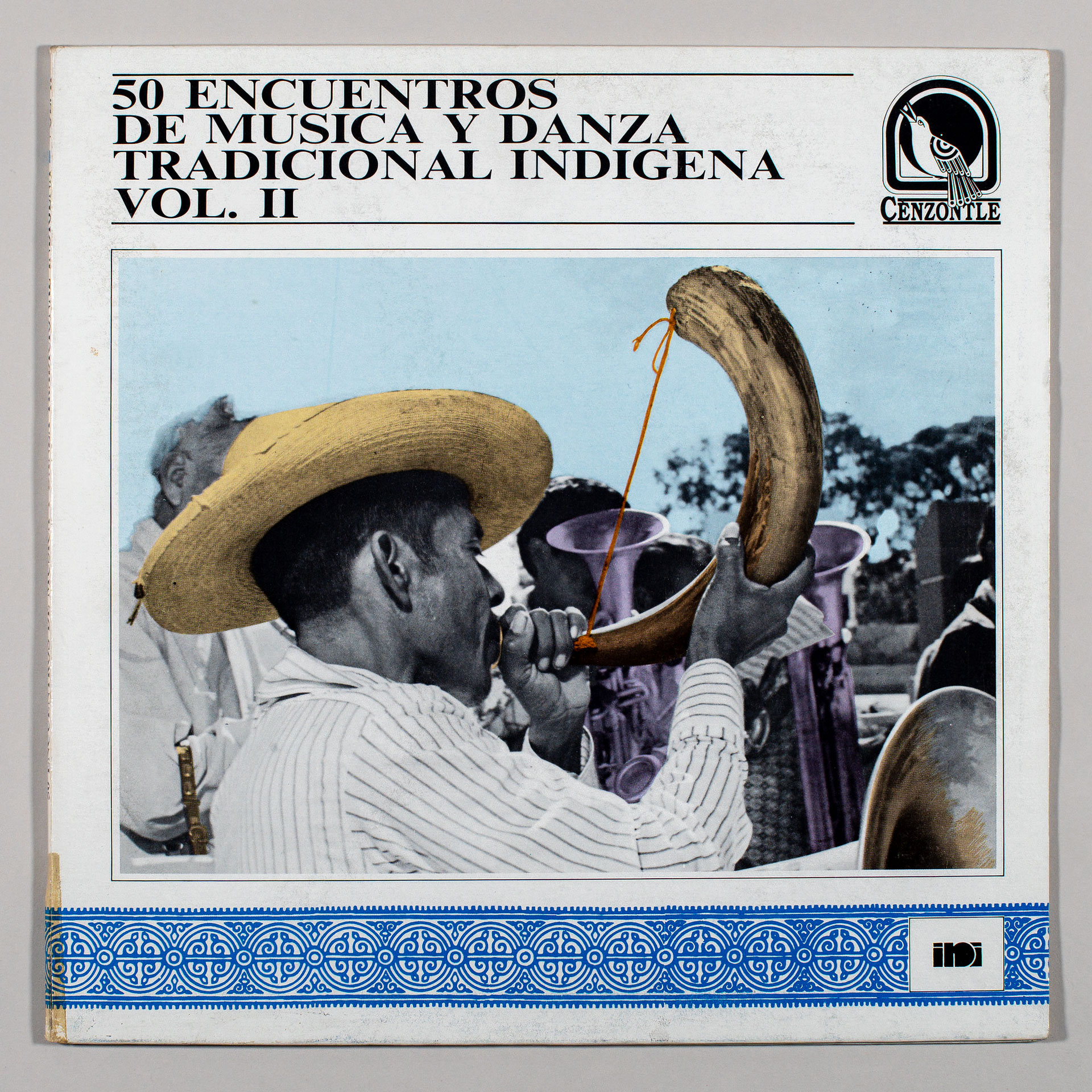







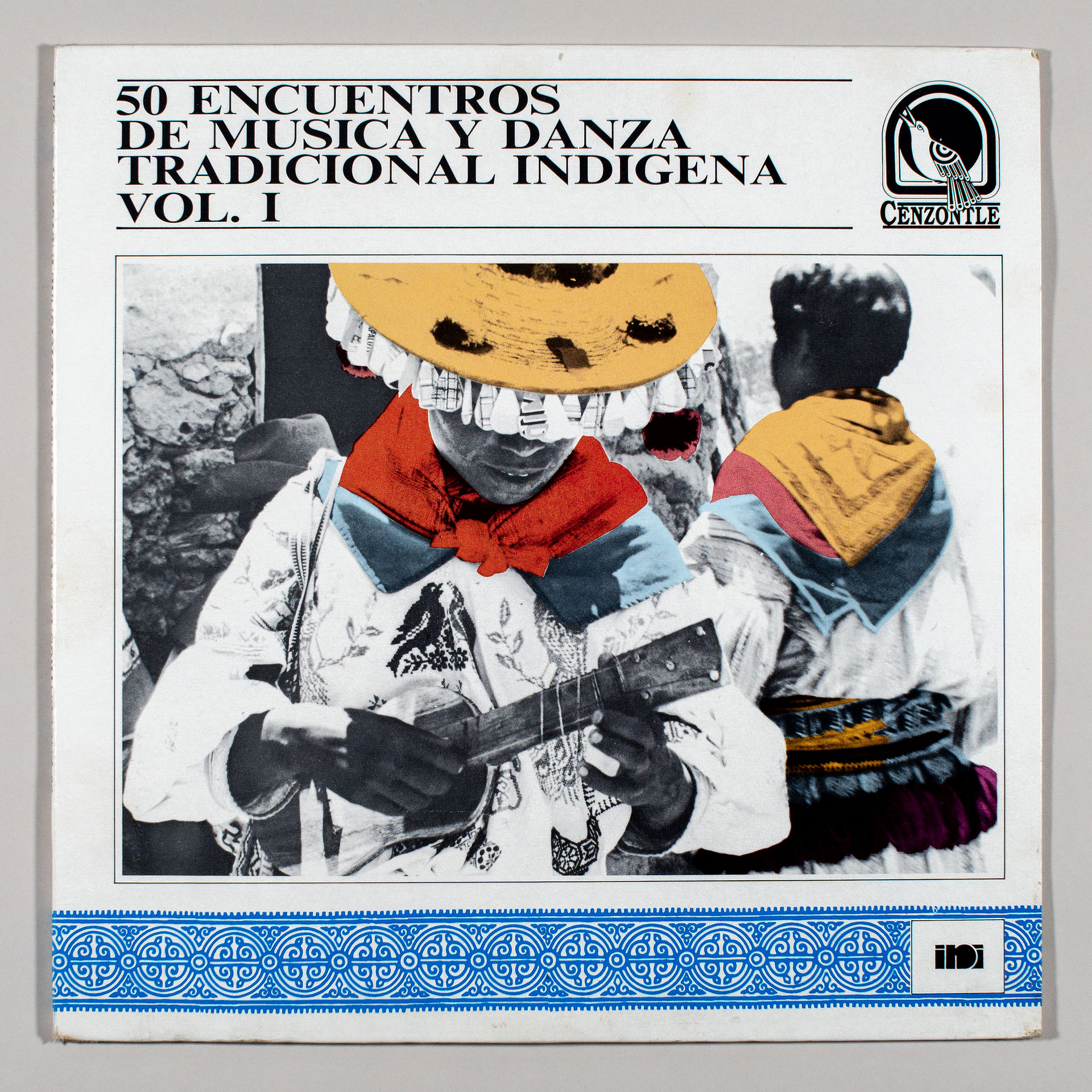
50 MEETINGS OF INDIGENOUS TRADITIONAL MUSIC AND DANCE VOL. I
Cenzontle
|
Format: Vinyl LP Album 12" 33 1/3 rpm Gatefold Compilation Released: 1990 |
Country: Mexico Genre: Folk World & Country |
Info:
50 MEETINGS OF INDIGENOUS TRADITIONAL MUSIC AND DANCE VOL. I
CENZONTLE
(MOCKINGBIRD)
INI
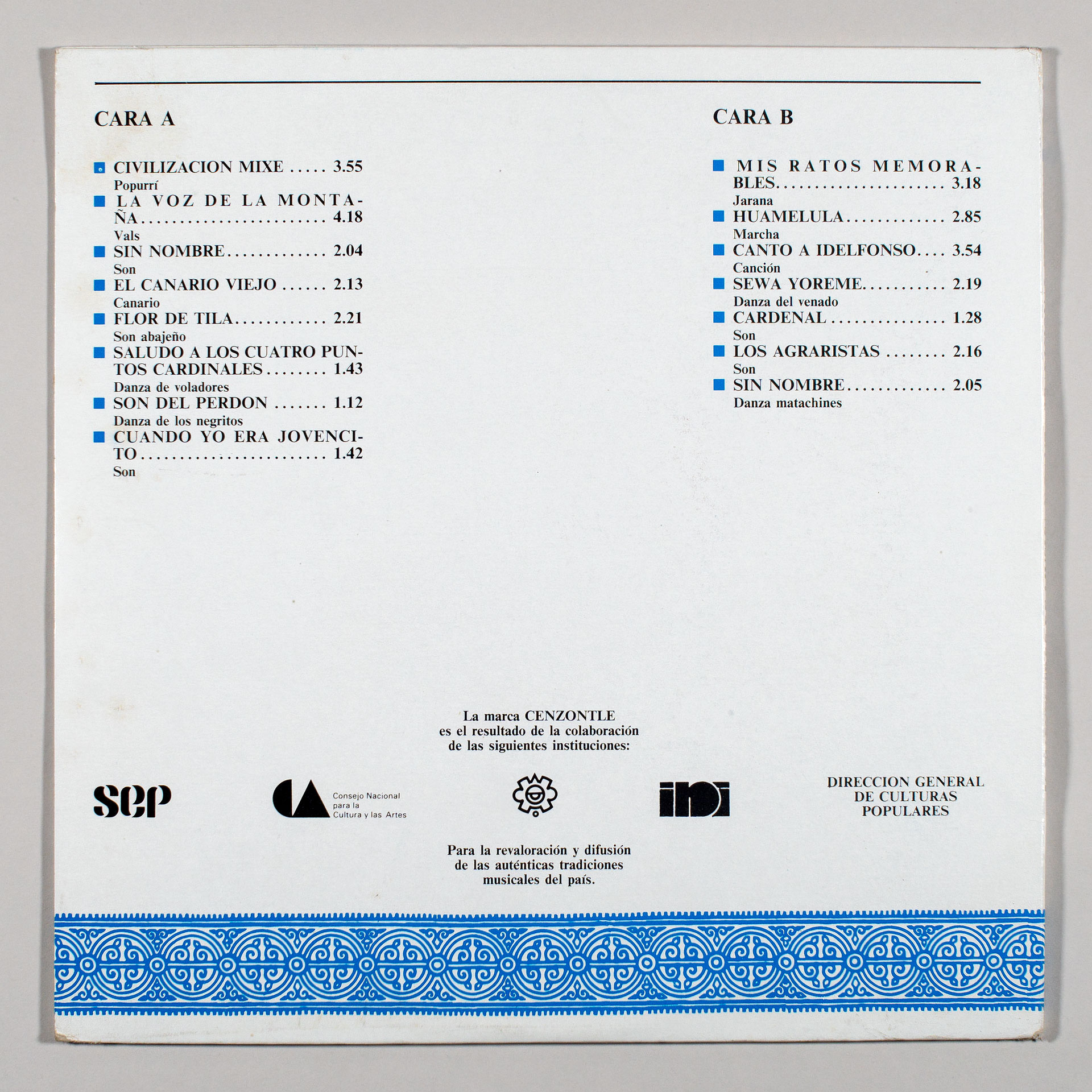
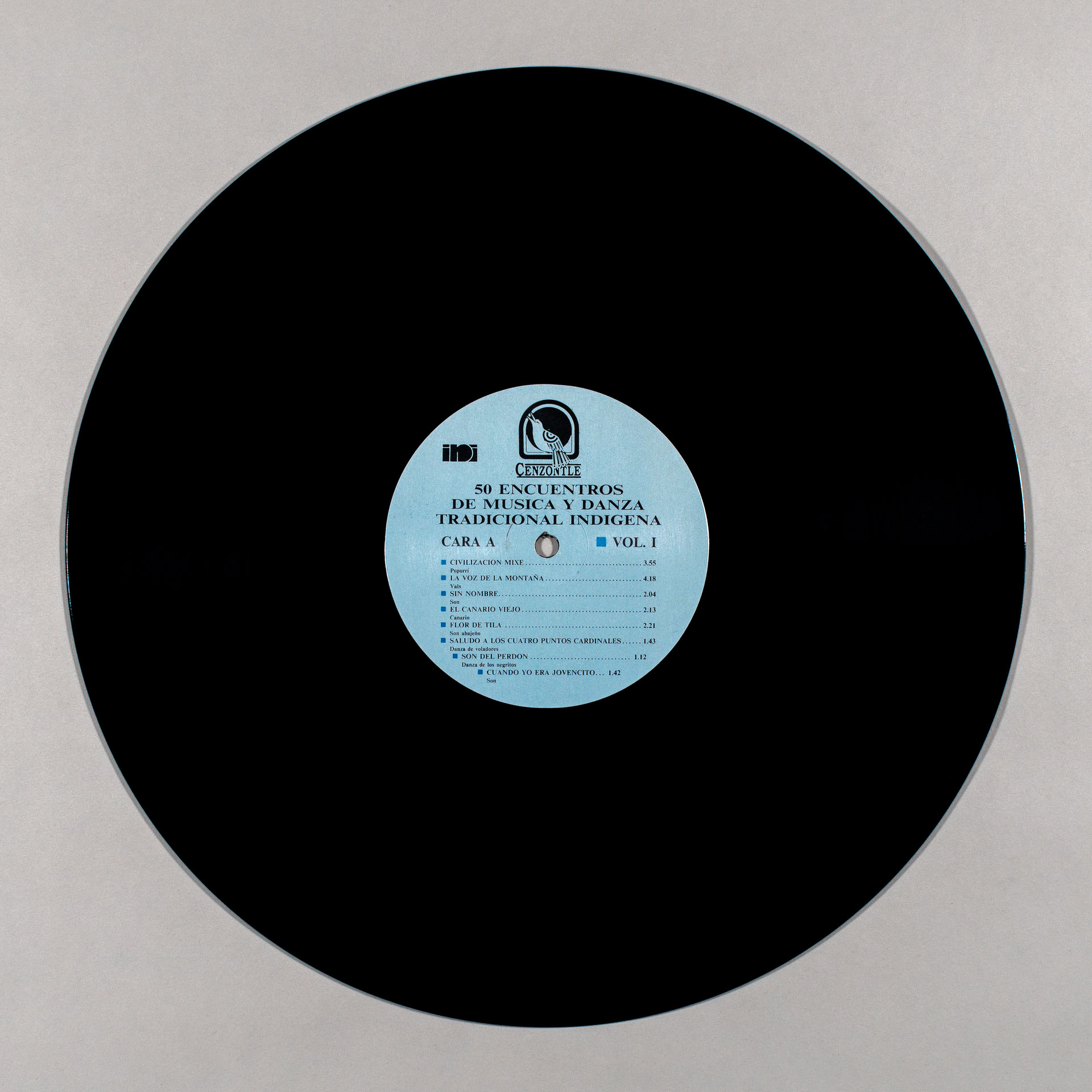
A SIDE
■ MIXE CIVILIZATION………………………………………………. 3:55
Potpourri
■ THE VOICE OF THE MOUNTAIN……………………………. 4:18
Waltz
■ WITHOUT A NAME……………………………………………….. 2:04
Son
■ THE OLD CANARY……………………………………………….. 2:13
Canary
■ LIME FLOWER…………………………………………………….. 2:21
Abajeño Son
■ GREETINGS TO THE FOUR CARDINAL POINTS…… 1:43
Dance of flyers
■ SON OF FORGIVENESS……………………………………….1:12
Dance of the blacks
■ WHEN I WAS YOUNG…………………………………………. 1:42
Son
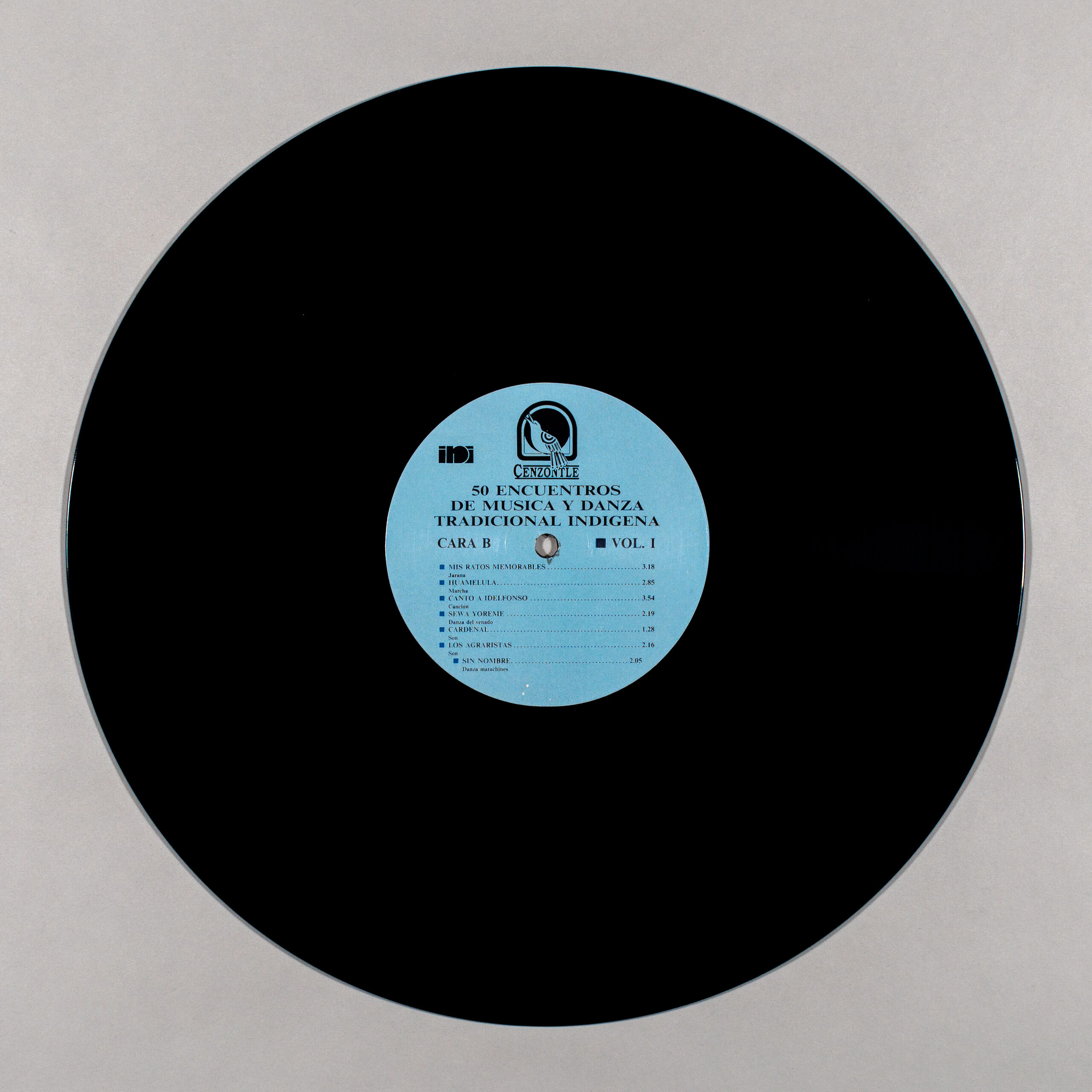
B SIDE
■ MY MEMORABLE TIMES…………………………………… 3:18
Revelry
■ HUAMELULA……………………………………………………. 2:85
March
■ SONG TO IDELFONSO……………………………………… 3:54
Song
■ SEWA YOREME……………………………………………….. 2:19
Deer Dance
■ CARDINAL………………………………………………………. 1:28
Son
■ THE AGRARIANS…………………………………………….. 2:16
Son
■ WITHOUT A NAME…………………………………………… 2:05
Matachines dance
The CENZONTLE brand is the result of the collaboration of the following institutions:
SEP, Consejo Nacional para la Cultura y las Artes, INAH, INI, DIRECCIÓN GENERAL DE CULTURAS POPULARES
For the revaluation and diffusion of the authentic musical traditions of the country.
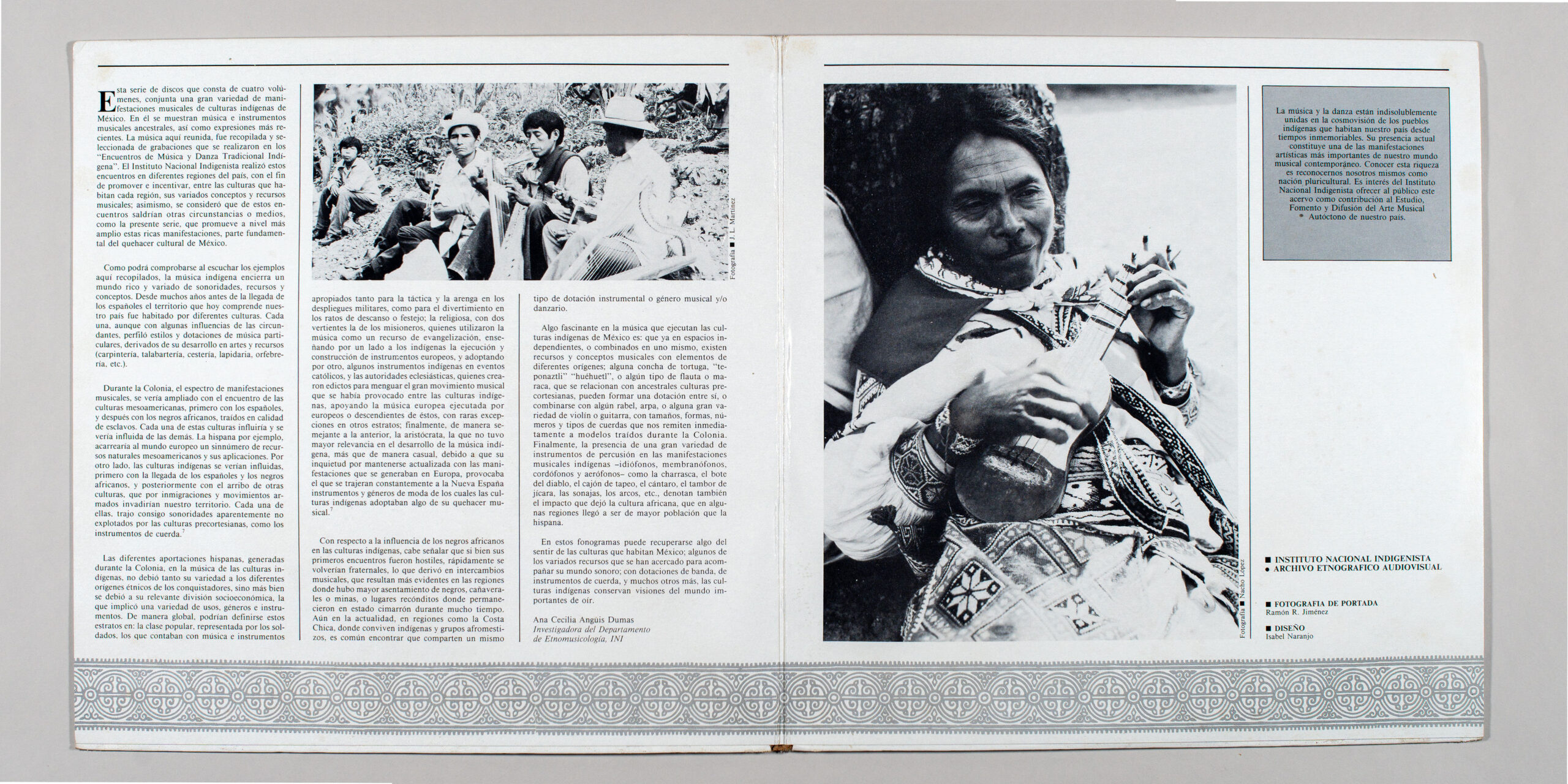
This series of records, consisting of four volumes, brings together a wide variety of musical expressions from the Indigenous cultures of Mexico. It presents both ancestral music and musical instruments, as well as more recent forms of expression. The music collected here was compiled and selected from recordings made during the “Encounters of Traditional Indigenous Music and Dance.” The National Indigenous Institute organized these gatherings in different regions of the country with the aim of promoting and encouraging, among the cultures inhabiting each region, their diverse musical concepts and resources. It was also believed that these encounters could lead to other initiatives and means of dissemination, such as the present series, which seeks to promote these rich expressions on a broader scale as a fundamental part of Mexico’s cultural life.
As can be heard in the examples collected here, Indigenous music encompasses a rich and varied world of sounds, resources, and concepts. Long before the arrival of the Spaniards, the territory that today constitutes our country was inhabited by different cultures. Each one, although influenced to some degree by neighboring cultures, developed distinctive musical styles and instrumental ensembles derived from its own development in the arts and crafts and the resources available to it (carpentry, leatherworking, basketry, stonework, metalwork, etc.).
During the colonial period, the spectrum of musical expressions expanded through the encounter between Mesoamerican cultures, first with the Spaniards and later with Black Africans brought as enslaved people. Each of these cultures influenced and was influenced by the others. Hispanic culture, for example, would bring back to the European world countless Mesoamerican natural resources and knowledge of their uses. Indigenous cultures, meanwhile, were influenced first by the arrival of the Spaniards and Africans, and later by other cultures that entered our territory through migration and armed conflicts. Each brought with it sounds apparently unknown or unexplored by pre-Columbian cultures, such as stringed instruments.
The various Hispanic contributions to the music of Indigenous cultures during the colonial period owed their diversity not so much to the different ethnic origins of the conquistadors, but rather to their pronounced socioeconomic divisions, which entailed a variety of uses, genres, and instruments. Broadly speaking, these strata could be defined as follows: the popular class, represented by soldiers, who had music and instruments suited both to military tactics and exhortation during deployments, as well as to entertainment during periods of rest or celebration; the religious class, with two branches—the missionaries, who used music as a means of evangelization, teaching Indigenous people, on the one hand, to perform on and construct European instruments, while on the other adapting certain Indigenous instruments for Catholic events; and the ecclesiastical authorities, who issued edicts intended to curb the great musical movement that had developed among Indigenous cultures, favoring European music performed by Europeans or their descendants, with rare exceptions in other social strata. Finally, in a manner similar to the latter, there was the aristocracy, which had no major relevance to the development of Indigenous music except occasionally, since its desire to remain up to date with cultural developments in Europe led to the constant introduction into New Spain of fashionable instruments and genres, from which Indigenous cultures adopted certain elements for their own musical practices.
With regard to the influence of Black Africans on Indigenous cultures, it should be noted that although their first encounters were hostile, they quickly became more fraternal, leading to musical exchanges. These are particularly evident in regions where there were larger African settlements, such as sugarcane-growing areas, mining regions, or remote places where communities of escaped enslaved people remained for long periods. Even today, in regions such as the Costa Chica, where Indigenous and Afro-Mestizo communities coexist, it is common to find that they share the same types of instrumental ensembles and musical and/or dance genres.
One fascinating aspect of the music performed by Mexico’s Indigenous cultures is that, whether independently or combined within the same musical practice, it incorporates resources and musical concepts originating from different traditions. A turtle shell, teponaztli, huehuetl, or some type of flute or rattle associated with ancient pre-Cortesian cultures may form an ensemble among themselves or be combined with a rebec, harp, violin, or one of the many varieties of guitar, whose sizes, shapes, numbers, and types of strings immediately recall models introduced during the colonial period. Finally, the presence of a great variety of instruments in Indigenous musical expressions—idiophones, membranophones, chordophones, and aerophones—such as the carrasca, bote del diablo, cajón de tapo, clay pot, gourd drum, rattles, musical bows, etc., also reveals the impact left by African culture, which in some regions came to outnumber the Hispanic population.
These recordings allow us to recover something of the sensibility of the cultures that inhabit Mexico and some of the many resources they have drawn upon to accompany their sonic world. Through wind bands, string ensembles, and many other instrumental formations, Indigenous cultures preserve worldviews that are important for us to hear.
Ana Cecilia Anguís Dumas
Researcher, Department of Ethnomusicology, INI
Text in the box
Music and dance are inseparably linked within the worldview of the Indigenous peoples who have inhabited our country since time immemorial. Their presence today constitutes one of the most important artistic expressions of our contemporary musical world. To understand this richness is to recognize ourselves as a multicultural nation. It is the intention of the National Indigenous Institute to make this collection available to the public as a contribution to the Study, Promotion, and Dissemination of the Indigenous Musical Art of our country.
NATIONAL INDIGENOUS INSTITUTE
ETHNOGRAPHIC AUDIOVISUAL ARCHIVE
COVER PHOTOGRAPHY
Ramón R. Jiménez
DESIGN
Isabel Naranjo
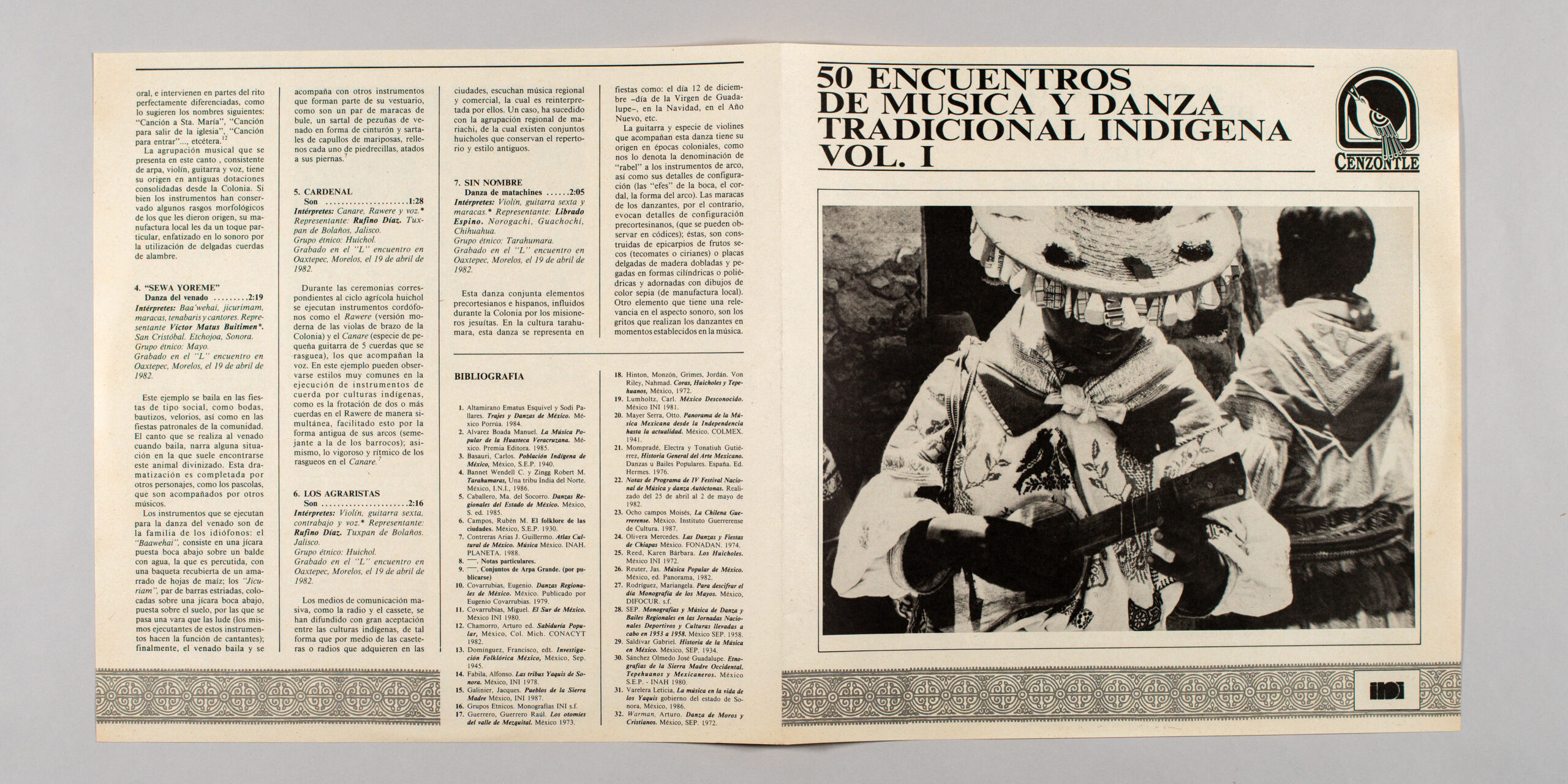
50 ENCOUNTERS OF TRADITIONAL INDIGENOUS MUSIC AND DANCE
VOL. I
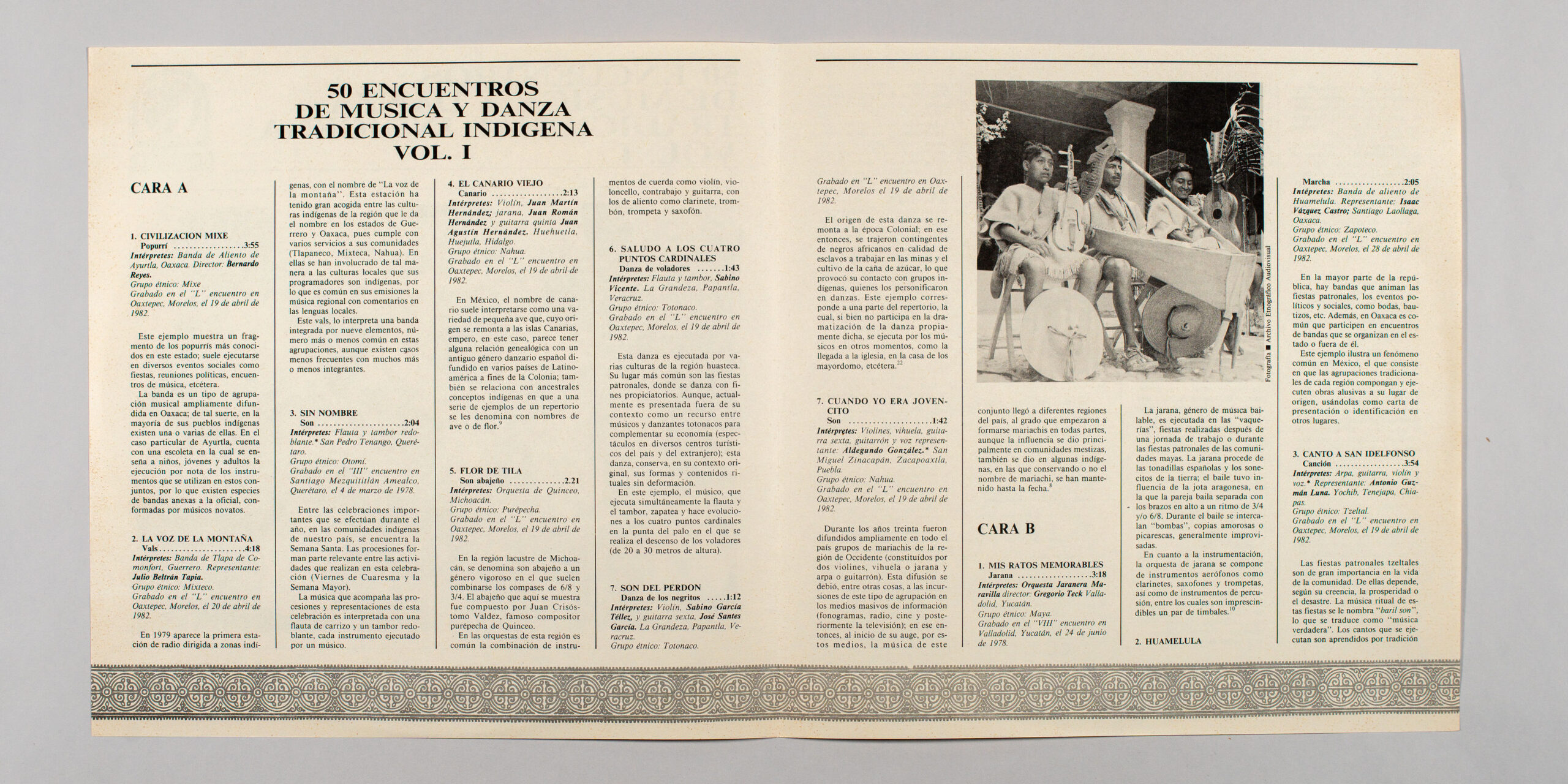
SIDE A
1. CIVILIZACIÓN MIXE
Medley — 3:55
Performers: Wind Band of Ayutla, Oaxaca.
Director: Bernardo Reyes.
Ethnic group: Mixe.
Recorded at the “L” Encounter in Oaxtepec, Morelos, April 19, 1982.
This example presents a fragment of some of the best-known medleys in the state; they are commonly performed at various social events such as celebrations, political gatherings, music festivals, etc.
The wind band is a type of musical ensemble widely found throughout Oaxaca; consequently, most of its Indigenous communities have one or several bands. In the particular case of Ayutla, there is a training ensemble in which children, young people, and adults are taught to read music and play the instruments used in these groups. As a result, there are apprentice bands associated with the main ensemble, made up of novice musicians.
2. LA VOZ DE LA MONTAÑA
Waltz — 4:18
Performers: Band of Tlapa de Comonfort, Guerrero. Representative: Julio Beltrán Tapia.
Ethnic group: Mixtec.
Recorded at the “L” Encounter in Oaxtepec, Morelos, April 20, 1982.
In 1979, the first radio station aimed at Indigenous regions appeared under the name “La Voz de la Montaña” (“The Voice of the Mountain”). The station has been warmly received among the Indigenous cultures of the region from which it takes its name, in the states of Guerrero and Oaxaca, since it provides various services to its communities (Tlapanec, Mixtec, Nahua). Local cultures have become so deeply involved that its programmers are themselves Indigenous, and its broadcasts commonly feature regional music accompanied by commentary in local languages.
This waltz is performed by a nine-member band, a fairly common size for ensembles of this type, although there are less frequent examples with considerably more or fewer musicians.
3. UNTITLED
Son — 2:04
Performers: Reed flute and snare drum: San Pedro Tenango, Querétaro.
Ethnic group: Otomí.
Recorded at the “III” Encounter in Santiago Mezquititlán, Amealco, Querétaro, March 4, 1978.
Among the important celebrations held throughout the year in the Indigenous communities of our country is Holy Week. Processions form an important part of the activities carried out during this celebration, including the Fridays of Lent and Holy Week itself.
The music accompanying the processions and representations of this celebration is performed with a reed flute and snare drum, each instrument played by one musician.
4. EL CANARIO VIEJO
Canario — 2:13
Performers: Violin, Juan Martín Hernández; jarana, Juan Román Hernández; guitarra quinta, Juan Agustín Hernández. Huehuetla, Hidalgo.
Ethnic group: Nahua.
Recorded at the “L” Encounter in Oaxtepec, Morelos, April 19, 1982.
In Mexico, the word canario is usually understood as referring to a small bird whose origin can be traced to the Canary Islands. In this case, however, it appears to have some genealogical relationship with an old Spanish dance genre that spread through several Latin American countries toward the end of the colonial period. It is also related to ancestral Indigenous concepts in which a series of pieces within a repertoire are named after birds or flowers.
5. FLOR DE TILA
Son abajeño — 2:21
Performers: Orchestra of Quinceo, Michoacán.
Ethnic group: Purépecha.
Recorded at the “L” Encounter in Oaxtepec, Morelos, April 19, 1982.
In the lake region of Michoacán, son abajeño is the name given to an energetic genre in which 6/8 and 3/4 meters are often combined. The abajeño presented here was composed by Juan Crisóstomo Valdez, a renowned Purépecha composer from Quinceo.
In the orchestras of this region, it is common to combine string instruments such as violin, cello, double bass, and guitar with wind instruments such as clarinet, trombone, trumpet, and saxophone.
6. SALUDO A LOS CUATRO PUNTOS CARDINALES
Dance of the Voladores — 1:43
Performers: Flute and drum, Sabino Vicente. La Grandeza, Papantla, Veracruz.
Ethnic group: Totonac.
Recorded at the “L” Encounter in Oaxtepec, Morelos, April 19, 1982.
This dance is performed by several cultures of the Huasteca region. Its most common setting is patron-saint festivals, where it is danced for propitiatory purposes. Today, however, it is also presented outside its traditional context as a source of income for Totonac musicians and dancers, in performances at tourist centers throughout Mexico and abroad. Within its original context, the dance nevertheless preserves its ritual forms and meanings without alteration.
In this example, the musician simultaneously plays the flute and drum, stamps his feet, and performs movements toward the four cardinal directions from the top of the pole from which the voladores descend, at a height of 20 to 30 meters.
7. SON DEL PERDÓN
Dance of the Negritos — 1:12
Performers: Violin, Sabino García Téllez; six-string guitar, José Santos García. La Grandeza, Papantla, Veracruz.
Ethnic group: Totonac.
Recorded at the “L” Encounter in Oaxtepec, Morelos, April 19, 1982.
The origin of this dance dates back to the colonial period, when contingents of Black Africans were brought as enslaved people to work in mines and sugarcane cultivation. This led to contact with Indigenous groups, who represented them in dances. This example corresponds to one part of the repertoire which, although not part of the dramatization of the dance itself, is performed by the musicians at other moments, such as upon arriving at the church, at the homes of the mayordomos, and so forth.
7. CUANDO YO ERA JOVENCITO
Son — 1:42
Performers: Violins, vihuela, six-string guitar, guitarrón, and voice. Representative: Aldegundo González. San Miguel Zinacapan, Zacapoaxtla, Puebla.
Ethnic group: Nahua.
Recorded at the “L” Encounter in Oaxtepec, Morelos, April 19, 1982.
During the 1930s, mariachi groups from western Mexico—consisting of two violins, vihuela or jarana, and harp or guitarrón—became widely known throughout the country. This dissemination was due, among other factors, to the appearance of these ensembles in mass media such as phonograph records, radio, cinema, and later television. At the beginning of their rise in popularity, mariachi music reached different regions of the country through these media, to the point that mariachi ensembles began to form everywhere. Although this influence occurred mainly in Mestizo communities, it also reached some Indigenous communities, where groups—whether or not they retained the name mariachi—have survived to the present day.
SIDE B
1. MIS RATOS MEMORABLES
Jarana — 3:18
Performers: Orquesta Jaranera Maravilla.
Director: Gregorio Teck. Valladolid, Yucatán.
Ethnic group: Maya.
Recorded at the “VIII” Encounter in Valladolid, Yucatán, June 24, 1978.
The jarana, a genre of dance music, is performed at vaquerías, celebrations held after a day’s work or during the patron-saint festivals of Maya communities. The jarana derives from Spanish tonadillas and sonesitos de la tierra. Its dance was influenced by the Aragonese jota, in which the couple dances apart with their arms raised, to a rhythm in 3/4 and/or 6/8. During the dance, bombas—romantic or humorous verses, generally improvised—are interspersed.
As for instrumentation, the jarana orchestra consists of wind instruments such as clarinets, saxophones, and trumpets, as well as percussion instruments, among which a pair of timpani is indispensable.
2. HUAMELULA
March — 2:05
Performers: Wind Band of Huamelula. Representative: Isaac Vázquez Castro; Santiago Laollaga, Oaxaca.
Ethnic group: Zapotec.
Recorded at the “L” Encounter in Oaxtepec, Morelos, April 28, 1982.
Throughout most of the country, bands provide music for patron-saint festivals and political and social events such as weddings, baptisms, and other celebrations. In Oaxaca, moreover, bands commonly participate in band gatherings organized both within and outside the state.
This example illustrates a common phenomenon in Mexico: traditional ensembles from each region compose and perform works referring to their place of origin, using them as a kind of calling card or means of identification when performing elsewhere.
3. CANTO A SAN IDELFONSO
Song — 3:54
Performers: Harp, guitar, violin, and voice.
Representative: Antonio Guzmán Luna. Yochib, Tenejapa, Chiapas.
Ethnic group: Tzeltal.
Recorded at the “L” Encounter in Oaxtepec, Morelos, April 19, 1982.
Tzeltal patron-saint festivals are of great importance in community life. According to local beliefs, prosperity or disaster may depend upon them. The ritual music of these celebrations is known as batz’i son, which translates as “true music.” The songs performed are learned through oral tradition and are used during clearly differentiated parts of the ritual, as suggested by titles such as “Song to Saint Mary,” “Song for Leaving the Church,” “Song for Entering…,” etc.
The musical ensemble heard in this song, consisting of harp, violin, guitar, and voice, has its origins in instrumental groupings established during the colonial period. Although the instruments have preserved certain morphological characteristics of the models from which they originated, their local manufacture gives them a distinctive character, further emphasized sonically by the use of thin wire strings.
4. “SEWA YOREME”
Deer Dance — 2:19
Performers: Baa’ wehai, jicuri’mam, rattles, drums, and singers.
Representative: Víctor Matus Buitimea. San Cristóbal, Etchojoa, Sonora.
Ethnic group: Mayo.
Recorded at the “L” Encounter in Oaxtepec, Morelos, April 19, 1982.
This dance is performed at social celebrations such as weddings, baptisms, and wakes, as well as during the community’s patron-saint festivals. The song performed for the deer while it dances narrates a situation in which this divinized animal might find itself. The dramatization is completed by other characters, such as the pascolas, who are accompanied by other musicians.
The instruments used for the Deer Dance include idiophones. The baawehai consists of a gourd placed upside down over a container of water and struck with a beater wrapped with tied corn leaves. The jicuri’mam are a pair of notched sticks placed over an inverted gourd resting on the ground; a stick is rubbed across them, and the musicians playing these instruments also serve as singers. Finally, the deer dances while accompanying itself with instruments that form part of its costume, including a pair of gourd rattles, a belt made from deer hooves, and strings of butterfly cocoons, each filled with small stones and tied around the dancer’s legs.
5. CARDENAL
Son — 1:28
Performers: Canare, Rawere, and voice.
Representative: Rufino Díaz. Tuxpan de Bolaños, Jalisco.
Ethnic group: Huichol.
Recorded at the “L” Encounter in Oaxtepec, Morelos, April 19, 1982.
During ceremonies corresponding to the Huichol agricultural cycle, chordophones such as the Rawere—a modern version of the colonial-era arm viols—and the Canare—a type of small five-string guitar played by strumming—are used to accompany the voice. This example reveals performance styles commonly found in string instruments among Indigenous cultures, such as bowing two or more strings of the Rawere simultaneously, facilitated by the old-fashioned shape of its bow, similar to Baroque bows. The vigorous and rhythmic strumming of the Canare is another characteristic feature.
6. LOS AGARRISTAS
Son — 2:16
Performers: Violin, six-string guitar, double bass, and voice.
Representative: Rufino Díaz. Tuxpan de Bolaños, Jalisco.
Ethnic group: Huichol.
Recorded at the “L” Encounter in Oaxtepec, Morelos, April 19, 1982.
Mass media such as radio and cassette recordings have become widely accepted among Indigenous cultures. Through cassette players and radios acquired in cities, communities listen to regional and commercial music, which they then reinterpret in their own way. One example of this process can be found in the regional mariachi ensemble: Huichol mariachi groups exist that preserve older repertoire and performance styles.
7. UNTITLED
Matachines Dance — 2:05
Performers: Violin, six-string guitar, and rattles.
Representative: Librado Espino. Norogachi, Guachochi, Chihuahua.
Ethnic group: Tarahumara.
Recorded at the “L” Encounter in Oaxtepec, Morelos, April 19, 1982.
This dance combines pre-Cortesian and Hispanic elements shaped during the colonial period through the influence of Jesuit missionaries. In Tarahumara culture, the dance is performed during celebrations such as December 12—the Feast of the Virgin of Guadalupe—Christmas, New Year, and others.
The guitar and types of violins accompanying this dance have their origins in the colonial period, as indicated by the use of the term rabel for bowed instruments and by details of their construction, such as the f-shaped sound holes, tailpiece, and shape of the bow. The dancers’ rattles, by contrast, evoke pre-Cortesian forms that can be observed in codices. They are made from the dried outer shells of fruits (tecomates or ciriancos) or from thin wooden sheets bent and glued into cylindrical or polyhedral forms and decorated with sepia-colored designs of local manufacture. Another important element of the sonic dimension is the dancers’ shouts, which occur at established moments in the music.
BIBLIOGRAPHY
- Altamirano Emaux Esquivel and Sol Piñeros. Trajes y Danzas de México. Mexico, 1984.
- Álvarez Boada, Manuel. La Música Popular de la Huasteca Veracruzana. Mexico: Premia Editora, 1985.
- Basauri, Carlos. Población Indígena de México. Mexico: S.E.P., 1940.
- Bennett, Wendell C. and Robert M. Zingg. Tarahumaras, Una tribu india del Norte. Mexico: I.N.I., 1986.
- Caballero, Ma. del Socorro. Danzas Regionales del Estado de México. Mexico, 1985.
- Campos, Rubén M. El folklore de las ciudades. Mexico: S.E.P., 1930.
- Contreras Arias, J. Guillermo. Atlas Cultural de México. Música. Mexico: INAH-PLANETA, 1988.
- ———. Notas particulares.
- ———. Conjuntos de Arpa Grande (forthcoming).
- Covarrubias, Eugenio. Danzas Regionales de México. Mexico, 1979.
- Covarrubias, Miguel. El Sur de México. Mexico: INI, 1980.
- Chamorro, Arturo, ed. Sahilaria Popular. Mexico: CONACYT, 1982.
- Domínguez, Francisco, ed. Investigación Folklórica. Mexico, 1945.
- Fabila, Alfonso. Las tribus Yaquis de Sonora. Mexico: INI, 1978.
- Galinier, Jacques. Pueblos de la Sierra Madre. Mexico: INI, 1987.
- Grupos Étnicos. Monografías INI, n.d.
- Guerrero, Raúl. Los otomíes del valle del Mezquital. Mexico, 1973.
- Hinton, Monzón, Grimes, Jordan, Von Riley, Nahmad. Coras, Huicholes y Tepehuanos. Mexico, 1972.
- Lumholtz, Carl. México Desconocido. Mexico: INI, 1981.
- Mayer Serra, Otto. Panorama de la Música Mexicana desde la Independencia hasta la actualidad. Mexico: COLMEX, 1941.
- Mompradé, Electra and Tonatiuh Gutiérrez. Historia General del Arte Mexicano. Danzas y Bailes Populares. Spain: Ed. Hermes, 1976.
- Notas de Programa de IV Festival Nacional de Música y Danza Autóctonas. April 25–May 2, 1982.
- Ochoa Campos, Moisés. La Chilena Guerrerense. Mexico: Instituto Guerrerense de Cultura, 1987.
- Olivera, Mercedes. Las Danzas y Fiestas de Chiapas. Mexico: FONADAN, 1974.
- Reed, Karen Barbara. Los Huicholes. Mexico: INI, 1972.
- Reuter, Jas. Música Popular de México. Mexico: Panorama, 1982.
- Rodríguez, Mariangela. Para descifrar el día. Monografía de los Mayos. Mexico: DIFOCUR, n.d.
- SEP. Monografías y Música de Danza y Bailes Regionales en las Jornadas Nacionales Deportivas y Culturales. Mexico: SEP, 1988.
- Saldívar, Gabriel. Historia de la Música en México. Mexico: SEP, 1934.
- Sánchez Olmedo, José Guadalupe. Etnografía de la Sierra Madre Occidental. Tepehuanos y Mexicaneros. Mexico: S.E.P.-INAH, 1980.
- Varela, Leticia. La música en la vida de los Yaquis. Government of the State of Sonora, Mexico, 1986.
- Warman, Arturo. Danza de Moros y Cristianos. Mexico: SEP, 1972.
Galería:
Tracklist:
50 MEETINGS OF INDIGENOUS TRADITIONAL MUSIC AND DANCE VOL. I
SIDE 1
- A1 Mixe Civilization 3:55
Performer(s): - A2 The Voice of the Mountain. 4:18
Performer(s): - A3 No Name. 2:04
Performer(s):
- A4 The Old Canary. 2:13
Performer(s): - A5 Lime Flower 2:21
Performer(s): - A6 Salute To The Four Cardinal Points 1:43
Performer(s): - A7 Son Of Forgiveness 1:12
Performer(s): - A8 When I Was Young 1:42
Performer(s):
SIDE 2
- B1 My Memorable Times 3:18
Performer(s): - B2 Huamelula 2:85
Performer(s): - B3 Song to Ildefonso 3:54
Performer(s): - B4 Sewa Yoreme 2:19
Performer(s): - B5 Cardinal 1:28
Performer(s): - B6 The Agraristas 2:16
Performer(s): - B7 Nameless 2:05
Performer(s):
Credits:
- Institution: National Indigenous Institute (INI)
- Archive: Ethnographic Audiovisual Archive
- Research and Text: Ana Cecilia Anguís Dumas, Department of Ethnomusicology, INI
- Cover Photography: Ramón R. Jiménez
- Design: Isabel Naranjo
- Series: 50 Encounters of Traditional Indigenous Music and Dance, Vol. I
- Label / Series: Cenzontle
Links:
 Various – 50 Encounters of Traditional Indigenous Music and Dance Vol. I
Condition:
Media Condition:
Mint (M)Sleeve Condition:
Mint (M)Condition Notes:
SEALED