






THE TOCOTINES
FONADAN
|
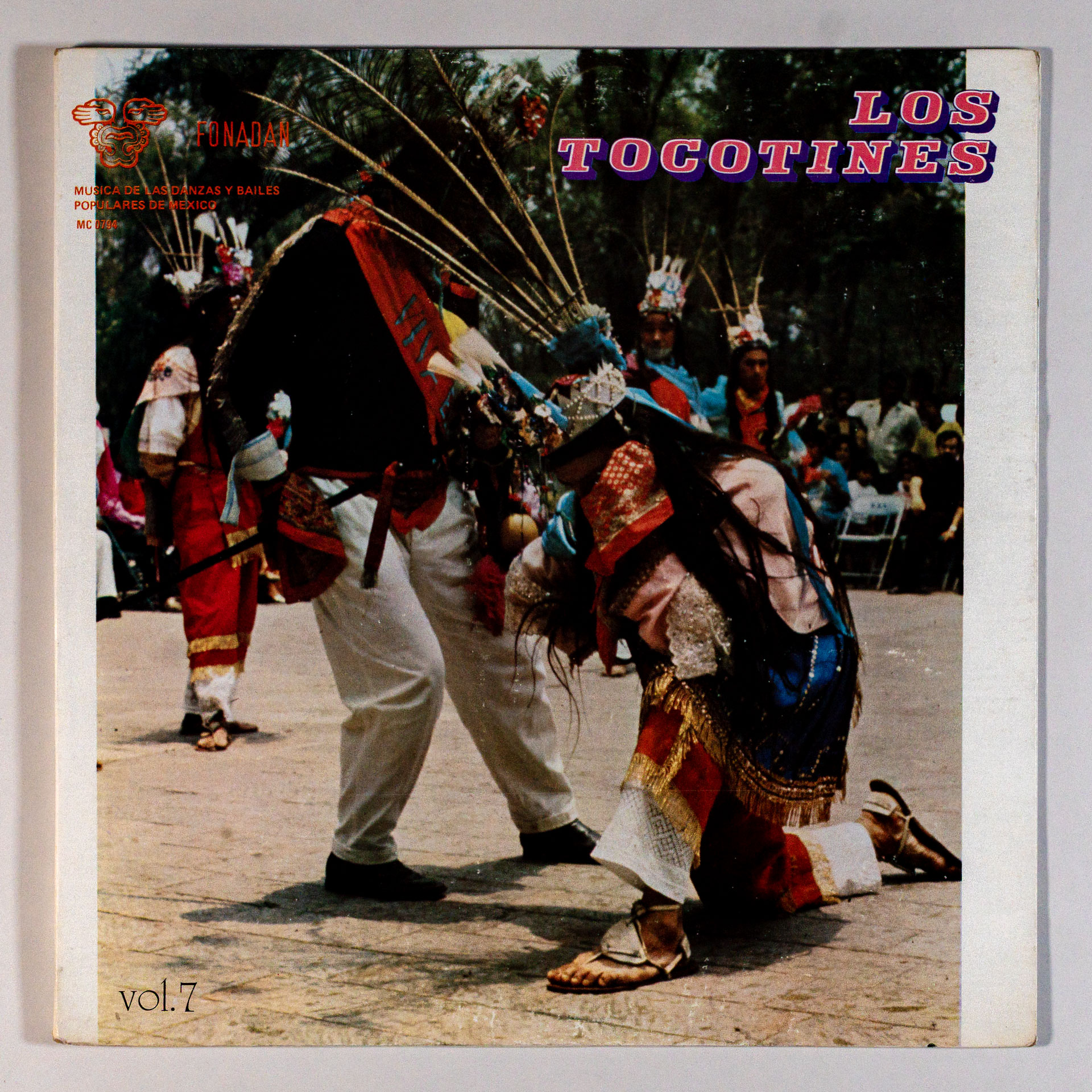
Label: FONADAN MC-0794 Format: Vinyl LP Album 12" 33 1/3 rpm Gatefold Compilation |
Country: Mexico Genre: Folk World & Country |
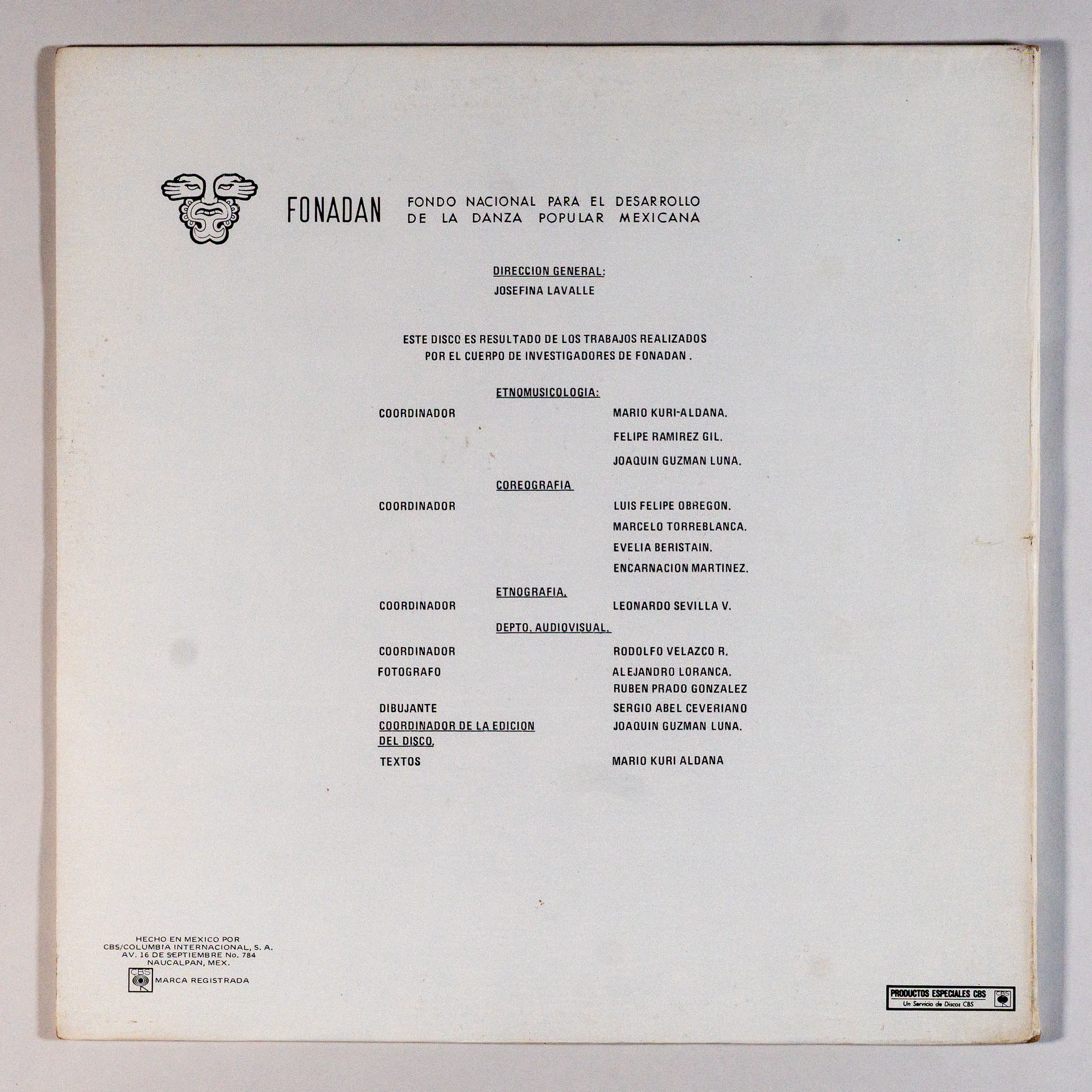
Info:
FONADAN
National Fund for the Development of Mexican Popular Dance.
MUSIC OF THE DANCES AND POPULAR DANCES OF MEXICO
THE TOCOTINES
MC-0794
VOL. 7
FONADAN
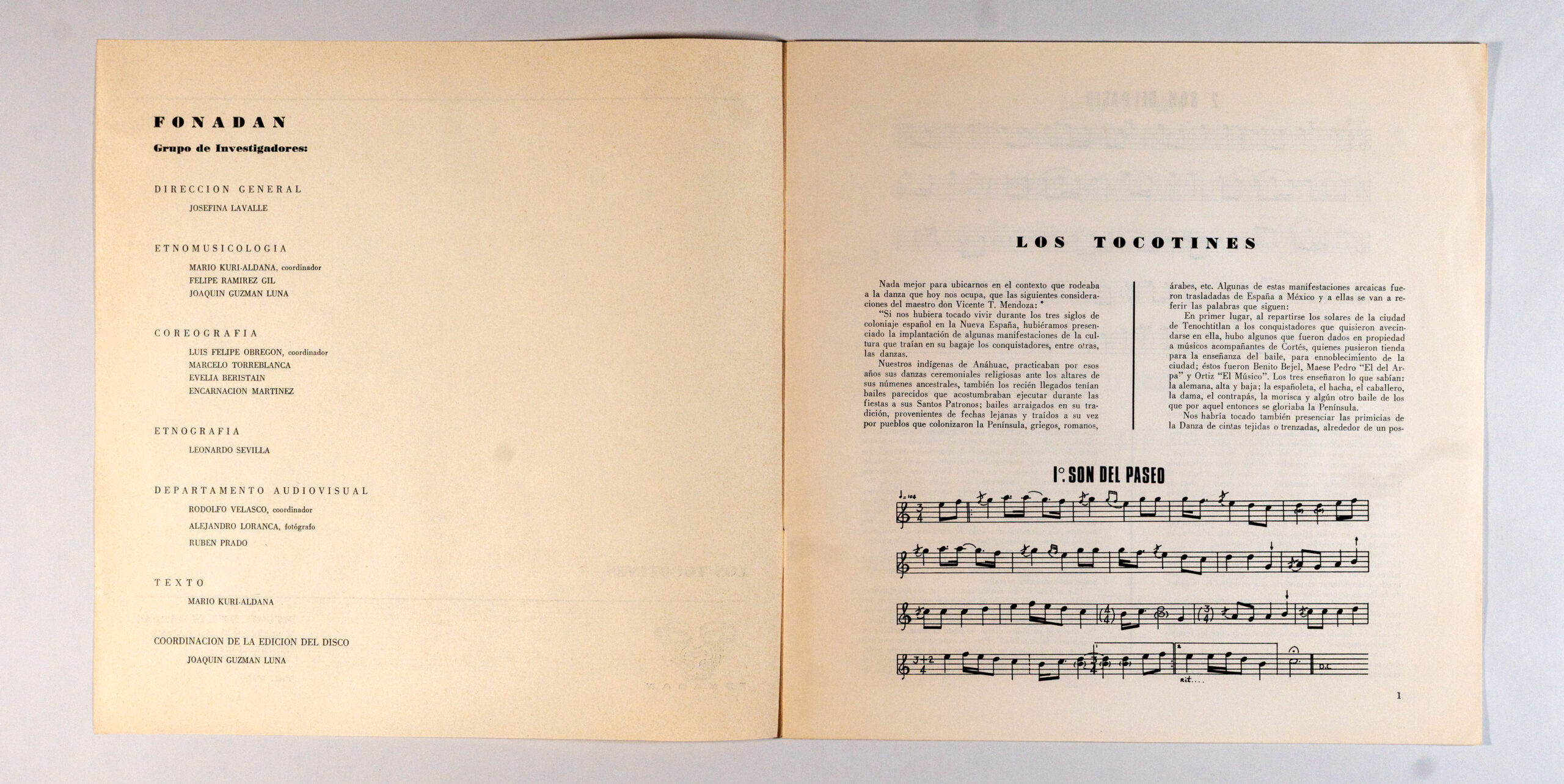
Research Group:
GENERAL DIRECTORATE:
JOSEFINA LAVALLE
ETHNOMUSICOLOGY:
MARIO KURI-ALDANA, Coordinator
JOAQUÍN GUZMÁN LUNA
CHOREOGRAPHY:
LUIS FELIPE OBREGÓN, Coordinator
EVELIA BERISTAIN
DIFFUSION:
XOCHITL MEDINA, Coordinator
DEPARTAMENTO AUDIOVISUAL:
RODOLFO VELASCO, Coordinator
ALEJANDRO LORANCA, Photographer
RUBEN PRADO, Editor technician
TEXT
MARIO KURI-ALDANA
THE TOCOTINES
Nothing better to situate ourselves in the context that surrounded the dance that concerns us today, than the following considerations of the teacher Don Vicente T. Mendoza: *
“If we had had to live during the three centuries of Spanish colonization in New Spain, we would have witnessed the implantation of some manifestations of the culture that the conquerors brought in their baggage, among others, dances.
Our natives of Anahuac, practiced in those years their religious ceremonial dances before the altars of their ancestral numbers, also the newcomers had similar dances that they used to perform during the festivities to their Patron Saints; dances rooted in their tradition, coming from distant dates and brought in turn by peoples that colonized the Peninsula, Greeks, Romans, Arabs, etc. Some of these archaic manifestations were transferred from Spain to Mexico and the following words will refer to them:
In the first place, when the plots of the city of Tenochtitlan were distributed to the conquistadors who wanted to settle there, there were some that were given as property to musicians accompanying Cortés, who set up a shop to teach dance, to ennoble the city; These were Benito Bejel, Maese Pedro “El del Arpa” and Ortiz “El Músico”. The three taught what they knew: the German, high and low; the Spanish, the axe, the gentleman, the lady, the contrapás, the Moorish and some other dance that the Peninsula gloried about at that time.
We would also have had to witness the first fruits of the Dance of woven or braided ribbons, around a pole, which the Castilians taught the maidens of Tlaxcala, whose tradition was deeply rooted in that Republic. In the same way we would have contemplated the Combats of Moors and Christians, which, the same in Mexico as in Tlaxcala, took place in 1583 under the title of “Taking of Rhodes” or “Taking of Jerusalem”. And we would have seen the natives, with great satisfaction, assume the immeasurable personalities of Captain Cortés, the Tlatoani Moctezuma and even more, that of the Apostle “Señor Santiago”, killing Moors with his invincible cutlass or declaiming those long lines of verses in which demands the great Sultan of Turkey to receive baptism. It was thus that the soul of the natives was captivated and accepted without fuss the new faith that the meek evangelizers instilled in them during the first days of expiration.
From Lagos de Jalisco to Guatemala, passing through Oaxaca, even among the Mixes, the memory of the events of the Conquest was perpetuated in the form of a dance…
Even without accepting that the savage imposition of the “new Faith” had “meekly” captivated the Mexicas, the words of Don Vicente can be a beginning to help us unravel the mystery that surrounds the origins of the Dance of Los Tocotines.
Currently, the dance of “El Tocotín” or “Tocotines” is widespread in the mountain towns of the State of Puebla and in neighboring regions of the States of Hidalgo and Veracruz; It is danced as an offering to the Patron Saints during religious festivities.
Within a general aspect, it corresponds to the cycle of dances of conquest, used to carry out evangelization among the indigenous people, since through its action, it intends to justify the conquest of Mexico through the new Christian faith, as it was It shows the last of the sones that are executed in this dance by merging the union of the two parties in the cross.
According to the version of the prominent folklorist Arturo Warman, this dance takes its name from one of the first musical forms created in the country after the conquest; the “Tocotín”, in which musical elements of pre-Hispanic origin were surely used. Later we will see that the opinion of this researcher is very close to the true origins of this dance, but it does not fully reach them.
In the book “The Spiritual Conquest of Mexico”, by Robert Ricard, it is indicated that “one of the first songs composed in Spanish by the Indians was the one that was sung on the occasion of the Forgiveness festival, called “Tocotín”. It is a partially correct report, since it would mean that the tocotines are only a series of songs.In reality, it seems that the word “Tocotín” has a much broader and more representative meaning.
For us, that meaning is discovered with crystal clarity by the notable historian Ignacio Osorio Romero, according to his following paragraphs:
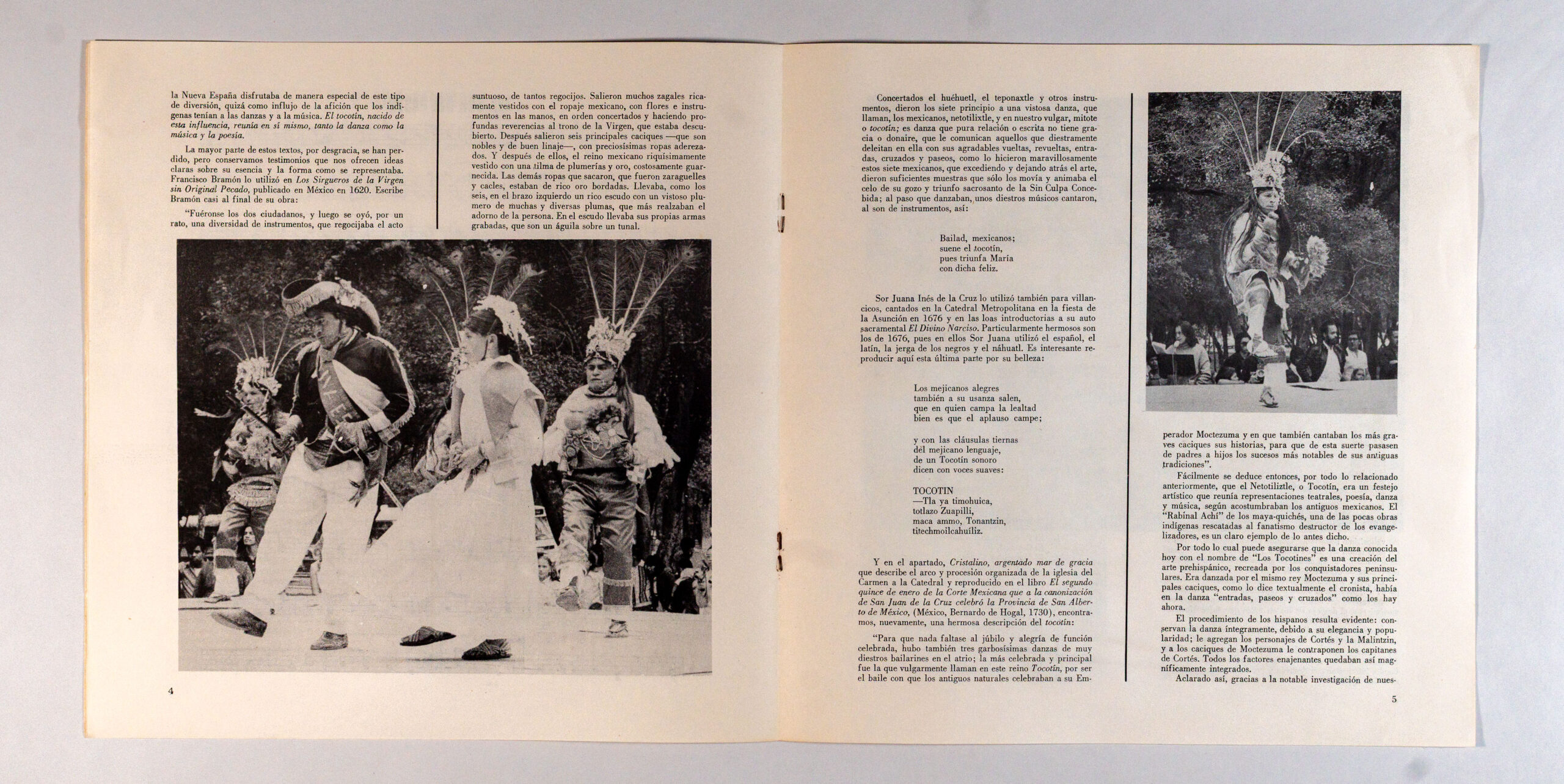
“The fondness of New Spain for theatrical performances responded not only to the evangelizing impulse of the friars, but was also a reflection of the peninsular enthusiasm for this genre that constituted, according to Alfonso Reyes, “their cinema and their daily newspaper, their fodder of imagination and its current commentary”. But the spectators not only demanded to see the dramatization of a theological or philosophical issue on the stage, they also needed popular entertainment such as dance, praise, hors d’oeuvres, jácaras and music. The public of New Spain He enjoyed this type of entertainment in a special way, perhaps as an influence of the fondness that the natives had for dances and music.The tocotín, born of this influence, brought together dance, music and poetry.
Unfortunately, most of these texts have been lost, but we have testimonies that offer us clear ideas about its essence and the way it was represented. Francisco Bramón used it in Los Sirgueros de la Virgen sin Original Pecado, published in Mexico in 1620. Bramón writes almost at the end of his work:
“The two citizens left, and then a diversity of instruments was heard, for a while, which rejoiced the sumptuous act, of so much rejoicing. Many lads richly dressed in Mexican clothing came out, with flowers and instruments in their hands, in order arranged and making profound obeisances to the throne of the Virgin, which was uncovered. Afterwards, six main caciques came out —who are nobles and of good lineage—, with very precious adorned clothes. And after them, the Mexican kingdom richly dressed in a tilma of plumerias and gold, costly trimmed. The other clothes they brought out, which were zaragüelles and cacles, were embroidered with rich gold. Like the six of them, on his left arm was a rich shield with a colorful duster of many and diverse feathers, which further enhanced the adornment of the person.In the shield he carried his own engraved arms, which are an eagle on a tunal.
Arranged the huehuetl, the teponaxtle and other instruments, the seven began a showy dance, which the Mexicans call netotiliztli, and in our vulgar, mitote or tocotín; It is dance that purely related or written has no great. cia or grace, communicated to it by those who skilfully delight in it with their pleasant twists, turns, entrances, crossings and walks, as these seven Mexicans did marvelously, who exceeding and leaving art behind, gave enough samples that only moved them and the zeal of his joy and sacrosanct triumph of Conceived Without Guilt animated; As they danced, some skilful musicians sang, to the sound of instruments, like this:
Dance, Mexicans;
sound the tocotín,
Well, Maria triumphs
with happy bliss.
Sor Juana Inés de la Cruz also used it for Christmas carols, sung in the Metropolitan Cathedral on the Feast of the Assumption in 1676 and in the introductory praises to her auto sacramental El Divino Narciso. Particularly beautiful are those of 1676, since in them Sor Juana used Spanish, Latin, the jargon of blacks and Nahuatl. It is interesting to reproduce this last part here because of its beauty:
The happy mexicans
They also go out in their fashion,
that in whom loyalty reigns,
it is good that the applause reigns;
and with the tender clauses
of the Mexican language,
of a sonorous Tocotín
they say in soft voices:
TOCOTIN
—Tla ya timohuica,
all bow Zuapilli,
maca ammo, Tonantzin,
titechmoilcahuíliz.
And in the section, Cristalino, argentado mar de gracia that describes the arch and organized procession from the church of Carmen to the Cathedral and reproduced in the book The second fifteenth of January of the Mexican Court that to the canonization of San Juan de la Cruz celebrated by the Province of San Alberto de México, (Mexico, Bernardo de Hogal, 1730), we find, once again, a beautiful description of the tocotín:
“So that nothing was lacking in the jubilation and joy of the function celebrated, there were also three very graceful dances performed by very skilful dancers in the atrium; the most celebrated and main one was the one that is commonly called in this kingdom Tocotín, for being the dance with which the ancient natives They celebrated their Emperor Moctezuma and in which the most serious caciques also sang their stories, so that in this way the most notable events of their ancient traditions would pass from father to son.
It is easily deduced then, from everything related above, that the Netotiliztle, or Tocotín, was an artistic celebration that brought together theatrical performances, poetry, dance and music, as the ancient Mexicans used to do. The “Rabinal Achí” of the Maya-Quichés, one of the few indigenous works rescued from the destructive fanaticism of the evangelizers, is a clear example of what has been said before.
For all of which it can be ensured that the dance known today as “Los Tocotines” is a creation of pre-Hispanic art, recreated by the peninsular conquerors. It was danced by King Moctezuma himself and his main caciques, as the chronicler literally says, there were in the dance “entrances, walks and crosses” as there are now.
The procedure of the Hispanics is evident: they preserve the dance entirely, due to its elegance and popularity; they add the characters of Cortés and Malinche, and the chiefs of Moctezuma are contrasted with the captains of Cortés. All the alienating factors were thus magnificently integrated.
Clarified in this way, thanks to the remarkable investigation of our invaluable historian Ignacio Osorio Romero, the mystery of the dance of “Los Tocotines”, let’s see what state this dance currently maintains, according to the investigations carried out since 1973 by FONADAN:
The mountain group that comes from the town of Atempan, Pue., presents its dramatized dance of “Los Tocotines” in a version of “dance of conquest”, for representing with movements the stripping of attributes suffered by Moctezuma by order of Hernán Cortés .
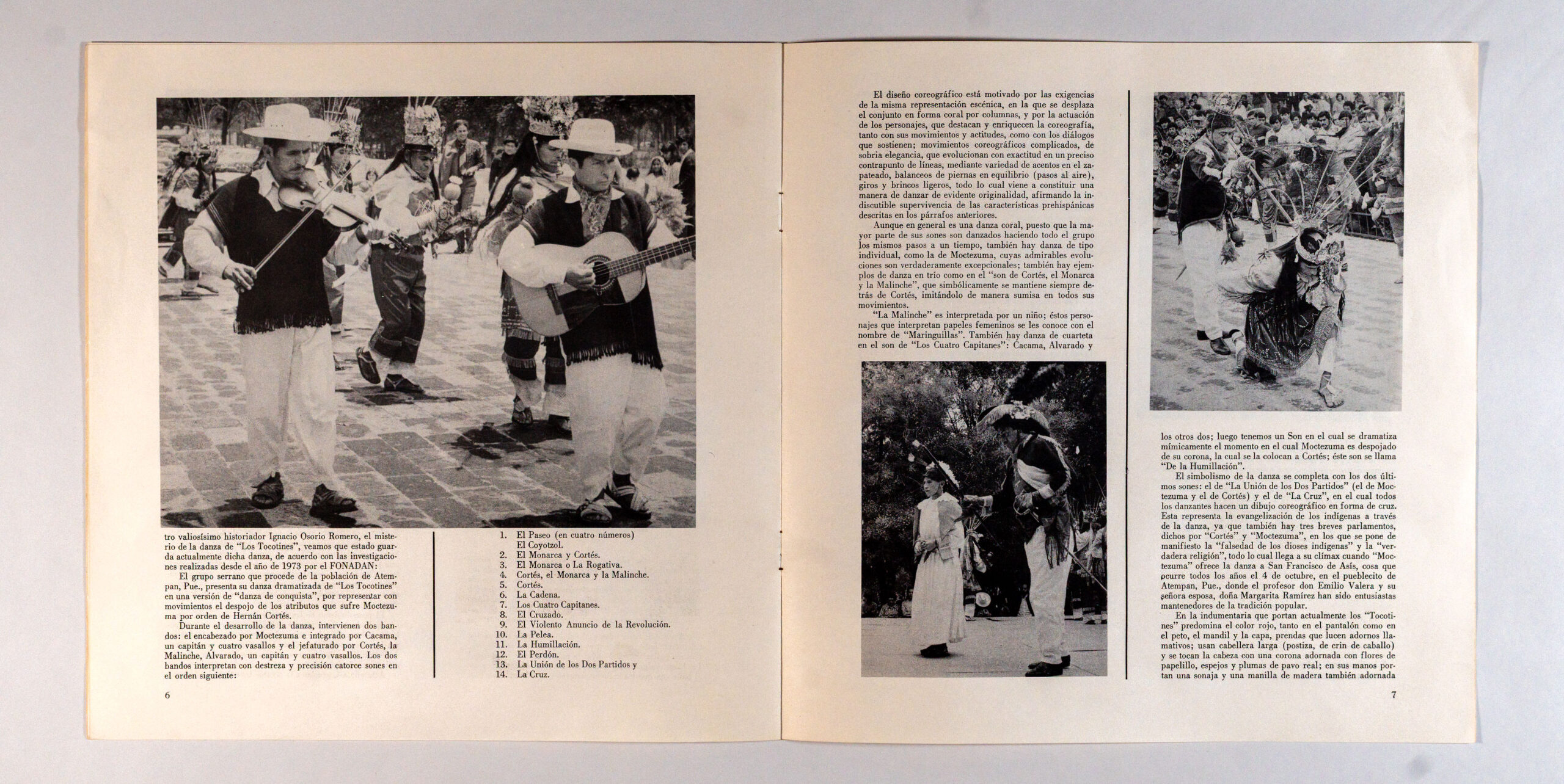
During the development of the dance, two groups intervene: the one headed by Moctezuma and integrated by Cacama, a captain and four vassals and the one led by Cortés, Malinche, Alvarado, a captain and four vassals. The two sides play fourteen sones with skill and precision in the following order:
The Walk (four sones)*
1. The Coyotzol.
2. The Monarch and Cortés.
3. The Monarch or La Rogativa.
4. Cortés, the Monarch and Malinche.
5. Polite.
6. The Chain.
7. The Four Captains.
8. The Crusader.
9. The Violent Announcement of the Revolution.
10. The Fight.
11. Humiliation.
12. Forgiveness.
13. The Union of the Two Parties and
14. The Cross.
* On this occasion, only one was recorded, annotated as a “record” by maestro Téllez Girón, back in 1940.
The choreographic design is motivated by the demands of the stage representation itself, in which the group moves in choral form by columns, and by the performance of the characters, who stand out and enrich the choreography, both with their movements and attitudes, as well as with the dialogues they hold; Complicated choreographic movements, of sober elegance, that evolve with precision in a precise counterpoint of lines, through a variety of accents in the footwork, swinging of the balanced legs (steps in the air), turns and light jumps, all of which constitutes a way of dancing of evident originality, affirming the indisputable survival of the pre-Hispanic characteristics described in the previous paragraphs.
Although in general it is a choral dance, since most of its sounds are danced with the whole group doing the same steps at the same time, there is also an individual type of dance, such as that of Moctezuma, whose admirable evolutions are truly exceptional; There are also examples of trio dance such as the “son de Cortés, el Monarca y la Malinche”, which symbolically always remains behind Cortés, imitating him submissively in all of his movements.
“La Malinche” is performed by a child; these characters that play female roles are known by the name of “Maringuillas”. There is also a quartet dance to the sound of “Los Cuatro Capitanes”: Cacama, Alvarado and the other two; then we have a Son in which the moment in which Moctezuma is stripped of his crown is mimicked, which is placed on Cortés; This one is called “El Despojo” and “La Humiliación”.
The symbolism of the dance is completed with the last two sones: that of “La Unión de los Dos Partidos” (the one of Moctezuma and that of Cortés) and that of “La Cruz”, in which all the dancers make a choreographic drawing. in cross shape. This represents the evangelization of the indigenous people through dance, since there are also three short speeches, spoken by “Cortes” and “Moctezuma”, “, in which the “falsehood of the indigenous gods” is revealed and the “true religion”, all of which reaches its climax when “Moctezuma” offers the dance to San Francisco de Asís, which happens every year on October 4, in the small town of Atempan, Pue., where Professor Don Emilio Valera and his wife, Mrs. Margarita Ramírez, have been enthusiastic maintainers of the popular tradition.
In the clothing that the “Tocotines” currently wear, the red color predominates, both in the pants and in the bib, the apron and the cape, garments that show off striking ornaments; they wear long hair (false, horsehair) and they touch their heads with a crown adorned with paper flowers, mirrors and peacock feathers; in their hands they carry a rattle and a wooden handle also decorated (attire very similar to those described in the aforementioned seventeenth-century chronicles). The clothing of “Moctezuma” stands out for the largest and best decorated plume, in the center of which is a golden crown. “Cortes”, for his part, wears a French military-style jacket, black with red stripes on the edges, gold chevrons, and a red sash across his chest with the sign “Viva España”, he wears black boots, and holds a fist in his left hand. a sword and on the right a baton. “La Malinche”, a boy dressed as a woman, with his own long hair, wears a white cloth blouse and skirt, wears sandals and on his head he wears a diadem of paper flowers; in his hands he holds colored bandanas.
In Atempan, Pue., when the ladies find themselves in some trouble, they make an “order” for one of their children to be a “maringuilla.” They let her hair grow; the boy suffers the ridicule of the other boys until the day arrives when the dance is presented. When he finishes dancing, the “command” also ends. The following year there will be another “maringuilla” in its place.
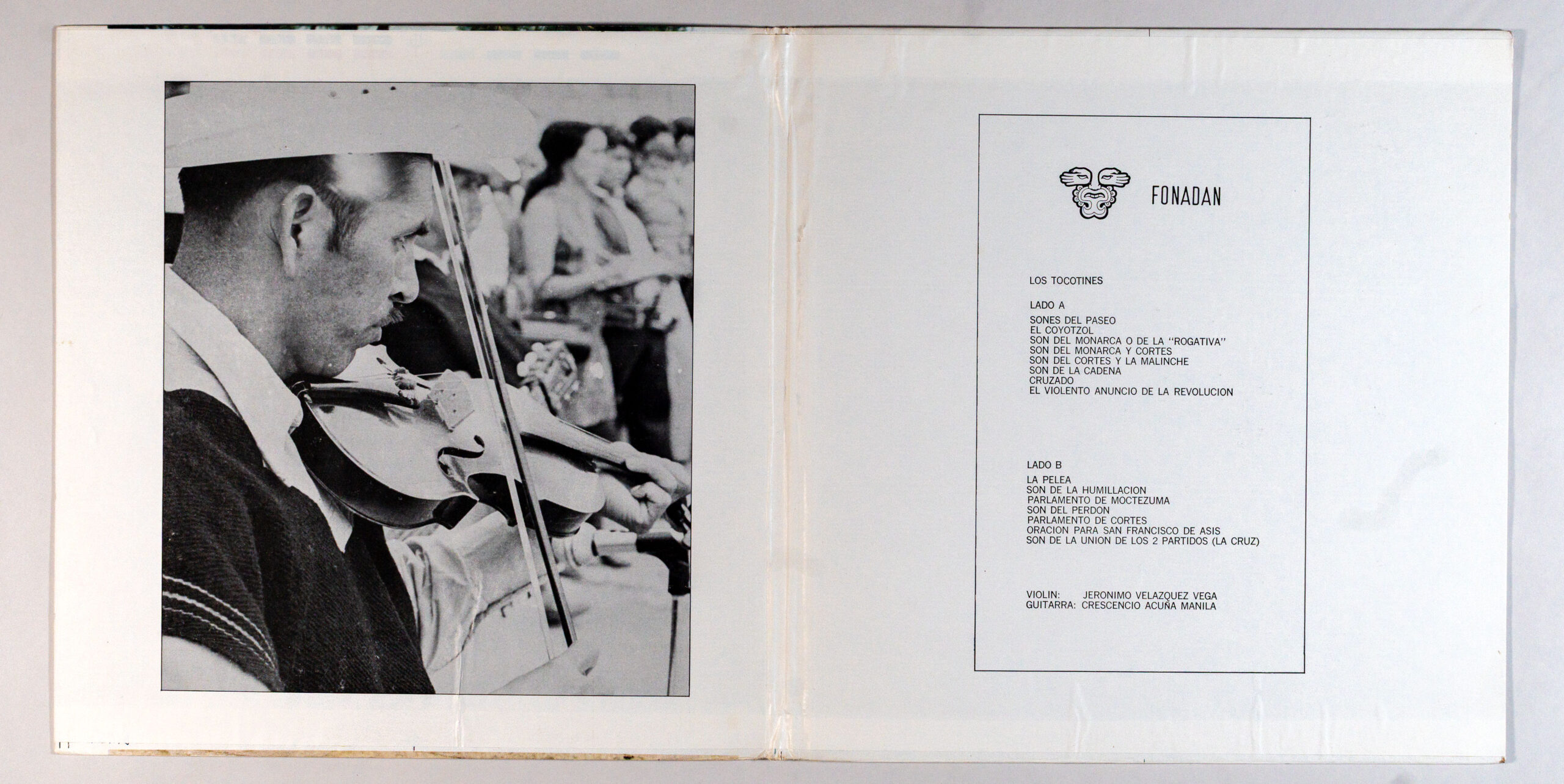
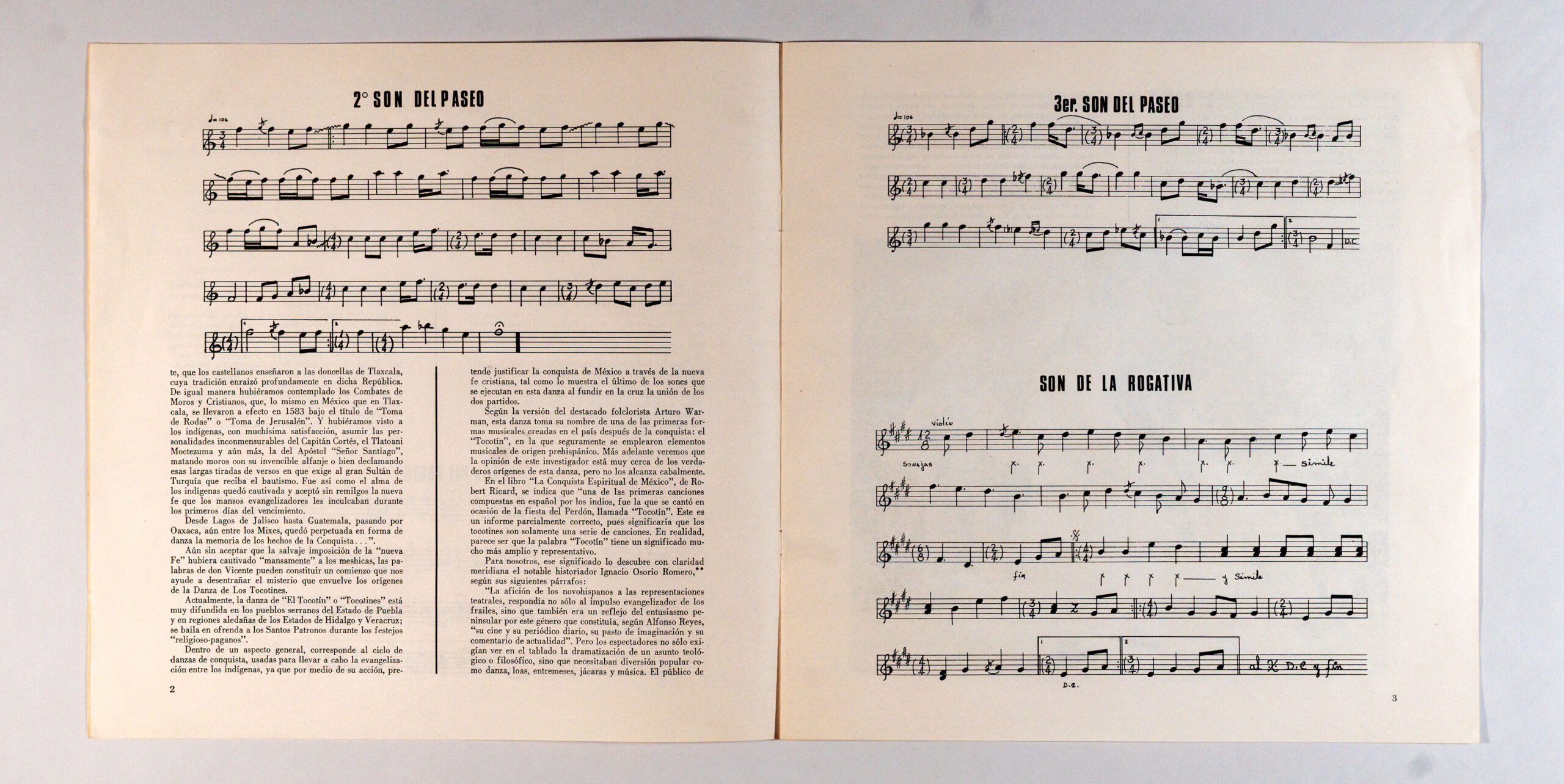
Violin (Jerónimo Velázquez) and guitar (Crescencio Acuña) musically accompanies this disciplined group that vibrates with emotion when dancing with feeling, in a hieratic attitude. From the first son of the “Paseo”, an unusual melodic richness can be noticed. The rhythm is basically symmetrical, but includes attractive irregular combinations, interspersing the time signatures of 2/4, 3/4, 4/4, and 5/4.
The rattles played by the dancers intervene mainly in the rhythm, as well as the accents that they execute with strong footsteps, accentuations that configure the phrases and musical periods quite clearly.
The melodies fall within the diatonic tonality, almost always in a major mode. The guitar chords, in degrees I, V and occasionally IV of the tonality, are also a constant support for the rhythm of the dance.
With the sole exception of the son of “Los Cuatro Capitanes”, the musical structure of the other sones is simple binary and almost always monothematic, with a common introduction to all of them, which also serves as a conclusion, a procedure that allows them to link without interruption. all the sounds of the first part of the dance, until before the tenth: “La Pelea”.
It is noteworthy the masterful way in which the peasant Carlos Ramiro interprets the character of Moctezuma II, not only for his ability to dance, but also for the emotion he shows, especially in the sound of “La Humilación”, where the character “Cortes”, after stripping him of his “Lord” attributes, forces him to touch the ground with his neck and forehead.
This dance deserved the distinction of representing our country, as part of the cultural embassy that the President, Lic. Luís Echeverría, was kind enough to send to Romania and France in 1974.
MARIO KURI-ALDANA
* Dance in the Colony.
** Fine Arts Magazine, No. 21.
THE DANCE OF “THE TOCOTINES”
The dance of “Los Tocotines” is danced in some towns in the Sierra Norte of the State of Puebla, mainly in Atempan, 17 km from the city of Teziutlán, on the national highway that goes to Nautla, and at km 325 of Mexico City. It is also danced in other small and remote towns that, having remained far from “civilization”, still preserve the language of their ancestors. It has been a long time since this dance has been danced with its primitive purity, with the luxury and wealth as it was danced at the time of the Aztecs. The indigenous nuclei that still preserve the tradition of their ancestors, dance this dance in which some Hispanic influence is noticed, despite the fact that it is one of the most authentic dances; the music, the steps, the evolutions and their clothing, allow the dancers to dance with all unction for hours in the atrium or in front of the town church, on the occasion of the religious festivals of each year, but mainly on that of their saint patron: Saint Francis of Assisi, on October 4.
Tocotines is a word found in documents that refer to pre-Hispanic life and customs. He is mentioned in two ways: the first with a musical meaning that represents a rhythmic figure; The other meaning refers to the tocotín as a dancer, that is, “Tocotín” means two things: group of rhythms or group of dancers.
The plot of the dance dramatizes the conquest of Mexico and is composed of 16 sones that last approximately four hours.
Among the main sones are: The Dance of the Monarch, that of the Four Captains, the Dance of Cortés and the Monarch, that of Malinche (Malintzin), the Paseo, the Crusader, the Dance of the Star, The Violent Announcement of the Revolution, the Fight and the Dance of the Cross.
Its main characters are: Moctezuma (whose dancer is the master of this dance), Cortés, Alvarado, Cacama and Malinche.
Although in general it is a choral dance since most of its sones are danced with the whole group doing the same steps, there is also an individual dance, that of Moctezuma, whose admirable evolutions are possibly of pre-Hispanic origin; There are also examples of couple dances: that of Cortés and Malinche; This type of dance is very special in the “Tocotines”, since Malinche always remains behind Cortés, imitating him in a submissive manner in all of his movements.
La Malinche is played by a boy; These characters who play female roles are known as maringuillas. There is also a dance of quatrains to the sound of the Four Captains: Cacama, Alvarado and two others; then we have a son in which the moment in which Moctezuma is stripped of his crown is dramatized, which is placed on Cortés; this sound is called “Humiliation”.
The symbolism of the dance is completed with the last two sones: from the Union of the Two Parties (Moctezuma’s and Cortés’) and the Son de la Cruz, in which all the dancers make a choreographic drawing in the shape of a cross. ; this typifies the evangelization of the indigenous people through dance, since there are also three brief speeches spoken by Cortés and Moctezuma, in which the “falsehood of the indigenous gods” and the “true religion”, brought to life, are revealed. its climax when he offers the dance to Saint Francis of Assisi.
Within a general aspect, it corresponds to the cycle of conquest dances used to carry out evangelization among the indigenous people, since through its action it intends to justify the conquest of Mexico through the new Christian faith.
It can be assured that the dance of “Los Tocotines” is a creation of pre-Hispanic art, recreated by the peninsular conquerors. It was danced by King Moctezuma himself and his main caciques, as the chronicler literally says; there were in the dance “entries, walks and crossed” as there are now.
The procedure of the Hispanics is evident: preserve the dance entirely, due to its elegance and popularity; they add the characters of Cortés and Malinche, and the chiefs of Moctezuma are contrasted with the captains of Cortés. All the colonizing factors were thus magnificently integrated.
With violin (Jerónimo Velázquez) and guitar (Crescencio Acuña) musically accompanies this disciplined group that vibrates with emotion when dancing with deep feeling in a hieratic attitude.
The melodic richness is unusual, as is the masterful way in which the peasant Carlos Ramiro interprets the character of Moctezuma II.
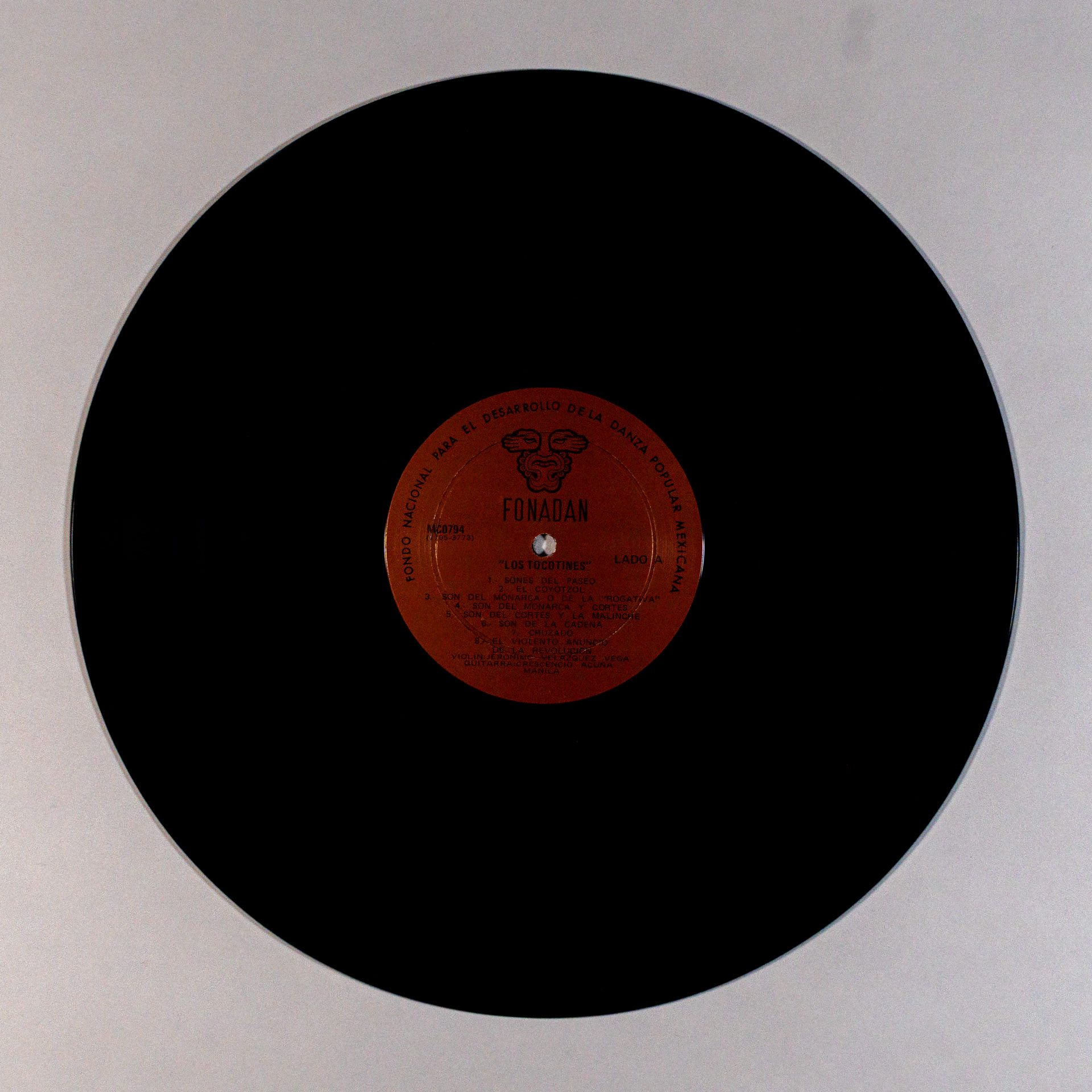
“A” SIDE
SOUND FROM THE WALK
THE COYOTZOL
SOUND OF THE MONARCH AND COURTS
SOUNDOF THE MONARCH OR OF THE ROGATIVE
SOUND OF CORTES, THE MONARCH AND LA MALINCHE
SOUND OF CORTES
SOUND OF THE CHAIN
THE CRUSADER
They are played in a row, linked by the register.
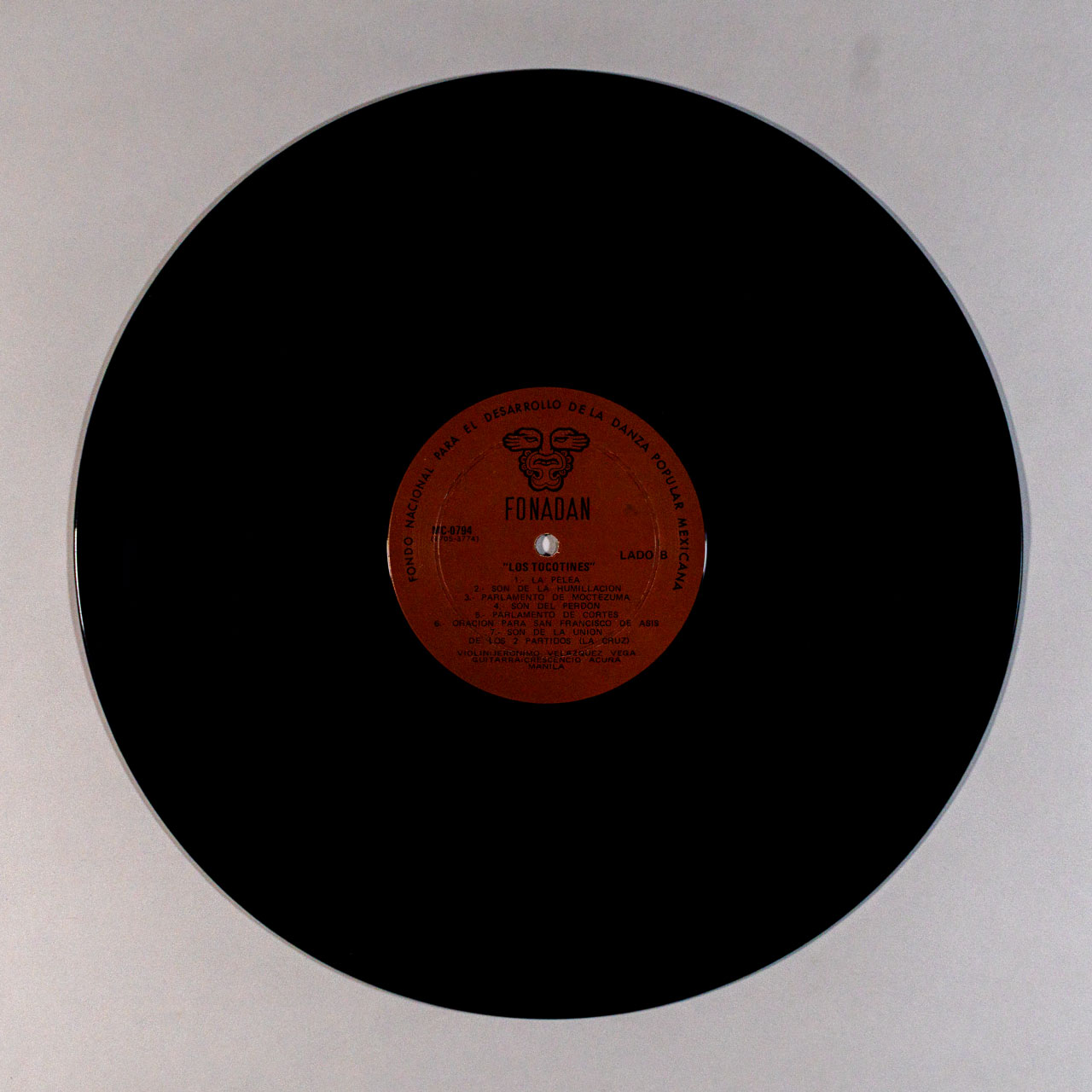
“B” SIDE
SOUND OF THE FIGHT – THE VIOLENT ANNOUNCEMENT OF THE REVOLUTION
SOUND OF THE DISPOSAL
SOUND OF HUMILIATION
MONTEZUMA’S PARLIAMENT
SOUND OF FORGIVENESS
CORTE’S PARLIAMENT
SOUND OF HUMILIATION (CONTINUES)
SOUND OF FORGIVENESS (CONTINUES)
PRAYER FOR SAINT FRANCIS
SOUND FROM THE UNION OF THE TWO PARTIES – LA CRUZ
VIOLIN: JERÓNIMO VELAZQUEZ VEGA
GUITAR: CRESCENCIO ACUÑA MANILA
FONADAN
National Fund for the Development of Mexican Popular Dance.
Morena 215 – Tel. 536-03-98
Col. del ValleC.P. 03100
Mexico, D.F.
INCLUDES EXPLANATORY BROCHURE
Rights registered in accordance with the law.
Total or partial reproduction is prohibited.
MADE IN MEXICO BY CBS/COLUMBIA INTERNACIONAL, S. A.
AV. 16 DE SEPTIEMBRE No. 784
NAUCALPAN, MEX.
CBS TRADEMARK
CBS SPECIAL PRODUCTS
A CBS Record Service
Gallery:
Tracklist:
THE TOCOTINES
SIDE 1
- A1 Sound From The Walk
Performer(s): Jerónimo Velázquez Vega, violin; Crescencio Acuña Manila, Guitar. - A2 The Coyotzol
Performer(s): Jerónimo Velázquez Vega, violin; Crescencio Acuña Manila, Guitar. - A3 Sound Of The Monarch And Courts
Performer(s): Jerónimo Velázquez Vega, violin; Crescencio Acuña Manila, Guitar. - A4 Soundof The Monarch Or Of The Rogative
Performer(s): Jerónimo Velázquez Vega, violin; Crescencio Acuña Manila, Guitar. - A5 Sound Of Cortes, The Monarch And La Malinche
Performer(s): Jerónimo Velázquez Vega, violin; Crescencio Acuña Manila, Guitar. - A6 Sound of Cortes
Performer(s): Jerónimo Velázquez Vega, violin; Crescencio Acuña Manila, Guitar. - A7 Sound Of The Chain
Performer(s): Jerónimo Velázquez Vega, violin; Crescencio Acuña Manila, Guitar. - A8 The Crusader
Performer(s): Jerónimo Velázquez Vega, violin; Crescencio Acuña Manila, Guitar.
SIDE 2
- B1 Sound Of The Fight – The Violent Announcement Of The Revolution
Intérprete(s): Jerónimo Velázquez Vega, Violín; Crescencio Acuña Manila, Guitarra.
- B2 Sound Of The Disposal
Intérprete(s): Jerónimo Velázquez Vega, Violín; Crescencio Acuña Manila, Guitarra.
- B3 Sound Of Humiliation
Intérprete(s): Jerónimo Velázquez Vega, Violín; Crescencio Acuña Manila, Guitarra.
- B4 Montezuma’s Parliament
Intérprete(s): Jerónimo Velázquez Vega, Violín; Crescencio Acuña Manila, Guitarra.
- B5 Sound Of Forgiveness
Intérprete(s): Jerónimo Velázquez Vega, Violín; Crescencio Acuña Manila, Guitarra.
- B6 Corte’s Parliament
Intérprete(s): Jerónimo Velázquez Vega, Violín; Crescencio Acuña Manila, Guitarra.
- B7 Sound Of Humiliation (Continues)
Intérprete(s): Jerónimo Velázquez Vega, Violín; Crescencio Acuña Manila, Guitarra.
- B8 Sound Of Forgiveness (Continues)
Intérprete(s): Jerónimo Velázquez Vega, Violín; Crescencio Acuña Manila, Guitarra.
- B9 Prayer For Saint Francis
Intérprete(s): Jerónimo Velázquez Vega, Violín; Crescencio Acuña Manila, Guitarra.
- B10 Sound From The Union Of The Two Parties – La Cruz
Intérprete(s): Jerónimo Velázquez Vega, Violín; Crescencio Acuña Manila, Guitarra.
Credits:
ETHNOMUSICOLOGY: Mario Kuri-Aldana, coordinator; Joaquin Guzman Luna.
CHOREOGRAPHY: Luis Felipe Obregón, coordinator; Evelia Beristain.
DISSEMINATION: Xóchitl Medina, coordinator.
AUDIOVISUAL DEPARTMENT: Rodolfo Velazco R, Coordinator; Alejandro Loranca, Photographer; Rubén Prado, Technical editor.
GENERAL MANAGEMENT: Josefina Lavalle.
TEXT: Mario Kuri-Aldana.
 Jeronimo Velazquez Vega / Crescencio Acuña Manila – Los Tocotines - Volumen 7