





YALALTEC DANCES
FONADAN
|
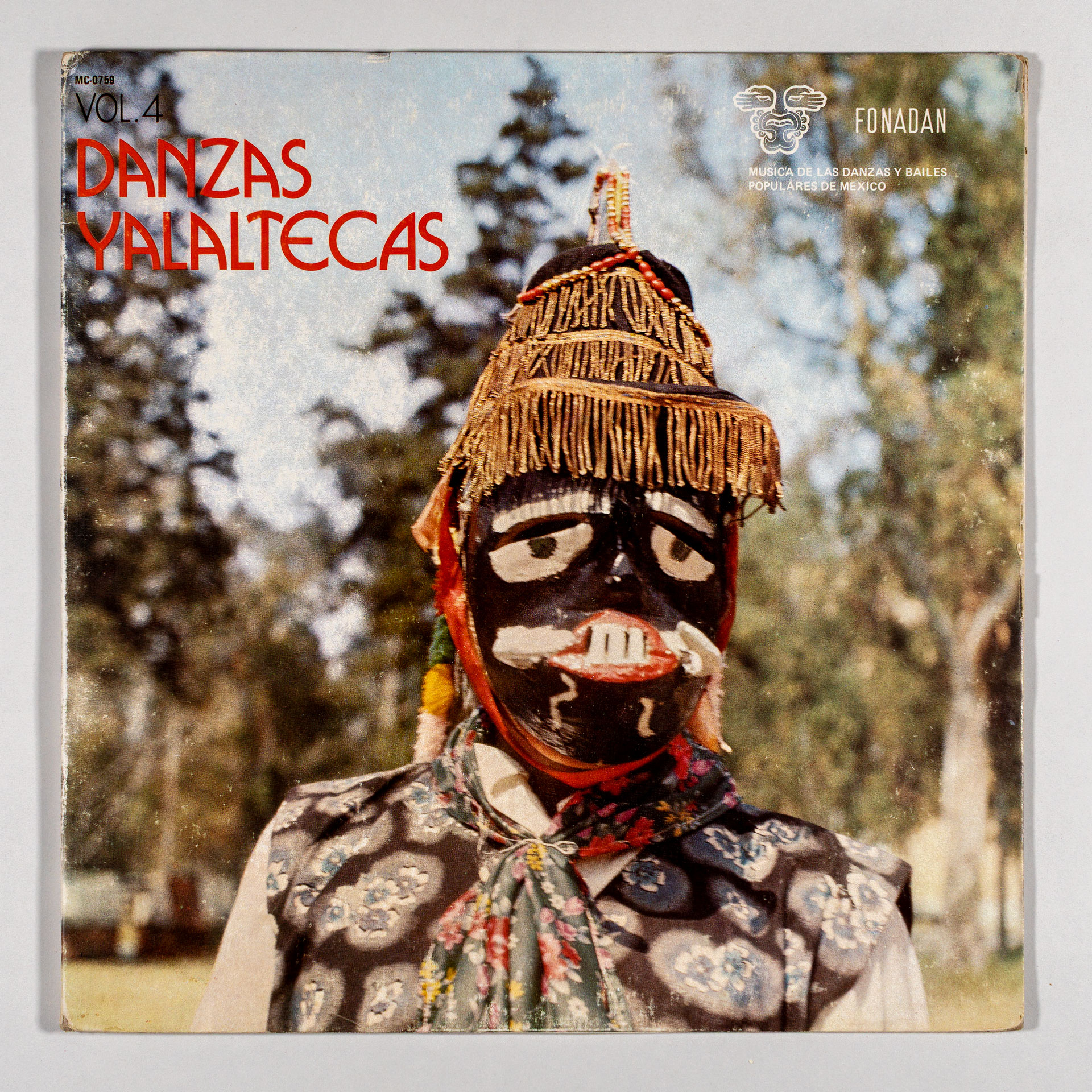
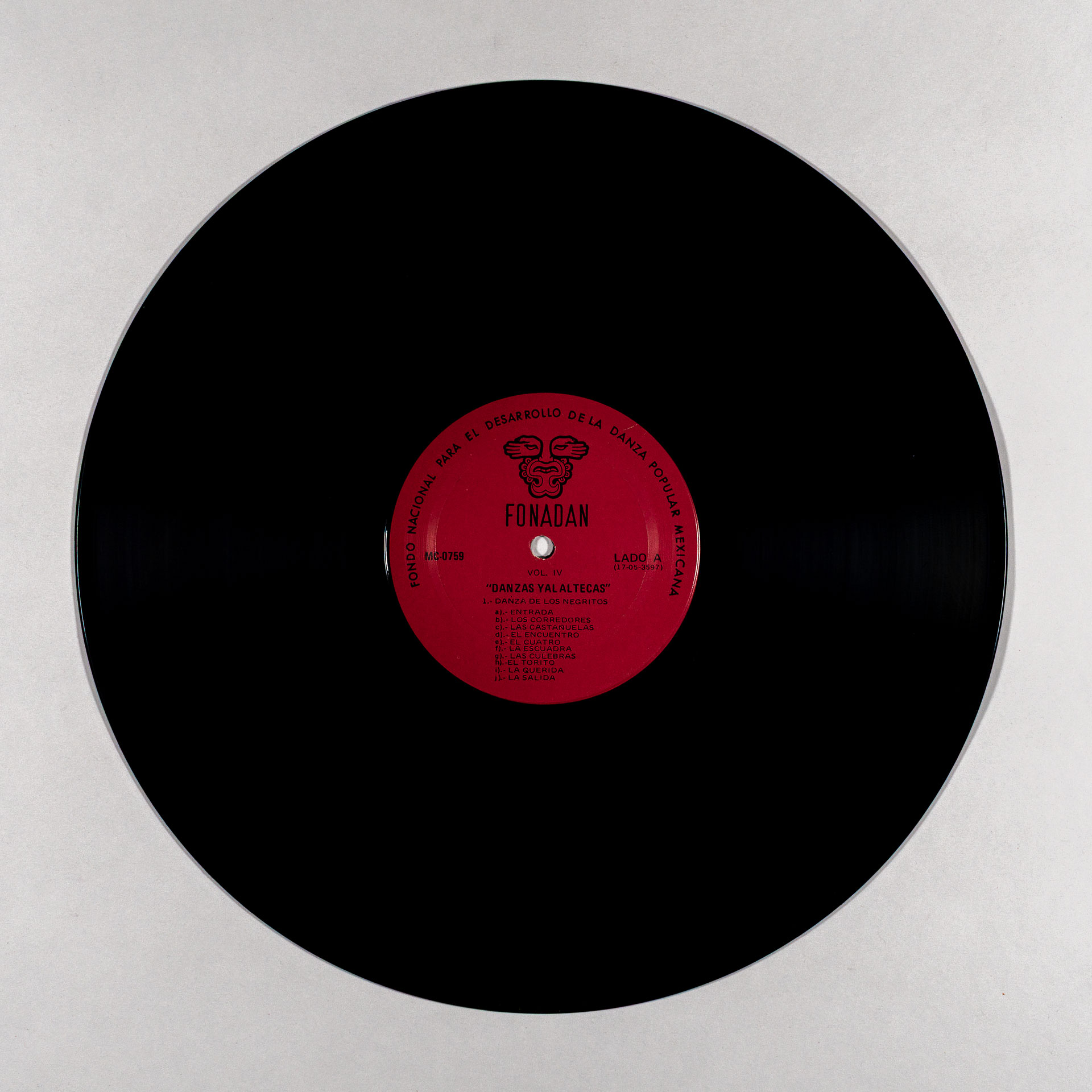
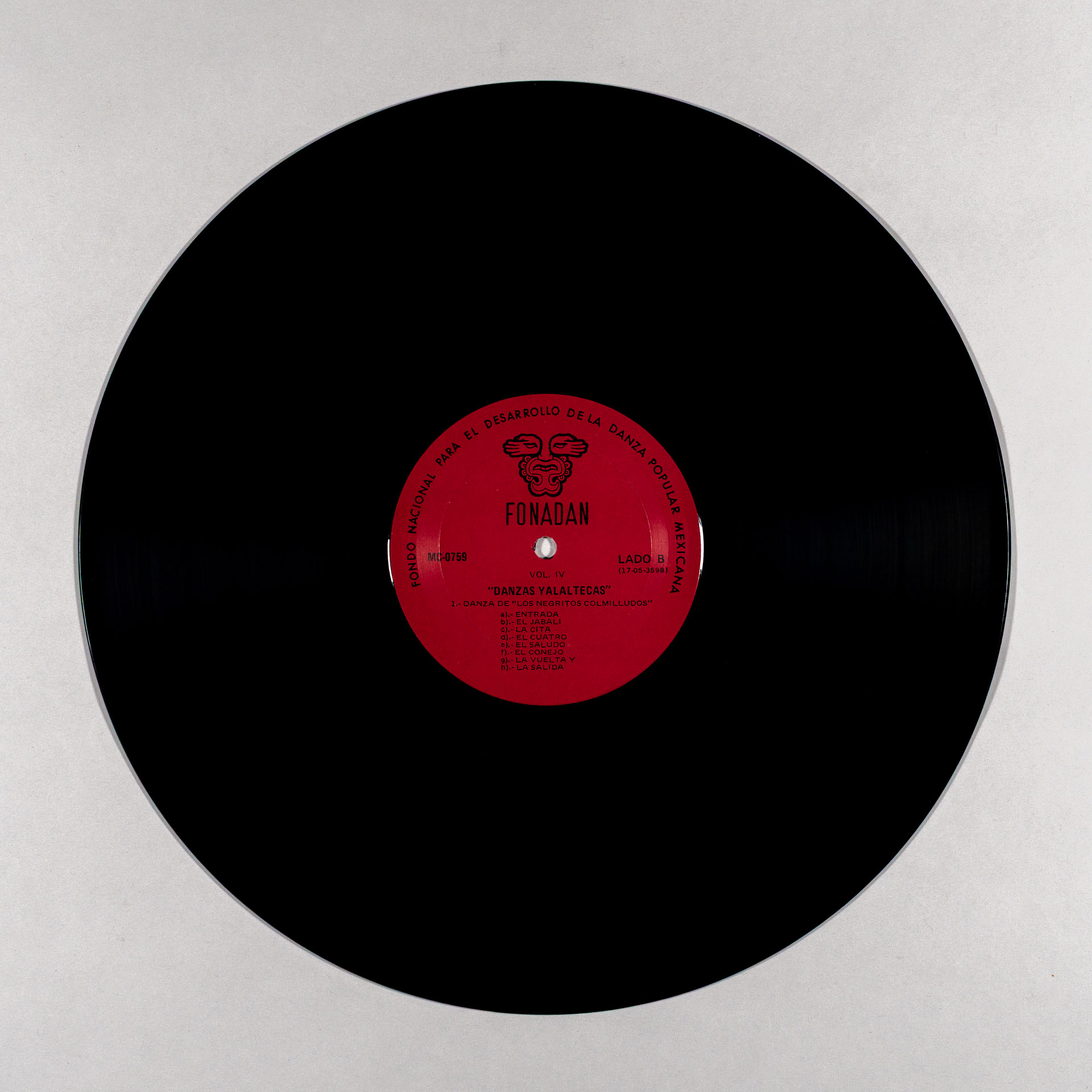
Label: FONADAN MC-0759 Format: Vinyl LP Album 12" 33 1/3 rpm Gatefold Compilation |
Country: Mexico Genre: Folk World & Country |
Info:
MC-0759
VOL. 4
YALALTEC DANCES
FONADAN
National Fund for the Development of Mexican Popular Dance.
MUSIC OF THE DANCES AND POPULAR DANCES OF MEXICO
FONADAN
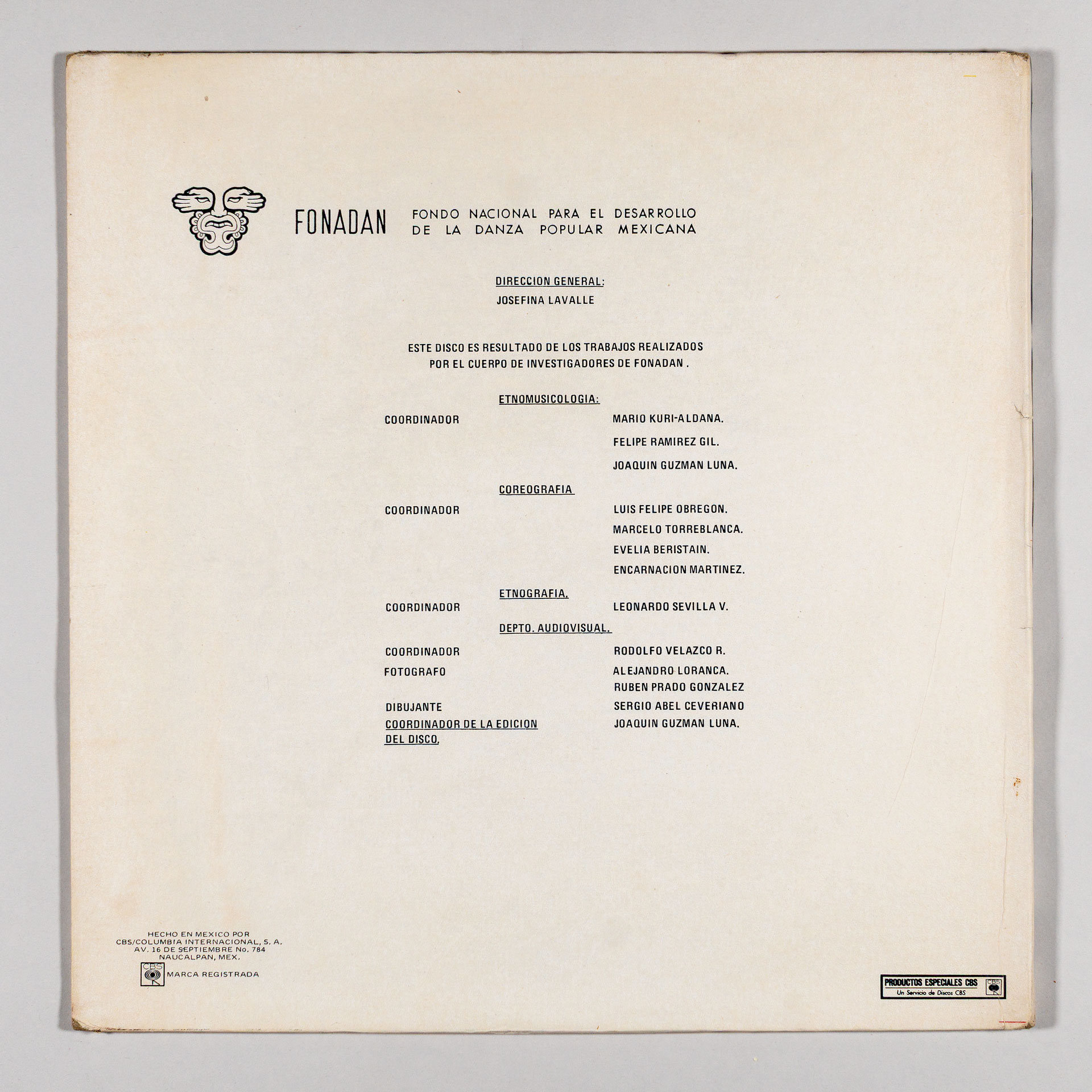
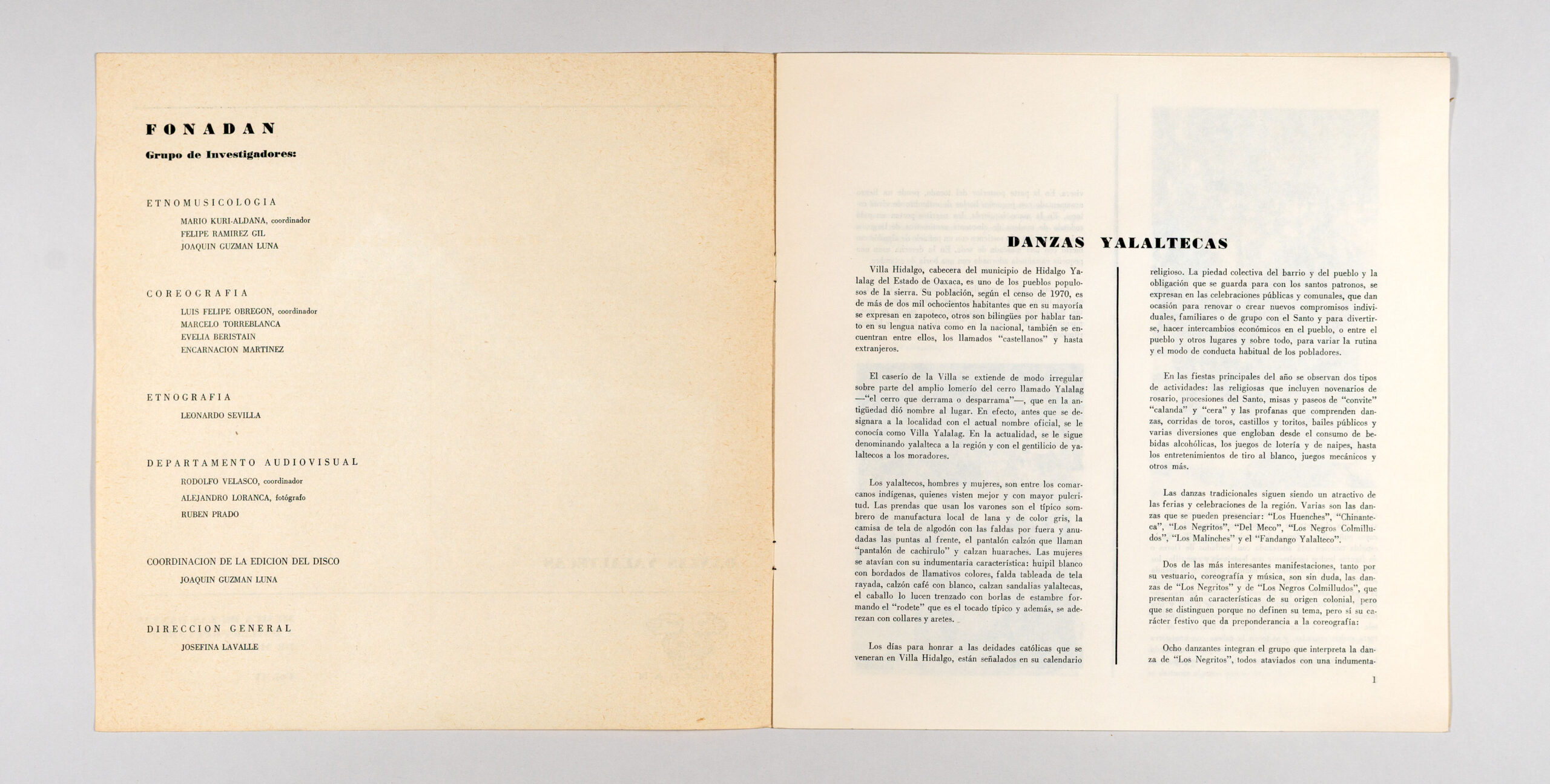
Research Group:
ETHNOMUSICOLOGY:
MARIO KURI-ALDANA, Coordinator
JOAQUIN GUZMAN LUNA
CHOREOGRAPHY:
LUIS FELIPE OBREGÓN, Coordinator
EVELIA BERISTAIN
DIFFUSION:
XOCHITL MEDINA, Coordinator
DEPT. AUDIOVISUAL:
RODOLFO VELASCO, Coordinator
ALEJANDRO LORANCA, Photographer
RUBEN PRADO, Technician-Editor
GENERAL DIRECTORATE:
JOSEPHINE LAVALLE
YALALTEC DANCES
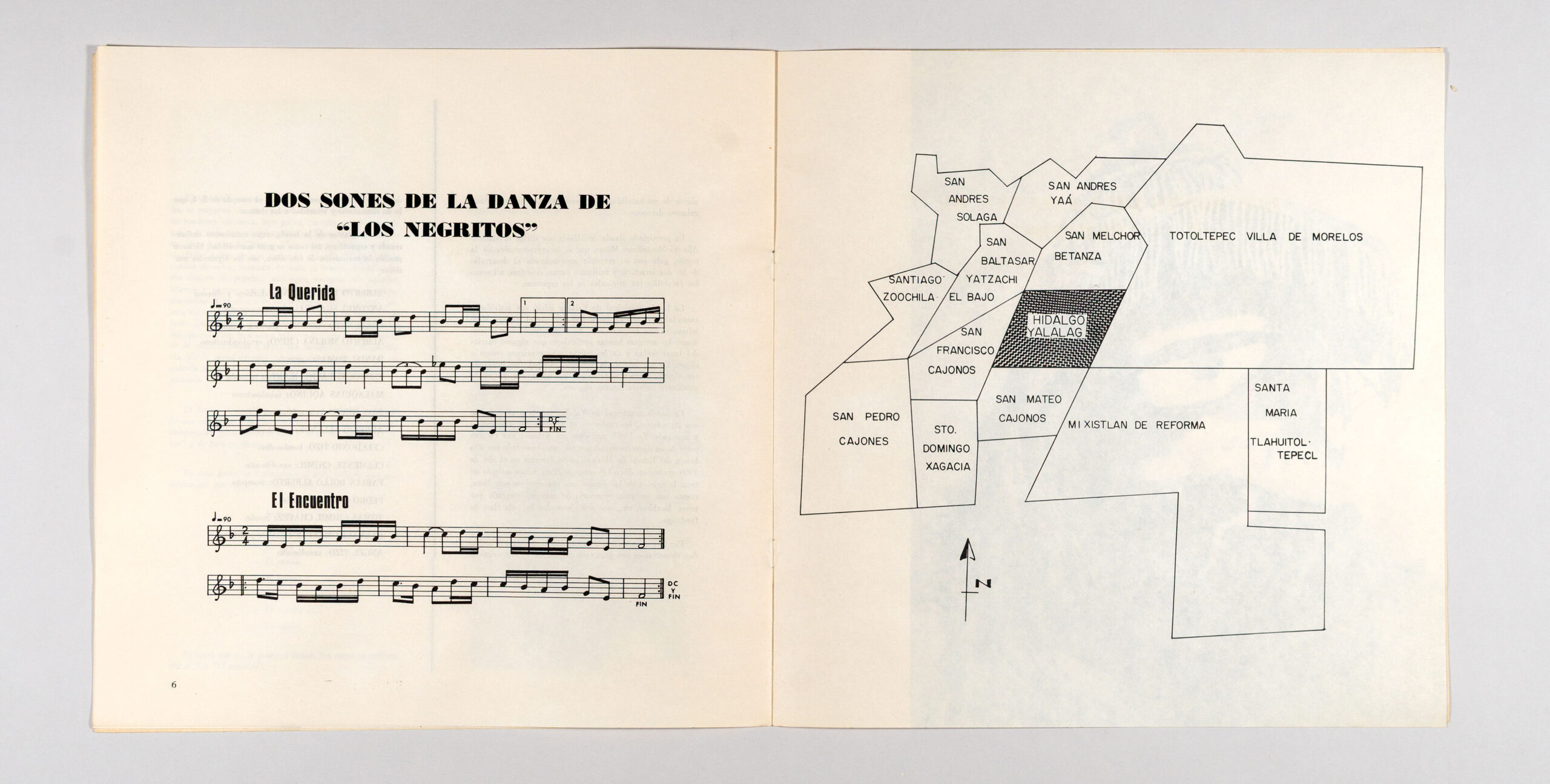
Villa Hidalgo, head of the municipality of Hidalgo Yalalag in the State of Oaxaca, is one of the most populous towns in the mountains. Its population, according to the 1970 census, is more than two thousand eight hundred inhabitants who mostly speak Zapotec, others are bilingual because they speak both their native and national languages, among them are also the so-called ” Castilians” and even foreigners.
The Villa’s hamlet extends irregularly over part of the wide slope of the hill called Yalalag – “the hill that spills or spreads” –, which in ancient times gave the place its name. Indeed, before the town was given its current official name, it was known as Villa Yalalag. At present, the region is still called Yalalteca and the residents are called Yalaltecos.
“Yalaltecos who live outside their town do not overlook the festivities that occur in their own or are important to them. Some who reside in Mexico, Oaxaca, or the region make a special trip to Yalálag to attend the town festival. Those who cannot do so, attend the religious ceremonies of the place where they live, go to equivalent parties, or do both.Those who live in Oaxaca, for example, celebrate May 3 by going to the Xoxo party and some young people They face the bulls. Those who live in Mexico go to Cuernavaca to the fiesta that is held in this city on the date corresponding to that of the town and witness the professional bullfight”*.
The Yalaltecos, men and women, are among the indigenous comarcanos, those who dress better and more neatly. The garments worn by the men are the typical gray wool hat manufactured locally, the cotton shirt with the skirts on the outside and the ends tied in front, the short pants that they call “cachirulo pants” and fit huaraches. The women are dressed in their characteristic clothing: white huipil with brightly colored embroidery, pleated skirt of striped fabric, brown and white pants, they wear Yalaltecan sandals, their hair is braided with yarn tassels forming the “bundle” that is the headdress. typical and also, they are decorated with necklaces and earrings.
The days to honor the Catholic deities that are venerated in Villa Hidalgo are indicated in its religious calendar. The collective piety of the neighborhood and the town and the obligation that is kept towards the patron saints, are expressed in public and communal celebrations, which provide an opportunity to renew or create new individual, family or group commitments with the Saint and to have fun, make economic exchanges in the town, or between the town and other places and above all, to vary the routine and habitual behavior of the settlers.
In the main festivities of the year, two types of activities are observed: religious ones that include rosary novenas, processions of the Saint, masses and “calenda” and “wax” walks and profane ones that include dances, bullfights, castles and bulls, public dances and various entertainments that range from the consumption of alcoholic beverages, lottery and card games, to target shooting entertainment, mechanical games and others.
“On the day of the fiesta, an early communion mass is celebrated, attended by the dancers, already dressed and ready to perform after their long preparation, and a high mass with processions, attended by the majority of outsiders and many locals. The elevation of the Blessed Sacrament and the conclusion of the high mass are always signaled with chirimía and drum calls, bell peals, rocket shots and the burning of a “lady wheel”. With the exposition of the Blessed Sacrament, the imposition of rosaries, after it, and matins, the main religious acts end.”
* YALALAG, a Villa Zapotec Serrana. Julio de la Fuente, I.N.I.
“The dances begin to act in the atrium (some, like the one of “huenches”, outside it) before the end of the mass, attracting a concurrence of relatives, locals and foreigners, keeping the mixes in groups separated by town, mixed or not with other spectators. The dances of the festival are that of Malinches (children), the Huenches “viejo” and “petate” and that of Marcos, performing several dances and several groups of musicians at the same time. Before the end of the Mass begins the bullfight, maximum fun of the party, which will attract all the people”.
“The neighborhood of San Juan does not have a party, but soon the enthusiastic residents here celebrate their patron in June with two or three days of celebration, “premiering” children’s dances such as “La Sota”, “Los Ratones” and others, created by a resident of the neighborhood.At the festival of Santiago (or that of Rosario) the game of “Los Indios” is organized with two nuclei, one made up of “soldiers” with outlandish appearances and uniforms, and the other of “Indians”, emblazoned and feathered, according to the local-regional conception of a certain “Indian. The first carry fictitious weapons, the second ties, and both fire rockets that they fire at each other, taking prisoners. The cases of Injured actors and spectators are not strangers. The specific dance of the festival is that of the “Santiagos”. The festival of Santa Rosa, like that of the town, acquires greater brilliance, literally and metaphorically, because the owner of the light plant shows willingness, as a resident of the neighborhood, to provide electricity. The dance of the occasion may be that of the Huenches”.
“The dance is taught in private homes, from two or three months before a party, the little dancers meeting night after night, brought by their relatives. The dance teacher whistles the sounds, or takes two or three musicians to the the final rehearsals are coming”.
“A commission similar to the one in the neighborhood, but made up of devotees from the town, makes the preparations for the celebration of the Virgen del Rosario on the date indicated by the calendar. The festival achieves great brilliance, given the number of devotees of the Virgin and its special power as a protector from disease and evil. This is the most specific occasion for the placement of rosaries. Religious acts follow the pattern of the town festival. The dance is the children’s dance of the “Negros”. The dancers pray at one in the morning in the church and receive a protective rosary. Twenty coins of a peso are no longer sewn on their costumes, as in the past, on the eve, and forty or more on the day of the festival. The significance of this The custom is unknown. Sometimes, the new children’s dance “Las Tehuanas” is performed, recently copied or imitated from another existing among the Chontals of Yautepec. Probably “La Sandunga”, or a variant of it.
Traditional dances continue to be an attraction at fairs and celebrations in the region. There are several dances that can be witnessed: “Los Huenches”, “Chinanteca”, “Los Malinches”, “Los Negritos”, “Del Meco”, “Los Negros Colmilludos” and the “Fandango Yalalteco”.
Two of the most interesting manifestations, both for their costumes, choreography and music, are undoubtedly the dances of “Los Negritos” and “Los Negros Colmilludos”, “which still present characteristics of their colonial origin, but which are distinguished because they do not define its theme, but rather its festive character that gives prominence to the choreography.
DANCE OF THE BLACKS
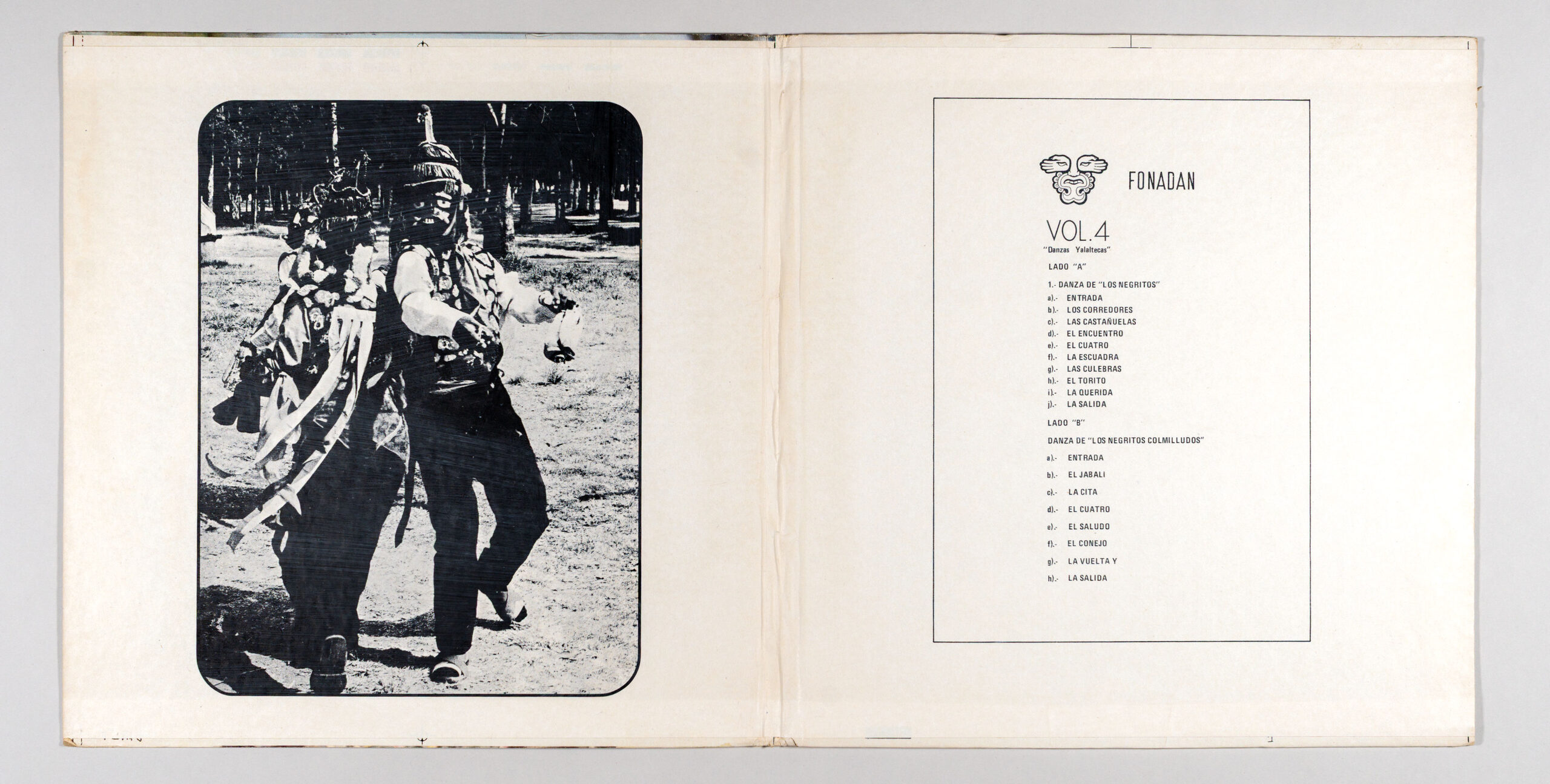
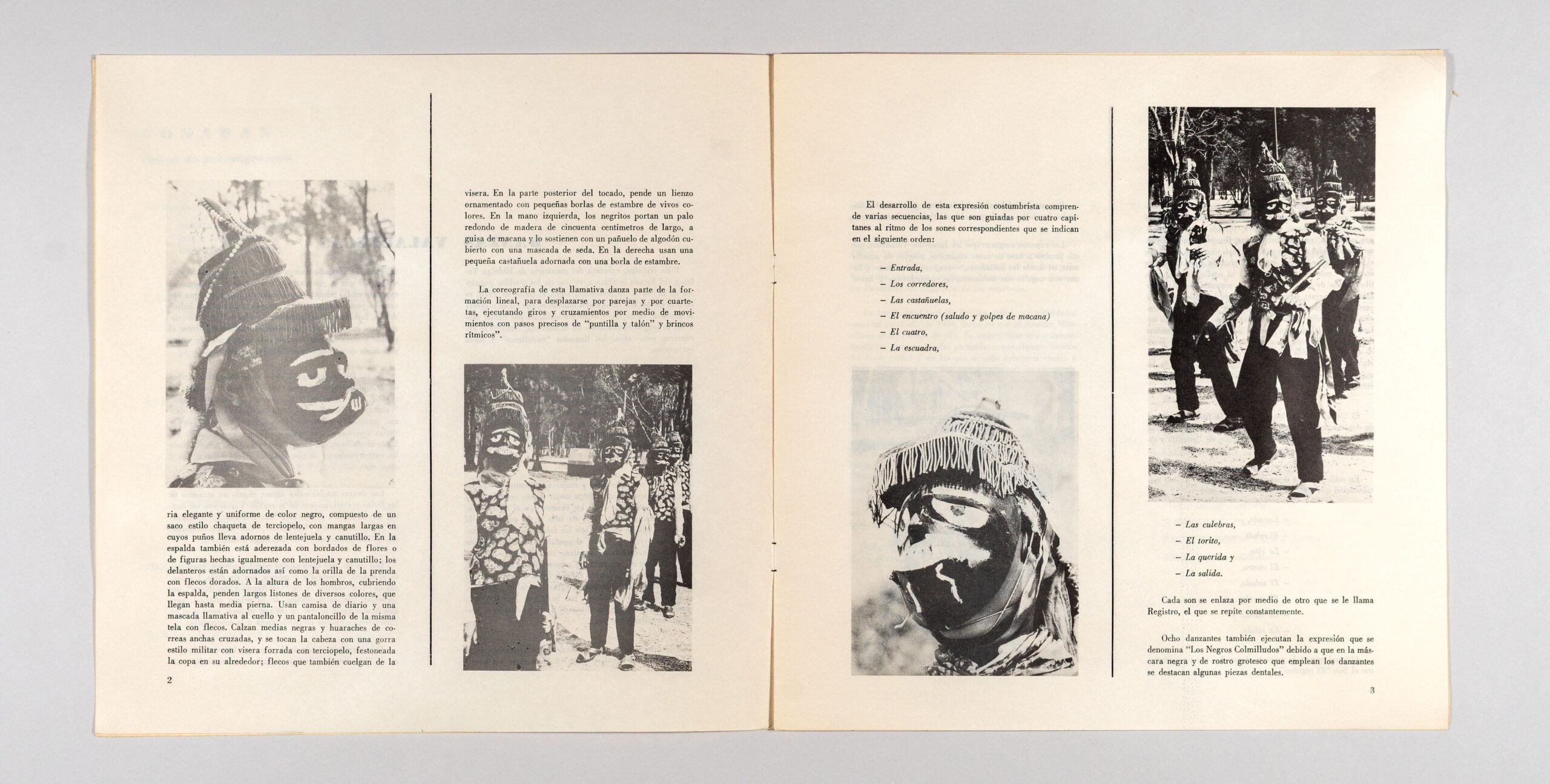
Eight dancers make up the group that performs the dance of “Los Negritos”, all dressed in elegant clothing and a black uniform, made up of a velvet jacket-style jacket, with long sleeves on whose cuffs it has sequin decorations and beads. On the back it is also adorned with embroidery of flowers or figures made also with sequins and beads; the front ones are adorned as well as the edge of the garment with golden fringes. At shoulder height, covering the back, hang long ribbons of various colors, which reach halfway up the leg. They wear an everyday shirt, a striking scarf around the neck, and shorts of the same fabric with fringes. They wear black stockings and sandals with wide crossed straps, and they touch their heads with a military-style cap with a visor lined with velvet, the crown scalloped around it; fringes that also hang from the visor. On the back of the headdress hangs a canvas decorated with small tassels of brightly colored yarn. In their left hand, the blacks carry a round wooden stick fifty centimeters long, as a club and hold it with a cotton handkerchief covered with a silk scarf. On the right they use a small castanet adorned with a yarn tassel.
The choreography of this striking dance starts from the linear formation, to move in pairs and in quatrains, executing twists and crossings through movements with precise “toe and heel” steps and rhythmic jumps”. The development of this costumbrista expression includes several sequences, which are guided by four captains to the rhythm of the corresponding sones that are indicated in the following order:
– Entrance
– The runners,
– The castanets
– The meeting (greeting and baton blows)
– The four,
– The squad,
– The snakes,
– The bull,
– The dear and
– The exit.
Each son is linked by means of another called Register, which is constantly repeated.
DANCE “THE FANGED BLACKS”
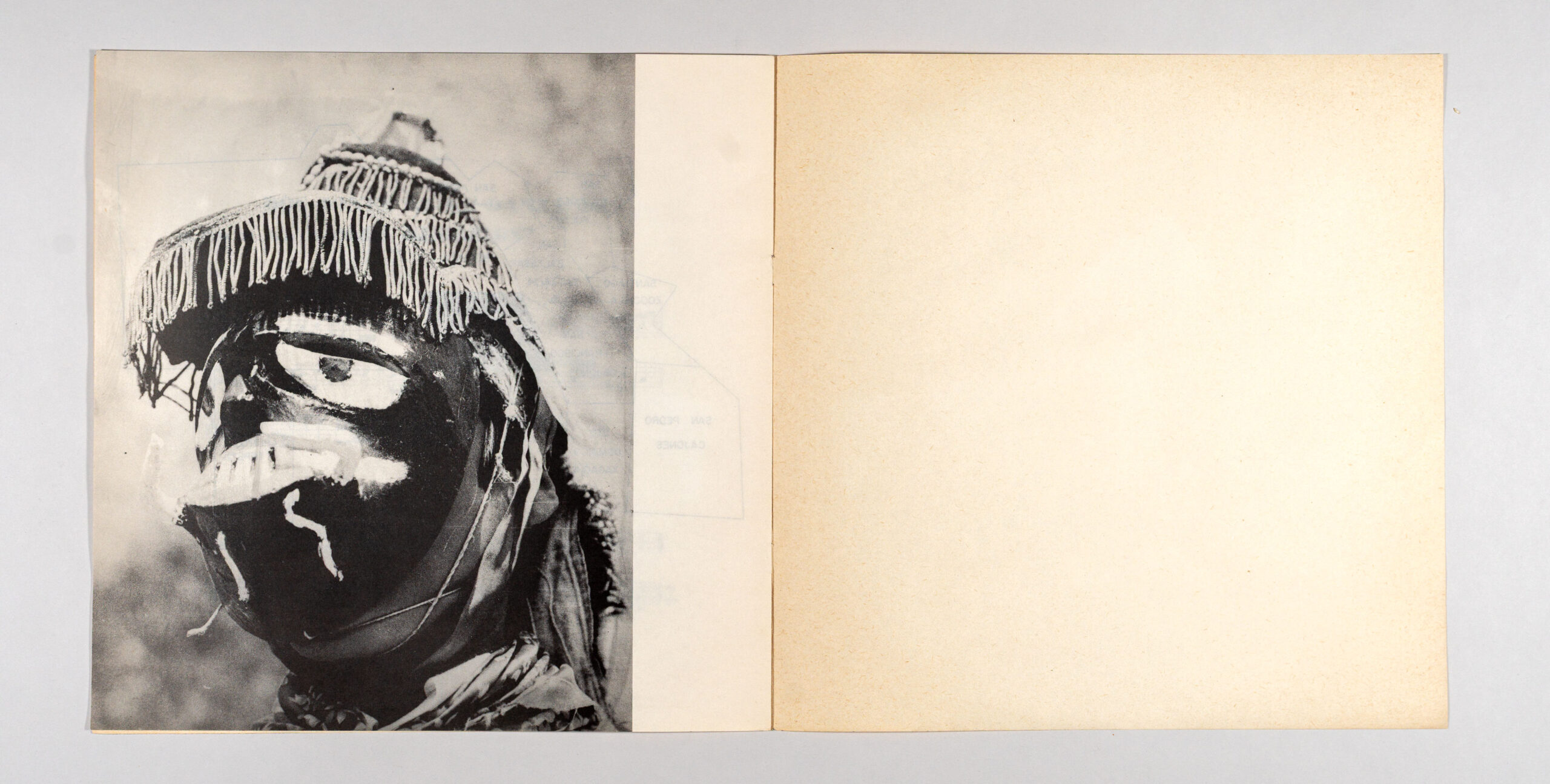
Eight dancers also perform the expression called “Los Negros Colmilludos” because some teeth stand out in the black mask with its grotesque face that the dancers use.
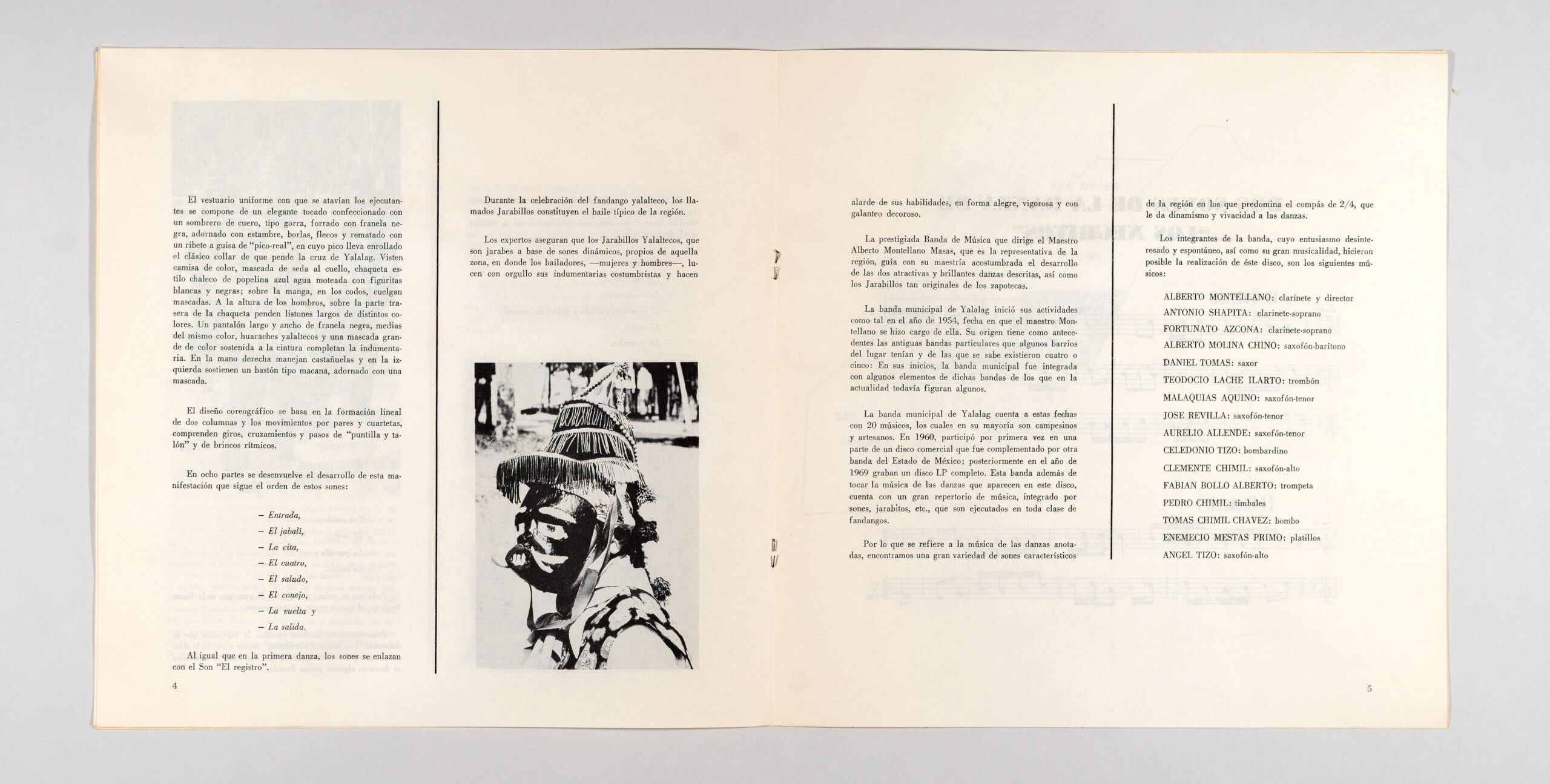
The uniform costume with which the performers are dressed consists of an elegant headdress made with a leather hat, cap type, lined with black flannel, decorated with yarn, tassels, fringes and finished off with a “beak-royal” edging. , at whose beak is wrapped the classic necklace from which the Yalalag cross hangs. They wear a colored shirt, a silk scarf around their necks, a water blue poplin vest-style jacket speckled with black and white figures; on the sleeve, on the elbows, hang scarves. At shoulder height, long ribbons of different colors hang on the back of the jacket. Long, wide black flannel pants, socks of the same color, Yalalteco sandals, and a large colored scarf held at the waist complete the outfit. In the right hand they handle castanets and in the left they hold a baton-type cane, adorned with a scarf.
The choreographic design is based on the linear formation of two columns and the movements in pairs and quatrains, including turns, crossings and “toe and heel” steps and rhythmic jumps.
The development of this manifestation unfolds in eight parts that follows the order of these sones:
– Entrance,
– The boar,
– Quote,
– The four,
– The greeting,
– Rabbit,
– turn around and
– The exit.
As in the first dance, the sones are linked to the Son “El registro”.
During the celebration of the Yalalteco fandango, the so-called Jarabillos constitute the typical dance of the region.
Experts assure that the Jarabillos Yalaltecos, which are syrups based on dynamic sounds, typical of that area, where the dancers –women and men– proudly wear their customary clothing and flaunt their skills, in a joyous way, vigorous and with decorous courtship.
The prestigious Music Band directed by Maestro Alberto Montellano Masas, which is the most representative of the region, guides with his customary mastery the development of the two attractive and brilliant dances described, as well as the so original Jarabillos of the Zapotecs.
The Yalalag municipal band began its activities as such in the year 1954, the date on which the maestro Montellano took charge of it. Its origin has as antecedents the old private bands that some local neighborhoods had and of which four or five are known to have existed: In its beginnings, the municipal band was integrated with some elements of said bands, some of which still appear today. .
The Yalalag municipal band currently has 20 musicians, most of whom are peasants and artisans. In 1960, he participated for the first time in a part of a commercial album that was complemented by another band from the State of Mexico; later in the year of 1969 they recorded a complete LP disc. This band, in addition to playing the music of the dances that appear on this album, has a large repertoire of music, made up of sones, jarabitos, etc., which are performed in all kinds of fandangos.
Regarding the music of the annotated dances, we find a great variety of characteristic sounds of the region in which the beats of 2/4, 6/8 and 3/4 predominate, which give dynamism and liveliness to the dances. dances.
The members of the band, whose selfless and spontaneous enthusiasm, as well as their great musicality, made the realization of this album possible, are the following musicians:
ALBERTO MONTELLANO: clarinet and conductor
ANTONIO SHAPITA: clarinet-soprano
FORTUNATO AZCONA: clarinet-soprano
ALBERTO MOLINA CHINO: saxophone-baritone
DANIEL TOMAS: saxor
TEODOCIO LACHE ILARTO: trombone
Malachi Aquino: saxophone-tenor
JOSE REVILLA: saxophone-tenor
AURELIO ALLENDE: saxophone-tenor
CELEDONIO TIZO: euphonium
CLEMENTE CHIMIL: saxophone-alto
FABIAN BOLLO ALBERTO: trumpet
PEDRO CHIMIL: timpani
TOMAS CHIMIL CHÁVEZ: hype
ENEMECIO MESTAS PRIMO: cymbals
ÁNGEL TIZO: saxophone-alto
TWO SONES FROM THE DANCE OF “LOS NEGRITOS”
The Dear
The Meeting
FONADAN: MORENA 215, Colonia del Valle, México 03100, D.F. TEL. 5-36-03-98
VOL.4
“Yalaltec Dances”
“A” SIDE
1.- DANCE OF THE BLACKS
a).- ENTRY
b).- THE BROKERS
c).- THE CASTANETS
d).- THE MEETING
e).- THE FOUR
f).- THE SQUARE
g).- THE SNAKES
B SIDE”
DANCE OF “THE FANGED BLACKS”
a).- ENTRY
b).- THE WILD BOAR
c).- THE APPOINTMENT
d).- THE FOUR
e).- THE GREETING
f).- THE RABBIT
g).- THE TURN AND
h).- THE DEPARTURE
h).- THE BULL
i).- THE DEAR
j).- THE DEPARTURE
Note: Sones are played straight, linked by a “register”
MADE IN MEXICO BY CBS/COLUMBIA INTERNACIONAL, S. A.
AV. 16 DE SEPTIEMBRE No. 784
NAUCALPAN, MEX.
CBS TRADEMARK
CBS SPECIAL PRODUCTS
A CBS Record Service
Gallery:
Tracklist:
YALALTEC DANCES
SIDE 1 DANCE OF THE BLACKS
- A1 Entrance
Performer(s): Yalalag Municipal Band - A2 The Corridors
Performer(s): Yalalag Municipal Band - A3 The Castanets
Performer(s): Yalalag Municipal Band - A4 The Meeting
Performer(s): Yalalag Municipal Band - A5 The Four
Performer(s): Yalalag Municipal Band - A6 The Squad
Performer(s): Yalalag Municipal Band - A7 Las Culebras
Performer(s): Yalalag Municipal Band
SIDE 2 DANCE OF “LOS NEGRITOS COLMILLUDOS”
- B1 Input
Performer(s): Yalalag Municipal Band - B2 The Boar
Performer(s): Yalalag Municipal Band - B3 The Date
Performer(s): Yalalag Municipal Band - B4 The Four
Performer(s): Yalalag Municipal Band - B5 The Greeting
Performer(s): Yalalag Municipal Band - B6 The Rabbit
Performer(s): Yalalag Municipal Band - B7 The Turn And
Performer(s): Yalalag Municipal Band - B8 The Exit
Performer(s): Yalalag Municipal Band - B9 El Torito
Performer(s): Yalalag Municipal Band - B10 The Darling
Performer(s): Yalalag Municipal Band - B11 The Exit
Performer(s): Yalalag Municipal Band
Credits:
ETHNOMUSICOLOGY: Mario Kuri-Aldana, coordinator; Joaquin Guzman Luna; Vincent Mendoza R.
CHOREOGRAPHY: Luis Felipe Obregón, coordinator; Evelia Beristain.
DISSEMINATION: Xóchitl Medina, coordinator.
DEPT. AUDIOVISUAL: Rodolfo Velazco R, Coordinator; Alejandro Loranca, Photographer; Rubén Prado, Audio Technician.
GENERAL MANAGEMENT: Josefina Lavalle.
 Banda Municipal De Yalalag – Danzas Yalaltecas - Volumen 4