







|
Label: INAH-SEP INAH-27 Released: 1984 |
Country: México Genre: Corrido |
Info:
THE CORRIDOS OF XALATLACO
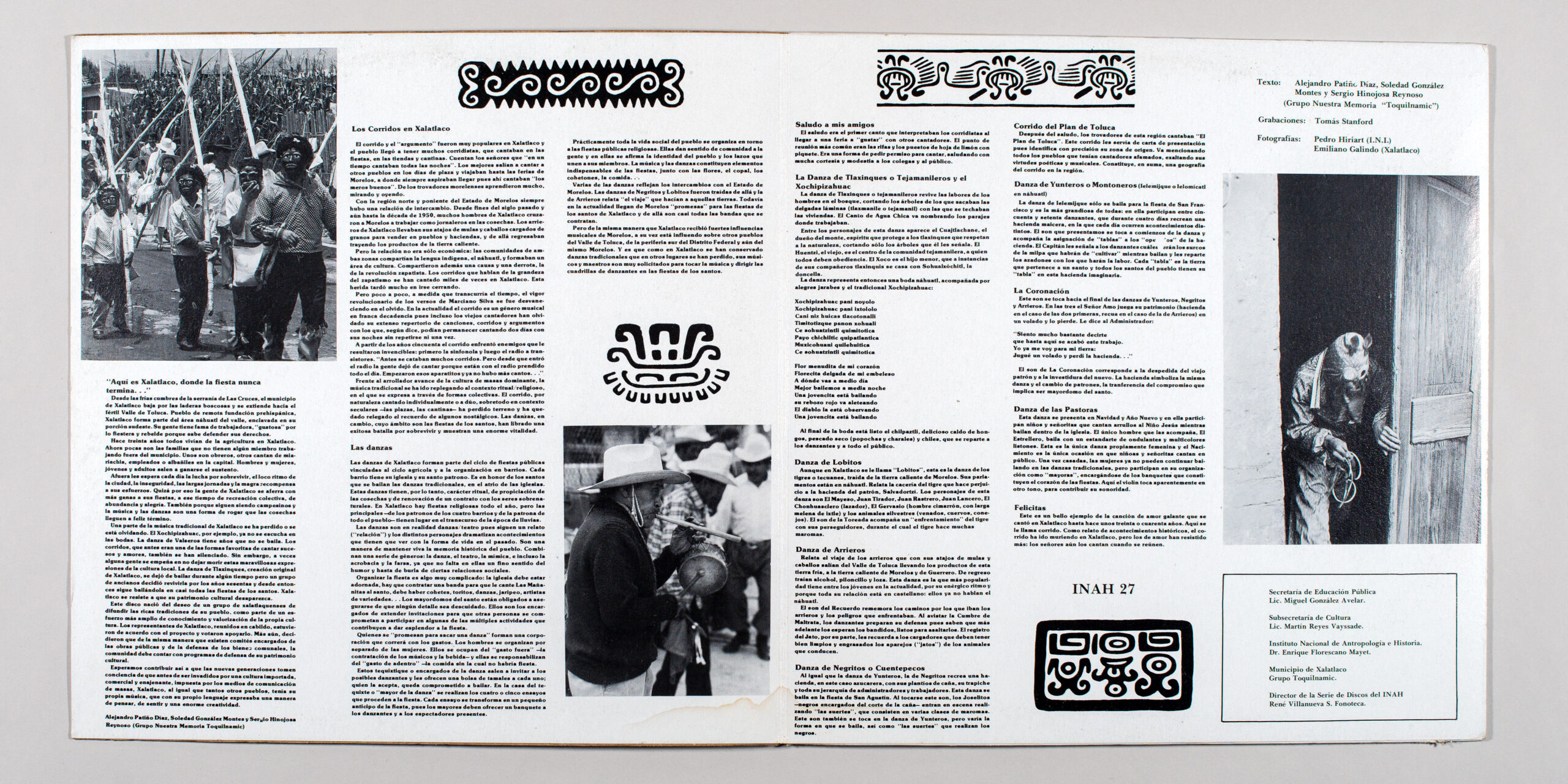
The corrido is the “argumento” (verse), a very popular form in Xalatlaco, and the town once had many corrido singers who performed at fiestas, in shops, and in cantinas. The elders say that “there was a time when people sang every night.” The best singers traveled to other towns on market days and journeyed as far as the fairs of Morelos, which they always aspired to reach because that was where “the truly good ones” sang. They learned a great deal from the troubadours of Morelos by watching and listening to them.
There was always a relationship of exchange with the northern and western regions of the State of Morelos. From the end of the last century and well into the 1950s, many men from Xalatlaco crossed into Morelos to work as day laborers during the harvests. The muleteers of Xalatlaco took their strings of mules and horses loaded with grain to sell in towns and haciendas, returning with products from the hot lowlands.
But the relationship was not merely economic: the communities of both regions shared the Indigenous language, Nahuatl, and formed a common cultural area. They also shared a cause and a defeat: that of the Zapatista Revolution. Corridos celebrating the greatness of Zapatismo have been sung thousands of times in Xalatlaco. This wound took a long time to heal.
Little by little, however, as time passed, the revolutionary vigor of Marciano Silva’s verses faded into oblivion. Today, the corrido is a musical genre in clear decline, for even the old singers have forgotten their extensive repertoire of songs, corridos, and argumentos with which, they say, they could once sing for two days and a night without repeating themselves even once.
Beginning in the 1950s, the corrido faced enemies it could not overcome: first the jukebox and later the transistor radio. “Before, many corridos were sung. But once the radio arrived, people stopped singing because they had the radio on all day. Those little devices arrived and there was no more singing…”
Faced with the overwhelming advance of dominant mass culture, traditional music gradually retreated into the ritual and religious sphere, where it is now expressed almost exclusively. Individual or duet singing, above all, has been relegated to the memories of a few nostalgic people. The dances, on the other hand, whose setting is the saints’ festivals, have fought a successful battle for survival and display enormous vitality.
Practically all of the town’s social life is organized around public religious festivals. They give the people a sense of community, and through them the town’s identity and the bonds that unite its members are affirmed. Music and dance are indispensable elements of the celebrations, together with flowers, copal incense, fireworks, food…
Several of the dances reflect exchanges with the State of Morelos. The Negritos and Lobitos dances were brought from there, while the Arrieros dance recounts “the journey” people made to those lands. Even today, “promesas” arrive from Morelos for the saints’ festivals of Xalatlaco, and nearly all the bands hired for these occasions also come from there.
But just as Xalatlaco received strong musical influences from Morelos, it is now influencing other towns in the Toluca Valley, the southern outskirts of the Federal District, and even Morelos itself. Because traditional dances that have disappeared elsewhere have been preserved in Xalatlaco, its musicians and dance masters are frequently asked to play the music and direct groups of dancers at saints’ festivals.
Alejandro Patiño Díaz, Soledad González Montes and Sergio Hinojosa Reynoso
(Grupo Nuestra Memoria “Toquilnamic”)
The Dances
The dances of Xalatlaco form part of the cycle of public festivals associated with the agricultural cycle and the organization of the town into barrios. Each barrio has its church and its patron saint. The traditional dances are performed in honor of these saints, in the church atriums. The dances therefore have a ritual character, serving to ensure the success of the crops and to renew a covenant with supernatural beings. Religious festivals take place throughout the year in Xalatlaco, but the principal ones—those of the patron saints of the four barrios and of the patroness of the entire town—occur during the rainy season.
The dances are actually dramas (theater), since they follow a narrative or “relación,” and the different characters dramatize events related to ways of life in the past. They are a means of keeping the town’s historical memory alive. They combine several genres: dance, theater, mime, and even acrobatics and farce, for they also contain a subtle sense of humor and even mockery of certain social relationships.
Organizing a fiesta is a very complicated undertaking: the church must be decorated; a band must be hired to play Las Mañanitas for the saint; there must be fireworks, food, dances, jaripeos, entertainers… The saint’s mayordomos are responsible for ensuring that no detail is overlooked. They are also responsible for extending invitations so that other people commit themselves to participating in some of the many activities that contribute to the splendor of the fiesta.
Those who make a “promesa” to present a dance form a corporation responsible for the expenses. Men and women organize separately. The men take care of the “outside expenses”—hiring the musicians and providing drinks—while the women are responsible for the “inside expenses”—the food without which there could be no fiesta.
These tequitique, or people responsible for the dance, go out to invite prospective dancers and offer each of them a bag of tamales; whoever accepts it becomes committed to dancing. The four or five rehearsals preceding the fiesta are held at the home of the tequitique, or “dance leader.” Each rehearsal becomes a small preview of the fiesta itself, since the leaders must provide a banquet for the dancers and spectators present.
Greeting to My Friends
The greeting is the first song that corrido singers would perform upon arriving at a fair to “compete” with other singers. Their meeting place was commonly around the gambling tables and the stalls selling lemon-leaf-infused pulque. It was a way of asking permission to sing, greeting fellow singers and the audience with great courtesy and modesty.
The Dance of the Tlaxinques or Shingle Makers and the Xochipizahua
The dance of the Tlaxinques, or shingle makers, recreates the work of men in the forest, cutting down the trees from which they obtained the thin wooden sheets (tlaxinque or tejamanil) used to roof houses. The song Agua Chica names the places where they worked.
Among the characters in this dance is the Cuajtlachane, the spirit and owner of the forest, who protects the Tlaxinques who respect nature by cutting only the trees he designates. The Huente, the old man, is the center of the shingle-makers’ community and must be obeyed by everyone. Xoco is the youngest son, who, at the urging of his fellow Tlaxinques, marries Xochisúchitl, the maiden.
The dance therefore represents a Nahua wedding, accompanied by lively jarabes and the traditional Xochipizahua:
Xochipizahuac pani noyolo
Xochipizahuac pani itololo
Cani mix hulcan tlacotonalli
Timitoctique panon xohualli
Ce sohualtzinli quimitoctia
Paye chichiltic quipatlantica
Muxicochuanli quilhuelitica
Ce sohualtzinli quimitoctia
Tiny flower of my heart
Delicate flower of my delight
Where are you going at midday?
Better that we dance at midnight
A young woman is dancing
Her red rebozo flutters
The devil is watching her
A young woman is dancing
At the end of the wedding, the chilpaztli is ready: a delicious broth made with mushrooms, dried fish (popochas and charales), and chiles, which is distributed among the dancers and the entire audience.
Dance of the Lobitos
Although in Xalatlaco it is called “Lobitos,” this is the dance of the tigers or tecuanes, brought from the hot lowlands of Morelos. Its spoken passages are in Nahuatl. It recounts the hunt for a tiger that is wreaking havoc on the estate of the patrón, Salvadorcito. The characters in this dance include El Mayeso, Juan Tirador, Juan Rastrero, Juan Lancero, El Chonhuasclero (the roper), El Gervasio (a wild man), and wild animals such as deer, crows, and rabbits. The son de la Torcada accompanies a confrontation between the tiger and its pursuers, during which the tiger performs numerous acrobatic feats.
Dance of the Muleteers
This dance recounts the journey of the muleteers who left the Toluca Valley with their strings of mules and horses, carrying products from this cold region to the hot lowlands of Morelos and Guerrero. On their return, they brought alcohol, piloncillo, and pottery. Today this is the most popular dance among young people because of its energetic rhythm and because its entire relación is in Spanish: they no longer speak Nahuatl.
The Son del Recuerdo evokes the roads traveled by the muleteers and the dangers they faced. Upon sighting the Cumbre de Maltrata, the dancers prepare to defend themselves, knowing that farther ahead bandits are waiting to rob them. The regatón del bato, meanwhile, reminds the handlers that the pack gear (“jatos”) of the animals they lead must be kept clean and well greased.
Dance of the Negritos or Cuentepocos
Like the Yunteros dance, the Negritos dance recreates a hacienda—in this case, a sugar estate—with its sugarcane fields, mill, and entire hierarchy of administrators and workers. This dance is performed during the feast of San Agustín. When this son is played, the Josefitos—Black workers responsible for cutting the cane—enter the scene performing “las muertes,” which consist of various kinds of acrobatic feats. This son is also played in the Yunteros dance, although the lyrics to which it is danced vary, as do the “muertes” performed by the Negritos.
Corrido of the Plan de Toluca
After the greeting, troubadours from this region would sing El Plan de Toluca. This corrido served as their calling card, since it precisely identified their place of origin. It names all the towns renowned for their celebrated singers, praising their poetic and musical virtues. In short, it constitutes a geography of the corrido tradition in the region.
Dance of the Yunteros or Montoneros
(Ielemijque or Ielomícatl in Nahuatl)
The Ielemijque dance is performed only for the feast of San Francisco and is the grandest of all: between fifty and seventy dancers take part, recreating a pulque-producing hacienda over the course of four days, with different events occurring each day. The son presented here is played at the beginning of the dance and accompanies the assignment of “tablas” to the workers of the hacienda. The Captain indicates to the dancers which rows of the cornfield they must “cultivate” while dancing and distributes the hoes they will use for the work. Each “tabla” is land belonging to a saint, and every saint in the town has a “tabla” on this imaginary hacienda.
The Coronation
This son is played toward the end of the Yunteros, Negritos, and Arrieros dances. In all three, the Señor Amo wagers his property—the hacienda in the first two dances and the mule train in the Arrieros dance—on a coin toss and loses it. He tells the Administrator:
I am very sorry to have to tell you
that our work ends here.
I am returning to my homeland:
I tossed a coin and lost the hacienda…
The Son de La Coronación accompanies the farewell of the old patrón and the investiture of the new one. The hacienda symbolizes the dance itself, and the change of patrones represents the transfer of the commitment involved in serving as the saint’s mayordomo.
Dance of the Shepherdesses
This dance is performed at Christmas and New Year. Children and young women participate, singing lullabies to the Christ Child while dancing inside the church. The only man accompanying them, El Estrellero, dances with a banner decorated with flowing, multicolored ribbons. This is the only specifically female dance, and the Nativity season is the only occasion on which children and unmarried young women sing in public. Once married, women can no longer continue dancing in the traditional dances, but they participate in their organization as mayoras, taking responsibility for the banquets that form the heart of the fiestas. Here the violin apparently plays in a different key, contributing to the dance’s distinctive sound.
Felicitas
This is a beautiful example of the courtly love song that was sung in Xalatlaco until some thirty or forty years ago. Here it is called a corrido. As a narrative of historical events, the corrido has gradually died out in Xalatlaco, but love corridos have endured longer: older men still sing them when they gather together.
Photograph Caption
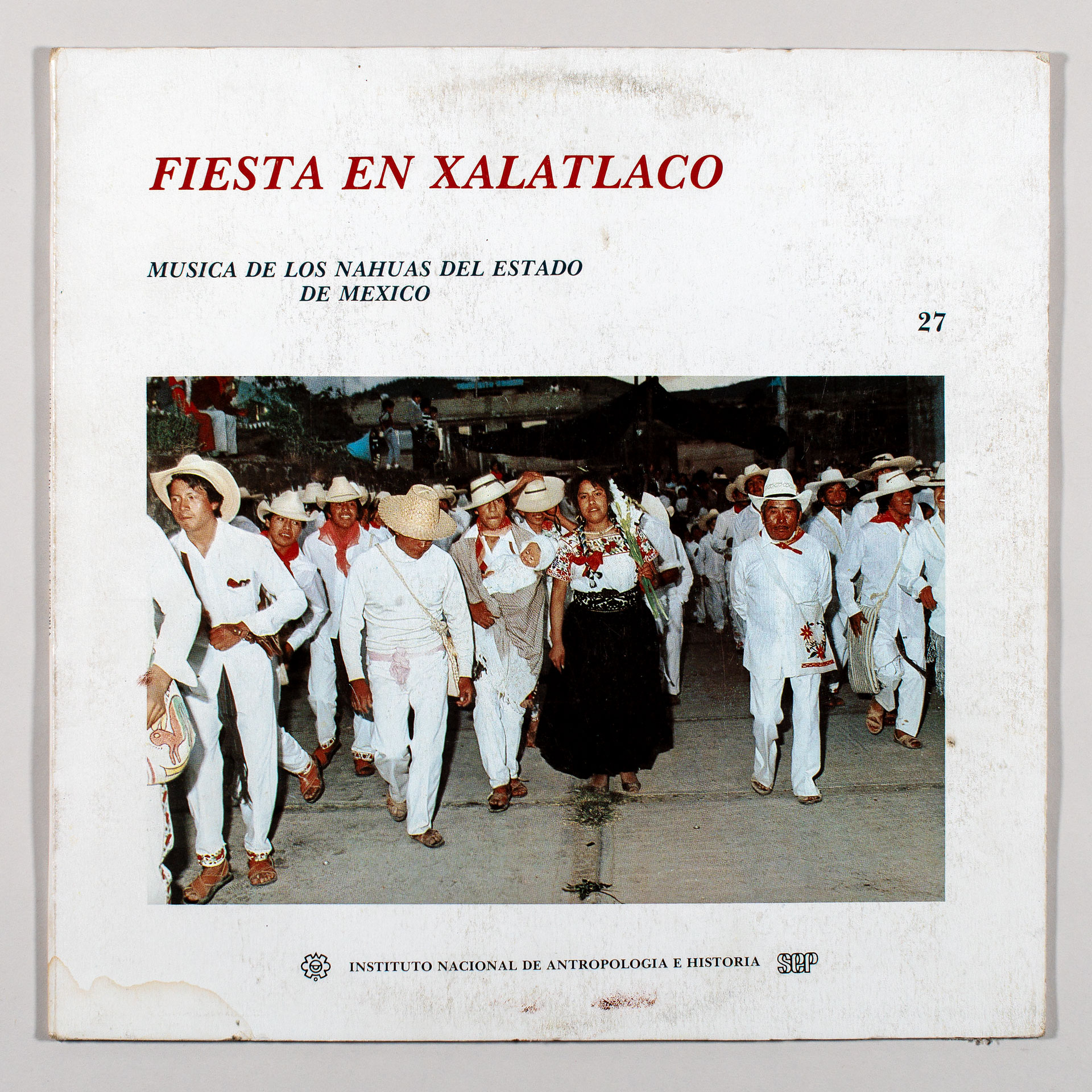
“This is Xalatlaco, where the fiesta never ends…”
From the rich peaks of the Sierra de Las Cruces, the municipality of Xalatlaco descends along wooded slopes toward the fertile Toluca Valley. A town of ancient pre-Hispanic foundation, Xalatlaco forms part of the Nahuatl-speaking area of the valley, situated in its southeastern portion. Its people have a reputation for being hardworking, fond of fiestas, and rebellious because they know how to defend their rights.
Thirty years ago, everyone in Xalatlaco made their living from agriculture. Today, few families do not have at least one member working outside the municipality. Some are factory workers; others practice a thousand different trades, working as employees or construction workers in the capital. Men and women, young and old, leave the town to earn a living.
Every day they face the struggle for survival, the frantic pace of the city, insecurity, long working hours, and meager compensation for their efforts. Perhaps this is why the people of Xalatlaco cling even more strongly to their fiestas, to that time of collective recreation, abundance, and joy. It is also because they remain farmers, and music and dance are a way of praying for the crops to come to a successful harvest.
Part of Xalatlaco’s traditional music has disappeared or is being forgotten. The Xochipizahuac, for example, is no longer heard at weddings. The Yunteros dance has not been performed for years. Corridos, once one of the favorite ways of singing about events and love, have also fallen silent. Nevertheless, some people remain determined not to allow these marvelous expressions of local culture to die. The Tlaxinques dance, an original creation of Xalatlaco, ceased to be performed for some time, but a group of elders decided to revive it around the 1960s, and since then it has continued to be danced at nearly all the saints’ festivals. Xalatlaco resists allowing its cultural heritage to disappear.
This record was born from the desire of a group of people from Xalatlaco to disseminate the rich traditions of their town as part of a broader effort to understand and value their own culture. Xalatlaco’s representatives, meeting in council, studied the project and voted to support it. Moreover, they decided that, just as there are committees responsible for public works and the defense of communal property, the community should also have programs dedicated to defending its cultural heritage.
We hope in this way to help new generations become aware that, before being invaded by an imported, commercial, and alienating culture imposed by the mass media, Xalatlaco, like so many other towns, possessed its own culture, with its own ways of thinking and feeling and its own creative forms.
Alejandro Patiño Díaz, Soledad González Montes and Sergio Hinojosa Reynoso
(Grupo Nuestra Memoria “Toquilnamic”)
Galería:

Escuche el álbum en la MEDIATECA del INAH, haga clic en la siguiente imagen:
Tracklist:
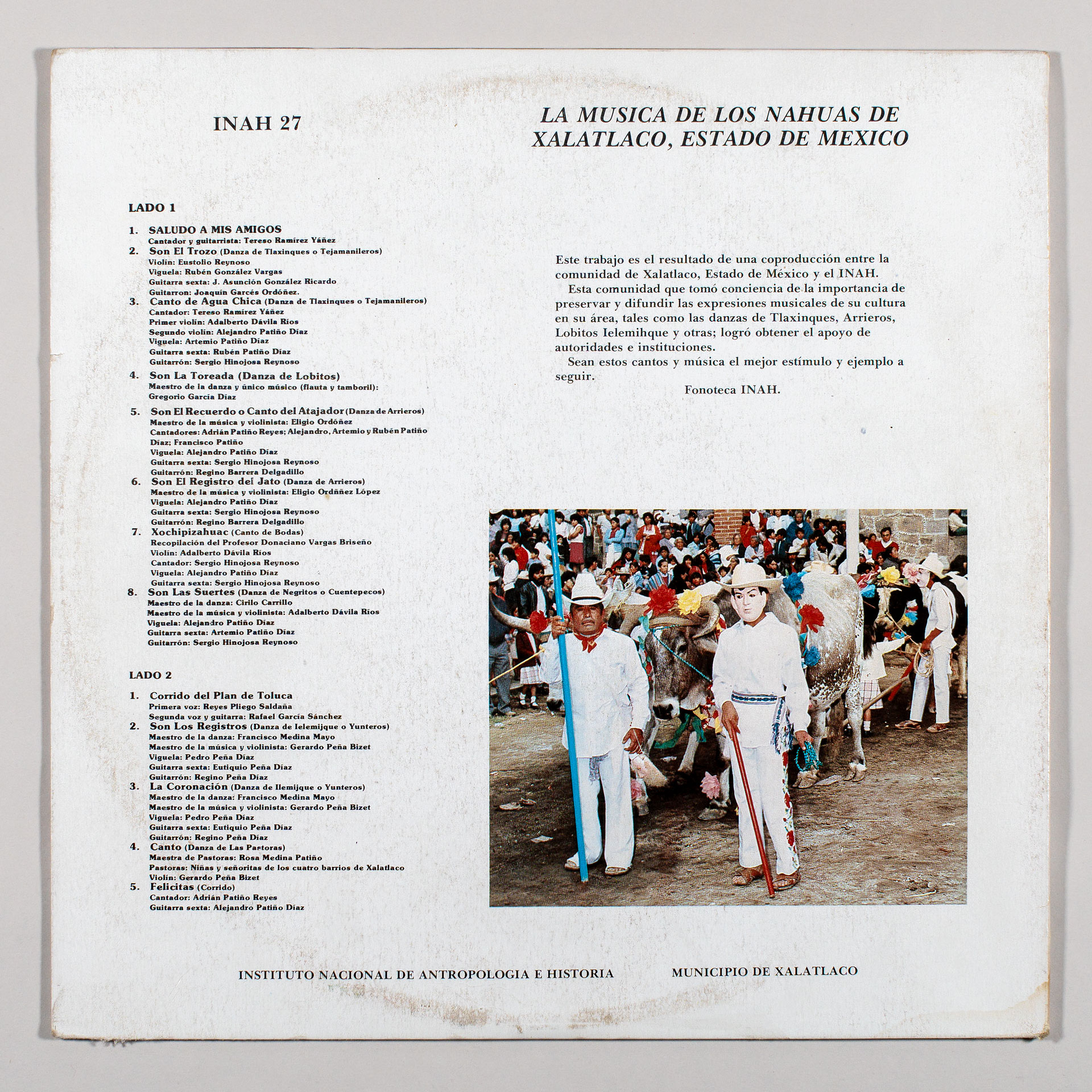
INAH 27
THE MUSIC OF THE NAHUA OF
XALATLACO, STATE OF MEXICO
SIDE 1
1. GREETING TO MY FRIENDS
Singer and guitarist: Tereso Ramírez Yáñez
2. Son El Tozo
(Dance of the Tlaxinques or Shingle Makers)
Violin: Eustolio Reynoso
Vihuela: Rubén González Vargas
Six-string guitar: J. Asunción González Ricardo
Guitarrón: Joaquín García Ordóñez
3. Song of Agua Chica
(Dance of the Tlaxinques or Shingle Makers)
Singer: Tereso Ramírez Yáñez
First violin: Adalberto Dávila Ríos
Second violin: Alejandro Patiño Díaz
Vihuela: Artemio Patiño Díaz
Six-string guitar: Rubén Patiño Díaz
Guitarrón: Sergio Hinojosa Reynoso
4. Son La Toreada
(Dance of the Lobitos)
Dance master and sole musician (flute and drum):
Gregorio García Díaz
5. Son El Recuerdo or Song of the Atajador
(Dance of the Muleteers)
Music master and violinist: Eligio Ordóñez
Singers: Adrián Patiño Reyes; Alejandro, Artemio and Rubén Patiño Díaz; Francisco Patiño
Vihuela: Alejandro Patiño Díaz
Six-string guitar: Sergio Hinojosa Reynoso
Guitarrón: Regino Barrera Delgadillo
6. Son El Registro del Jato
(Dance of the Muleteers)
Music master and violinist: Eligio Ordóñez López
Vihuela: Alejandro Patiño Díaz
Six-string guitar: Sergio Hinojosa Reynoso
Guitarrón: Regino Barrera Delgadillo
7. Xochipizahuac
(Wedding Song)
Collected by Professor: Donaciano Vargas Briseño
Violin: Adalberto Dávila Ríos
Singer: Sergio Hinojosa Reynoso
Vihuela: Alejandro Patiño Díaz
Six-string guitar: Sergio Hinojosa Reynoso
8. Son Las Suertes
(Dance of the Negritos or Cuentepocos)
Dance master: Cirilo Carrillo
Music master and violinist: Adalberto Dávila Ríos
Vihuela: Alejandro Patiño Díaz
Six-string guitar: Artemio Patiño Díaz
Guitarrón: Sergio Hinojosa Reynoso
SIDE 2
1. Corrido del Plan de Toluca
First voice: Reyes Pliego Saldaña
Second voice and guitar: Rafael García Sánchez
2. Son Los Registros
(Dance of the Ilemijque or Yunteros)
Dance master: Francisco Medina Mayo
Music master and violinist: Gerardo Peña Bizet
Vihuela: Pedro Peña Díaz
Six-string guitar: Eutiquio Peña Díaz
Guitarrón: Regino Peña Díaz
3. La Coronación
(Dance of the Ilemijque or Yunteros)
Dance master: Francisco Medina Mayo
Music master and violinist: Gerardo Peña Bizet
Vihuela: Pedro Peña Díaz
Six-string guitar: Eutiquio Peña Díaz
Guitarrón: Regino Peña Díaz
4. Song
(Dance of the Shepherdesses)
Leader of the Shepherdesses: Rosa Medina Patiño
Shepherdesses: Girls and young women from the four barrios of Xalatlaco
Violin: Gerardo Peña Bizet
5. Felicitas
(Corrido)
Singer: Adrián Patiño Reyes
Six-string guitar: Alejandro Patiño Díaz
Text
This work is the result of a co-production between the community of Xalatlaco, State of Mexico, and INAH.
This community, having become aware of the importance of preserving and disseminating the musical expressions of its culture in the region—such as the dances of the Tlaxinques, Arrieros, Lobitos, Ielemijque, and others—succeeded in obtaining the support of authorities and institutions.
May these songs and music serve as the finest encouragement and an example to follow.
INAH Sound Archive
NATIONAL INSTITUTE OF ANTHROPOLOGY AND HISTORY
MUNICIPALITY OF XALATLACO
Credits:
Credits
Texts:
Alejandro Patiño Díaz, Soledad González Montes and Sergio Hinojosa Reynoso
(Grupo Nuestra Memoria “Toquilnamic”)
Recordings:
Tomás Stanford
Photographs:
Pedro Hirriart (I.N.I.)
Emiliano Galindo (Xalatlaco)
INAH 27
Secretariat of Public Education
Lic. Miguel González Avelar
Undersecretariat of Culture
Lic. Martín Reyes Vayssade
National Institute of Anthropology and History
Dr. Enrique Florescano Mayet
Municipality of Xalatlaco
Grupo Toquilnamic
Director of the INAH Record Series
René Villanueva S., Fonoteca
Links:
otro Various – Fiesta En Xalatlaco
Sold For:
Highest Price:
$300 MXMedium Price:
$300 MXCondition:
Media Condition:
Very Good (VG)Sleeve Condition:
Very Good Plus (VG+)