




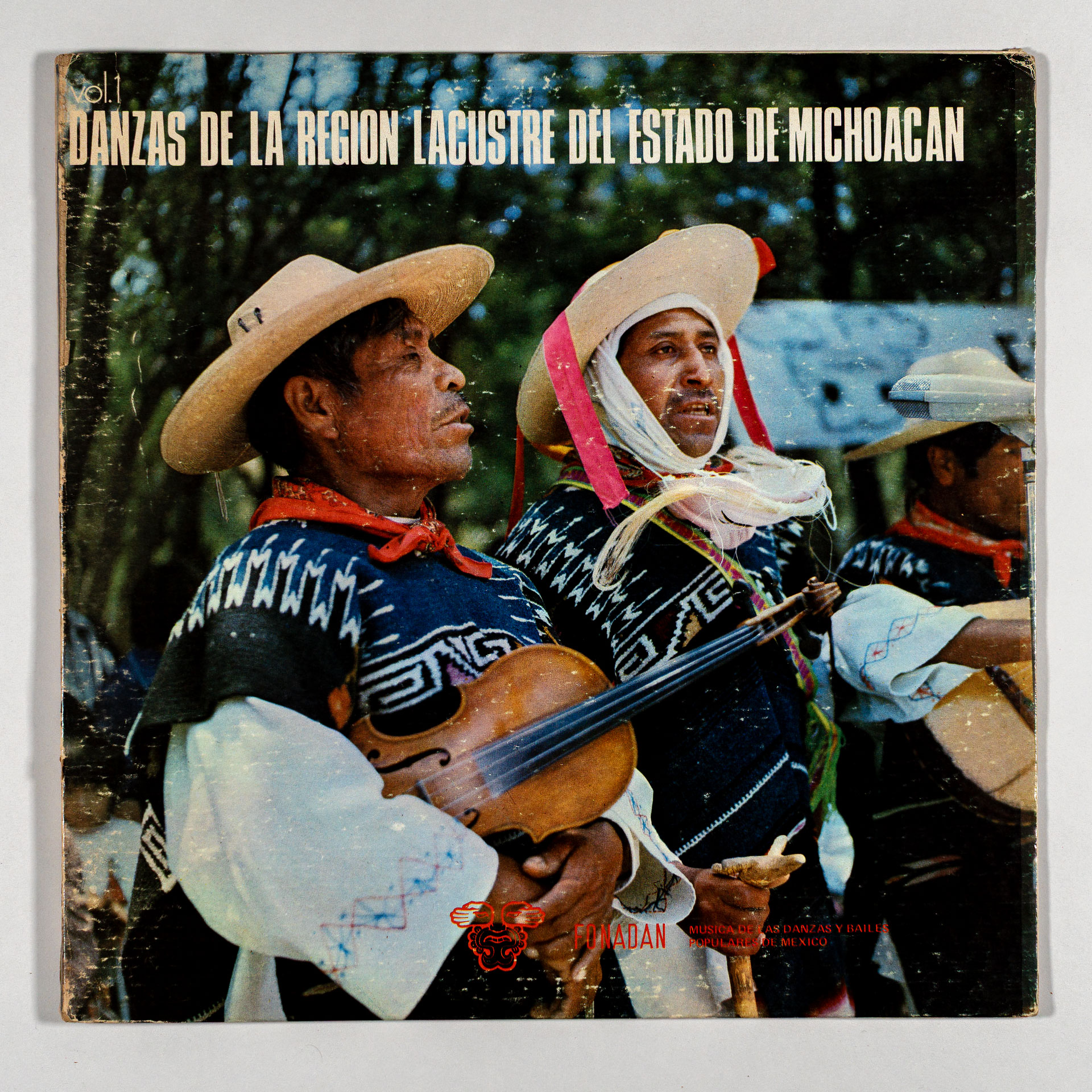
DANCES OF THE LAKE REGION OF THE STATE OF MICHOACAN
FONADAN
|
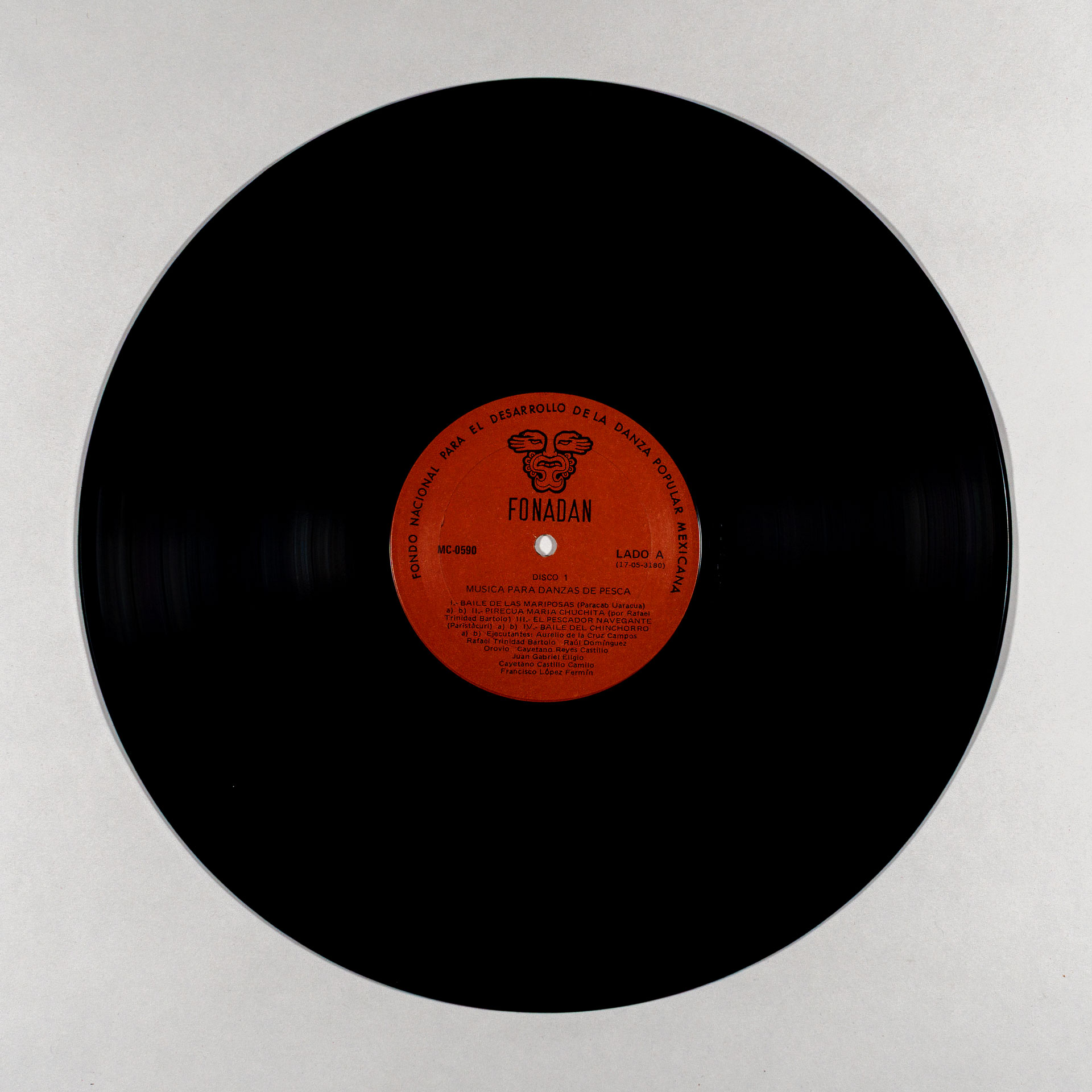
Label: FONADAN MC-0590 Format: Vinyl LP Album 12" 33 1/3 rpm Gatefold Compilation Released: 1972 |
Country: Mexico Genre: Folk World & Country Latin |
Info:
vol. 1
DANCES OF THE LAKE REGION OF THE STATE OF MICHOACAN
F A C E 1
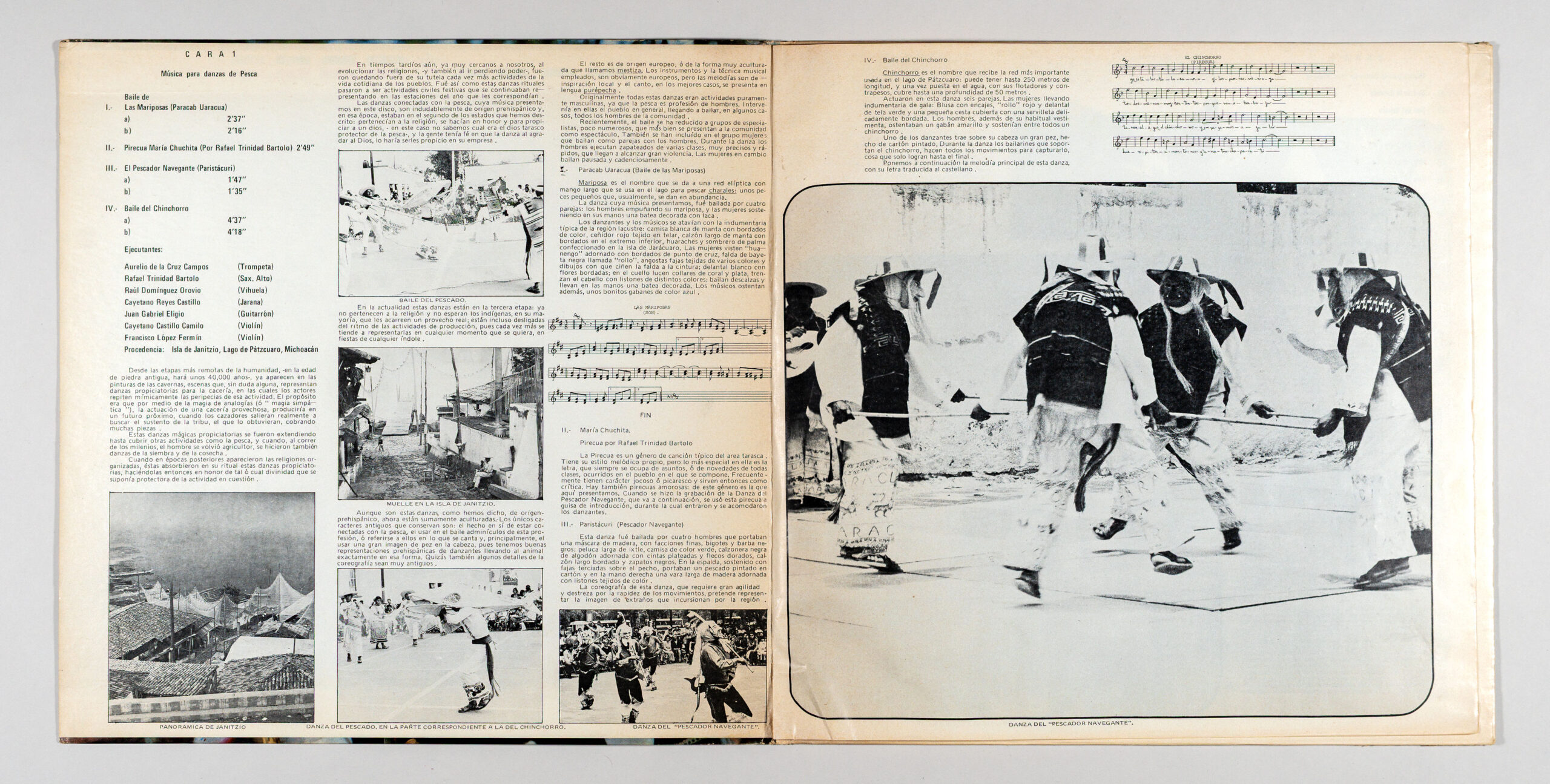
Music for fishing dances
I.- Dance of the Butterflies (Paracab Uaracua)
a) 2′37″
b) 2’16”
II.- Pirekua Maria Chuchita (By Rafael Trinidad Bartolo) 2’49”
III.- The Sailing Fisherman (Paristacuri)
a) 1’47”
b) 1’35”
IV.- Dance of the Chinchorro
a) 4’37”
b) 4’18”
Performers:
Aurelio de la Cruz Campos (Trumpet)
Rafael Trinidad Bartolo (High Sax.)
Raúl Domínguez Orovio (Vihuela)
Cayetano Reyes Castillo (Revelry)
Juan Gabriel Eligio (Guitarron)
Cayetano Castillo Camilo (Violin)
Francisco López Fermín (Violin)
Origin: Janitzio Island, Lake Pátzcuaro, Michoacán
From the most remote stages of humanity, -in the ancient stone age, about 40,000 years ago-, already appear in the cave paintings, scenes that, without a doubt, represent propitiatory dances for the hunt, in which the actors mimically repeat the incidents of that activity. The purpose was that through the magic of analogies (or “sympathetic magic”), the performance of a profitable hunt, would produce in the near future, when the hunters really went out to look for the sustenance of the tribe, which they obtained, collecting many pieces.
These magical propitiatory dances were extended to cover other activities such as fishing, and when, over the millennia, man became a farmer, sowing and harvest dances were also performed.
When organized religions appeared in later times, they absorbed these propitiatory dances into their ritual, making them then in honor of this or that divinity that was supposed to protect the activity in question.
In late times, already very close to us, as religions evolved, -and also as they gradually lost power-, more and more activities of the daily life of the peoples were left out of their guardianship. This is how these ritual dances became festive civil activities that continued to be performed in the corresponding seasons of the year.
The dances connected with fishing, whose music we present on this album, are undoubtedly of pre-Hispanic origin and, at that time, they were in the second of the states that we have described: they belonged to religion, they were done in honor and to propitiate a god, -in this case we do not know which was the Tarascan protector god of fishing-, and the people had faith that the dance to please the God, would make him propitious in their company.
At present these dances are in the third stage: they no longer belong to the religion and the indigenous people, for the most part, do not expect them to bring them any real benefit; They are even disconnected from the rhythm of the production activities, since more and more they tend to be represented at any time you want, at parties of any kind.
Although these dances are, as we have said, of pre-Hispanic origin, they are now highly acculturated. The only ancient characters that they preserve are: the fact of being connected with fishing, the use of gadgets of this profession in the dance, or referring to them in what is sung and, mainly, the use of a large image of a fish in the head, since we have good pre-Hispanic representations of dancers carrying the animal in exactly that way. Perhaps also some details of the choreography are very old.
The rest is of European origin, or in the highly acculturated form that we call mestizo. The instruments and musical technique used are obviously European, but the melodies are of local inspiration and the singing, in the best cases, is presented in the Purépecha language. .
Originally all these dances were purely male activities, since fishing is a male profession. The people in general took part in them, getting to dance, in some cases, all the men of the community.
Recently, the dance has been reduced to groups of specialists, few in number, who rather present themselves to the community as a show. Women who dance as couples with men have also been included in the group. During the dance, the men perform very precise and fast foot tapping of various kinds, which can reach great violence. The women, on the other hand, dance slowly and rhythmically.
I.- Paracab Uarakua (Dance of the Butterflies)
Mariposa is the name given to an elliptical net with a long handle that is used in the lake to fish for charales: small fish that usually occur in abundance.
The dance whose music we present was danced by four couples: the men holding their butterfly, and the women holding a tray decorated with lacquer in their hands.
The dancers and musicians dressed in the typical clothing of the lake region: white blanket shirt with colored embroidery, loom-woven red girdle, long blanket breeches with embroidery at the bottom end, huaraches, and a palm hat made of the island of Jaracuaro. The women wear “huanengo” adorned with cross-stitch embroidery, a skirt made of black baize called “rollo”, narrow woven sashes of various colors and drawings with which they cinch the skirt at the waist; white apron with embroidered flowers; On their necks they wear coral and silver necklaces, they braid their hair with ribbons of different colors; they dance barefoot and carry a decorated tray in their hands. The musicians also wear beautiful blue coats.
II.- Maria Chuchita.
Pirekua by Rafael Trinidad Bartolo
The Pirekua is a typical song genre from the Tarascan area. It has its own melodic style, but the most special thing about it is the lyrics, which always deals with issues, or news of all kinds, that occur in the town where it is composed. They are frequently humorous or picaresque in nature and thus serve as criticism. There are also loving pirekuas: of this genre is the one that we present here. When the recording of the Navigator Fisherman’s Dance was made, which follows, this pirekua was used as an introduction, during which the dancers entered and settled.
III.- Paristácuri (Navigator Fisherman)
This dance was danced by four men wearing a wooden mask, with fine features, black mustaches and beards; long ixtle wig, green shirt, black cotton pants adorned with silver ribbons and gold fringes, long embroidered pants and black shoes. On their backs, held up by sash across their chests, they carried a fish painted on cardboard and in their right hand a long wooden stick adorned with colored woven ribbons.
The choreography of this dance, which requires great agility and dexterity due to the speed of the movements, tries to represent the image of strangers who venture into the region.
IV.- Dance of the Chinchorro
Chinchorro is the name given to the most important net used in Lake Pátzcuaro: it can be up to 250 meters long, and once placed in the water, with its floats and counterweights, it covers up to a depth of 50 meters.
Six couples performed in this dance. The women wearing gala attire: lace blouse, red “roll” and green cloth apron and a small basket covered with a delicately embroidered napkin. The men, in addition to their usual clothing, wore a yellow overcoat and held a hammock between all of them.
One of the dancers carries a large fish on his head, made of painted cardboard. During the dance, the dancers who support the hammock make all the movements to capture it, which they only manage to the end.
We put below the main melody of this dance, with its lyrics translated into Spanish.
F A C E 2
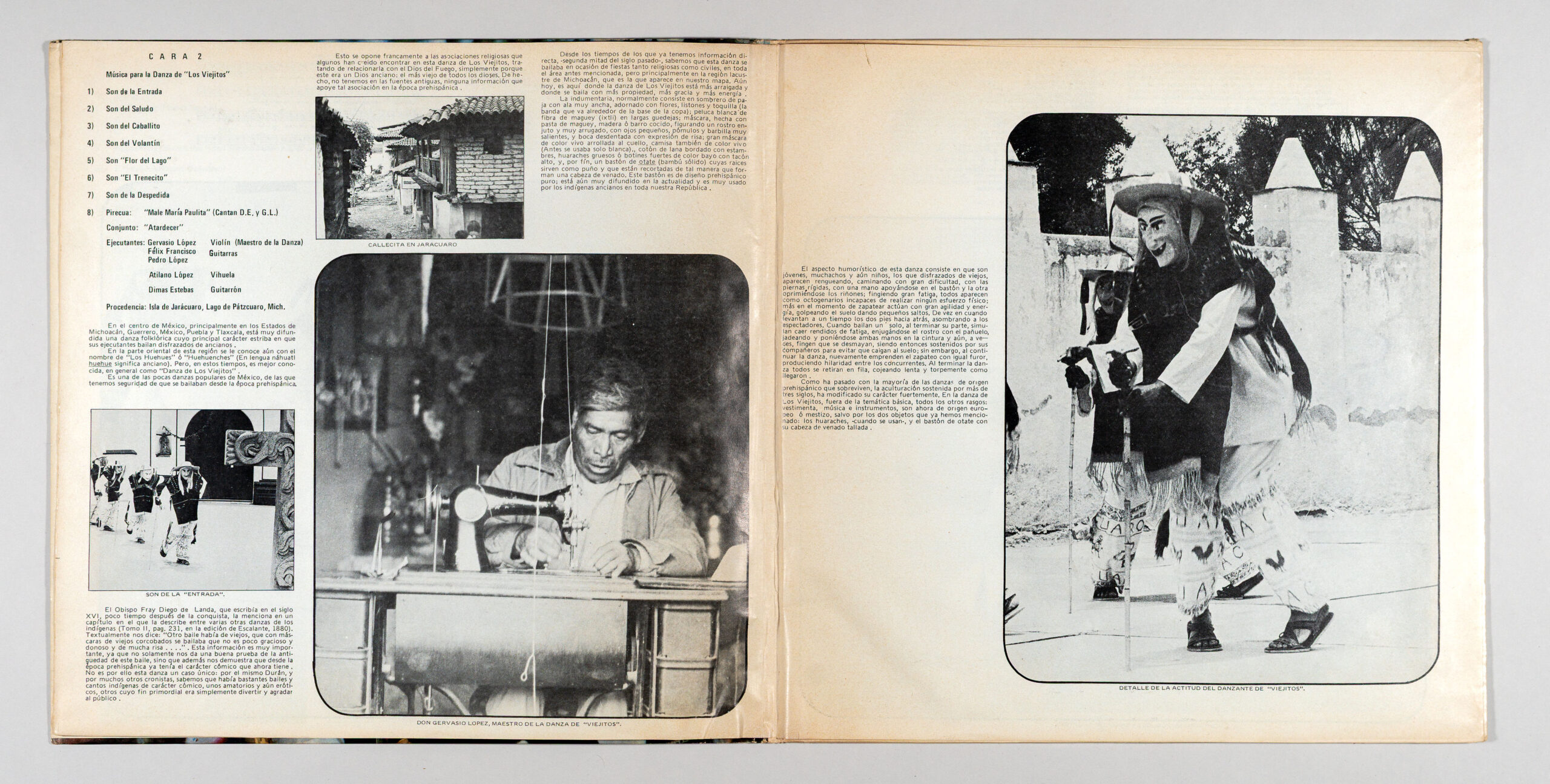
Music for the Dance of “Los Viejitos”
1) Sound from the Entrance
2) Sound of Greeting
3) Sound del Caballito
4) Sound from the Volantín
5) Sound “Flower of the Lake”
6) Sound “The Little Train”
7) Sound from the Farewell
8) Pirekua: “Male Maria Paulita” (They sing D.E. and G.L.)
Set: “Sunset”
Performers:
Gervasio López Violín (Dance Master)
Félix Francisco (Guitars)
Pedro López
Atilano López Vihuela
Dimas Estebas (Guitarron)
Origin: Isla de Jarácuaro, Lake Pátzcuaro, Mich.
In central Mexico, mainly in the states of Michoacán, Guerrero, México, Puebla and Tlaxcala, a folkloric dance is widespread whose main character is that its performers dance disguised as old people.
In the eastern part of this region it is still known by the name of “Los Huehues” or “Huehuenches” (In the Nahuatl language, huehue means old man). But, these days, it is better known, generally as “Danza de Los Viejitos”.
It is one of the few popular dances in Mexico, of which we are sure that they have been danced since pre-Hispanic times.
Bishop Fray Diego de Landa, who was writing in the 16th century, shortly after the conquest, mentions it in a chapter in which he describes it among several other indigenous dances (Volume II, p. 231, in the edition of Escalante, 1880). He literally tells us: “There was another dance for old people, who danced with masks of old hunched-overs, which is not unfunny and graceful and full of laughter…”. This information is very important, since it not only gives us good proof of the antiquity of this dance, but also shows us that since pre-Hispanic times it already had the comic character it has now. For this reason, this dance is not a unique case: from Durán himself, and from many other chroniclers, we know that there were quite a few indigenous dances and songs of a comical nature, some amatory and even erotic, others whose primary purpose was simply to entertain and please the public. .
This is frankly opposed to the religious associations that some have believed to find in this dance of Los Viejitos, trying to relate it to the God of Fire, simply because this was an ancient God; the oldest of all gods. In fact, we do not have any information in ancient sources that supports such an association in pre-Hispanic times.
From the times of which we already have direct information, -second half of the last century-, we know that this dance was danced on the occasion of both religious and civil festivals, in the entire aforementioned area, but mainly in the lake region of Michoacán, which is what appears on our map. Even today, it is here where the dance of Los Viejitos is most deeply rooted and where it is danced with more propriety, more grace and more energy.
The clothing normally consists of a straw hat with a very wide brim, decorated with flowers, ribbons and a toquilla (the band that goes around the base of the crown); white maguey fiber wig (ixtli) in long locks; mask, made with maguey paste, wood or baked clay, figuring a lean and very wrinkled face, with small eyes, very prominent cheekbones and chin, and a toothless mouth with a laughing expression; large brightly colored mask wrapped around the neck, also brightly colored shirt. (Before, only white was used), cotton wool embroidered with yarn, thick huaraches or strong bay booties with high heels, and, finally, a cane made of otate (solid bamboo) whose roots serve as a cuff and are cut in such a way that they form a deer’s head. This cane is of pure pre-Hispanic design; It is still very widespread today and is widely used by indigenous elders throughout our Republic.
The humorous aspect of this dance consists in the fact that it is young people, boys and even children, who, disguised as old men, appear limping, walking with great difficulty, with stiff legs, with one hand leaning on the cane and the other squeezing his kidneys; feigning great fatigue, they all appear as octogenarians incapable of making any physical effort; but at the moment of stomping they act with great agility and energy, hitting the ground making small jumps. From time to time they lift both feet back at the same time, astonishing the spectators. When they dance a solo, at the end of their part, they pretend to fall exhausted, wiping their faces with their handkerchiefs, panting and putting both hands on their waists and even, sometimes, they pretend to faint, being then supported by their partners to avoid let them fall to the ground; however, as the dance continues, they again start tapping with equal fury, causing hilarity among those present. At the end of the dance they all file out, limping slowly and awkwardly as they arrived.
As has happened with most of the dances of pre-Hispanic origin that survive, acculturation sustained for more than three centuries has strongly modified their character. In the dance of Los Viejitos, apart from the basic theme, all the other features: clothing, music and instruments, are now of European or mestizo origin, except for the two objects that we have already mentioned: the huaraches, -when they are used- , and the otate cane with its carved deer head.
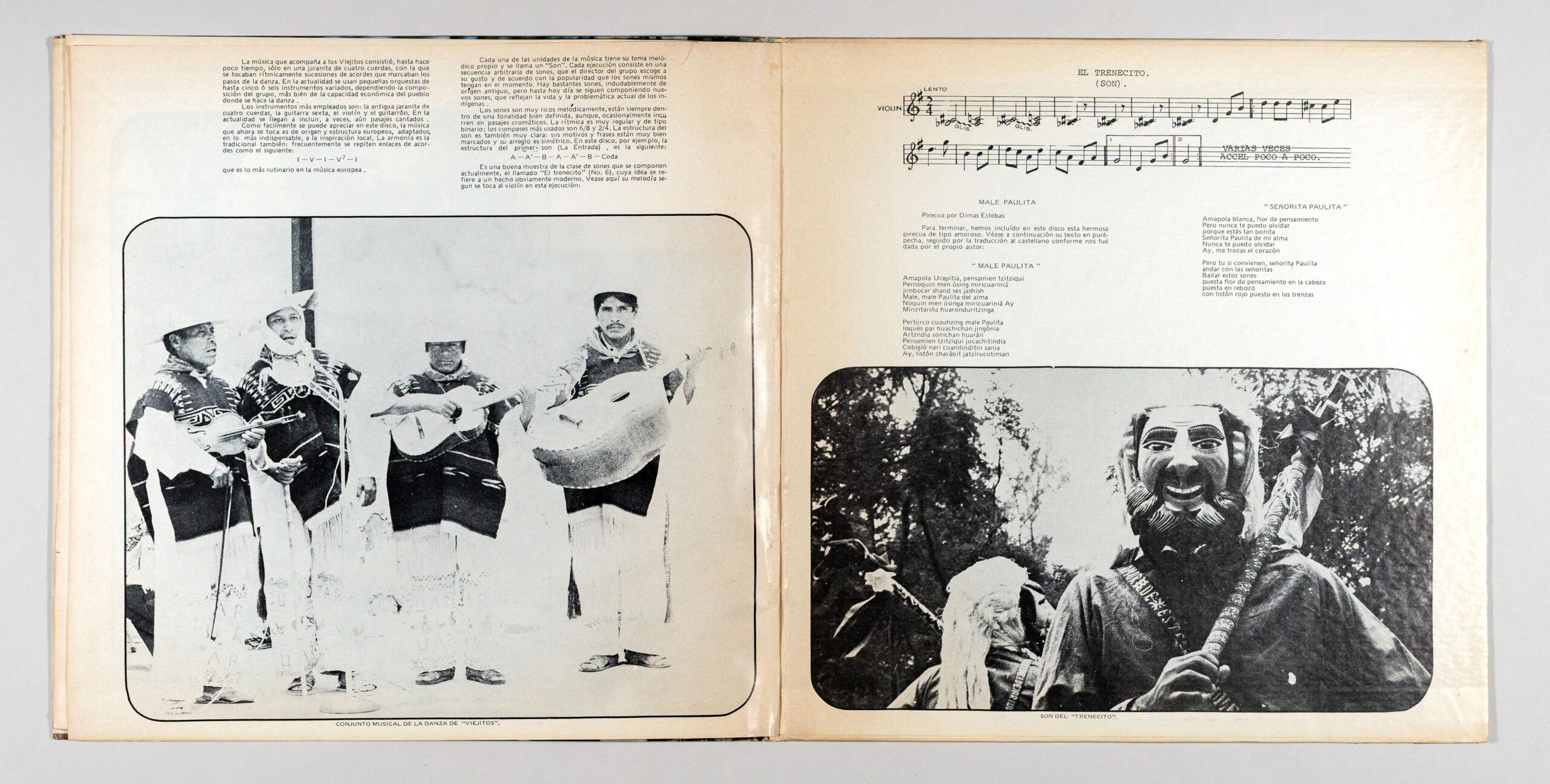
The music that accompanies the Viejitos consisted, until recently, only of a four-stringed jaranita, with which successions of chords that marked the steps of the dance were played rhythmically. At present, small orchestras of up to five or six varied instruments are used, depending on the composition of the group, rather on the economic capacity of the town where the dance is performed.
The most used instruments are: the old four-string jaranita, the sixth guitar, the violin and the guitarrón. At present, sometimes even sung passages are included. As can easily be seen on this album, the music now played is of European origin and structure, adapted, in the most essential, to local inspiration. The harmony is also traditional: chord links such as the following are frequently repeated:
I – V – I – V⁷ – I
which is the most routine thing in European music.
Each of the units of music has its own melodic theme and is called a “Son”. Each performance consists of an arbitrary sequence of sones, which the director of the group chooses to his liking and according to the popularity of the sones themselves at the time. There are quite a few sones, undoubtedly of ancient origin, but until today new sones continue to be composed, which reflect the life and current problems of the indigenous people.
The sones are very rich melodically, they are always within a well-defined tonality, although they occasionally incur in chromatic passages. The rhythm is very regular and of a binary type; the most used time signatures are 6/8 and 2/4. The structure of the son is also very clear: its motifs and phrases are very well defined and its arrangement is symmetrical. On this record, for example, the structure of the first son (La Entrada) is as follows:
A – A’ – B – A – A’ – B – Coda
It is a good example of the kind of sones that are currently composed, the so-called “El trenecito” (No. 6), whose idea refers to an obviously modern fact. See here his melody as played on the violin in this performance:
THE LITTLE TRAIN.
(SOUND).
MALE PAULITA
Pirekua by Dimas Estebas
To finish, we have included in this album this beautiful pirekua of a loving type. See below its text in Purépecha, followed by the translation into Spanish as it was given to us by the author himself:
“ MALE PAULITA ”
Amapola Urapitia, pensamien tzitziqui
Pernoquin men úsing miricuariniá
jimbocar shand ses jashish
Male, male Paulita del alma
Noquin men úsinga miricuariniá Ay
Minzitariña huaronduritzinga
Pertúrco cuauhzing male Paulita
loqués par huachichan jingónia
Artzndia sonichan huarán
Pensamien tzitziqui jucachitindia
Cobigió nari cuandinditin sania
Ay, listón charápit jatzirucutinsan
“ MISS PAULITA ”
White poppy, pansy flower
But I can never forget you
why are you so pretty
Miss Paulita of my soul
I can never forget you
Oh, you break my heart
But you do agree, Miss Paulita
hang out with the ladies
dance these sounds
put pansy flower on her head
put in batter
with red ribbon attached to the braids
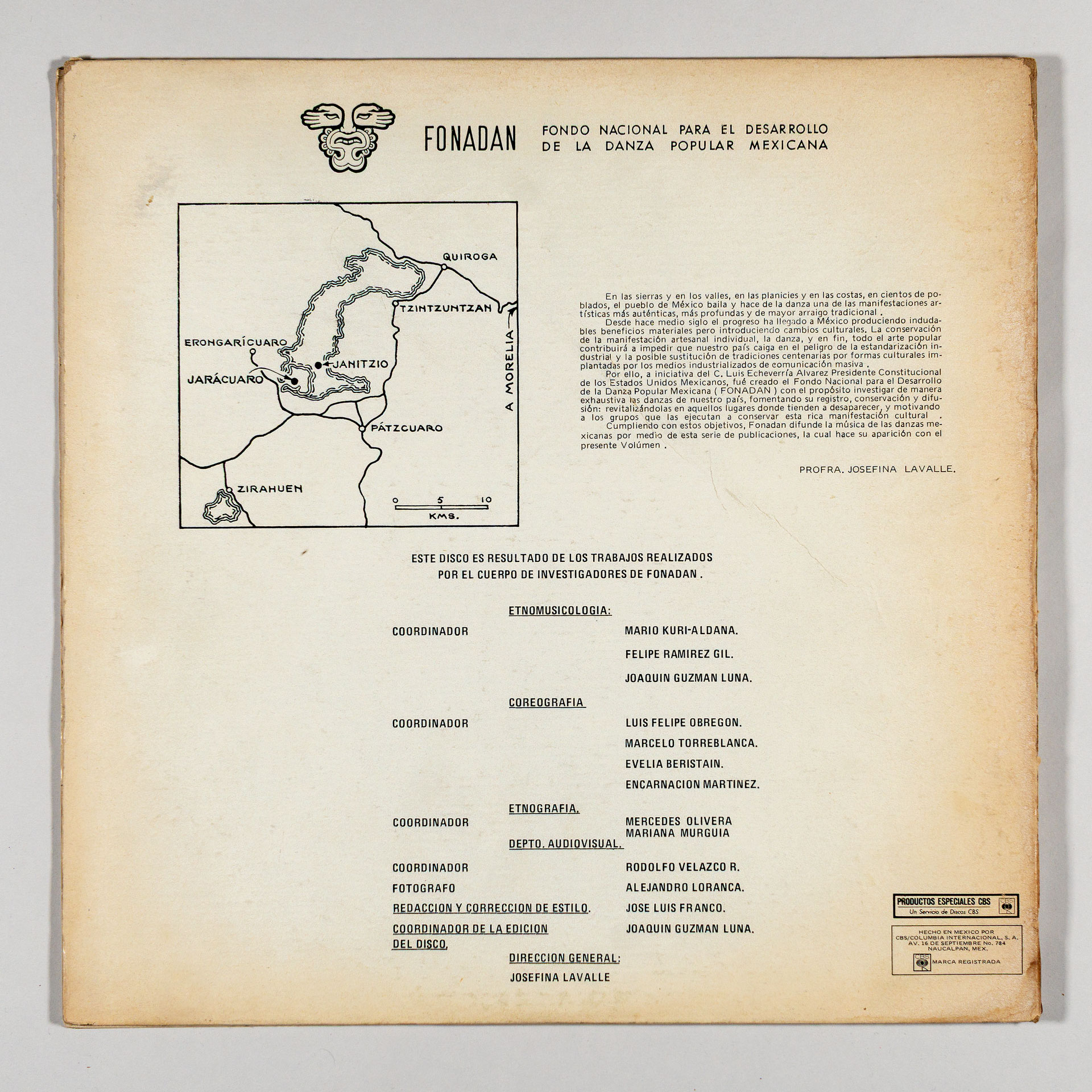
FONADAN
FONDO NACIONAL PARA EL DESARROLLO DE LA DANZA POPULAR MEXICANA
(NATIONAL FUND FOR THE DEVELOPMENT OF MEXICAN POPULAR DANCE)
In the mountains and in the valleys, on the plains and on the coasts, in hundreds of towns, the people of Mexico dance and make dance one of the most authentic, deepest and most traditionally rooted artistic manifestations.
For half a century progress has come to Mexico producing unquestionable material benefits but introducing cultural changes. The conservation of the individual artisan manifestation, the dance, and finally, all the popular art will contribute to prevent our country from falling into the danger of industrial standardization and the possible substitution of centuries-old traditions by cultural forms implanted by the industrialized means of communication. massive.
Therefore, at the initiative of C. Luis Echeverría Alvarez Constitutional President of the United Mexican States, the National Fund for the Development of Mexican Popular Dance (FONADAN) was created with the purpose of exhaustively investigating the dances of our country, promoting their registration, conservation and dissemination: revitalizing them in those places where they tend to disappear, and motivating the groups that execute them to preserve this rich cultural manifestation.
Fulfilling these objectives, Fonadan disseminates the music of Mexican dances through this series of publications, which makes its appearance with this volume.
PROFESSOR JOSEFINA LAVALLE.
THIS RECORD IS THE RESULT OF THE WORK CARRIED OUT BY THE FONADAN CORPS OF RESEARCHERS.
ETHNOMUSICOLOGY:
COORDINATOR
MARIO KURI-ALDANA.
FELIPE RAMIREZ GIL.
JOAQUÍN GUZMÁN LUNA.
CHOREOGRAPHY:
COORDINATOR
LUIS FELIPE OBREGÓN.
MARCELO TORREBLANCA.
EVELIA BERISTAIN.
ENCARNACION MARTINEZ.
ETHNOGRAPHY:
COORDINATOR
MERCEDES OLIVERA
MARIANA MURGUIA
AUDIOVISUAL DEPARTMENT:
COORDINATOR
RODOLFO VELAZCO R.
PHOTOGRAPHER
ALEJANDRO LORANCA.
WRITING AND STYLE CORRECTION
JOSE LUIS FRANCO.
COORDINATOR OF THE EDITION OF THE DISC
JOAQUÍN GUZMÁN LUNA.
GENERAL DIRECTORATE:
JOSEFINA LAVALLE
CBS SPECIAL PRODUCTS
A CBS Record Service
MADE IN MEXICO BY CBS/COLUMBIA INTERNACIONAL, S. A. AV. 16 DE SEPTIEMBRE No. 784 NAUCALPAN, MEX.
TRADEMARK
Gallery:
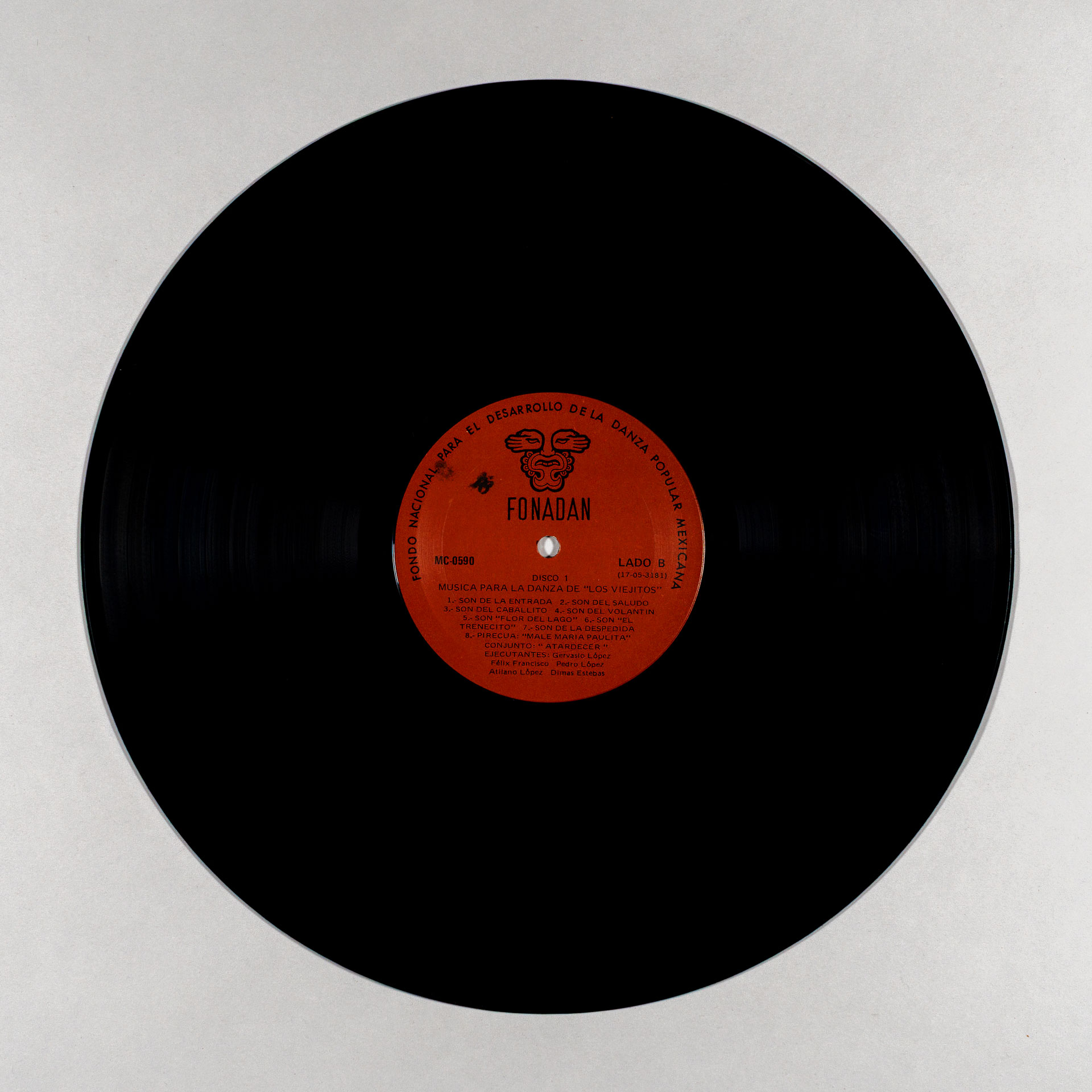
Tracklist:
DANCES OF THE LAKE REGION OF THE STATE OF MICHOACAN
SIDE 1 MUSIC FOR FISHING DANCES
- A1 Dance of the Butterflies (Paracab Uaraqua): A) AND B)
Performer(s): Aurelio de la Cruz Campos; Rafael Trinidad Bartolo; Raúl Domínguez Orovio; Cayetano Reyes Castillo; Juan Gabriel Eligio; Cayetano Castillo Camilo; Francisco López Fermín.
- A2 Pirekua Maria Chuchita (By Rafael Trinidad Bartolo)
Performer(s): Aurelio de la Cruz Campos; Rafael Trinidad Bartolo; Raúl Domínguez Orovio; Cayetano Reyes Castillo; Juan Gabriel Eligio; Cayetano Castillo Camilo; Francisco López Fermín.
- A3 The Sailing Fisherman (Paristacuri): A) Y B)
Performer(s): Aurelio de la Cruz Campos; Rafael Trinidad Bartolo; Raúl Domínguez Orovio; Cayetano Reyes Castillo; Juan Gabriel Eligio; Cayetano Castillo Camilo; Francisco López Fermín. - A4 Chinchorro Dance: A) Y B)
Performer(s): Aurelio de la Cruz Campos; Rafael Trinidad Bartolo; Raúl Domínguez Orovio; Cayetano Reyes Castillo; Juan Gabriel Eligio; Cayetano Castillo Camilo; Francisco López Fermín.
SIDE 2 MUSIC FOR THE DANCE OF “LOS VIEJITOS”
- B1 Sound from the Entrance
Performer(s): Atardecer Set: Gervasio López; Félix Francisco Pedro López; Atilano López Y Dimas Estebas.
- B2 Sound of the Greeting
Performer(s): Atardecer Set: Gervasio López; Félix Francisco Pedro López; Atilano López Y Dimas Estebas.
- B3 Sound Of The Little Horse
Performer(s): Atardecer Set: Gervasio López; Félix Francisco Pedro López; Atilano López Y Dimas Estebas.
- B4 Sound of Volantin
Performer(s): Atardecer Set: Gervasio López; Félix Francisco Pedro López; Atilano López Y Dimas Estebas.
- B5 Sound “Flower Of The Lake”
Performer(s): Atardecer Set: Gervasio López; Félix Francisco Pedro López; Atilano López Y Dimas Estebas.
- B6 Sound “The Little Train”
Performer(s): Atardecer Set: Gervasio López; Félix Francisco Pedro López; Atilano López Y Dimas Estebas.
- B7 Sound Of Farewell
Performer(s): Atardecer Set: Gervasio López; Félix Francisco Pedro López; Atilano López Y Dimas Estebas.
- B8 Pirekua: “Male Maria Paulita”
Performer(s): Atardecer Set: Gervasio López; Félix Francisco Pedro López; Atilano López Y Dimas Estebas.
Credits:
ETHNOMUSICOLOGY: Coordinator, Mario Kuri-Aldana; Felipe Ramirez Gil; Joaquin Guzman Luna.
CHOREOGRAPHY: Coordinator, Luis Felipe Obregón; Marcelo Torreblanca; Evelia Beristain; Encarnacion Martinez.
ETHNOGRAPHY: Coordinator, Mercedes Olivera; Mariana Murguia.
AUDIOVISUAL DEPARTMENT: Coordinator, Rodolfo Velazco R; Photographer, Alejandro Loranca; Writing and Style Correction, Jose Luis Franco; Record Edition Coordinator, Joaquín Guzmán Luna.
GENERAL MANAGEMENT: Josefina Lavalle.