







|
Format: Vinyl LP Album 12" 33 1/3 rpm Gatefold Compilation Released: 1990 |
Country: Mexico Genre: Folk World & Country |
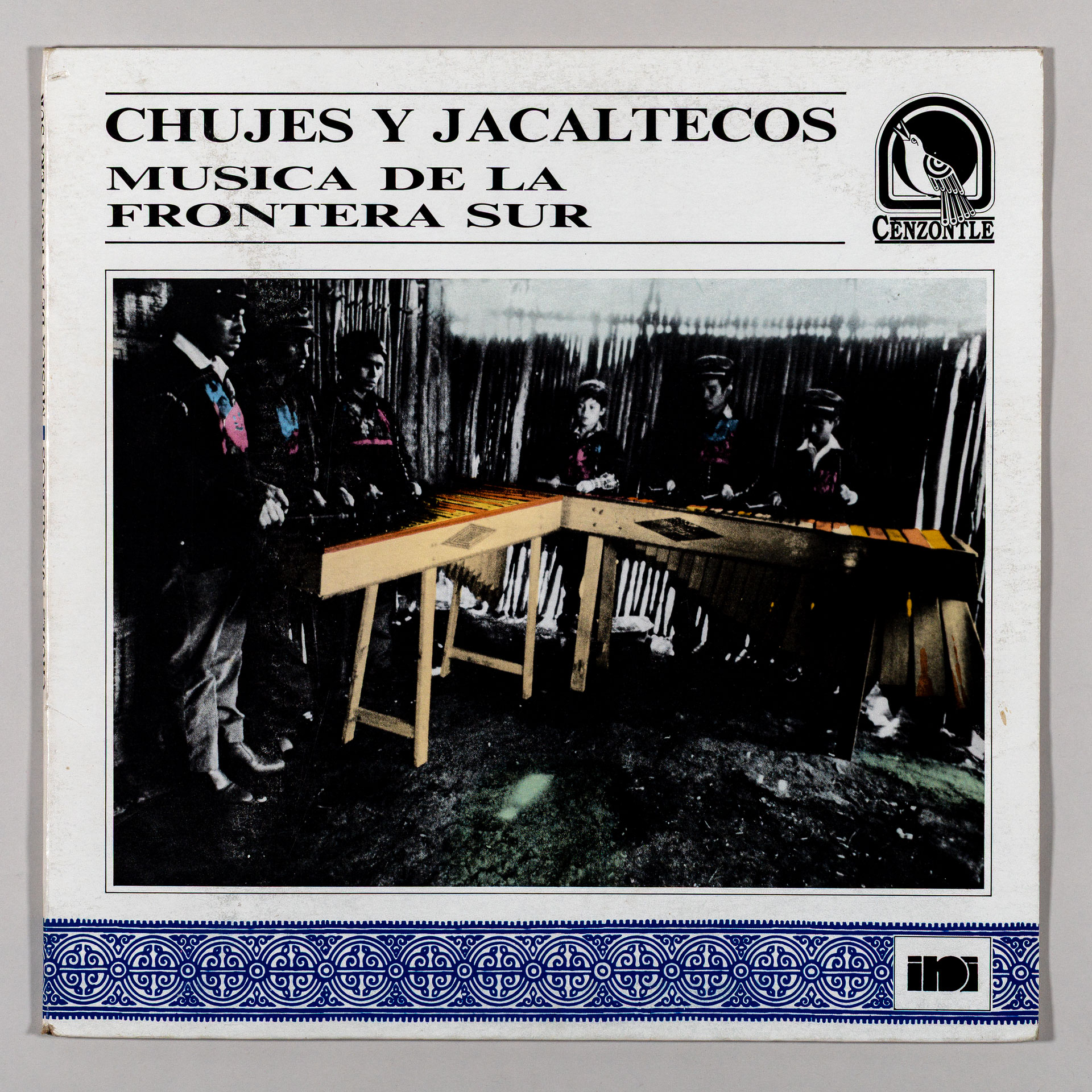
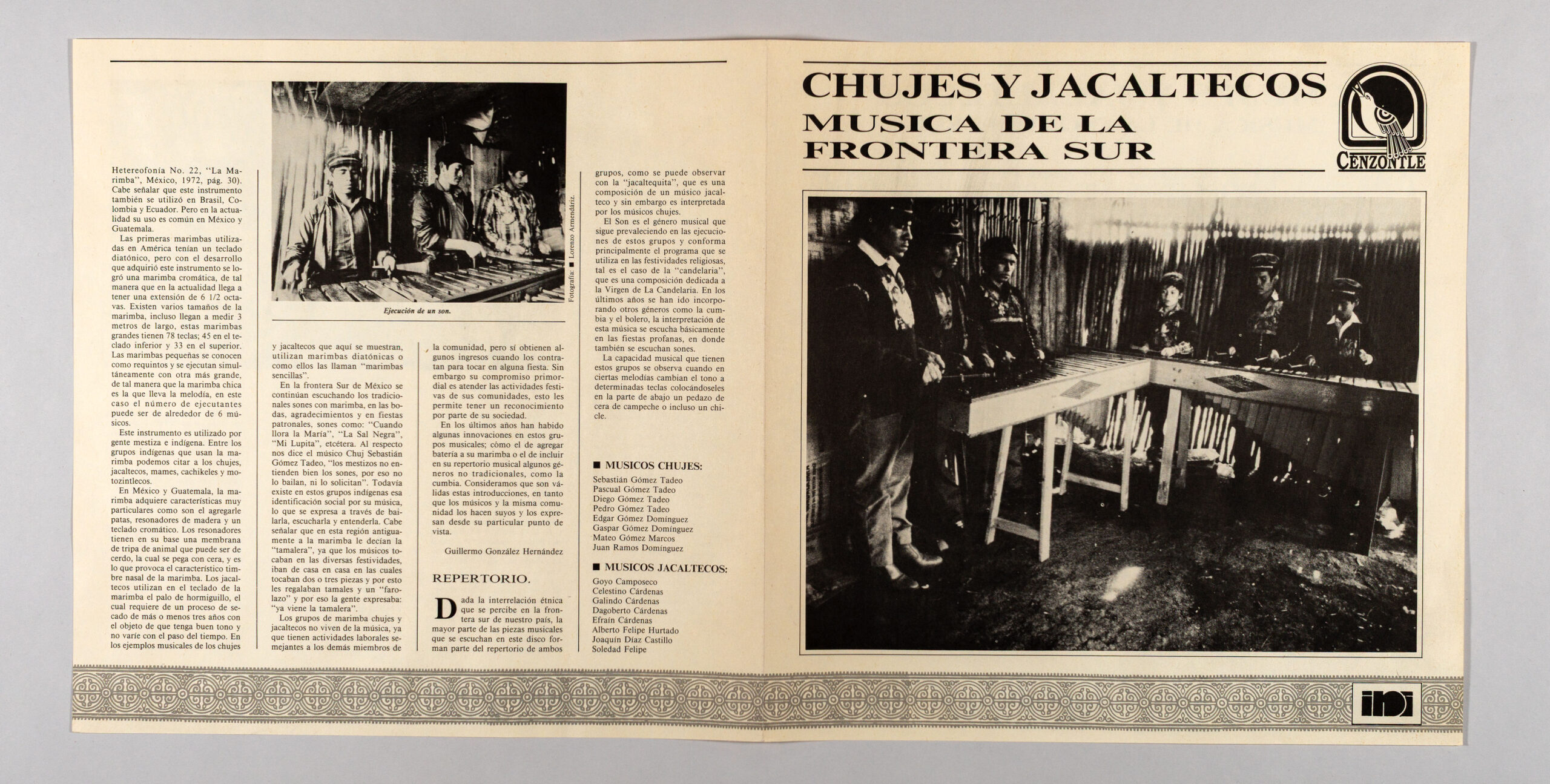
CHUJES AND JACALTECOS MUSIC OF THE SOUTH BORDER
CENZONTLE
(MOCKINGBIRD)
INI
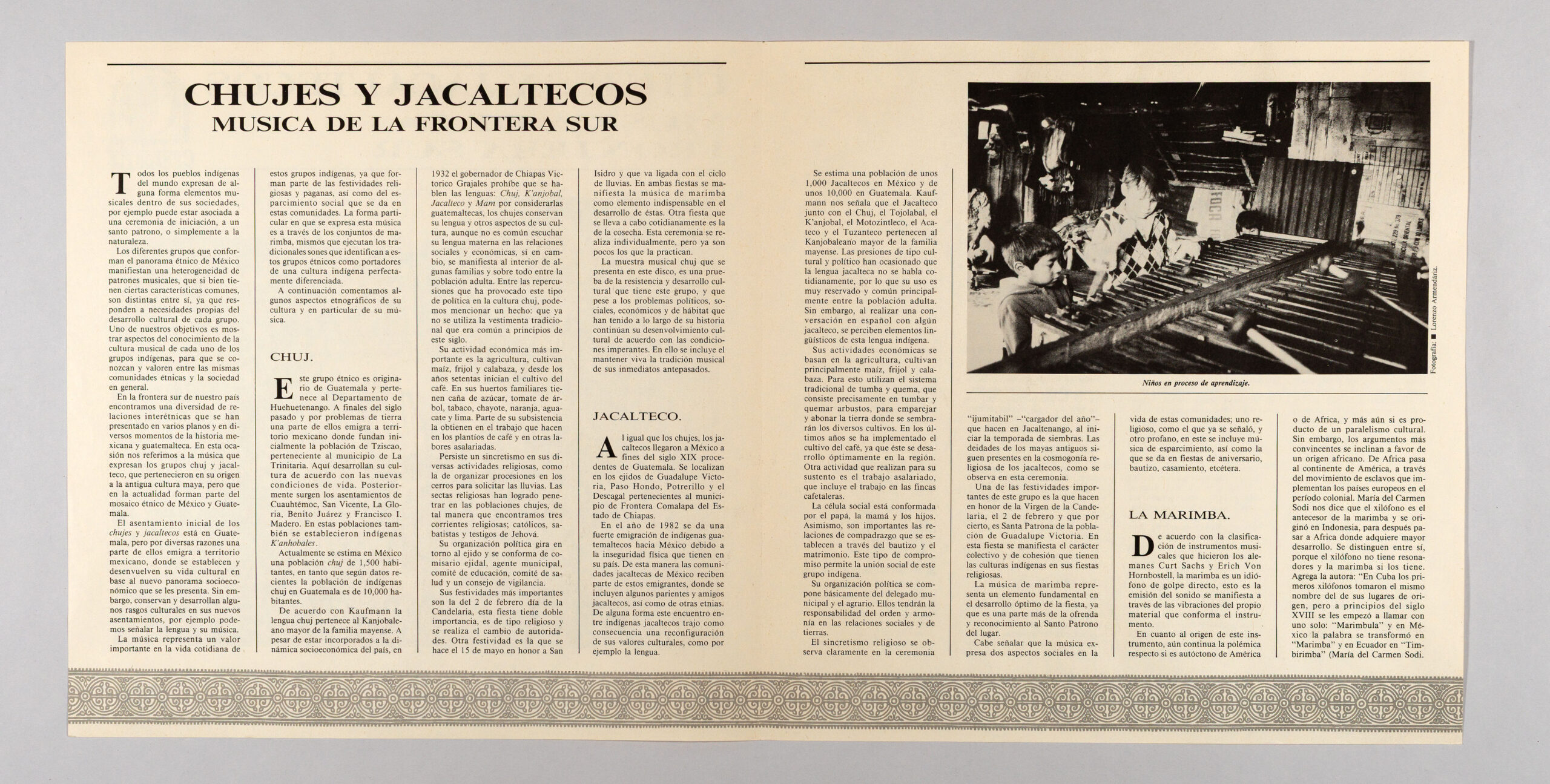
All the indigenous peoples of the world express musical elements in some way within their societies, for example it may be associated with an initiation ceremony, a patron saint, or simply nature.
The different groups that make up the ethnic panorama of Mexico show a heterogeneity of musical patterns, which although they have certain common characteristics, are different from each other, since they respond to the needs of the cultural development of each group. One of our objectives is to show aspects of the knowledge of the musical culture of each of the indigenous groups, so that they are known and valued among the same ethnic communities and society in general.
On the southern border of our country we find a diversity of inter-ethnic relations that have arisen at various levels and at various times in Mexican and Guatemalan history. On this occasion we are referring to the music expressed by the Chuj and Jacalteco groups, which originally belonged to the ancient Mayan culture, but which are currently part of the ethnic mosaic of Mexico and Guatemala.
The initial settlement of the Chujes and Jacaltecos is in Guatemala, but for various reasons a part of them emigrates to Mexican territory, where they establish themselves and develop their cultural life based on the new socioeconomic panorama that is presented to them. However, they retain and develop some cultural traits in their new settlements, for example we can point out the language and its music. Music represents an important value in the daily life of these indigenous groups, since they are part of religious and pagan festivities, as well as the social recreation that occurs in these communities. The particular way in which this music is expressed is through marimba ensembles, which perform the traditional sones that identify these ethnic groups as carriers of a perfectly differentiated indigenous culture.
Below we comment on some ethnographic aspects of their culture and in particular their music.
CHUJ.
This ethnic group is originally from Guatemala and belongs to the Department of Huehuetenango. At the end of the last century and due to land problems, a part of them emigrated to Mexican territory where they initially founded the town of Tziscao, belonging to the municipality of La Trinitaria. Here they develop their culture according to the new conditions of life. Subsequently, the settlements of Cuauhtémoc, San Vicente, La Gloria, Benito Juárez and Francisco I. Madero arose. K’anhobal Indians also settled in these populations.
Currently, a Chuj population of 1,500 inhabitants is estimated in Mexico, while according to recent data the Chuj indigenous population in Guatemala is 10,000 inhabitants.
According to Kaufmann, the Chuj language belongs to the greater Kanjobalean of the Mayense family. Despite being incorporated into the socioeconomic dynamics of the country, in 1932 the governor of Chiapas Victorico Grajales prohibited the languages being spoken: Chuj, Kanjobal, Jacalteco and Mam, considering them Guatemalan, the Chujes retained their language and other aspects of their culture. Although it is not common to listen to their mother tongue in social and economic relations, it does manifest itself within some families and especially among the adult population. Among the repercussions that this type of policy has caused in the Chuj culture, we can mention one fact: that the traditional clothing that was common at the beginning of this century is no longer used.
Their most important economic activity is agriculture, they grow corn, beans and squash, and since the 1970s they have started growing coffee. In their family gardens they have sugar cane, tree tomato, tobacco, chayote, orange, avocado and lime. Part of their subsistence is obtained from the work they do in the coffee plantations and other salaried work.
A syncretism persists in their various religious activities, such as organizing processions in the hills to request the rain. The religious sects have managed to penetrate the Chuje populations, in such a way that we find three religious currents; Catholics, Sabbatarians, and Jehovah’s Witnesses.
Its political organization revolves around the ejido and is made up of an ejido commissioner, municipal agent, education committee, health committee and a vigilance council.
Its most important festivities are on February 2, the day of Candelaria, this festival has double importance, it is religious and the change of authorities takes place. Another festivity is the one that takes place on May 15 in honor of San Isidro and that is linked to the rainy cycle. In both festivals, marimba music is manifested as an essential element in their development. Another festival that takes place daily is that of the harvest. This ceremony is performed individually, but there are few who practice it.
The Chuj musical sample presented on this record is proof of the resistance and cultural development of this group, and that despite the political, social, economic and habitat problems they have had throughout their history, they continue their cultural development according to prevailing conditions. This includes keeping alive the musical tradition of their immediate ancestors.
JACALTECO.
Like the Chujes, the Jacaltecos arrived in Mexico at the end of the 19th century from Guatemala. They are located in the ejidos of Guadalupe Victoria, Paso Hondo, Potrerillo and Descagal belonging to the municipality of Frontera Comalapa in the State of Chiapas.
In 1982 there was a strong emigration of indigenous Guatemalans to Mexico due to the physical insecurity they have in their country. In this way, the Jacalteca communities of Mexico receive part of these emigrants, which include some Jacalteco relatives and friends, as well as other ethnic groups. Somehow this encounter between Jacalteco indigenous people brought as a consequence a reconfiguration of their cultural values, such as language.
It is estimated a population of about 1,000 Jacaltecos in Mexico and about 10,000 in Guatemala. Kaufmann tells us that the Jacalteco along with the Chuj, the Tojolabal, the K’anjobal, the Motozintleco, the Acateco and the Tuzanteco belong to the greater Kanjobalean of the Mayense family. Cultural and political pressures have meant that the Jacalteca language is not spoken on a daily basis, so its use is very reserved and common, mainly among the adult population. However, when carrying out a conversation in Spanish with someone from Jacalteco, linguistic elements of this indigenous language are perceived.
Their economic activities are based on agriculture, they mainly grow corn, beans and squash. For this they use the traditional slash and burn system, which consists precisely in cutting down and burning bushes, to even out and fertilize the land where the various crops will be planted. In recent years, coffee cultivation has been implemented, since it developed optimally in the region. Another activity they carry out for their livelihood is salaried work, which includes work on coffee farms.
The social cell is made up of the father, the mother and the children. Likewise, the compadrazgo relationships that are established through baptism and marriage are important. This type of commitment allows the social union of this indigenous group.
Its political organization is basically made up of the municipal and agrarian delegates. They will have the responsibility for order and harmony in social and land relations.
Religious syncretism is clearly observed in the “ijumitabil” ceremony –”bearer of the year”– that they do in Jacaltenango, at the beginning of the planting season. The deities of the ancient Maya are still present in the religious cosmogony of the Jacaltecos, as seen in this ceremony.
One of the important festivities of this group is the one they do in honor of the Virgen de la Candelaria, on February 2 and who, by the way, is the patron saint of the town of Guadalupe Victoria. In this festival, the collective character and cohesion that indigenous cultures have in their religious festivals is manifested.
The marimba music represents a fundamental element in the optimal development of the festival, since it is one more part of the offering and recognition to the Patron Saint of the place.
It should be noted that music expresses two social aspects in the life of these communities; one religious, like the one already mentioned, and another profane, this includes entertainment music, as well as that given at anniversary parties, baptisms, weddings, etc.
THE MARIMBA.
According to the classification of musical instruments made by the Germans Curt Sachs and Erich Von Hornbostell, the marimba is a direct hit idiophone, that is, the emission of sound is manifested through the vibrations of the material that makes up the instrument itself.
Regarding the origin of this instrument, the controversy continues regarding whether it is native to America or Africa, and even more so if it is the product of cultural parallelism. However, the most convincing arguments lean in favor of an African origin. From Africa it passes to the continent of America, through the movement of slaves implemented by European countries in the colonial period. María del Carmen Sodi tells us that the xylophone is the ancestor of the marimba and originated in Indonesia, to later move to Africa where it acquired further development. They are distinguished from each other, because the xylophone does not have resonators and the marimba does. The author adds: “In Cuba the first xylophones took the same name as their places of origin, but at the beginning of the 18th century they began to be called with only one: “Marimbula” and in Mexico the word became “Marimba”. and in Ecuador in “Timbirimba” (María del Carmen Sodi. Heterofonía No. 22, “La Marimba”, México, 1972, p. 30). It should be noted that this instrument was also used in Brazil, Colombia and Ecuador. But in the Today its use is common in Mexico and Guatemala.
The first marimbas used in America had a diatonic keyboard, but with the development that this instrument acquired, a chromatic marimba was achieved, in such a way that it currently has an extension of 6 1/2 octaves. There are several sizes of the marimba, they even measure 3 meters long, these large marimbas have 78 keys; 45 on the lower keyboard and 33 on the upper one. The small marimbas are known as requintos and are played simultaneously with a larger one, in such a way that the small marimba is the one that carries the melody, in this case the number of performers can be around 6 musicians.
This instrument is used by mestizo and indigenous people. Among the indigenous groups that use the marimba we can mention the chujes, jacaltecos, mames, kaqchikeles and motozintlecos.
In Mexico and Guatemala, the marimba acquires very particular characteristics such as adding legs, wooden resonators and a chromatic keyboard. The resonators have at their base an animal gut membrane that can be pig, which is glued with wax, and is what causes the characteristic nasal timbre of the marimba. The Jacaltecos use the ant stick on the marimba keyboard, which requires a drying process of more or less three years in order to have a good tone and not vary over time. In the musical examples of the Chujes and Jacaltecos shown here, they use diatonic marimbas or as they call them “simple marimbas”.
On the southern border of Mexico, the traditional sounds with the marimba continue to be heard at weddings, thanksgivings and patron saint festivities, sounds such as: “Cuando llora la María”, “La Sal Negra”, “Mi Lupita”, etc. In this regard, the musician Chuj Sebastián Gómez Tadeo tells us, “the mestizos do not understand the sones well, that is why they do not dance it, nor do they request it.” In these indigenous groups, that social identification for their music still exists, which is expressed through dancing, listening to, and understanding it. It should be noted that in this region in the past they called the marimba the “tamalera”, since the musicians played in the various festivities, they went from house to house in which they played two or three pieces and for this they were given tamales and a “farolazo” “and that’s why people said: “the tamalera is coming”.
The Chujes and Jacaltecos marimba groups do not live from music, since they have work activities similar to the other members of the community, but they do obtain some income when they are hired to play at a party. However, their primary commitment is to attend the festive activities of their communities, this allows them to be recognized by their society.
In recent years there have been some innovations in these musical groups; how to add drums to his marimba or to include some non-traditional genres in his musical repertoire, such as cumbia. We believe that these introductions are valid, as long as the musicians and the community itself make them their own and express them from their particular point of view.
Guillermo Gonzalez Hernandez
REPERTOIRE.
Given the ethnic relationship that is perceived on the southern border of our country, most of the musical pieces heard on this album are part of the repertoire of both groups, as can be seen with the “jacaltequita”, which is a composition of a Jacalteco musician and yet it is interpreted. by the chuje musicians.
Son is the musical genre that continues to prevail in the performances of these groups and mainly forms the program used in religious festivities, such is the case of “candelaria”, which is a composition dedicated to the Virgin of La Candelaria. In recent years, other genres such as cumbia and bolero have been incorporated, the interpretation of this music is basically heard at secular parties, where sones are also heard.
The musical capacity that these groups have is observed when in certain melodies they change the tone to certain keys by placing a piece of campeche wax or even a piece of chewing gum at the bottom.
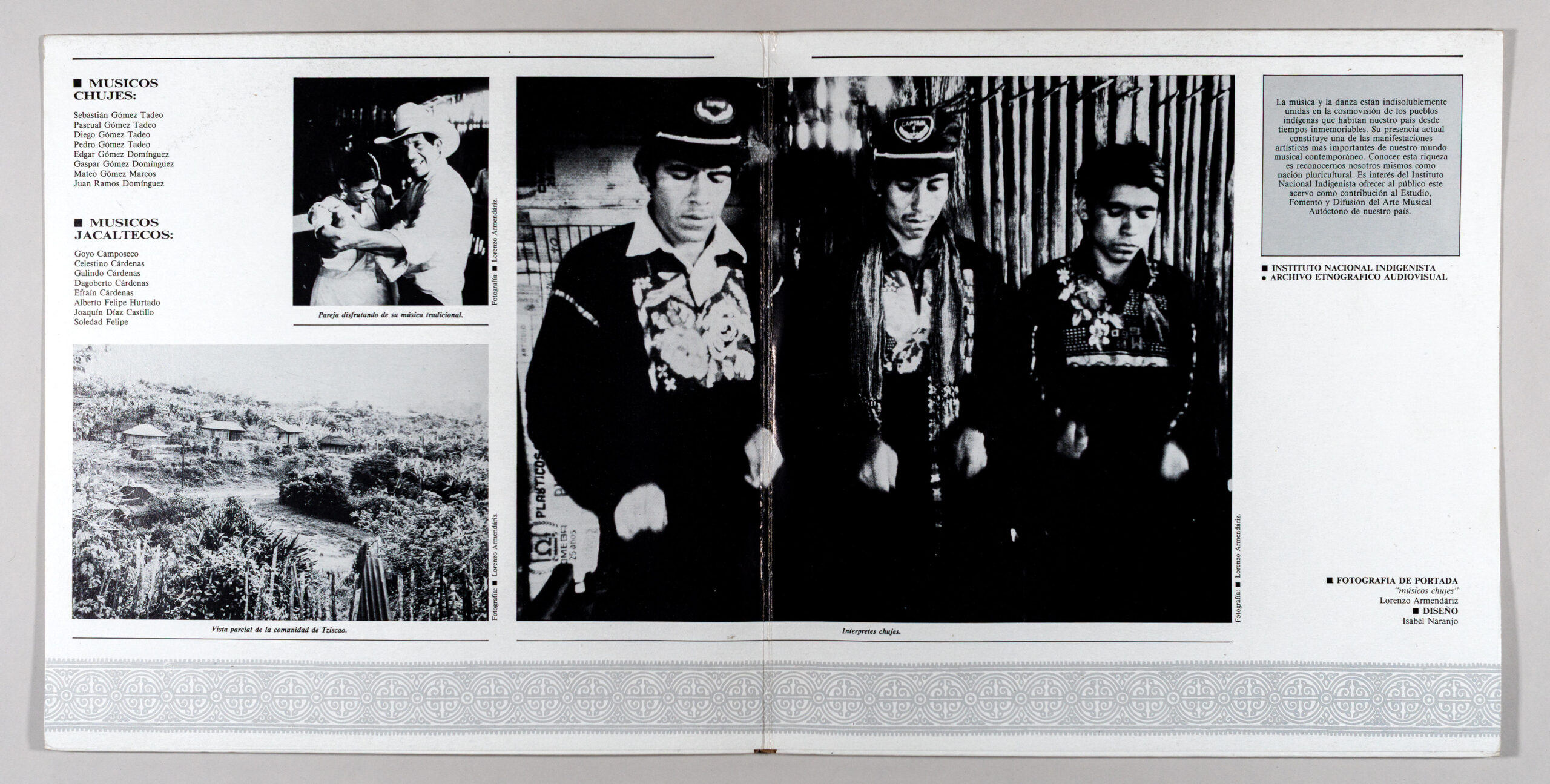
■ CHUJE MUSICIANS:
Sebastián Gómez Tadeo
Pascual Gómez Tadeo
Diego Gómez Tadeo
Pedro Gómez Tadeo
Edgar Gómez Domínguez
Gaspar Gómez Domínguez
Mateo Gómez Marcos
Juan Ramos Domínguez
■ JACALTECO MUSICIANS:
Goyo Camposeco
Celestino Cárdenas
Galindo Cárdenas
Dagoberto Cárdenas
Efraín Cárdenas
Alberto Felipe Hurtado
Joaquín Díaz Castillo
Soledad Felipe
Music and dance are inextricably linked in the worldview of the indigenous peoples who have inhabited our country since time immemorial. His current presence constitutes one of the most important artistic manifestations of our contemporary musical world. Knowing this richness is recognizing ourselves as a multicultural nation. It is the interest of the National Indigenous Institute to offer the public this collection as a contribution to the Study, Promotion and Diffusion of the Autochthonous Musical Art of our country.
■ NATIONAL INDIGENIST INSTITUTE
AUDIOVISUAL ETHNOGRAPHIC ARCHIVE
■ COVER PHOTOGRAPH
Nacho Lopez
■ DESIGN
Isabel Naranjo
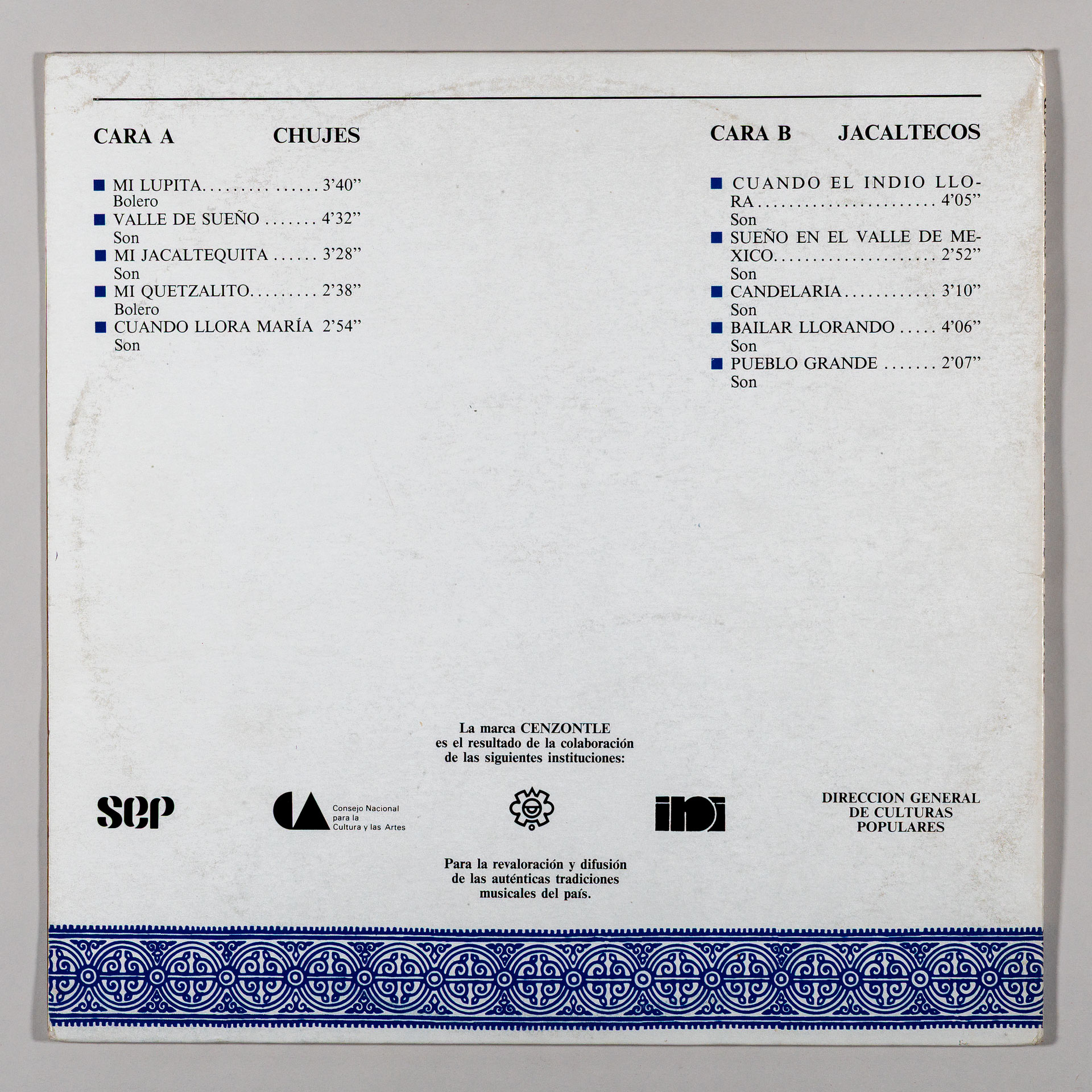
A-SIDE CHUJES
■ MY LUPITA…………3:40
Bolero
■ DREAM VALLEY…………4:32
Son
■ MY JACALTEQUITA…………3:28
Son
■ MY LITTLE QUETZAL…………2:38
Bolero
■ WHEN MARIA CRIES…………2:54
Son
B SIDE JACALTECOS
■ WHEN THE INDIAN CRIES…………4:05
Son
■ DREAM IN THE VALLEY OF MEXICO…………2:52
Son
■ CANDELARIA…………3:10
Son
■ DANCE CRYING…………4:06
Son
■ BIG TOWN…………2:’07
Son
The CENZONTLE brand is the result of the collaboration of the following institutions:
SEP, Consejo Nacional para la Cultura y las Artes, INAH, INI, DIRECCIÓN GENERAL DE CULTURAS POPULARES
For the revaluation and diffusion of the authentic musical traditions of the country.
Gallery:


Tracklist:
CHUJES AND JACALTECOS MUSIC OF THE SOUTH BORDER
SIDE 1 CHUJES
- A1 MY LUPITA 3:40
Performer(s):
- A2 DREAM VALLEY 4:32
Performer(s):
- A3 MY JACALTEQUITA 3:28
Performer(s):
- A4 MY LITTLE QUETZAL 2:38
Performer(s):
- A5 WHEN MARIA CRIES 2:54
Performer(s):
SIDE 2 JACALITOS
- B1 WHEN THE INDIAN CRIES 4:05
Performer(s): - B2 DREAM IN THE VALLEY OF MEXICO 2:52
Performer(s):
- B3 CANDELARIA 3:10
Performer(s):
- B4 DANCE CRYING 4:06
Performer(s):
- B5 BIG TOWN 2:’07
Performer(s):
Credits:
Researcher at the Department of Ethnomusicology, INI
Ana Cecilia Anguis Dumas
NATIONAL INDIGENIST INSTITUTE AUDIOVISUAL ETHNOGRAPHIC ARCHIVE
COVER PHOTOGRAPH
Nacho Lopez
DESIGN
Isabel Naranjo
 Chujes And Jacaltecos - Musica De La Frontera Sur