







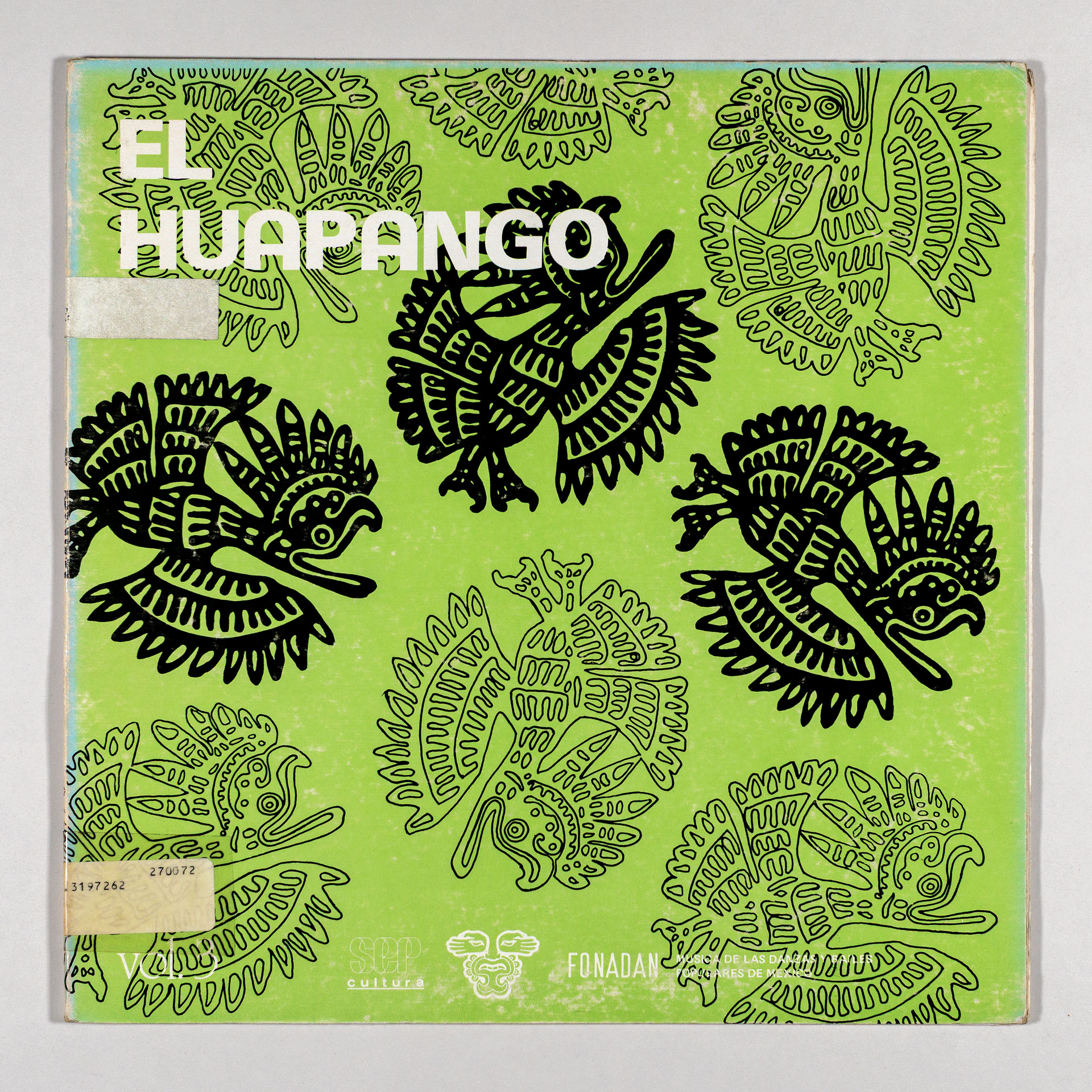
THE HUAPANGO
FONADAN
|
Label: FONADAN MC-722, MC-0722 Format: Vinyl LP Album 12" 33 1/3 rpm Gatefold Compilation |
Country: Mexico Genre: Folk World & Country |
Info:
THE HUAPANGO
SEP culture
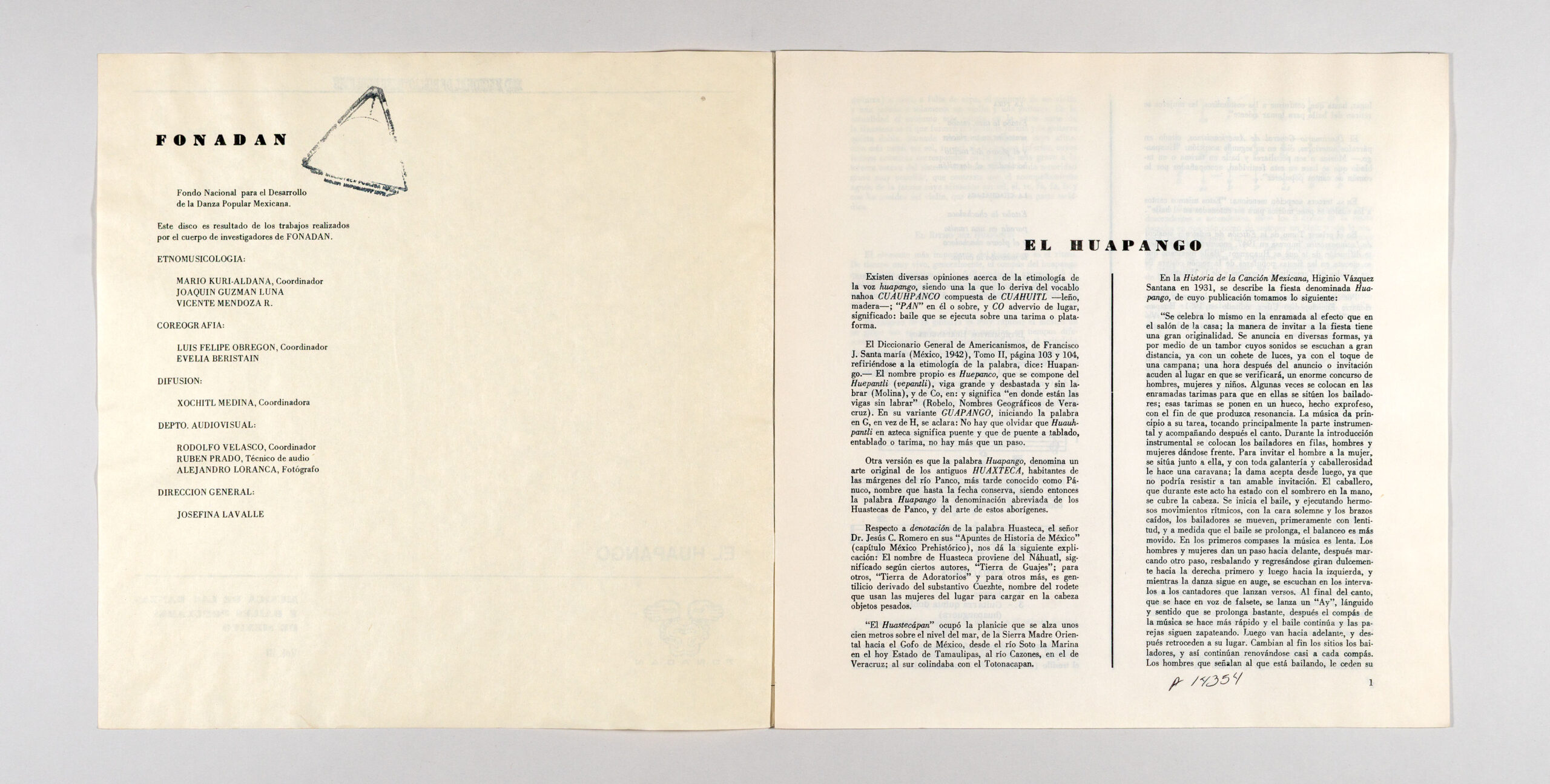
FONADAN
National Fund for the Development of Mexican Popular Dance
MUSIC OF THE DANCES AND POPULAR DANCES OF MEXICO
Vol. III
This record is the result of the work carried out by the FONADAN research body.
ETHNOMUSICOLOGY:
MARIO KURI-ALDANA, Coordinator
JOAQUÍN GUZMÁN LUNA
VICENTE MENDOZA R.
CHOREOGRAPHY:
LUIS FELIPE OBREGÓN, Coordinator
EVELIA BERISTAIN
DIFFUSION:
XOCHITL MEDINA, Coordinator
AUDIOVISUAL DEPARTMENT:
RODOLFO VELASCO, Coordinator
RUBEN PRADO, Audio technician
ALEJANDRO LORANCA, Photographer
GENERAL DIRECTORATE:
JOSEFINA LAVALLE
THE HUAPANGO
There are different opinions about the etymology of the word huapango, being one that derives it from the Nahoa word CUAUHPANCO composed of CUAHUITL –lleño, wood–; “PAN” in it or on, and CO adverb of place, meaning: dance that is executed on a platform or platform.
The General Dictionary of Americanisms, by Francisco J. Santa María (Mexico, 1942), Volume II, page 103 and 104, referring to the etymology of the word, says: Huapango.– The proper name is Huepanco, which is made up of Huepantli (vepantli), large and devastated and unworked beam (Molina), and from Co, en: and means “where the unworked beams are” (Robelo, Geographical Names of Veracruz). In its GUAPANGO variant, starting the word in G, instead of H, clarifies: Do not forget that Huauhpantli in Aztec means bridge and that from bridge to board, board or platform, there is only one step.
Another version is that the word Huapango refers to an original art of the ancient HUAXTECA, inhabitants of the banks of the Panco River, later known as Pánuco, a name that it retains to this day, the word Huapango then being the abbreviated name of the Huastecas of Panco, and the art of these aborigines.
Regarding the denotation of the word Huasteca, Mr. Dr. Jesús C. Romero in his “Notes on the History of Mexico” (Prehistoric Mexico chapter), gives us the following explanation: The name of Huasteca comes from Nahuatl, meaning according to certain authors , “Land of Guajes”; for others, “Land of Shrines” and for still others, it is a demonym derived from the noun Cuezhte, name of the bun that local women use to carry heavy objects on their heads.
“El Huastecapan” occupied the plain that rises some hundred meters above sea level, from the Sierra Madre Oriental to the Gulf of Mexico, from the Soto la Marina river in what is now the State of Tamaulipas, to the Cazones river, in the state of Veracruz; to the south it bordered the Totonacapan.
In the History of the Mexican Song, Higinio Vázquez Santana in 1931, describes the party called Huapango, from whose publication we take the following:
“The same thing is celebrated in the bower for that purpose as in the living room of the house; the way of inviting to the party has a great originality. It is announced in various ways, already by means of a drum whose sounds are heard at a great distance, Now with a rocket of lights, now with the ringing of a bell, an hour after the announcement or invitation they come to the place where it will be verified, a huge concourse of men, women and children, sometimes they are placed on the ramadas platforms so that the dancers sit on them; these platforms are placed in a hole, made specifically, in order to produce resonance. The music begins its task, playing mainly the instrumental part and then accompanying the singing. During the instrumental introduction the dancers are placed in lines, men and women facing each other.To invite the man to the woman, he stands next to her, and with all gallantry and chivalry makes a caravan for her; the lady accepts of course, since she could not resist such a kind invitation. The gentleman, who during this act has been with his hat in his hand, covers his head. The dance begins, and executing beautiful rhythmic movements, with solemn faces and arms lowered, the dancers move, slowly at first, and as the dance continues, the swaying becomes more moved. In the first bars the music is slow. The men and women take a step forward, then marking another step, slipping and coming back, turning sweetly first to the right and then to the left, and while the dance continues in full swing, the singers are heard in the intervals launching verses. At the end of the song, which is done in a falsetto voice, a languid and heartfelt “Ay” is released, which lasts a long time, then the beat of the music becomes faster and the dance continues and the couples continue tapping. Then they go forward, and then they go back to their place. Finally, the dancers change places, and thus they continue to renew themselves almost at every beat. The men who point to the one who is dancing, give him their place, until, according to the customs, the women withdraw from the dance to take their seats”.
The General Dictionary of Americanisms, cited in previous paragraphs, says in its second meaning: “Huapango.– Music or are peculiar and dance on the stage or on the stage that is done on this festivity, usually accompanied by popular songs.”
In its third meaning it mentions: “These same songs to which music is put to be sung in the dance.”
In the first Volume of the Edition of music and musicians from Latin America, printed in 1947, we find the following definition of what Huapango is: “Mexican dance that is performed at popular festivals in the coastal region of the States of Tamaulipas, Veracruz and of the Huasteca”.
Finally, we will mention what the Uteha Encyclopedic Dictionary, published in 1951, says about it: Huapango.– “In Mexico, typical popular festival of the State of Veracruz, Music and dance of this festival and popular songs that accompany them.” As we can see, the previous opinions consider the Huapango as the party, the dance and even the songs, since, in the opinion of the Uteha dictionary, which we mentioned in the last paragraph, it says in one part: “Music and dance of these parties , and popular songs that accompany them”. This sentence must be taken into account, since when adding the opinion issued by the teacher Don Vicente T. Mendoza in his book Panorama of traditional music of Mexico, in its part related to Huapango, page 88, end of the second paragraph, referring to to this, he mentions: “It must be grouped by regions, styles and accompaniment formulas”, comes to complete the opinion of the Uteha dictionary, since in this way it will be possible to understand that the huapango is not only the party, or the dance, but also some popular songs executed in a certain style and accompaniment.
Due to its musical aspect, some authors derive the huapango from the Spanish dance El Villano and others see its origin in the Fandango, which was accompanied by bagpipes and guitar, affirming the writers that the bagpipe was replaced by the violin used in the huapango.
Gabriel Saldívar, a historian from Tamaulipas, believes that the huapango did not get rid of African influence and believes it derives from the ancient Tango, which may well be the gypsy tango or the Ethiopian tango, whose origin is the dance of certain ritual ceremonies, called tang. The Ethiopian tango was danced in Veracruz by the mulattoes.
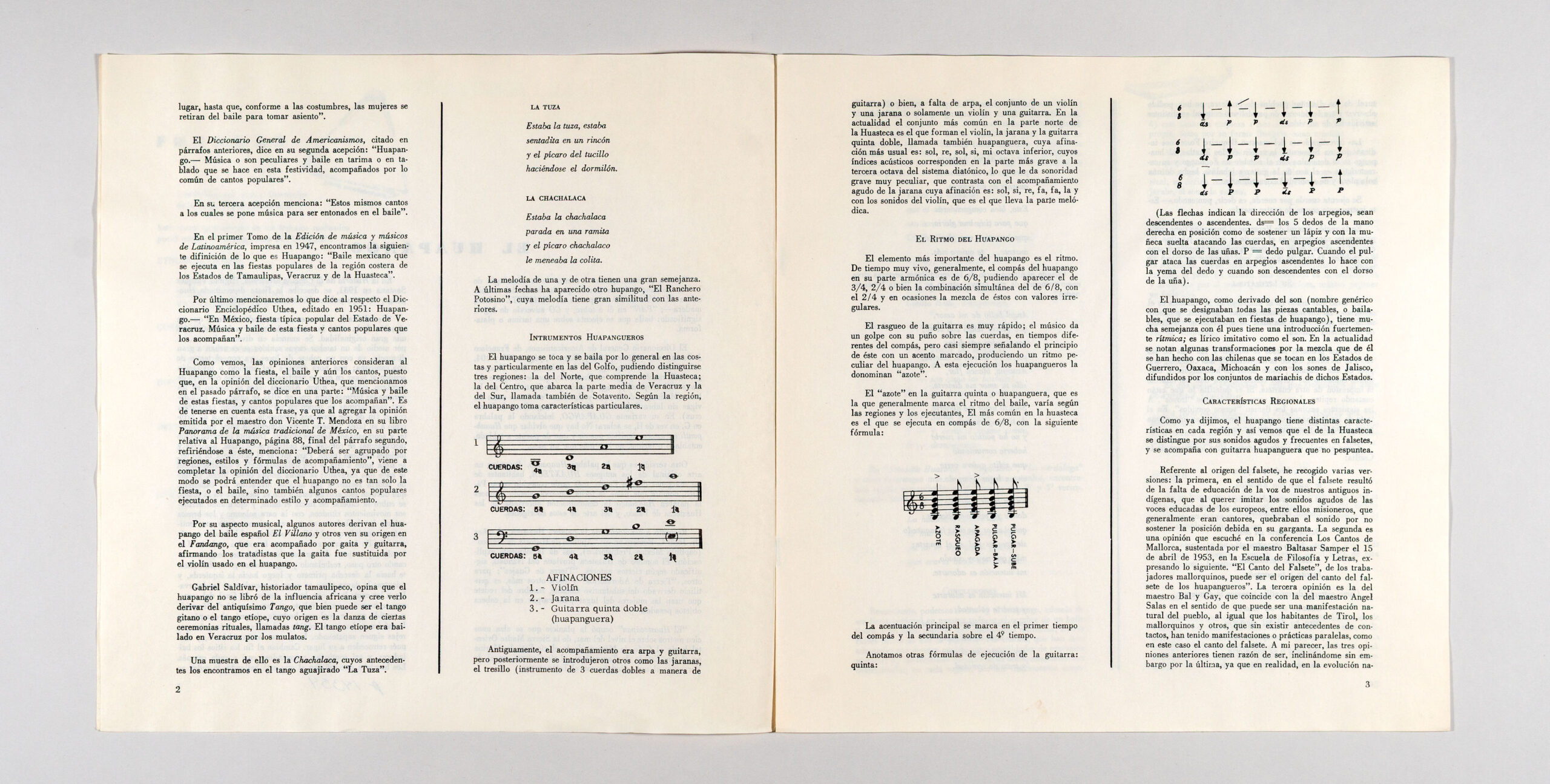
An example of this is the Chachalaca, whose precedents can be found in the watery tango “La Tuza”.
THE GOBER
There was the gopher, there was
sitting in a corner
and the rogue of the tucillo
playing the sleepyhead
THE CHACHALACA
There was the chachalaca
standing on a twig
and the rogue chachalaco
he wagged his tail.
The melody of one and the other have a great similarity. Recently another huapango has appeared, “El Ranchero Potosino”, whose melody is very similar to the previous ones.
HUAPANGUERO INSTRUMENTS
The huapango is played and danced in general on the coasts and particularly on those of the Gulf, being able to distinguish three regions: the North, which includes the Huasteca; that of the Center, which covers the middle part of Veracruz and that of the South, also called Sotavento. Depending on the region, the huapango takes particular characteristics.
In the past, the accompaniment was harp and guitar, but later others were introduced, such as jaranas, the tresillo (instrument with 3 double strings resembling a guitar) or, in the absence of a harp, a violin and a jarana ensemble or just a violin and a guitar. At present, the most common ensemble in the northern part of the Huasteca is the one formed by the violin, the jarana and the double fifth guitar, also called huapanguera, whose most usual tuning is: sol, re, sol, si, mi octava inferior , whose acoustic indices correspond in the lowest part to the third octave of the diatonic system, which gives it a very peculiar low sound, which contrasts with the sharp accompaniment of the jarana whose tuning is: sol, si, re, fa, fa, the and with the sounds of the violin, which is the one that carries the melodic part.
THE RHYTHM OF THE HUAPANGO
The most important element of the huapango is the rhythm. Of very lively time, generally, the compass of the huapango in its harmonic part is 6/8, being able to appear that of 3/4, 2/4 or the simultaneous combination of that of 6/8, with 2/4 and in sometimes the mixture of these with irregular values.
The strumming of the guitar is very fast; the musician strikes the strings with his fist, in different beats of the measure, but almost always indicating the beginning of the measure with a marked accent, producing a peculiar rhythm of the huapango. The huapangueros call this execution “whipping.”
The “whipping” on the fifth or huapanguera guitar, which is the one that generally marks the rhythm of the dance, varies according to the regions and the performers. The most common in the Huasteca is the one that is executed in 6/8 time, with the following formula:
The main accent is marked on the first beat of the bar and the secondary on the 4th beat.
We write down other formulas for playing the fifth guitar:
(The arrows indicate the direction of the arpeggios, whether descending or ascending. ds= the 5 fingers of the right hand in a position like holding a pencil and with the wrist loose attacking the strings, in ascending arpeggios with the back of the nails. P = thumb When the thumb attacks the strings in ascending arpeggios it does so with the tip of the finger and when they are descending with the back of the nail).
The huapango, as a derivative of the son (the generic name used to designate all the singable or danceable pieces that were performed at huapango parties), is very similar to it, it has a strongly rhythmic introduction; it is lyrical imitative like the son. At present, some transformations are noticeable due to the mixture that has been made of it with the Chileans that are played in the States of Guerrero, Oaxaca, Michoacán and with the sones of Jalisco, spread by the mariachi groups of said States.
REGIONAL CHARACTERISTICS
As we have already said, the huapango has different characteristics in each region and thus we see that the Huasteca is distinguished by its high-pitched and frequent falsetto sounds, and is accompanied by a huapango guitar that does not backstitch.
Regarding the origin of the falsetto, I have collected several versions: the first, in the sense that the falsetto resulted from the lack of education of the voice of our ancient indigenous people, who, wanting to imitate the high-pitched sounds of the educated voices of Europeans, among them missionaries, who were generally singers, broke the sound for not holding the proper position in their throats. The second is an opinion that I heard at the Los Cantos de Mallorca conference, supported by the teacher Baltasar Samper on April 15, 1953, at the School of Philosophy and Letters, expressing the following. “El Canto del Falseto”, of the Mallorcan workers, may be the origin of the falsetto singing of the huapangueros”. The third opinion is that of maestro Bal y Gay, who coincides with that of maestro Angel Salas in the sense that it can to be a natural manifestation of the people, like the inhabitants of Tyrol, the Majorcans and others, who, without a history of contact, have had parallel manifestations or practices, as in this case the singing of the falsetto. In my opinion, the three opinions previous ones have a reason for being, leaning however towards the last one, since in reality, in the natural evolution of the different peoples of the earth, these phenomena of cultural parallelism have been observed in different activities of their lives.
The investigations of the teacher Baqueiro Foster indicate that in Sotavento, the Tuxtlas region, the huapango is called Fandango and its characteristic is the use of the javelin guitar, made in one piece and with extraordinary sound.
It is played string by string, that is, plucking.– This instrument has four strings.
In the central region of Veracruz, the huapango has as its main characteristics the use of the javelin guitar, played the same as in the south, but also adding the harp without pedals, which is almost always performed in triplet rhythm.
ITS LITERATURE
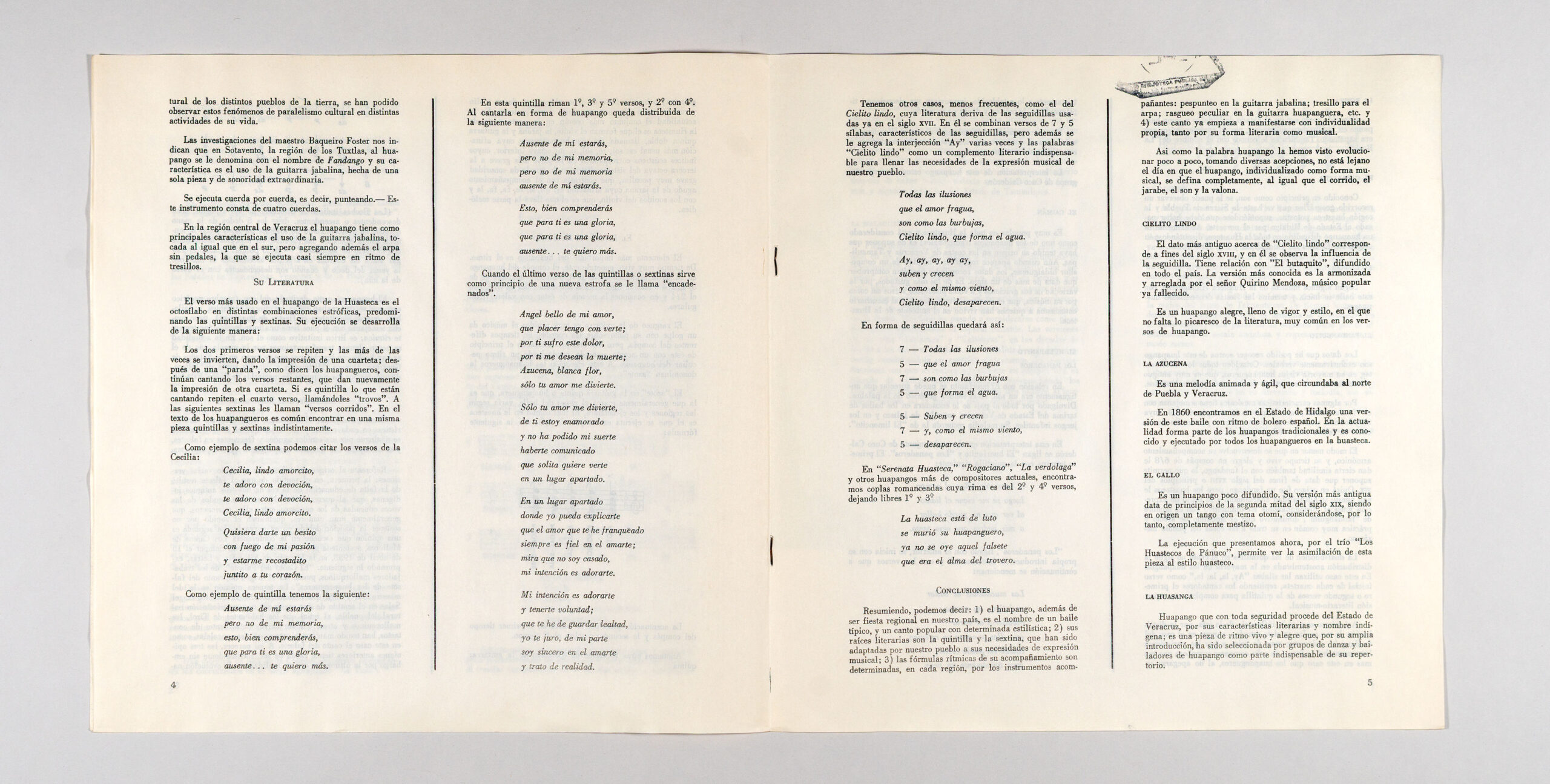
The most used verse in the huapango of the Huasteca is the eight syllable in different stanza combinations, predominating the quintillas and sextinas. Its execution proceeds as follows:
The first two verses are repeated and most of the time they are inverted, giving the impression of a quatrain; after a “stop,” as the huapangueros say, they continue singing the remaining verses, which again give the impression of another quatrain. If it is a limerick that they are singing, they repeat the fourth verse, calling them “trovos”. The following sextinas are called “versos corridos”. In the text of the huapangueros it is common to find in the same piece quintillas and sextinas interchangeably.
As an example of a sextina we can cite the verses of La Cecilia:
Cecilia, pretty sweetheart,
I adore you with devotion
I adore you with devotion
Cecilia, pretty sweetheart.
I would like to give you a kiss
with fire of my passion
and be lying down
close to your heart
As an example of a limerick we have the following:
You will be absent from me
but not from my memory
this, you will understand,
that for you is a glory,
absent… I love you more.
In this limerick the 1st, 3rd and 5th verses rhyme, and the 2nd with 4⁹. When singing it in the form of a huapango, it is distributed as follows:
You will be absent from me
but not from my memory
but not from my memory
you will be absent from me
This, you will understand
that for you is a glory,
which for you is a glory, to
absent… I love you more.
When the last verse of the limericks or sextinas serves as the beginning of a new stanza, it is called “chained”.
Beautiful angel of my love,
What a pleasure I have to see you;
I suffer this pain for you
for you they wish me death;
Lily, white flower,
only your love amuses me.
Only your love amuses me
I’m in love with you
and my luck has not been able
have communicated to you
who alone wants to see you
in a secluded place.
In a secluded place
where i can explain
that the love that I have franked you
he is always faithful in loving you;
Look I’m not married
My intention is to adore you.
My intention is to adore you
and have you will;
come on, I have to keep loyalty to you,
I swear to you, from me
I am sincere in loving you
and I try reality.
We have other, less frequent cases, such as that of Cielito lindo, whose literature derives from the seguidillas already used in the 17th century. In it, verses of 7 and 5 syllables are combined, characteristic of the seguidillas, but also the interjection “Ay” is added several times and the words “Cielito lindo” as an essential literary complement to meet the needs of the musical expression of our town.
All the illusions
that love forges,
They are like bubbles
Pretty sky, that forms the water.
Oh, oh, oh, oh, oh,
rise and grow
and like the same wind,
Sweet heaven, they disappear.
In the form of seguidillas it will look like this:
7 – All illusions
5 – that love forges
7 – they are like bubbles
5 – that forms the water.
5 – They rise and grow
7 – and, like the wind itself,
5 – disappear.
In “Serenata Huasteca,” “Rogaciano,” “La pursolaga” and other huapangos by current composers, we find romanced couplets whose rhyme is the 2nd and 4th lines, leaving the 1st and 3rd free.
The Huasteca is in mourning
his huapanguero died,
you can’t hear that falsetto anymore
which was the soul of the trovero.
CONCLUSIONS
Summarizing, we can say: 1) the huapango, in addition to being a regional festival in our country, is the name of a typical dance, and a popular song with a certain style; 2) its literary roots are the limerick and the sextina, which have been adapted by our people to their needs for musical expression; 3) the rhythmic formulas of its accompaniment are determined, in each region, by the accompanying instruments: backstitching on the javelin guitar; triplet for the harp; peculiar strumming on the huapanguera guitar, etc. and 4) this song is already beginning to manifest itself with its own individuality, both due to its literary and musical form.
Just as we have seen the word huapango evolve little by little, taking on various meanings, the day is not far off when the huapango, individualized as a musical form, will be completely defined, just like the corrido, the syrup, the son and the walloon. .
THE PRETTY SKY
The oldest data about “Cielito lindo” corresponds to the end of the 18th century, and the influence of the seguidilla is observed in it. It is related to “El butaquito”, broadcast throughout the country. The best known version is the one harmonized and arranged by Mr. Quirino Mendoza, a popular musician who is now deceased.
It is a cheerful huapango, full of vigor and style, in which the picaresque of literature is not lacking, very common in huapango verses.
THE LILY
It is a lively and agile melody, which circled the north of Puebla and Veracruz.
In 1860 we find in the State of Hidalgo a version of this dance with the rhythm of a Spanish bolero. At present it is part of the traditional huapangos and is known and executed by all the huapangueros in the Huasteca.
THE ROOSTER
It is a little spread huapango. Its oldest version dates from the beginning of the second half of the 19th century, originally being a tango with an Otomi theme, therefore being considered completely mestizo.
The execution that we present now, by the trio “Los Huastecos de Pánuco”, allows us to see the assimilation of this piece to the Huasteco style.
THE HUASANGA
Huapango that surely comes from the State of Veracruz, due to its literary characteristics and indigenous name; It is a piece with a lively and happy rhythm that, due to its extensive introduction, has been selected by dance groups and huapango dancers as an essential part of their repertoire.
THE LITTLE ROSE
Known as they are in the State of Hidalgo and as huapango in the Huasteca in general, due to its character, it was originally zapateado. It is also known by the name of “La Rosa”.
LITTLE HORSE
Known in principle as they are, a geographical route can be observed that goes to the Sierra de Puebla and the Huasteca region of Potosi, assuming that it must have passed to the State of Hidalgo to the northwest. Currently it is a huapango spread throughout the Huasteca, its origin being disputed by the States of Tamaulipas and San Luis Potosí.
CRYING
According to some musicians from the Huasteca Hidalguense, the festivals called huapangos begin and end with this dance.
THE FANDANGUITO
The data that I have been able to collect about this huapango are exclusively verbal. All the informants agree, mostly old huapangueros, which is very old and traditional in the repertoire of Huasteca musicians.
Due to some musical characteristics it is similar to the “fandanguillo”, a Hispanic dance in 3/4 time, whose introduction consists of nine bars and through a falsetto song prepares the entrance of the voice.
The minor mode in which its harmonic accompaniment unfolds, and its lively and happy time in 6/8 time also give it a certain similarity to the fandango, which allows us to suppose that it dates from the late 18th or early 19th centuries. Perhaps originally it was a fandango, but the Huastecos have given it their sensitivity, adapting it to their style of musical expression, calling it diminutively “fandangito”, a diminutive that is synonymous with affection and a very common practice in their treatment of things. of the Mexican people.
The distribution of the quintillas in the song does not follow the customary distribution in most of the huapangos. In this case, they use the syllables “Ay, la, la, la,” as the initial verse of each quatrain, the singers repeating the first or second verse of the limerick to complete their literary-musical expression.
Likewise, the influence of the jota is noticeable, due to the distribution of its couplets in seven stanzas, although in the case of the fandanguito there are only six; and due to the instrumental variations in eight-measure phrases, it corroborates once again in this case that the huapangueros, by not strictly adhering to what is established, improvise their performances, thus typifying the music and dance of their region.
Because the “fandangito” is related to the “fandango”, we point out the fact that some writers derive the latter from the old canary.
The interpretation of this huapango was in charge of the Cuco Calderón group.
THE ALLIGATOR
It is very popular throughout the Huasteca and is considered one of the traditional huapangos; presumably it originated on the coasts of Veracruz and Tamaulipas. Even when it appears registered in the name of a composer from Hidalgo, the data collected allows us to verify that it dates back more than a century. It is one of the most liked, due to the variety of its funny and sometimes picaresque verses as well as its music, which has a lively and happy rhythm, and when listening to it excites those who have lived in the Huasteca environment.
THE LITTLE ORPHAN
THE BAKERS
In relation to El huerfanito, it can be seen that in the past it was a son, in the generic sense of the word. Disseminated throughout the country, it is found in the stage dances of the State of Veracruz, among those of Jalisco and in children’s games. Its melody is reminiscent of “El limoncito”.
In this performance by Cuco Calderón’s ensemble, “El huerfanito” and “Los panaderos” are linked. The former ends with the following limerick:
Sometimes I go out to the field,
then the crying comes
Seeing that I can’t find
To my parents that I love so much.
“Los panaderos”, linked to the previous one, begins with its own instrumental introduction and with the verses mentioned below:
The girls when dancing
they get overtired,
gentlemen looking
that they have a drink,
how much can it cost
Well, only a weight.
The oldest data about this huapango tell us that already in the year 1805 a complaint had been filed in the city of Cuernavaca, in which it said “That having sung and danced ‘Los panaderos’, the musicians, by custom, requested What is there to ask, that those who sing and dance said are to do something”. The custom of inviting the couple to have dinner or a snack after having danced is still preserved in the Huasteca and some towns in the State of Tamaulipas.
THE MALAGUEÑA
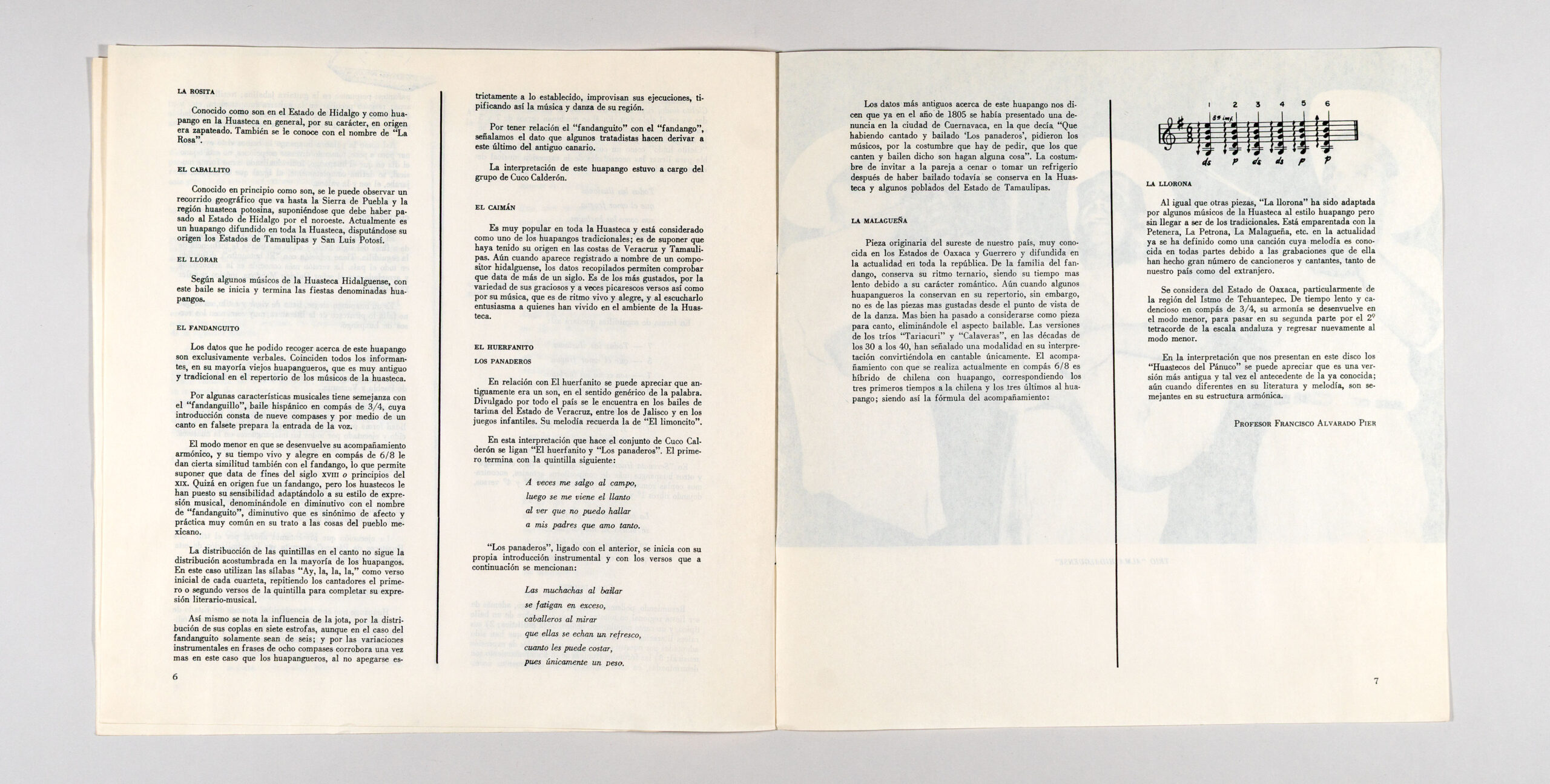
Original piece from the southeast of our country, well known in the States of Oaxaca and Guerrero and currently spread throughout the republic. From the fandango family, it retains its ternary rhythm, its time being slower due to its romantic nature. Even when some huapangueros keep it in their repertoire, however, it is not one of the most liked pieces from the point of view of dance. Rather, it has come to be considered as a piece for singing, eliminating the danceable aspect. The versions of the trios “Tariacuri” and “Calaveras”, in the decades from the 30s to the 40s, have indicated a modality in their interpretation making it singable only. The accompaniment with which it is currently performed in 6/8 time is a hybrid of chilena with huapango, the first three times corresponding to chilena and the last three to huapango; thus being the accompaniment formula:
THE CRYING GIRL
Like other pieces, “The Crying Girl” has been adapted by some Huasteca musicians to the huapango style but without being traditional. It is related to La Petenera, La Petrona, La Malagueña, etc. At present it has already been defined as a song whose melody is known everywhere due to the recordings that a large number of songbooks and singers have made of it, both in our country and abroad.
It is considered from the State of Oaxaca, particularly from the Tehuantepec Isthmus region. With a slow and rhythmic time in 3/4 time, its harmony develops in the minor mode, to pass in its second part through the 2nd tetrachord of the Andalusian scale and return again to the minor mode.
In the interpretation presented to us on this album by “Huastecos del Pánuco” it can be seen that it is an older version and perhaps the antecedent of the already known one; even though they are different in their literature and melody, they are similar in their harmonic structure.
PROFESSOR FRANCISCO ALVARADO PIER
THE HUAPANGO
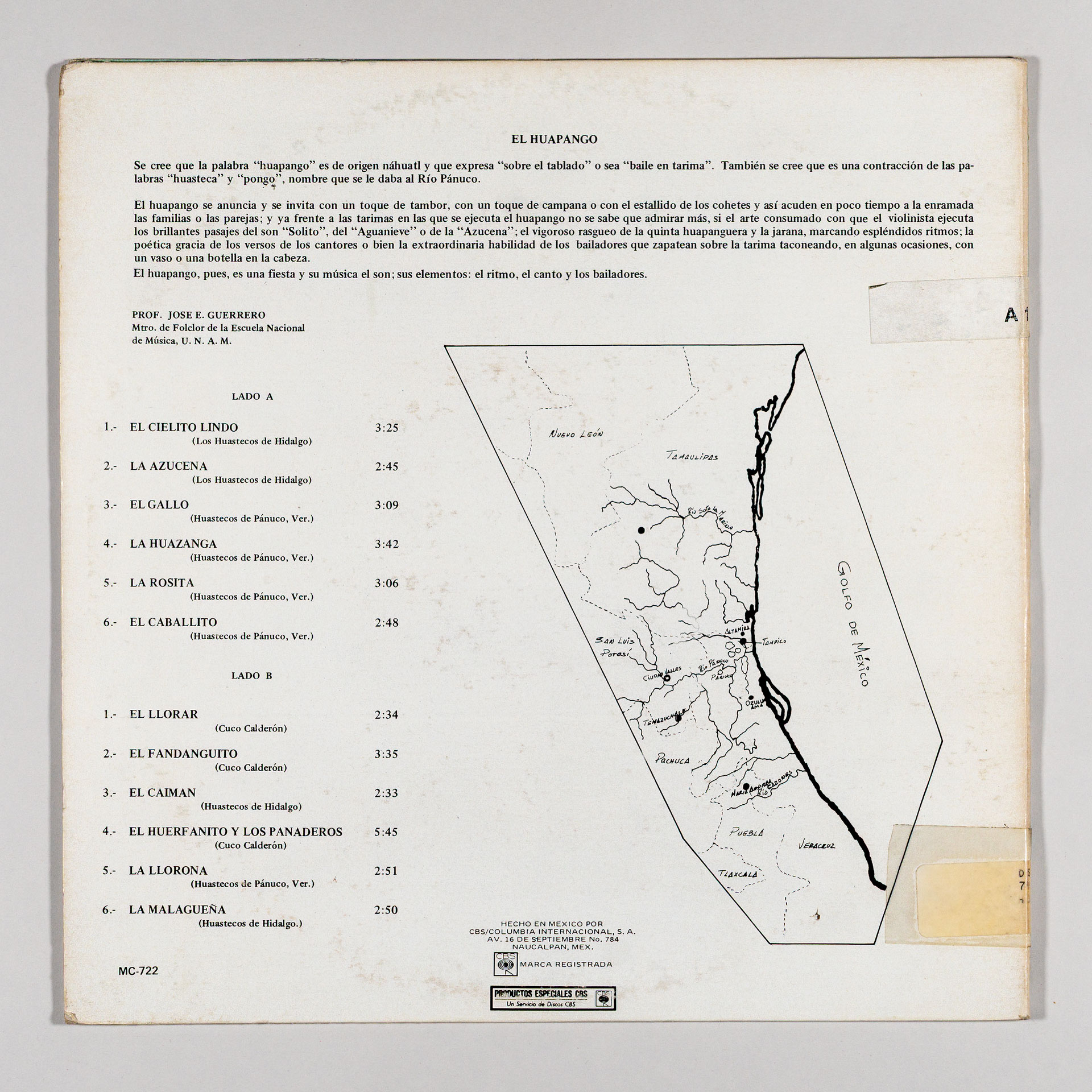
It is believed that the word “huapango” is of Nahuatl origin and that it expresses “on the stage” or “dance on the stage”. It is also believed to be a contraction of the words “huasteca” and “pongo”, a name given to the Pánuco River.
The huapango is announced and invited with a drumbeat, with the ringing of a bell or with the explosion of rockets and thus families or couples come to the bower in a short time; and already in front of the platforms on which the huapango is performed, one does not know what to admire more, if the consummate art with which the violinist executes the brilliant passages of the son “Solito”, “Aguanieve” or “Azucena”; the vigorous strumming of the quinta huapanguera and the jarana, marking splendid rhythms; the poetic grace of the singers’ verses or the extraordinary skill of the dancers who stamp their feet on the stage, tapping their heels, on some occasions, with a glass or a bottle on their heads.
The huapango, then, is a party and its music is son; its elements: rhythm, singing and dancers.
PROFESSOR JOSE E. GUERRERO
Folklore Teacher of the National School of Music, U.N.A.M.
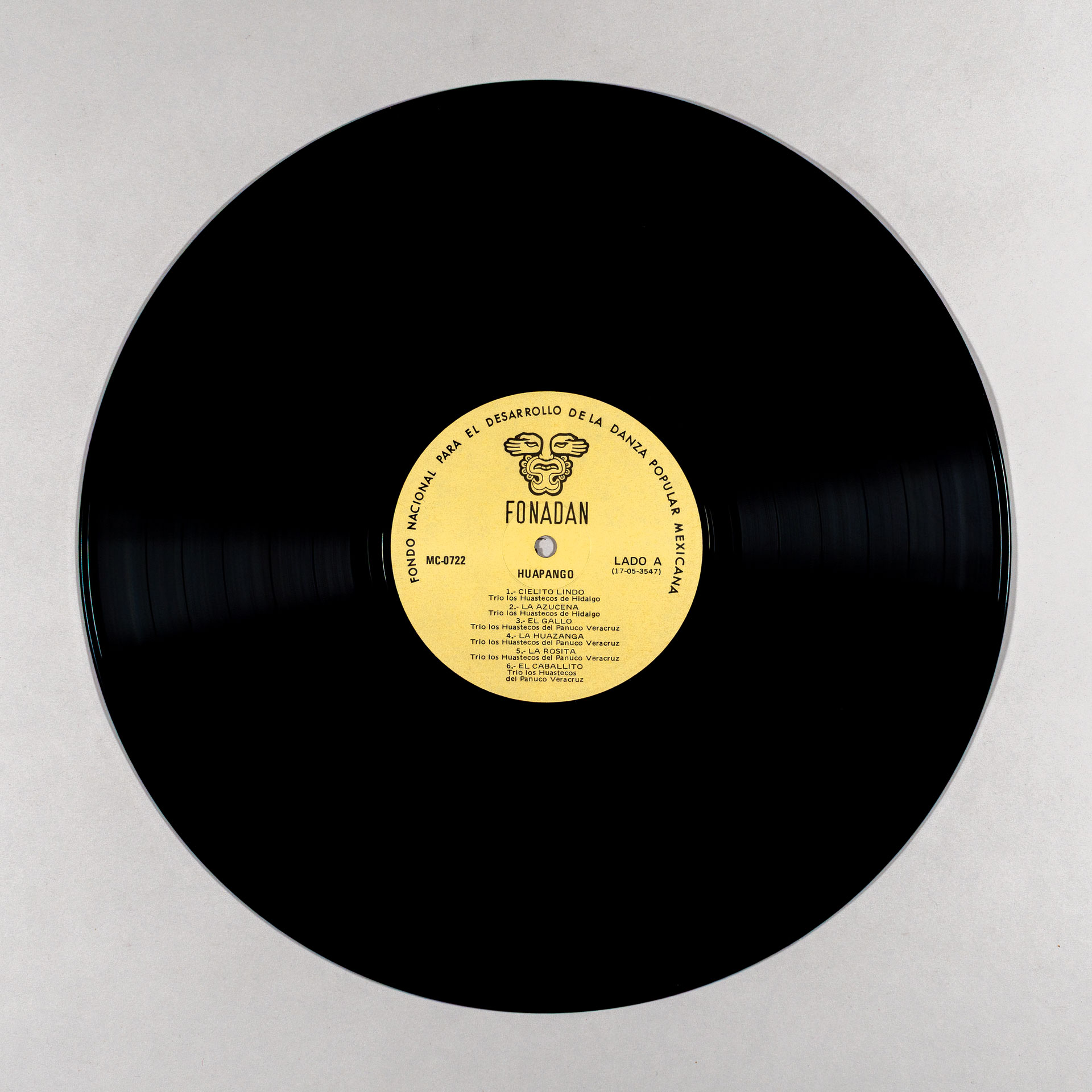
A SIDE
1.- THE PRETTY SKY (The Huastecos of Hidalgo) 3:25
2.- THE LILY (The Huastecos of Hidalgo) 2:45
3.- THE ROOSTER (Huastecos from Pánuco, Veracruz) 3:09
4.- THE HUAZANGA (Huastecos from Pánuco, Veracruz) 3:42
5.- THE LITTLE ROSE (Huastecos from Pánuco, Veracruz) 3:06
6.- THE LITTLE HORSE (Huastecos from Pánuco, Veracruz) 2:48
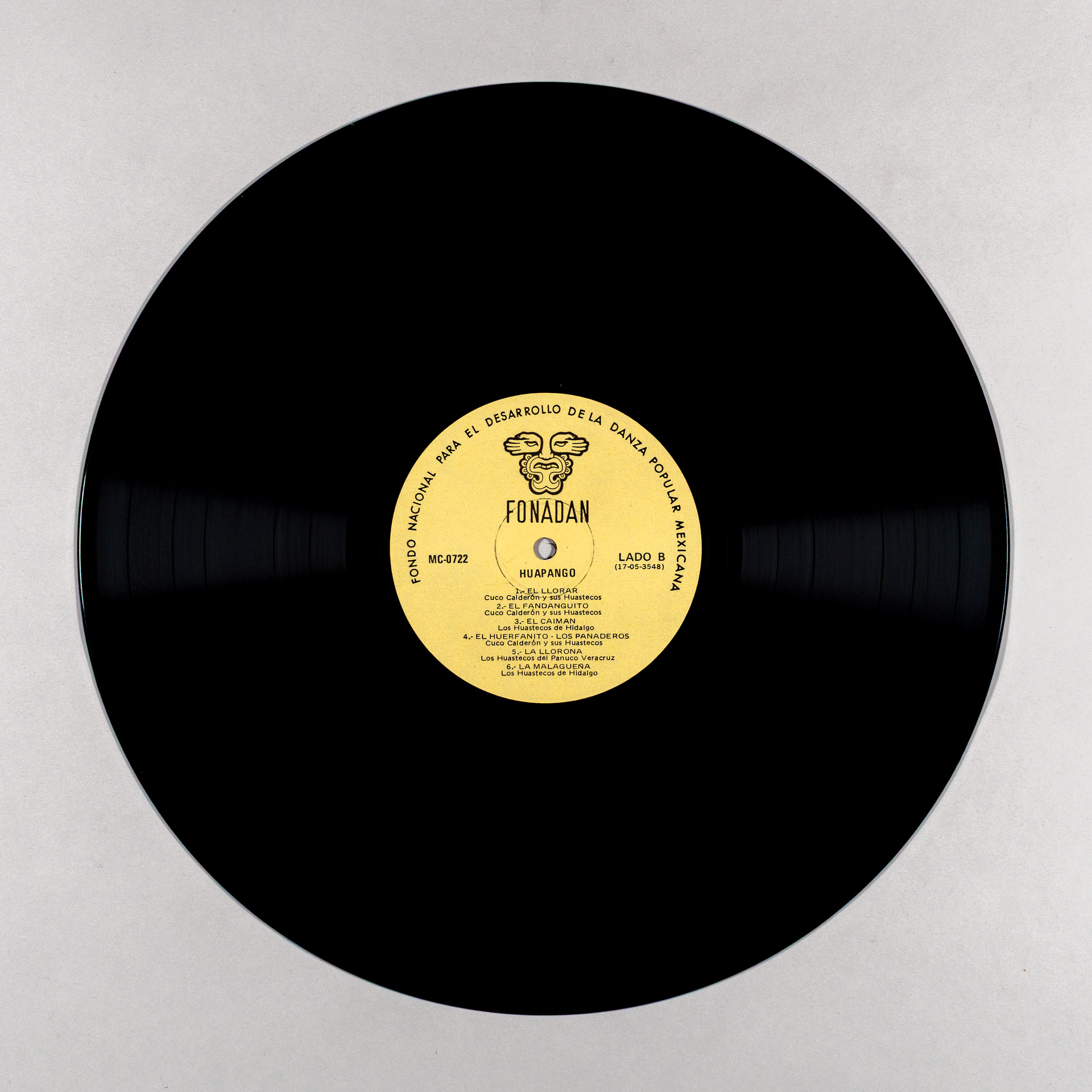
B SIDE
1.- CRYING (Cuco Calderon) 2:34
2.- THE FANDANGUITO (Cuco Calderon) 3:35
3.- THE ALLIGATOR (Huastecos from Pánuco, Veracruz) 2:33
4.- THE LITTLE ORPHAN AND THE BAKERS (Cuco Calderón) 5:45
5.- THE CRYING GIRL (Huastecos from Pánuco, Veracruz) 2:51
6.- THE MALAGUEÑA (The Huastecos of Hidalgo) 2:50
MC-722
MADE IN MEXICO BY CBS/COLUMBIA INTERNACIONAL, S.A.
AV. SEPTEMBER 16 No. 784
NAUCALPAN, MEX.
CBS TRADEMARK
CBS SPECIAL PRODUCTS
A CBS Record Service
Gallery:
Tracklist:
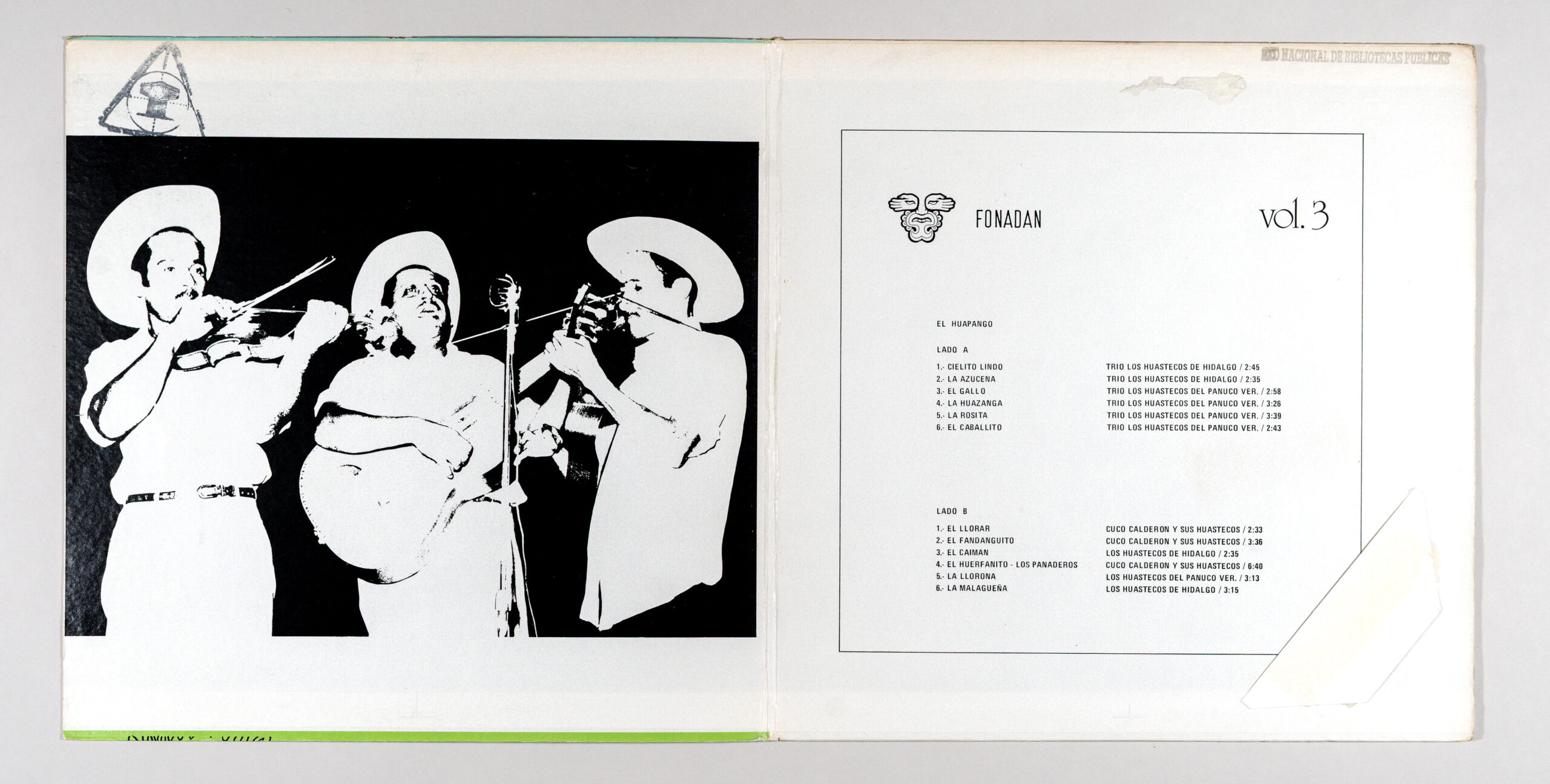
THE HUAPANGO
SIDE 1
- A1 The Pretty Little Sky 3:25
Performer(s): The Huastecos of Hidalgo - A2 The Lily 2:45
Performer(s): The Huastecos of Hidalgo - A3 The Rooster 3:09
Performer(s): Huastecos from Pánuco, Veracruz. - A4 The Huazanga 3:42
Performer(s): Huastecos from Pánuco, Veracruz. - A5 The Little Rose 3:06
Performer(s): Huastecos from Pánuco, Veracruz. - A6 The Little Horse 2:48
Performer(s): Huastecos from Pánuco, Veracruz.
SIDE 2
- B1 Crying 2:34
Performer(s): Cuco Calderón - B2 The Fandanguito 3:35
Performer(s): Cuco Calderón - B3 The Alligator 2:33
Performer(s): The Huastecos of Hidalgo - B4 Little Orphan And The Bakers 5:45
Performer(s): Cuco Calderón - B5 The Crying Girl 2:51
Performer(s): Huastecos from Pánuco, Veracruz. - B6 The Malagueña 2:50
Performer(s): The Huastecos of Hidalgo
Credits:
ETHNOMUSICOLOGY: Mario Kuri-Aldana, coordinator; Joaquin Guzman Luna; Vincent Mendoza R.
CHOREOGRAPHY: Luis Felipe Obregón, coordinator; Evelia Beristain.
DISSEMINATION: Xóchitl Medina, coordinator.
AUDIOVISUAL DEPARTMENT: Rodolfo Velazco R, Coordinator; Alejandro Loranca, Photographer; Rubén Prado, Audio Technician.
GENERAL MANAGEMENT: Josefina Lavalle.
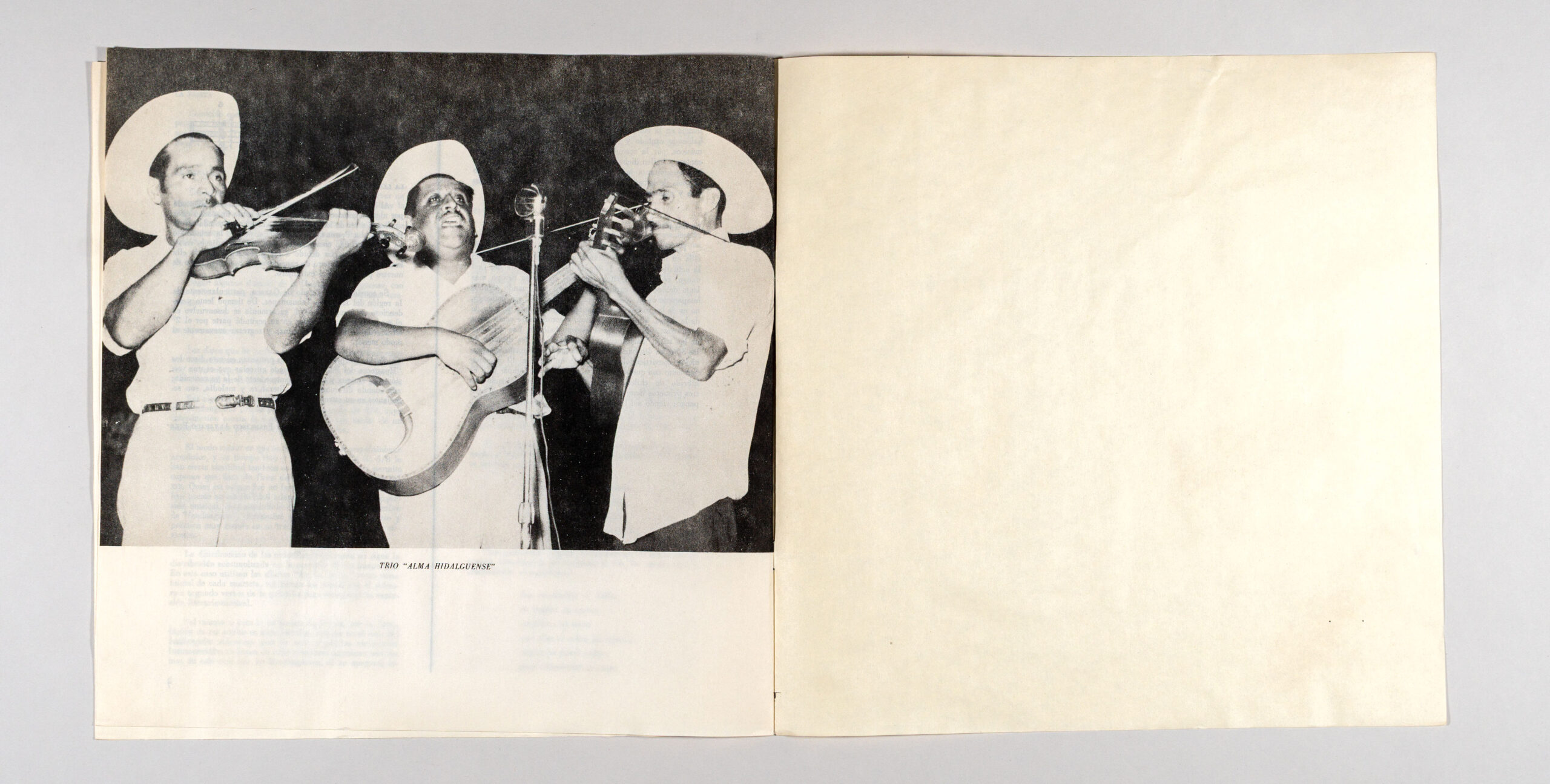
 Trio Los Huastecos De Hidalgo, Trio Los Huastecos Del Panuco Ver., Cuco Calderon And His Huastecos – El Huapango Vol.3